This Is A Movie Review: Lucy

3 Comments

scarlett-johansson-lucy

Lucy (Scarlett Johansson) is an unwilling drug mule who becomes infected with the cargo (known as CPH4) that she is meant to be transporting, thus enabling her to use more than the ten percent of the brain that humans are typically capable of using.  Of course, the idea that humans only use ten percent of their brains is a myth.  That misconception is not necessarily a problem with a Luc Besson movie, as it is not striving for realism.  But a legitimate idea can be used for absurd ends, and Lucy does not make it clear if it believes that the ten percent myth is illegitimate and is just rendering it unrealistic or if the lack of realism is meant to expose how foolish the ten percent perception is.

The reason why that remains unclear is because, weirdly, Lucy is not as crazy as it could be.  Sure, there are plenty of idiosyncratic touches – the initial kidnapping of Lucy is intercut with a leopard hunting a gazelle, there are 2001-style appearances by prehistoric man (hence the title) – but Lucy’s increased brain powers come off as a little mundane in a cinematic age saturated by superheroes.  The plot stakes are lowered considerably as she becomes more powerful – it is fairly clear that she cannot be defeated, except perhaps by an overload of CPH4, but with her cranial capacity increasing, one could assume that she is smart enough to know when to stop in that regard anyway.  But her essential invincibility is used as an excuse to have her just show off for the sake of set pieces, such as one moment when she leaves a crew of Korean gangsters stuck writhing in mid-air.

Despite all these problematic elements, Lucy is right up my alley: it takes a bunch of disparate parts and re-fashions them together for a new context and improves upon those that didn’t work in their original iteration.  Lucy is a combination of just about every one of Scarlett Johansson’s roles from the past year: the drive to understand all human knowledge (and beyond), like operating system Samantha from Her; the droning, quizzical outsider’s perspective like the alien from Under the Skin (Lucy also shares the inky black against white visuals of Skin); and the swaggering, action-star bravado of Black Widow from The Avengers and Captain America.  As for non-Scarlett Johansson influences, Lucy also works as the more insane, and therefore more successful, version of Transcendence, regarding uploading humanity onto computers.  Then there are the dawn of man sequences, which set themselves apart from 2001 by being shot in the sleek style favored by the entirety of Lucy.

Lucy avoids failure by being all over the place with its philosophical mumbo jumbo, but it cannot quite reach transcendence because it is too caught up in that mumbo jumo. B+

Best Episode of the Season: Archer Season 5

Leave a comment

Season Analysis: Re-branded as Archer: Vice, the season-long transformation of ISIS into drug runners did not produce laughs as consistently as in previous years, but it was always admirable in its ambition.

archer-arrival-departure-cold-open-with-holly-and-slater-636x381

“Arrival/Departure”
I will admit that my lack of laughs this season may have had to do with me watching the episodes at a time of night when I was tired and/or my mind was just elsewhere.  But I think the arch humor of this show has not really evolved and has thus lost some of its zest.  But as all the pieces came together in the season finale, and it was clear that this year had been designed by creator Adam Reed and his team like clockwork from the beginning, it began to click for me, and I was feeling the satisfaction that Archer: Vice was attempting to inspire in its viewers.  It was like a real-life dream (or nightmare) that the ISIS crew actually lived through, as everything essentially reset at the end.  The actual events at San Marcos seemed like they would have little long-term bearing (beyond the psychological effects), and that wasn’t because what had happened was going to be ignored but because everything was dealt with as it needed to be.  There was a bit of a deus ex machina feel to the machinations, but they were as narratively justified as they needed to be.  Then there was the surprisingly affecting final scene, in which Lana introduced Sterling to his daughter.  The slow fade out of the sound as he struggled to process the news was audiovisual storytelling at its finest.

Best Episode of the Season: Scandal Season 3

Leave a comment

Season Analysis: Scandal started to turn into Alias a bit in Season 3, which was good, because the subterfuge was a whole lot more interesting than Olivia and Fitz’s umpteenth attempt to make their impossible love affair work.

Scandal-Episode-3-07-Everything-s-Coming-Up-Mellie-Promotional-Photos-scandal-abc-36008819-595-396

“Everything’s Coming Up Mellie”
Scandal is a sort of opera, insofar as every character has the biggest emotions possible at any moment.  Thus, the best performances that can be wrung from that style are those that cover every the full range of big emotions.  Bellamy Young is able to imbue First Lady Mellie Grant with just this range by playing her as villain, hero, victim, and manipulator.  And she got to shine in all those roles like no other time with the flashback-heavy “Everything’s Coming Up Mellie.”  This episode revealed that not only has Mellie been a victim of unfaithfulness, but also a victim of rape by her father-in-law.  But she used that total loss of control to take charge like never before.  The whole point of this episode is that you cannot peg anybody so easily.  Even when people are direct and show their personalities so openly – and Mellie easily fits that description – you never know just what is in their past and who they really, fully are.  And that is the trick of Scandal at its best: its operatic emotions make it seem like everyone can be easily judged, but its most revelatory moments make it clear that nobody can ever be so simply pegged.

Best Episode of the Season: Parenthood Season 5

Leave a comment

Season Analysis: Parenthood probably works better with shorter season orders, as the 22-episode fifth season allowed it to indulge in storylines that were not always working.  Still, there was stellar acting throughout, particularly from Ray Romano and Max Burkholder.

parenthood_promises

“Promises”
Smack dab in the middle of the season, “Promises” was the point at which every Braverman story – the questionable and the sensible ones both – were all clicking.  I was always skeptical of the Joel and Julia marriage troubles storyline, because the existence of their issues required some unusually unreasonable behavior.  But when it produces scenes like Julia confiding in Adam about her problems, with Erika Christensen perfectly conveying how she cannot understand how her life is the way it is right now, it doesn’t really matter if the story didn’t make much sense in the first place.  Then there is the weird, but totally engaging, love triangle with Drew, Amy, and Natalie in which it was kind of just fun to examine the personalities of these characters and analyze who really fits with whom.  But the best moments of this episode – and really the whole season – come from the best storyline of the year, Max hanging out at Hank’s photography studio.  The latest crisis with Max leads Hank to realize that he too might have Asperger’s, and Ray Romano delivers a whole host of reactions that convey how this revelation changes everything about his past and present.  It is cathartic because everything finally makes sense but devastating because it might be confirmation that things will never be better.  It is this sort of emotional conflict that is Parenthood’s bread and butter, the device that guarantees a few tears will be jerked every episode, and it is rarely pulled off more consistently than it was in “Promises.”

Fuse Top 20 Countdown – 7/29/14

Leave a comment

Each week, I check out FUSE’s Top 20 countdown, and then I rearrange the songs based on my estimation of their quality.

Original Version
1. Sam Smith – “Stay With Me”
2. Nico & Vinz – “Am I Wrong”
3. Ariana Grande ft. Iggy Azalea – “Problem”
4. Iggy Azalea ft. Charli XCX – “Fancy”
5. Maroon 5 – “Maps”
6. Sia – “Chandelier”
7. Charli XCX – “Boom Clap”
8. OneRepublic – “Love Runs Out”
9. Jason Derulo ft. Snoop Dogg – “Wiggle”
10. Disclosure ft. Sam Smith – “Latch”
11. Becky G – “Shower”
12. Calvin Harris – “Summer”
13. Meghan Trainor – “All About That Bass”
14. Kongos – “Come With Me Now”
15. Clean Bandit ft. Jess Glynne – “Rather Be”
16. Pharrell – “Happy”
17. MKTO – “Classic”
18. John Legend – “All of Me”
19. Shawn Mendes – “Life of the Party”
20. DJ Snake & Lil’ Jon – “Turn Down For What”

Jmunney’s Revision
1. Chandelier
2. Summer
3. Fancy
4. Happy
5. Come With Me Now
6. Turn Down For What
7. Latch
8. Stay With Me
9. Rather Be
10. Am I Wrong
11. Boom Clap
12. Problem
13. Love Runs Out
14. Maps
15. All of Me
16. All About That Bass
17. Wiggle
18. Classic
19. Shower
20. Life of the Party

Best Episode of the Season: Broad City Season 1

Leave a comment

Season Analysis: A big deal is often made when female voices emerge in male-dominated genres, and Broad City accomplished that, but not because that was what it was specifically attempting.  It worked out that way because Ilana Glazer and Abbi Jacobson – who conveyed their unique, optimistic, and pleasantly skewed perspective on young adult life in New York City – just happen to be women.

broadcity_107_never_have_i_ever_640x360

“Hurricane Wanda”
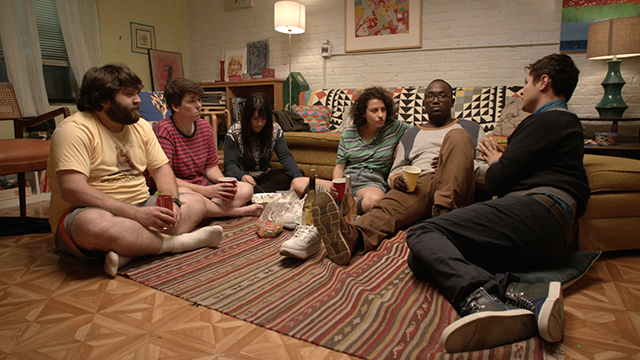
Bottle episodes– those half-hours that take place entirely within one physical location – continue to be sitcom staples because they continue to work so well.  Keeping everyone stuck in one spot raises the pressure and thus the emotions that have been simmering over the course of the preceding episodes.  When a hurricane keeps Abbi and Ilana stuck in Abbi’s apartment, they are forced to deal with the overwhelming presence of Abbi’s crush Jeremy, the overwhelming (in a different way) presence of Abbi’s roommate’s boyfriend Bevers and Bevers’ sister (UCB stalwart Shannon O’Neill in an energetic performance befitting an episode named after a hurricane), and a malfunctioning toilet.  There wasn’t much development on the Jeremy front (although we did get a memorable threesome dream sequence thanks to Ilana).  The Bevers siblings, while freakishly aggressive to most everyone else, were mostly destructive towards each other, thanks to the mystery plot of the shit in the shoe.  Ultimately, like all of Broad City, this episode was about the power of friendship, with a coda showing Ilana’s duct tape-aided adventure in disposing of Abbi’s turd that would not be flushed.

This Is A Movie Review: Snowpiercer

1 Comment

Snowpiercer

The premise of Snowpiercer is ostensibly depressing, but in a weird way, it is also optimistic about the current state of the world.  The future ice age of director Bong Joon-ho’s dystopia is caused by an experiment to counteract global warming that works too well.  As the prologue explains, the temperatures were lowered to uninhabitable levels by dropping the cooling agent CW7 all over the planet.  The idea that the solution to global warming could be so simple is naive, but also weirdly hopeful.  Of course, this snowy apocalypse could be interpreted as an argument against attempting to reverse global warming, in that it implies that doing so could lead to the opposite problem.  Ultimately, though, the terms in which Snowpiercer presents this possibility are too simplistic and the movie itself is too insane for anything realistic about the environment to be inferred here.  This setup is just an excuse to have the entire remaining human population trapped on a train that is speeding around the planet, and that proves to be a perfectly fine justification.

Like most dystopian pictures, Snowpiercer is about a fight between the have’s and the have-not’s, and naturally enough, there is a handsome hero (Chris Evans) leading the rebellion.  The particular social inequality of Snowpiercer is not all that unique or meaningful.  But luckily it is not really about the allegory; instead, it is about what life would be like if all of human society (consisting mainly of Koreans, Americans, Brits, and a few Eastern Europeans) were trapped in a confined space.  It has been 17 years since life on the Snowpiercer has begun, so people have settled into it as a home, but there is not really enough room – at least not for everyone – to truly be at home.  Those in the back of the train with the least means cannot afford to be anything other than constant travelers.  Thus, we have a character like Tilda Swinton’s Mason, visiting to impose the rules from the front of the train onto these passengers.  Swinton is typically androgynous and outrageous (making her the perfect actor for this film), and she is also typically nuanced, which is much appreciated for a role that could have been pure evil in other hands.

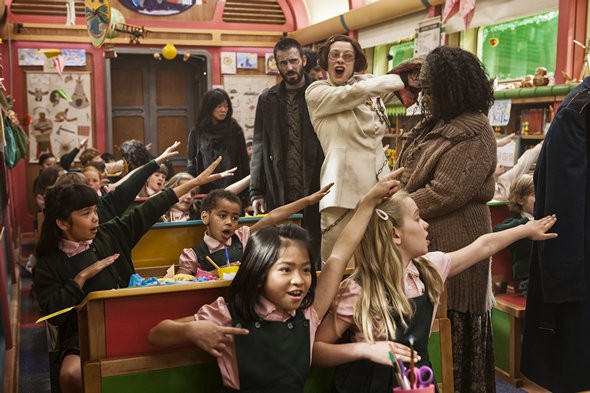
There is a lived-in griminess to the opening act that effectively sets the stakes of the narrative, but it is not until the middle section that Snowpiercer gets truly bizarre and memorable by showing off the elements of society that are not of the sort in constant flux.  One train car that the rebels make their way through features a middle-school classroom, with Alison Pill in a delightfully deranged turn as the gun-toting, pregnant teacher.  The type of education offered aboard the Snowpiercer is indoctrination to the cult of personality of Wilford, the creator of the titular train.  There is no way to physically cordon the revolution from the schooling, nor is there even an attempt to bother to do so.  But really, the most insane thing about this scenario is the illusion that a normal-looking classroom can remain a sensible idea.

The conclusion of Snowpiercer is well worth discussing, but not worth spoiling except in the vaguest of terms.  It features a surprising turn from an Oscar-nominated actor in a narrative turn that diverges sharply from the rest of the film in a way that was reminiscent of William Hurt’s appearance at the end of A History of Violence.  It plays around with the concluding tropes of dystopian films a fair bit.  Ultimately, Snowpiercer is a singularly bizarre action fantasia with a legendary set design that will not soon be forgotten. A-

What Won TV? – July 20-July 26, 2014

Leave a comment

In this feature, I look back at each day of the past week and determine what shows “won TV” for the night. That is, I consider every episode of television I watched that aired on a particular day and declare which was the best.

Sunday – Last Week Tonight with John Oliver
Monday – Whose Line is it Anyway?
Tuesday – Nathan For You
Wednesday – The Meltdown Show With Jonah and Kumail
Thursday – You’re the Worst
Friday – Girl Meets World is a little silly, but I’m still entertained.
Saturday – N/A

VH1 Top 20 Countdown – 7/26/14

2 Comments

Each week, I check out VH1′s Top 20 countdown, and then I rearrange the songs based on my estimation of their quality.

Original Version
1. Nico & Vinz – “Am I Wrong”
2. Magic! – “Rude”
3. Sam Smith – “Stay With Me”
4. Ariana Grande ft. Iggy Azalea – “Problem”
5. Calvin Harris – “Summer”
6. Disclosure ft. Sam Smith – “Latch”
7. Sia – “Chandelier”
8. Iggy Azalea ft. Charli XCX – “Fancy”
9. Maroon 5 – “Maps”
10. OneRepublic – “Love Runs Out”
11. Lorde – “Tennis Court”
12. Demi Lovato ft. Cher Lloyd – “Really Don’t Care”
13. Kongos – “Come With Me Now”
14. MKTO – “Classic”
15. Ed Sheeran ft. Pharrell – “Sing”
16. Jason Derulo ft. Snoop Dogg – “Wiggle”
17. Charli XCX – “Boom Clap”
18. American Authors – “Believer”
19. Tove Lo – “Habits”
20. Clean Bandit ft. Jess Glynne – “Rather Be”

Jmunney’s Revision
1. Chandelier
2. Summer
3. Fancy
4. Come With Me Now
5. Latch
6. Stay With Me
7. Rather Be
8. Tennis Court
9. Am I Wrong
10. Boom Clap
11. Problem
12. Love Runs Out
13. Sing
14. Really Don’t Care
15. Habits
16. Maps
17. Rude
18. Wiggle
19. Believer
20. Classic

This Is A Movie Review: Dawn of the Planet of the Apes

Leave a comment

DAWN PLANET APES MOV

Dawn of the Planet of the Apes doesn’t play by the damn dirty rules of Hollywood blockbuster sequels.  While I currently prefer its predecessor, Rise of the Planet of the Apes, Dawn may yet supplant it, as it is the type of movie that demands mulling over, which is already one way it sets itself apart.  It is also strikingly small-scale.  Your typical action spectacular is about saving the entire world, while Dawn takes place entirely in and around what remains of San Francisco, even though the whole planet has been decimated by the virus that began spreading at the end of Rise.  That tight focus is simply smart storytelling: the audience can keep track of one emblematic storyline and see how it fits into the larger context.

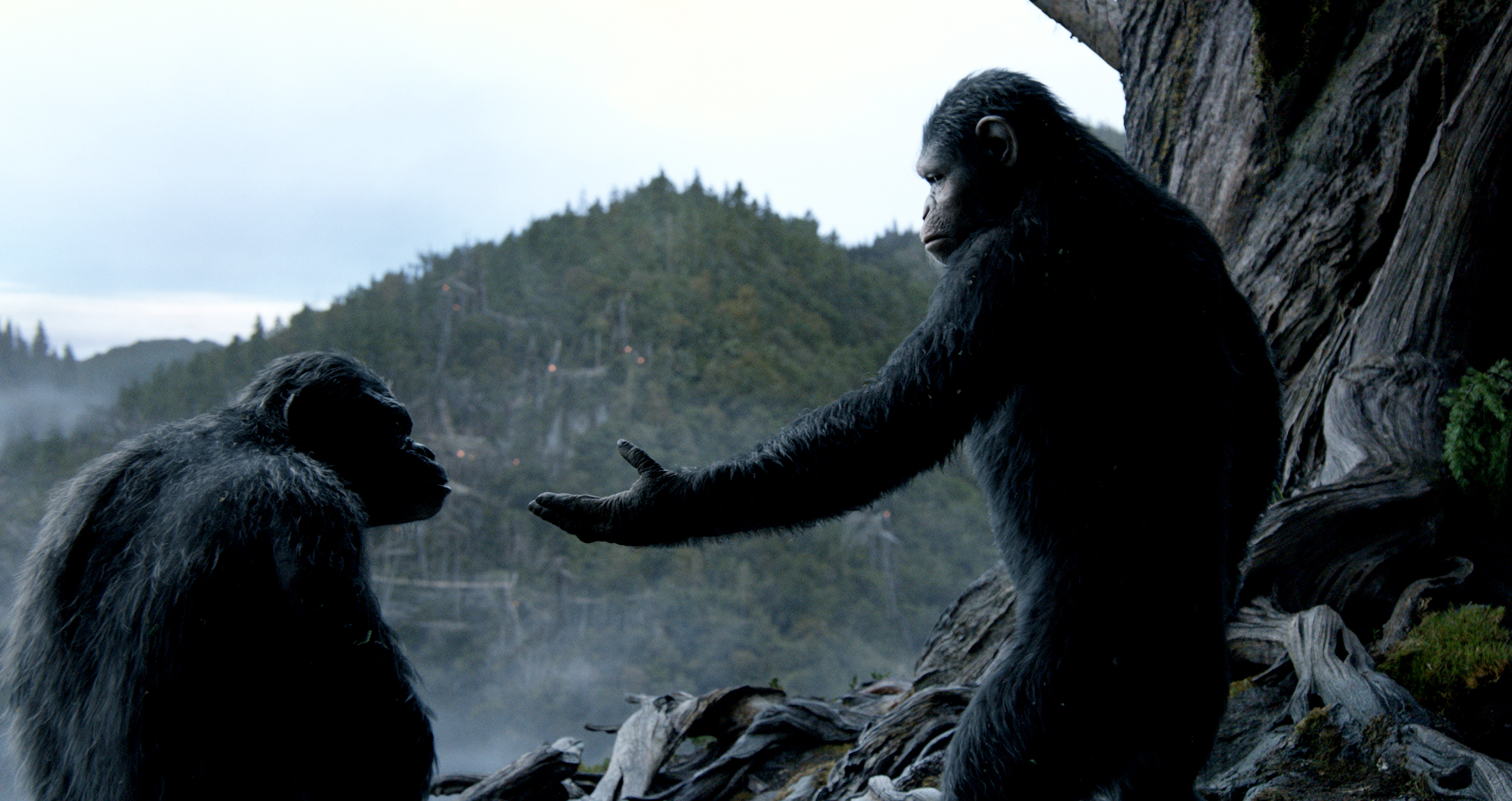
But what is most striking about how Dawn‘s independently-minded m.o. is its thoughtfulness, and this is especially striking considering how singularly action-oriented it also is.  This is essentially a war movie: when a group of humans who are genetically immune to the virus stumble upon the ape community in the Muir Woods, it leads to a series of conflicts that culminates in an apes-vs.-humans battle for the city.  So obviously there is plenty of action (including several lovingly shot sequences of apes riding horseback), but it is complemented with lots of scenes of talking.  Most of this verbal communication involves the apes, providing a mix of sign language, grunts and screams, and some basic spoken English.  The lines that make up the dialogue are not particularly extraordinary, but the fact that so much screen time is spent on what is essentially the development of a new form of communication is extraordinary.

This ape communication is a key component to how Dawn truly excels.  In portraying the evolution of apes adapting human abilities, this movie essentially presents a species unlike any other that we have seen before.  The original Planet of the Apes just had people in ape costumes, which was fine, but what was started in Rise and now fully realized in Dawn goes beyond just people with ape characteristics or apes with people characteristics.  Andy Serkis, reprising his role here as ape leader Caesar, has been rightly praised as the trailblazer of motion capture acting, but this technology is now strong enough that every ape performer is on his level: among others, there is Toby Kebbell going wild as the rebellious Koba, Karin Konoval supplying peaceful energry as Caesar’s trusted orangutan advisor Maurice, and Judy Greer providing plenty of pathos as Caesar’s wife Cornelia.  The combination here of CGI, practical effects, and the presence of actual individuals produces something that is unknown but familiar.  Too many current action blockbusters rely on CGI to fill everything in and come off as painfully fake.  Dawn goes for a more practical approach but recognizes that the CGI can be corralled to achieve the mark of a successful movie: real connection. B+

Older Entries