Entertainment To-Do List: Week of 3/15/19

Leave a comment

CREDIT: Saeed Adyani/Netflix

Every week, I list all the upcoming (or recently released) movies, TV shows, albums, podcasts, etc. that I believe are worth checking out.

Movies
The Mustang

TV
Arrested Development Season 5 Part 2 (Premieres March 15 on Netflix) – The final (?) episodes!
Shrill Season 1 (Premieres March 15 on Hulu) – Starring Aidy Bryant!
Turn Up Charlie Season 1 (Premieres March 15 on Netflix)

Comedy
Amy Schumer Growing (Premieres March 19 on Netflix)

Sports on TV
-March Madness (March 19-April 8 on CBS, TBS, TNT, and truTV)

Movie Review: ‘Five Feet Apart’ Wrangles Cystic Fibrosis Into the Young-People-With-Terminal-Diseases-Find-Love Genre

1 Comment

CREDIT: Alfonso Bresciani

Starring: Haley Lu Richardson, Cole Sprouse, Moises Arias, Kimberly Hebert Gregory, Parminder Nagra, Claire Forlani, Emily Baldoni, Cynthia Evans, Gary Weeks, Sophia Bernard, Cecilia Leal

Director: Justin Baldoni

Running Time: 116 Minutes

Rating: PG-13 for Medical Minutiae and Sensuality

Release Date: March 15, 2019

I have a sharply adverse physiological reaction to needles, so I am not especially excited about the prospect of a movie set entirely in a hospital. Five Feet Apart does indeed remain ensconced in a medical facility, but it is actually rather merciful, for the most part, in its depiction of medical equipment inserted into bodies. But that does not mean it is without its icky moments. It focuses on a group of young people with cystic fibrosis, a genetic disorder that primarily affects the lungs and as such leads to a lot of discharged mucus. As someone who is pretty much constantly congested, I am quite familiar with mucus and in fact have been able to find amusement in its expulsion. But it is a little harder to bear in Five Feet Apart, in which every mucus-filled cough sounds like it could be deadly.

While director Justin Baldoni (best known as Rafael on Jane the Virgin) brings us down into the muck, he knows, as we all do, that the real reason for a movie about terminally ill young people is an overwrought love story. It’s a classic opposites-attract pairing, holding close to the stereotypes to an excruciating degree, despite the actors’ most charming efforts. Stella Grant’s (Haley Lu Richardson) CF diagnosis has led her to become a control freak, which means that she makes it her mission to ensure that the devil-may-care Will Newman (Cole Sprouse) will stick to his medical regimen.

The twist that superficially separates Five Feet Apart from any other entry in this genre is that Stella and Will are not supposed to stand closer than six feet apart from each other, lest they catch each other’s infections. Their resolution to take one foot back (hence the title) comes across more as foolhardy than as romantic. I appreciate promulgating the idea that anyone, even those with terminal diseases, can fall in love and express that love (one scene in which Stella and Will strip down to their skivvies and show off their scars is a beautiful moment of vulnerability), but if it’s going to play out on the big screen, it could really use some more crackling dialogue than what we have here.

Five Feet Apart is Recommended If You Like: The Fault in Our Stars, Midnight Sun, Everything, Everything

Grade: 2 out of 5 Pill Cocktails

Movie Review: ‘The Hummingbird Project’ Wrings Some Meaning Out of a Story That Few, If Any, People Were Clamoring to Hear

Leave a comment

CREDIT: The Orchard

Starring: Jesse Eisenberg, Alexander Skarsgård, Michael Mando, Salma Hayek, Sarah Goldberg

Director: Kim Nguyen

Running Time: 111 Minutes

Rating: R for The Profanity of High-Stakes Finance

Release Date: March 15, 2019 (Limited)

The Hummingbird Project has one of the most stunningly esoteric premises of any theatrically released movie I have ever come across. So it’s a bit of a small miracle that it actually manages to be halfway compelling. It helps that the execution is straightforward, but that is also what holds it back from being truly memorable. Vincent Zaleski (Jesse Eisenberg) is a high-frequency trader whose dream is to build a fiber-optic cable line between Kansas and New Jersey that is efficient enough to decrease the time that information currently travels over that distance by one millisecond. But is that really his dream? Is that really anyone’s dream? His cousin and partner Anton (Alexander Skarsgård) is just as committed to the goal, but he essentially has a healthier perspective, treating it as a game or a code to crack. For Vincent, this is really about proving to the world that the little guy can come out on top, but his obsession has led him to turn the meaning of this highly specialized thing into the thing itself, when it actually represents normal human desires.

I imagine that many viewers will have the same reaction to Vincent and Anton that I did, which is to want to assure them that one millisecond cannot possibly be that important, no matter how many millions it will make them over the long run. Their pursuit is fundamentally maddening, though Eisenberg and Skarsgård make it palatable by tuning their performances to a sensitive enough key. It also helps that the script underlines how much they are doing this for a better family life. Vincent keeps reminding Anton that this job will ultimately lead to a charming, country mansion. Their desires are simple, really, as Vincent also promises that he will take Anton’s daughters out for ice cream once they return home.

Unsurprisingly, then, for a number of reasons, it turns out that Vincent is doing this all for his father, a Russian immigrant who was shaken down by government types on suspicion of being a communist spy. That led Vincent to learn that he needs to be so good at what he does that the people in charge cannot possibly deny it. This is a fairly unique version of the trope of attempting to please your parents after they’ve died, but it is not reason enough for Vincent to practically kill himself with his single-mindedness. It is a bit of a marvel how much relatable meaning can come out of this premise, but is still so esoteric as to have been seemingly made for one very specific theoretical viewer, and that viewer is not me.

The Hummingbird Project is Recommended If You Like: The specifics of laying down fiber-optic cable

Grade: 2.5 out of 5 Milliseconds

Movie Review: ‘The Mustang’ is a Quietly Beautiful Tale of a Convict Finding Redemption Through Horse Training

2 Comments

CREDIT: Focus Features

Starring: Matthias Schoenaerts, Jason Mitchell, Gideon Adlon, Connie Britton, Bruce Dern

Director: Laure de Clermont-Tennerre

Running Time: 96 Minutes

Rating: R for Horse-on-Human and Human-on-Horse Violence and Prison Profanity

Release Date: March 15, 2019 (Limited)

Is it possible to forgive yourself and move forward from the worst, most destructive mistake you’ve ever made in your life? That’s the question at the heart of The Mustang, the feature directorial debut of French actress Laure de Clermont-Tennerre. Roman Coleman (Matthias Schoenarts) is in prison for assaulting his wife, but you don’t know that’s his crime until about halfway through, because he’s so tightly coiled that he barely conveys any information vocally beyond acknowledging people’s presence and asking them to go away. You get the sense that he wasn’t always this way, or at least that it wasn’t always this extreme. A key scene is a group therapy session in which the therapist (Connie Britton) asks Roman and the other convicts, “How long from the thought of the crime to the actual crime?” For most of them it was a matter of seconds, a moment of passion that instantly, dramatically altered their lives and self-perception.

For Roman, he cannot see a way back to himself or a version of his life in which he could ever again be comfortable spending time with his pregnant teenage daughter (Gideon Adlon). But despite the personal hell he is stuck in, a chance for redemption comes through via, of all things, a program for convicts to break and train wild horses (run by a no-nonsense Bruce Dern, charming in a crotchety sort of way). You don’t have to think too deeply to see the symbolism of Roman as a broken animal and to know that’s how they form such an empathetic bond after a violently unpromising introduction (Roman pounds the horse’s chest out of frustration in an early training session). Thankfully, De Clermont-Tennerre wisely underplays just about every moment, allowing Schoenaerts’ quiet intensity to do its job and speak every message that needs to be conveyed. This is a movie about hope emerging from a profoundly hopeless situation. That always has currency in cinema, and life itself.

The Mustang is Recommended If You Like: The Rider but with a lot more quietly intense masculinity with hidden sensitivity, The Shawshank Redemption

Grade: 4 out of 5 Wild Horses

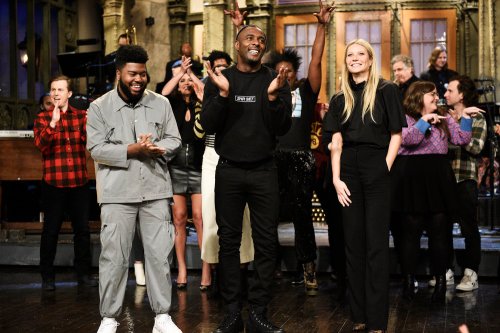
SNL Love It/Keep It/Leave It: Idris Elba/Khalid

Leave a comment

CREDIT: Will Heath/NBC

Jeffrey Malone watches every new episode of Saturday Night Live and then organizes the sketches into the following categories: “Love It” (potentially Best of the Season-worthy), “Keep It” (perfectly adequate), or “Leave It” (in need of a rewrite, to say the least). Then he concludes with assessments of the host and musical guest.

Love It

Can I Play That? – The push to avoid having actors of one identity group play characters of any other identity group is, I believe, generally well-intentioned, and it has done real good in terms of achieving better representation in the entertainment industry. But it can also be taken to ridiculous lengths that forget that the point of acting is to (typically) play someone other than yourself. But at least the tying-oneself-in-knots and constriction that result from that ridiculousness are, we now know, a great formula for an SNL game show parody. This could make for a decent recurring sketch, considering that, even though the joke has already been fully established, these controversies and conundrums tend to keep cropping up.

More

Entertainment To-Do List: Week of 3/8/19

Leave a comment

CREDIT: Marvel Studios

During my time at News Cult, I had a weekly recommendation column called “Entertainment Essentials.” Since I posted the last edition back in January, I’ve been a little worried that I haven’t been fully keeping track of all the movies, TV shows, albums, podcasts, etc. that I want to check out. So I decided to launch a new column, called “Entertainment To-Do List,” which is basically a weekly list of all the upcoming (or recently released) content I am planning on consuming. Its main purpose is so that I don’t forget about anything. And for anyone reading, if you happen to see something that you believe you’ll find worthwhile as well, then all the better!

Movies
Captain Marvel (Theatrically Nationwide)
Gloria Bell (Limited Theatrically)

TV
KRFT Punk’s Political Party (Premieres midnight on March 8 [technically March 9 early morning] on Adult Swim)

Movie Review: ‘Captain Marvel’ is a Blast of Low-Key Wonder

1 Comment

CREDIT: Marvel Studios

Starring: Brie Larson, Samuel L. Jackson, Jude Law, Ben Mendelsohn, Annette Bening, Djimon Hounsou, Lee Pace, Lashana Lynch, Gemma Chan, Clark Gregg

Directors: Anna Boden and Ryan Fleck

Running Time: 124 Minutes

Rating: PG-13 for Sci-Fi Action Violence That Tends to Cause Nosebleeds

Release Date: March 8, 2019

It’s been a while since I have felt consistently sustained excitement for the Marvel Cinematic Universe. I’m a fan of superheroes, and Marvel in particular, but I’m a bigger film buff, and I often find myself in a weird liminal space where I want to have more unbridled emotions for these movies, but it is hard to feel that way about a series sticking to a formula that is so much about ticking off obligatory long-term checkpoints. Captain Marvel does not burst free of that formula, but it has enough of its own magic to make it the first MCU movie in quite some time in which I left the theater wanting to re-watch it. It could have just been the way it happened to hit me on one particular day, but I think it has also something to do with its vibe of ignoring all the noise and getting on with it mission.

The plot is a little too complicated to easily synopsize, which Disney and Marvel are surely happy about, as they do not want us spoiling any of their MCU flicks, particularly this one, as it is uniquely dependent on backstory reveals and memory retrieval. Suffice it to say then that Vers (Brie Larson) is an intergalactic warrior fighting for the race known as the Kree, but she is also plagued by visions of a past life as U.S. Air Force fighter pilot Carol Danvers. The Kree are stuck in a long-term struggle against the shapeshifting Skrulls, which leads Vers to Earth in 1995 in a race for a powerful energy source. This is a typical McGuffin-focused Marvel film, but this particular McGuffin is unusually resonant, touching on themes of refugees and the perils of deep psychological deception.

Captain Marvel is also your standard MCU movie insofar as it builds to a climax with an unengaging, undistinguished action set piece. But luckily, that is not the main attraction. Vers teams up with a pre-eye patch Nick Fury, resulting in a buddy flick that serves as Samuel L. Jackson’s biggest showcase thus far in this franchise. His and Larson’s dynamic is one of instant respect that still leaves plenty of room for clowning around as they save the universe. That feeling is matched by a strong sense overall of the film being aesthetically tuned in. I cannot think of any other superhero movie that features a steady stream of crickets chirping amidst characters talking outside.

Captain Marvel is not massively revolutionary. While it may be the first MCU movie fronted by a female hero, it is not about femininity the way that Black Panther is about blackness. But while it does not respond hard to the big questions, it gets so many of the little things right.

Captain Marvel is Recommended If You Like: Top Gun, Nineties Rock, Friendly and Intelligent Aliens Who Speak English or At Least Have Universal Translators

Grade: 4 out of 5 Supreme Intelligences

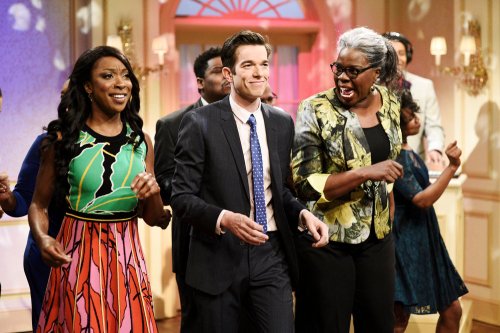
SNL Love It/Keep It/Leave It: John Mulaney/Thomas Rhett

2 Comments

CREDIT: Will Heath/NBC

Jeffrey Malone watches every new episode of Saturday Night Live and then organizes the sketches into the following categories: “Love It” (potentially Best of the Season-worthy), “Keep It” (perfectly adequate), or “Leave It” (in need of a rewrite, to say the least). Then he concludes with assessments of the host and musical guest.

Love It

Toilet Death Ejector – I’m going to say it, folks. I’m walking on hallowed ground here, but I believe it’s warranted: Toilet Death Ejector is on the same level as Old Glory Insurance. It took nearly 25 years, but SNL finally innovated another bona fide solution for what ails today’s seniors. There is a strong chance that this fake product will enter the cultural lexicon as shorthand for the embarrassing death that we all want to avoid.

More

‘Green Book’ is a Modestly Enjoyable Movie, But It Shouldn’t Have Won Best Picture

Leave a comment

CREDIT: Universal Pictures/Participant Media

Of all the Best Picture winners since I’ve been closely following the Oscars (starting with Titanic 21 years ago), none besides Green Book has provoked a more diverse and contradictory set of reactions within myself. There have been better winners, and there have been worse winners, but none have given me more confusing emotions.

Upon my initial viewing of the (mis)adventures of Tony Lip and Don Shirley, I found myself as crowd-pleased as the film’s biggest proponents had promised. But the contingent of critics who considered Green Book antiquated or even regressive made some good points that I felt obligated to reckon with. But I had the nagging sense that they were missing the mark just a bit. It felt worth defending, but in a tricky way I was not quite sure how best to explain. And then I read Kareem Abdul-Jabbar’s take in The Hollywood Reporter, and it started to click.

One particular point in that piece stood out, in which the former NBA great and astute cultural critic noted that black people “know that after viewing the movie, some white people will be self-congratulatory and dismissive by saying, ‘Well, at least it’s not like that anymore.’ But others will be moved to see how those events in history have shaped our current challenges.” Unsurprisingly enough, a common criticism of Green Book I’ve seen is that it caters to supposedly progressive white people who like to think that stories like this prove that racism has been more or less “solved.” And maybe there are people like that, but those missing the point shouldn’t strip the film of what merits it does have.

Where Green Book most excels is in its portrayal of a burgeoning friendship. This is a story setup that we as a species keep returning to because it has proven to be consistently fruitful. Tony and Don are two very different men who find themselves forced to spend long periods of time together in tight spaces. Even if you take away the racial component, their backgrounds are still miles apart (although, to be sure, the black/white divide does play a part in their other differences). Tony is family-oriented, vulgar, and unignorable, while Don is isolated, cultured, and preeminently even-keeled. Green Book does not in any way solve racism, but it is not trying to be so ambitious as to eradicate or even merely least tackle something so systemic. It is a modest movie: old-fashioned, but not regressive.

Amidst all the awards-season hubbub, I had forgotten what I had truly liked about Green Book, so I revisited my original review, where I was a little surprised to be reminded that what I most connected to was Tony Lip’s insatiable appetite. For my money, the best moments are when he wins a bet by eating a bunch of hot dogs and, of course, when he folds an entire pizza in half to bite into the whole thing. This was clearly a passion project for Tony Lip’s real life son, Nick Vallelonga, one of the screenwriters and producers. And as far as I can tell, his motivation was nothing so high-minded as to fix what ails society, but rather, merely to tell his dad’s story, and spread the joie de vivre inherent in that tale.

But as much as I enjoyed Green Book, it was a dispiriting Best Picture selection. As a film that succeeded at a modest goal, its win was like receiving an award for “best high school athlete” at the Olympics (or maybe the inverse of that). As an old-fashioned throwback, it does not really push cinema forward in any way. Academy voters are left to themselves to decide what criteria constitutes the best movie of the year, so I do not know how many of them are using the “push cinema forward” metric, but I would highly recommend that they use it. But that lack of cinematic innovation is not really why it didn’t deserve to win, and here we come to the other, perhaps more important, metric for determining the Best Picture, which is: which of the nominated films has the best message? According to its campaign, Green Book‘s message was a tribute to the power of coming together despite our differences in these divisive times, which understandably rang hollow to a lot of people. When it came to racial commentary, this was by no means the most astute film of 2018, or even the most astute Best Picture nominee of 2018.

But what if the narrative had been different? What if Green Book‘s team had instead been pushing its message of a man with a boundless appetite and a man with a more restrained appetite learning from each other? If each campaign stop had focused around the hot dogs and the pizza and and the fried chicken, I doubt that its Oscar chances would have been as strong as they were, but its merits would have been advertised more accurately. And thus a more delicious sort of chaos would have reigned. So to all you Oscar campaigners, I say: embrace the crudeness now and forevermore!

Newer Entries