This Is a Movie Review: 20th Century Women

Leave a comment

20th-century-women-cast

This review was originally published on News Cult in December 2016.

Starring: Annette Bening, Lucas Jade Zumann, Elle Fanning, Greta Gerwig, Billy Crudup

Director: Mike Mills

Running Time: 118 Minutes

Rating: R for Frankness When It Comes to Sexuality and Drug Use

Release Date: December 28, 2016 (Limited)

In this semi-autobiographical effort from writer/director Mike Mills (Beginners, Thumbsucker), Dorothea (Annette Bening) is a single mom struggling to raise her son Jamie (Lucas Jade Zumann) by herself in 1970s Southern California. The idea that she is struggling mostly comes from her own neurotic self. But regardless of how accurate her worries are, she decides to enlist the help of some of the women in her life in the making of Jamie into a man. Her cadre includes Abbie (Greta Gerwig), a wayward boarder at Dorothea’s house, and Julie (Elle Fanning), a plainly independent teenager prone to sneaking into Jamie’s bedroom (but not doing much else once she gets there). Also on hand is the rugged and sensitive William (Billy Crudup), another boarder.

Your appreciation of 20th Century Women will likely depend on how much you can relate to this living situation, whether via experience or imagination. For me personally, I could not connect with it too deeply because I found the relationships between the main characters ever-so-slightly off-putting. They do not lack for affection, and they are thoroughly observed, but they are uncomfortable in a way that makes this film easier to merely appreciate rather than embrace.

There are a couple elements that I do want to praise without qualification. The film often evokes a dreamy, hazy quality that evokes the liberal atmosphere of the time. Splashes of vibrant color are strewn across the screen, and montages of major incidents ramp up the intensity via manipulation-of-time editing techniques. Then there is the dinner scene, in which everyone in attendance suddenly finds themselves tasked with teaching Jamie the proper way to sexually please a woman. Crudup delivers a soon-to-be-classic line of sage wisdom on that topic (don’t watch the trailer if you don’t want to be spoiled), and those who see 20th Century Women will never be the same again.

20th Century Women is Recommended If You Like: Beginners, The Kids Are All Right

Grade: 3 out of 5 Billowy Shirts

This Is a Movie Review: Paterson

Leave a comment

paterson-adam-driver

This review was originally published on News Cult in December 2016.

Starring: Adam Driver, Golshifteh Farahani, Nellie the English Bulldog

Director: Jim Jarmusch

Running Time: 118 Minutes

Rating: R for Language Apparently, But I Don’t Remember Anything Particularly Harsh

Release Date: December 28, 2016 (Limited)

In Paterson, the latest from director Jim Jarmusch (Dead Man, Ghost Dog, Broken Flowers), Adam Driver plays a bus driver named Paterson in Paterson, NJ who writes poetry in between his routes. Maybe that sounds way boring to you, or maybe it sounds very lovely. Either way, this film will most likely not change your mind. But I urge those who are skeptical to give it a chance. The multiplex culture of cinema dictates that high-intensity action must be going on at all times, which relegates films like Paterson to a ghetto in which they can only be appreciated by “arthouse” nerds. But any living human being can find value in taking the time to appreciate the rhythms of daily life as realized by Jarmusch and Driver.

In addition to driving his routes and writing his verses, Paterson spends his days at home with his supportive wife Laura (Golshifteh Farahani), who encourages him to publish his poems. (It helps a great deal that we can actually agree with Laura in regards to the high quality of her husband’s literary skills.) He also walks his bulldog Marvin to a local bar and gets a drink alongside some crazy characters. They are not sitcom-grade stereotypes, but real people, you know? But some sitcom-worthy shenanigans do go down, y’all.

Driver’s intense sensitivity (or is that sensitive intensity?) anchors the whole proceedings. As much as I believe in the power of reflective, low-stakes cinema in and of itself, it requires an especially magnetic actor to be particularly worthwhile. Driver is proving himself to be the type of performer who can make anything compelling. What he can accomplish just by listening is evident when he has a chance encounter with a Japanese tourist who also loves poetry. That scene is the apotheosis of Paterson’s entire purpose.

A final note: special recognition must be given to Nellie, the later canine actor who portrays Marvin in a gender-bending performance that was good enough to win the Palm Dog Award at the last Cannes Film Festival.

Paterson is Recommended If You Like: Free Verse

Grade: 3.5 out of 5 Sensitive Man Poems

This Is a Movie Review: Hidden Figures

Leave a comment

hidden-figures-janelle-monae-taraji-p-henson-octavia-spencer

This review was originally published on News Cult in December 2016.

Starring: Taraji P. Henson, Octavia Spencer, Janelle Monáe, Kevin Costner, Jim Parsons, Kirsten Dunst

Director: Theodore Melfi

Running Time: 126 Minutes

Rating: PG for the Everyday Realities of Racism

Release Date: December 25, 2016 (Limited), Expands Nationwide January 6, 2017

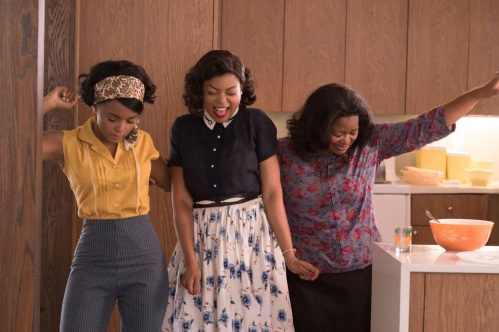
Hidden Figures tells the true stories of African-American mathematicians Katherine Johnson, Dorothy Vaughan, and Mary Jackson, who were essential employees to NASA during the Space Race. Let me reiterate: this is a TRUE story, but somehow these ladies are not an iconic part of the fabric of American history. Surely, there is institutional sexism and racism at play here, but less insidiously, there is also the fact that most workers at NASA who remained on the ground are not household names. But also, come on! – Katherine Johnson was John Glenn’s trusty confidant, relying on her for accurate calculations during his time in the stars.

As Hidden Figures kicks off, we know we are in good hands. Taraji P. Henson, Octavia Spencer, and Janelle Monáe (Johnson, Vaughan, and Jackson, respectively) are stuck on the side of the road due to a broken-down car while on their way to work. I think I speak for most of humanity when I say I would happily watch these ladies just hang out and do anything. The white Virginia traffic cop who pulls up to inspect their situation apparently feels the same way. This scene looks like it is about to play out like a typical example of civil rights-era Southern racism, but instead the officer is impressed that these ladies know their science and offers them an escort service.

This is how much of the film plays out. The racism and sexism these “hidden figures” experience are institutional and not personal except insofar as any instance of discrimination is personal. Everyone in this story wants to see America succeed above the clouds, and these women meet resistance only when their efforts get in the way of standard practice. For Henson, that means a hilarious/heartbreaking routine of racing 20 minutes each way across the NASA campus to the nearest colored restroom. Indignities like these are eventually beaten into submission, and the crowd-pleasing meter is constantly at its highest level.

I would be remiss not to mention the wholesome and sweet love story between Katherine, a single mother widower, and her second husband Jim. I don’t know if the real-life Johnsons are as gorgeous as Taraji P. Henson and Mahershala Ali, but I am convinced that they must have been. Otherwise, Henson and Ali are miracle workers.

Hidden Figures is the sort of movie that you take your mother to see because you know she is going to love it. It is also the type of movie whose relatively unambitious filmmaking techniques you might criticize, or at least excuse. But in the case of a story as inspiring as this one, that feels unnecessarily petty. Hidden Figures does not gussy itself up, because it will be inspiring even without all the frills. Besides, putting on such airs would be anathema to its humble origins.

Hidden Figures is Recommended If You LikeApollo 13A League of Their OwnThe Help

Grade: 3.75 out 5 Hammers to Racism


This Is a Movie Review: A Monster Calls

Leave a comment

A MONSTER CALLS (2016) Conor (Lewis MacDougall) and The Monster (performed and voiced by Liam Neeson)

This review was originally published on News Cult in December 2016.

Starring: Lewis MacDougall, Felicity Jones, Sigourney Weaver, Liam Neeson, Toby Kebbell

Director: J.A. Bayona

Running Time: 108 Minutes

Rating: PG-13 for Not Watering Down the Rough Patches in Life

Release Date: December 23, 2016 (Limited), Expands Nationwide January 6, 2017

In the fantasy/domestic drama A Monster Calls, adolescent Conor O’Malley (Lewis McDougal) must deal with his mother’s (Felicity Jones) terminal illness, his grandmother’s (Sigourney Weaver) overbearing presence, a classmate’s (James Melville) frequent torments, and the geographical distance from his father (Toby Kebbell). In the midst of all this arises a humanoid tree visitor (voiced by Liam Neeson) from the cemetery by his house. Is this monster a friend offering relief, or a foe busting in with more troubles? Hard to say. What he does have are stories, but their meanings are either difficult to parse or not as comforting as Conor would like.

A Monster Calls is admirably challenging for a film ostensibly aimed at family audiences. The laws of nature are likely to make the life of any teenage boy turbulent, and that difficulty is piled on via his parents’ separation, mother’s closeness to death, and the oppressive dreariness of England. A more typical “fantasy creature meets boy” story would position the monster as protector or companion, but for Conor the Liam Neeson Tree is mostly a source of frustration, which he internalizes and takes out on those around him – destroying a room at his grandmother’s in a fit of rage, getting back at the bully – and the consequences are confoundingly minimal. Conor expects to be punished, but life does not always make sense.

Making A Monster Calls difficult to embrace fully are the unpleasant sound effects that accompany every movement of the tree monster. They are, in a word, oppressive. Perhaps they are meant to illustrate the lack of comfort inherent in Conor’s story, but that strikes me as a step too far.

A Monster Calls is Recommended If You LikeThe BFG, The Mother-Son Relationship from The Babadook, Kid Actors with Fiery Emotions

Grade: 3 out of 5 Snapping Tree Branches

This Is a Movie Review: Why Him?

Leave a comment

why-him-bryan-cranston-james-franco

This review was originally published on News Cult in December 2016.

Starring: Bryan Cranston, James Franco, Zoey Deutch, Megan Mullally

Director: John Hamburg

Running Time: 111 Minutes

Rating: R for Getting a Little Loose with the Language

Release Date: December 23, 2016

When I first saw the trailer for Why Him?, I thought, “Well, if there’s anyone who can wring something worthwhile out of this stale premise, it might just be Bryan Cranston and James Franco.” It’s Guess Who’s Coming to Dinner for the 21st century: instead of a black man marrying a white woman, it’s James Franco. This particular version of Franco is Laird Mayhew, a vulgar and oversharing but very sweet billionaire video game mogul. He butts heads with father of his girlfriend Ned Fleming (Cranston), the high-strung head of a struggling Detroit printing company. A big deal is made about how alike Ned and Laird are, which is a bit of an exaggeration, though they are both honest to a fault. It is also striking how similar these characters are to their stars’ past roles. Ned is a harried dad that is a variation of the same vein as Walter White or Malcolm in the Middle’s Hal. And Franco is as irrepressible as always.

So, the leads are all set to bite into the gags, and they are not timid about exploring the explicit shenanigans the script leads them into. But the marks of assembly-line modern film comedy (i.e., unimaginative editing and cinematography that favors simple coverage of all angles) cramp their style. That lack of directorial personality is a shame, because the film has some fascinating and relatively unique ideas at its core. For example, Laird was raised by a single mother who never let him outside the house much, which renders Why Him? an interesting examination of someone who never had the experience to learn social skills.

Why Him? also aims to go thematically deeper, as Ned’s predicament touches upon the disappearance of traditional Midwest manufacturing jobs – a sort of Office meets Brexit, as it were. This does not play as a huge concern, but it is a hard topic to avoid in 2016. More pressing, and more timeless, are the women-friendly bona fides at play. This may be no fiery treatise, but the underlying message is undeniably feminist. The film is positively aware that the girlfriend/daughter (Zoey Deutch) is no mere MacGuffin, but a legitimate person in her own right.

Why Him? is Recommended If You LikeDaddy’s Home But Wish It Had Been a Good Movie, Guess Who’s Coming to Dinner But Wish That James Franco Had Played Sidney Poitier, Breaking Bad But Wish That James Franco Had Played the Methamphetamine

Grade: 3.5 out 5 Bidet-Style Toilets

This Is a Movie Review: Patriots Day

1 Comment

040616_PATRIOTSDAY_KB_462.CR2

This review was originally published on News Cult in December 2016.

Starring: Mark Wahlberg, John Goodman, Kevin Bacon, J.K. Simmons, Michelle Monaghan

Director: Peter Berg

Running Time: 133 Minutes

Rating: R for a Graphic Recreation and the Explicit Language Reacting to It

Release Date: December 21, 2016 (Limited)/Expands Nationwide January 13, 2017

Films about real-life terrorist attacks are tough beasts. Even with the best of intentions, the results can be sensationalistic. And even if the end product is as respectful as possible, survivors and witnesses may be too traumatized to relive that day in any capacity, which begs the question: is it even worth it? It is a conundrum whose scope goes beyond any simple answer, but it is important to keep in mind.

Then on pure storytelling terms, there is the matter of where to even place the focus. Patriots Day, which retells the story of the 2013 Boston Marathon bombing and the subsequent capture of its perpetrators, chooses to spread its character reach far and wide, which works surprisingly well. The implications and motivations behind a terrorist act can be too massive to capture completely, but this particular event actually lends itself well to the real-life recreations that director Peter Berg (Lone SurvivorDeepwater Horizon) has recently excelled at.

A frequently reiterated theme is that Bostonians have each others’ backs, and that is borne out through how interlinked the main characters are to each other. That connection is heightened through crisis, but the glue is already there. Even the terrorists themselves (chillingly and matter-of-factly played by Themo Melikidze and Alex Wolff), classmates and neighbors to many, are part of the Boston milieu.

Following the bombing, Patriots Day turns into a chase movie, with the urgency of the best of that genre already baked in. Armed forces, intelligence agencies, and civilians join together for an inspiring display of coordinated decision-making and action. The actors playing them summon their best reserves of basic decency to pull it off. The entire cinematic effort makes for a mix of emotions, often uncomfortable, frequently awe-inspiring, never without honor, even through the cathartic bursts of laughter.

Patriots Day is Recommended If You LikeLone SurvivorWorld Trade Center, Credits Scenes with the Real-Life People Portrayed in the Movie

Grade: 4 out of 5 Acts of Bravery

This Is a Movie Review: Passengers

Leave a comment

passengers-jen-looks-sad

This review was originally published on News Cult in December 2016.

Starring: Chris Pratt, Jennifer Lawrence, Michael Sheen

Director: Morten Tyldum

Running Time: 116 Minutes

Rating: PG-13 for Pratt Butt and J-Law Sideboob

Release Date: December 21, 2016

WARNING: This review is SPOILER-heavy.

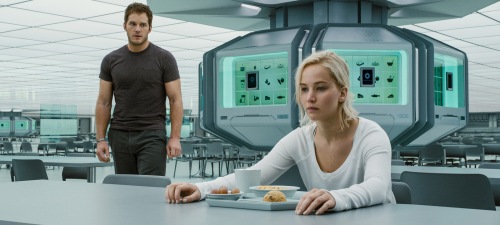
The first 30 minutes or so of Passengers is not exactly what you have seen advertised in the trailers. That is surely on purpose, because it is not the sort of thing that pops in whizbang mainstream cinema. The ads might lead you to believe that Jim Preston (Chris Pratt) and Aurora Lane (Jennifer Lawrence) wake up simultaneously 90 years too soon from their faulty hibernation pods, but in fact, Jim is all by his lonesome for about a year. Thus the film kicks off with Pratt knocking about in Homeless Lumberjack Chic.

Personally, I would be happy to watch 2 hours of this. There is plenty of hilarity in Jim’s interactions with a spaceship programmed to promise a bright future, which play like a horror satire of cultish weekend resorts. Jim however turns to despair, with only Android Bartender Michael Sheen keeping him from sliding into complete insanity. Robot companions make so many things bearable.

This particular robot companion, however, is not built to solve Jim’s dilemma. So when he discovers Aurora, he believes he has found the human connection to shake him back to life … this despite really only having her looks to establish an attraction. But I get it – sometimes a photo of a rando has struck my fancy, leading me to wonder, “What is the mystery behind this person?” The film also tries to suggest that Jim is won over by Aurora’s writing, but the words of hers we are privy to are rather banal – that nagging movie shortcoming in which a supposed expert’s works are not particularly impressive.

The more pressing issue is the ethical quandary regarding the appropriateness of Jim waking Aurora up. While his motives are presented as primarily selfish, they are not without justification. The ship is critically malfunctioning, and he does not have access to any of the areas that would allow him to fix it. Nor can he wake up any crew members, as he does not have access to their hibernation pods either. But from Aurora’s perspective, this is a huge violation of her agency. There is a chance to play this as a horror movie about the loss of control, and Lawrence is all ready to go to that vein of darkness, but she is granted precious little time to do so.

Passengers climaxes as Titanic in Space, which is to say: those who made the spaceship had the hubris to claim that there is no way it can possibly fail. The A.I. running the ship is categorically unable to process any malfunction. This is at least the third promising premise this film has at its disposal but also the least interestingly executed. The action moves along briskly, but it is overly methodical and flavorless, too concerned with just getting from Point A to Point B.

Despite its shortcomings, I generally enjoyed Passengers. Part of that is surely due to the magnetism of Pratt and Lawrence (and the slyness of Sheen). But even moreso, I am amused by the off-kilter dialogue, in which absurdly large numbers like “8 quadrillion dollars” are bandied about like they’re nothing. (Why are there such big numbers? Because, it’s THE FUTURE!) Then there are the indelible neologisms like “Ultimate Geographical Suicide.” The flaws of Passengers are unavoidable, but so are its irrepressible bursts of personality.

Passengers is Recommended If You LikeTitanic minus all the extras and supporting cast crossed with the post-apocalypse

The First 30 Minutes of Passengers Are Recommended If You Like: The pilot episode of The Last Man on Earth

Grade: 3 out of 5 Space Basketball Pickup Games

This Is a Movie Review: Rogue One: A Star Wars Story

Leave a comment

star-wars-rogue-one-rebels

I like the prologue (little Jyn is a great cinematic runner), and the last 10 minutes burn with the fiery passion of “gotta get this done.” The acting is great, but I don’t really care about any of the characters.

I give Rogue One: A Star Wars Story 4-6 Cameos out of 6-9 Transmissions.

(For more of my thoughts on Rogue One, click here: http://newscult.com/why-cant-rogue-one-be-a-half-hour-shorter/)

Why Can’t ‘Rogue One’ Be a Half Hour Shorter?

Leave a comment

CREDIT: YouTube Screenshot

This article was originally posted on News Cult in December 2016.

SPOILER WARNING – This article discusses major plot points from Rogue One: A Star Wars Story.

After seeing The Force Awakens, my initial feeling was one of gratitude that a new Star Wars movie could actually be good. After seeing Rogue One, my initial feeling was a desire to trim the fat. I generally do not get too hung up on the “right” running time for a movie. Sure, I’ll have an opinion about pacing, but there are usually more significant issues to discuss. And in this case, the running time is not my hangup so much as it is the hangup of the whole blockbuster template.

The best part of Rogue One is the last ten minutes, when the Rebels manage to transmit the Death Star plans expressly to Princess Leia (thus leading directly into A New Hope). The pace of this sequence is electric, which is as it should be in a heist film, which is indeed what Rogue One is. The driving purpose of such a film is a plot with a very specific purpose. The most obvious, and usually most effective, way for the audience to feel the urgency essential to this genre is by compressing the runtime.

So what could be lost in a hypothetical shorter Rogue One? The character work is uniformly unimpressive. Plenty of time is spent examining whether or not Jyn Erso (Felicity Jones) is a true rebel and if the others are willing to accept her into the fold. But that conflict is never all that interesting, nor does it especially matter. This story is not a hero’s journey, like the rest of the Star Wars saga.

But perhaps there are some viewers who appreciate the time given to Jyn’s arc, or all the time spent with Saw Gerrera (Forest Whitaker) that does not really affect the ultimate direction of the plot. (I can certainly understand the latter, thanks to Whitaker’s off-kilter performance.) It is not an absolute requirement that heist flicks must be on the short end of feature running times. If the character work of Rogue One were more impressive, I could very well be singing a different tune.

My real issue, though, is the implicitly accepted, rarely examined convention that big-budget action blockbusters must hit that sweet spot between 110 and 140 minutes. That standard holds true across all the numbered Star Wars episodes as well as Rogue One, and nobody has ever really stopped to ask, “Why?” One might suggest the old saw of “getting your money’s worth,” but a film’s value decreases when it has 30 minutes of padding.

Rogue One is just one example. My larger point is that major franchise films should be more adventurous. Star Wars does appear to be interested in such variability. The one-off nature of this film and the upcoming Han Solo prequel are evidence of that. As for other franchises, the Marvel Cinematic Universe has done an admirable job of exploring various genres within its own overarching template. But diversity of running time has hitherto been neglected in this approach towards diverse filmmaking. And I am not just arguing for kinetic short blasts. Three-hour plus, Godfather-esque generational sagas are also welcome!

The point is, this is not TV. There is no categorical need to fit within a strict temporal box. In a series that can travel long distances at the speed of light, I see plenty of yet explored possibilities.

This Is a Movie Review: Moana

Leave a comment

moana_ocean_parting

Moana is a rather small-scale story, at least geographically. The title character (Auli’i Cravalho, tenacious as one can be in voice acting), a Polynesian chief’s daughter, must sail across a reef and procure a MacGuffin to save her people. Along the way, she must defy her overprotective father and forge an Unlikely Friendship with the self-interested demigod Maui (Dwayne Johnson, because of course). We never doubt that Moana will succeed, because she is too strong-willed to fail, and also, the ocean has her back. Which is my favorite song? Why, “Shiny,” as sung by Jemaine Clement, of course.

I give Moana 7 Pounamus out of 10 Te Fiti’s.

Older Entries Newer Entries