This Is a Movie Review: Café Society

Leave a comment

Cafe-Society

Latter-day Woody Allen films have a tendency to use narration as a crutch to make their themes obvious and their plots overly clear. But somehow the voiceover of Café Society (courtesy of Allen himself) won me over. As the story moves away from the glitz of 1930s Hollywood towards the gangster-run business of New York, the compressed approach that results from the heavy narration allows the deadly violence to work as comedy. Indeed, Café Society works best when it focuses on Woody’s specialty of nihilist existentialism. (A conversation about fear of death, or lack thereof, is a highlight.) And with Jesse Eisenberg managing the best Woody Allen impression of any Woody avatar, the connections to the classics are enough to get by.

I give Café Society a B- in Jewish Philosophy 201.


This Is a Movie Review: Florence Foster Jenkins

Leave a comment

Meryl_Streep_Florence

It is hard to pin down Florence Foster Jenkins the film. Is it inspirational biopic, goofball comedy, relationship drama, tragedy, or even horror? Florence Foster Jenkins the woman is just as tricky. The true story of a tone-deaf singer who was celebrated as much as she was mocked is indeed a tonal challenge, and the result is confusing and fascinating in equal measure. This is hardly a surprise, as director Stephen Frears has a knack for transforming what initially seems like a simple prestige picture into something subtly challenging.

The performances embody the multifaceted whole. Meryl Streep alternately plays Jenkins as guileless and take-charge. It might be among her best performances, but it is so unusual for her that I can’t say for sure. As Jenkins’ husband, Hugh Grant is intensely loyal and intensely conflicted. And Simon Helberg (relishing the freedom from the stereotype-heavy Big Bang Theory) is a tic-filled delight as Jenkins’ pianist, won over by her charms despite the laughs he holds back and the worries for his reputation. Your reaction to her is likely to be just as mixed, in a good way.

I give Florence Foster Jenkins a hearty round of applause.

This Is a Movie Review: Nerve

1 Comment

Nerve-movie

So many reviews of Nerve have compared the titular online reality game to Pokémon GO, and rightly so. Rarely does such a perfect real-world analogue serendipitously appear, and with such uncanny timing to boot. Obviously, the team behind Nerve could not have been unaware of the latest augmented reality sensation during production, but they end up so close to it because they are thoroughly attuned to the aesthetics of all the modern major online channels.

As a sort of mixed media collage, Nerve is somehow both disorienting and natural, which is how the adoption of new technology goes. The players of Nerve must film themselves performing their dares on their cell phones, which is both awkward (often dangerously so) and second nature.

The film zips along with just enough believability until its conclusion, when everyone suddenly develops superpowers. But while it falters plot-wise, it remains thematically strong (a sly moment of mass implication hits hard). This is an exaggerated world, but it feels unnervingly plausible. While Nerve goes down easy, it does not really let anyone off the hook.

I give Nerve $50,000, plus a $1,000 bonus for not bailing when it probably should have.

This Is a Movie Review: Star Trek: Beyond

Leave a comment

star-trek-beyond

Star Trek: Beyond finds the Enterprise attacked by a relentless alien swarm, led by the hellbent commander Krall (played by an actor who has been in everything lately). It is not initially clear what Krall’s purpose is, which makes Beyond a little hard to get into. But that mystery is purposeful, and once all is revealed, the whole film retroactively clicks into gear. Before it ends up at that point, this entry establishes itself as the nerdiest of the rebooted cinematic Star Trek series yet. Main characters new to the series are caked under mounds of makeup and saddled with semi-permeable alien accents. First time Trek director Justin Lin’s approach is a departure from the accessible ethos established by J.J. Abrams, but not a complete one. Beyond is more episodic as opposed to being a grand singular statement, which makes sense for a series this old. There is a hard sci-fi style here that qualifies as throwback because most major geeky film franchises nowadays eschew it completely. The Enterprise’s mission is “to boldly go where no man has gone before” – in 2016, going back to where Star Trek has already been is also pretty bold.

I give Star Trek: Beyond 17 Alien Hairstyles out of 21 Beamed-Up Action Sequences.

This Is a Movie Review: Lights Out

1 Comment

Lights Out

If you see Lights Out, do not be surprised if it is the most energetic movie crowd you have ever been a part of. The screams will be relentless, and the whoops will be boisterous. Generally, I do not let the crowd reaction influence my review too significantly, but the Lights Out crew is particularly instructive. This film is so in tune with the rhythm of horror reactions, and it manipulates them so thoroughly right down to the micro level. Jeers over characters making stupid decisions are immediately followed by cheers for their ingenious resourcefulness. Hardened horror vets often ask, “Why don’t characters just do [supposedly easy solution]?” Lights Out answers, “Let’s see what happens when they do. But for the record, it’s not easy, and there’s plenty more movie left to go.”

The premise – a villain that can only attack in the darkness – is a gracefully simple setup, though it does not necessarily portend innovative execution. At first glance, Lights Out looks like it is going to be a fairly straightforward genre exercise, just with above average spookiness and performances. But it ends up being filled with so many unusual, nearly confounding, decisions. It is like this from the get-go. Cinematic supernatural entities tend to reveal themselves gradually, but the presence of Diana – the darkness dweller – is immediately apparent. Arcs of characters coming to accept the presence of evil are compressed to one scene, if they are there at all.

Ultimately, Lights Out succeeds by combining the satisfaction of an understandable plot with the disturbing nature of a world in which everything feels just a little bit incomprehensible. There are several awkward line readings, and it is hard to tell how intentional they are, but regardless, the overall effect is unsettling. Furthermore, the twists are intensely surprising, but what truly sets this movie apart is what follows those twists: sudden, frankly manic shifts in emotion. In a way, this is a story of mental illness caused by ghosts instead of chemical imbalances. It only makes sense, then, that the ultimate explanation of Diana is prosaic but also supernatural, or corporeal but somehow also spectral. And so, Lights Out is a simple fright flick, but also a secret game-changer.

I give Lights Out 99 Surprises Out of 10 Smart Decisions That Seem Like Dumb Decisions.

This Is a Movie Review: Captain Fantastic

Leave a comment

CFday25-580.jpg

Is the quest for utopia always a folly? It is hard to argue otherwise, considering the difficulty of convincing every member of a sufficiently large population to go along with the same grand unifying vision. But perhaps it can be achieved on a smaller scale, possibly with a family unit, as posited by Captain Fantastic. Viggo Mortensen plays the head of a brood living completely off the grid in the Pacific Northwest. He leads his six kids in rigorous physical and scholarly training, and for the most part they feel fulfilled.

When they must re-enter society for their mother’s funeral, their social shortcomings are brought into stark relief, but for all their eccentricities, they are more intellectually and emotionally capable than most of the people around them. They truly live up to their parents’ goal for them to be “philosopher-kings.” Eventually, compromises must be made to continue living alongside the rest of the world, and narratively speaking, they happen a little too quickly and cleanly. Captain Fantastic is a sort of utopian wish-fulfillment, but it is wish-fulfillment with conviction and a practical streak.

I give Captain Fantastic an 80% Satisfaction Rating on Noam Chomsky Day.

This Is a Movie Review: Ghostbusters (2016)

2 Comments

ghostbusters2016

My overriding feeling after watching Paul Feig’s Ghostbusters is that I would have preferred a different movie with this same cast. The chemistry between the four leads is right on, and all the supporting roles are slotted just as they should be, but the whole thing feels reverse-engineered to fit into the framework of the classic it is rebooting (a tough task no matter how much talent is assembled). There are plenty of great laugh lines (either improvised or just well-timed), because Kristen Wiig, Melissa McCarthy, Kate McKinnon, and Leslie Jones are so in tune with what their unique reaction to every situation should be. They could pull that trick off no matter what the kooky premise. But what they lack is deep-rooted conviction. For them, Ghostbusters does not feel like a necessity, but instead just a good idea. The former gets you a singular vision, the latter gets you a pleasant diversion.

I give Ghostbusters 6 “It’s Funny Enough to Justify Itself’s” out of 10 “It’s Unnecessary’s.”

This Is a Movie Review: The BFG

Leave a comment

The BFG Disney

Your mileage may vary regarding Mark Rylance’s incessant delivery of Roald Dahl-isms like “snozzcumber” and “jigglyraffe,” but whatever your take on whimsical slang, there are more essential matters when evaluating The BFG. The Big Friendly Giant’s capture of little Sophie (Ruby Barnhill – the most moppet-ish moppet who ever moppet-ed) happens right quick, and thus her life in the orphanage is never fully cinematically formulated. The BFG’s lair is fun to play around in, but it feels less like a fantasy world of escape and more like the status quo. Thus, much of The BFG feels oddly detached from any purpose.

Eventually, the film clicks into gear when Sophie and the BFG visit the Queen (a delightful Penelope Wilton) to enact their plan against the more cannibalistic giants. It is a matter context: yes, the Sophie-BFG relationship is obviously the crux of the movie, but it must be seen within the rest of the world’s (or at least England’s) reaction to giants. The royal reception is optimistic about statesmanship, and also makes a weird case in favor of the monarchy’s continued relevance.

I give The BFG 6 Frobscottle Farts out of 10 Corgis.

This Is a Movie Review: The Purge: Election Year

Leave a comment

Purge-Election-Year-Mykelti-Williamson-Frank-Grillo-Joseph-Julian-Soria-Betty-Gabriel-Elizabeth-Mitchell

It took three attempts, but the Purge series has finally figured out that essential element that so many horror movies forget: characters whose lives we actually care about! It wasn’t for lack of trying, but it was for lack of casting. Ethan Hawke did what he could in the first Purge, and Frank Grillo managed a decent B-movie hero vibe in Anarchy (thus he is the only main cast member back for Election Year), but overall the tapestry fell flat.

This time around, there is oomph to the targeted senator/presidential candidate (a steady Elizabeth Mitchell). Her survival matters since she is running on an anti-Purge platform. But the real satisfaction comes from the supporting purgers, especially Mykelti Williamson as a deli owner who suddenly finds himself on the senator’s security detail. Williamson leans a bit into Blaxploitation stereotypes, but in a knowing sense, so it is more ridiculous than offensive. It is not perfect, but at least this series finally figured out it needed a huge injection of fun.

As for the bluntly satirical election plot, it is – no surprise – simplistic and silly. It’s not that the Purge couldn’t happen in real life, just that its implementation and potential dissolution wouldn’t be so clean. But hey, this is a movie in which all crimes are legal for one night. It is fine that it breaks the rules and bends sense. It is, in fact, encouraged. More overly simplistic ridiculousness would have been even better.

I give The Purge: Election Year 30 Anti-Purge States out of 50 Pro-Purge States.

This Is a Movie Review: The Neon Demon

Leave a comment

neon-demon

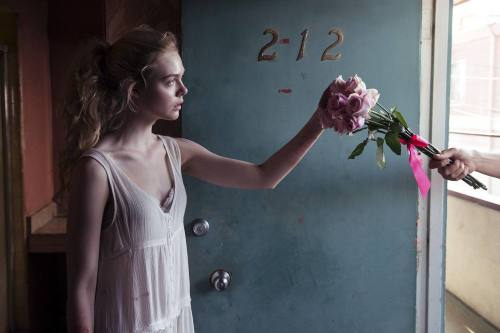
About halfway through The Neon Demon, I realized, “Oh, this is a comedy.” The audience had been chuckling throughout, and I wasn’t sure if those moments were meant to be funny, but after a certain point, I thought, “This has to be intentional.” It hit me during the scene when Jesse (Elle Fanning – innocent, affectless) and the cabal of models (Jena Malone – fierce; Bella Heathcote – piercing eyes, affectless; Abbey Lee – severely angled, affectless) are at a bar with a designer (Alessandro Nivola). The entire movie’s dialogue is so devoid of personality and context, but the bar scene is where it is really heightened into Waiting for Godot-worthy absurdism. Nivola pokes at the core of the statements that aim for profundity and mean nothing. I don’t know if Nicolas Winding Refn intended to make a parody of an overly stylized art film, but that is what he did.

Like any good parody, The Neon Demon intuitively understands the genre it takes aim at. But it actually comes at it a bit sideways. The plot (young ingénue is eaten alive by a performance industry) is not so much the target of lampooning as much as it is the canvas draped in self-evident pretentiousness. We’ve seen this story before – All About Eve, Showgirls, Black Swan, etc. – but never this deconstructed. If you cannot jive to The Neon Demon’s wavelength completely, fear not, as its closest antecedent is Suspiria. Just like that landmark giallo, the plot is opaque, but the aesthetics (hypnotic score, violently vibrant colors) are undeniable. See this one on the big screen, and be agog.

I give The Neon Demon 8 Examples of Symbolic Cannibalism out of 9 Implied Promises of Real Cannibalism.

Older Entries Newer Entries