This Is A Movie Review: Lucy

3 Comments

scarlett-johansson-lucy

Lucy (Scarlett Johansson) is an unwilling drug mule who becomes infected with the cargo (known as CPH4) that she is meant to be transporting, thus enabling her to use more than the ten percent of the brain that humans are typically capable of using.  Of course, the idea that humans only use ten percent of their brains is a myth.  That misconception is not necessarily a problem with a Luc Besson movie, as it is not striving for realism.  But a legitimate idea can be used for absurd ends, and Lucy does not make it clear if it believes that the ten percent myth is illegitimate and is just rendering it unrealistic or if the lack of realism is meant to expose how foolish the ten percent perception is.

The reason why that remains unclear is because, weirdly, Lucy is not as crazy as it could be.  Sure, there are plenty of idiosyncratic touches – the initial kidnapping of Lucy is intercut with a leopard hunting a gazelle, there are 2001-style appearances by prehistoric man (hence the title) – but Lucy’s increased brain powers come off as a little mundane in a cinematic age saturated by superheroes.  The plot stakes are lowered considerably as she becomes more powerful – it is fairly clear that she cannot be defeated, except perhaps by an overload of CPH4, but with her cranial capacity increasing, one could assume that she is smart enough to know when to stop in that regard anyway.  But her essential invincibility is used as an excuse to have her just show off for the sake of set pieces, such as one moment when she leaves a crew of Korean gangsters stuck writhing in mid-air.

Despite all these problematic elements, Lucy is right up my alley: it takes a bunch of disparate parts and re-fashions them together for a new context and improves upon those that didn’t work in their original iteration.  Lucy is a combination of just about every one of Scarlett Johansson’s roles from the past year: the drive to understand all human knowledge (and beyond), like operating system Samantha from Her; the droning, quizzical outsider’s perspective like the alien from Under the Skin (Lucy also shares the inky black against white visuals of Skin); and the swaggering, action-star bravado of Black Widow from The Avengers and Captain America.  As for non-Scarlett Johansson influences, Lucy also works as the more insane, and therefore more successful, version of Transcendence, regarding uploading humanity onto computers.  Then there are the dawn of man sequences, which set themselves apart from 2001 by being shot in the sleek style favored by the entirety of Lucy.

Lucy avoids failure by being all over the place with its philosophical mumbo jumbo, but it cannot quite reach transcendence because it is too caught up in that mumbo jumo. B+
This Is A Movie Review: Snowpiercer

1 Comment

Snowpiercer

The premise of Snowpiercer is ostensibly depressing, but in a weird way, it is also optimistic about the current state of the world.  The future ice age of director Bong Joon-ho’s dystopia is caused by an experiment to counteract global warming that works too well.  As the prologue explains, the temperatures were lowered to uninhabitable levels by dropping the cooling agent CW7 all over the planet.  The idea that the solution to global warming could be so simple is naive, but also weirdly hopeful.  Of course, this snowy apocalypse could be interpreted as an argument against attempting to reverse global warming, in that it implies that doing so could lead to the opposite problem.  Ultimately, though, the terms in which Snowpiercer presents this possibility are too simplistic and the movie itself is too insane for anything realistic about the environment to be inferred here.  This setup is just an excuse to have the entire remaining human population trapped on a train that is speeding around the planet, and that proves to be a perfectly fine justification.

Like most dystopian pictures, Snowpiercer is about a fight between the have’s and the have-not’s, and naturally enough, there is a handsome hero (Chris Evans) leading the rebellion.  The particular social inequality of Snowpiercer is not all that unique or meaningful.  But luckily it is not really about the allegory; instead, it is about what life would be like if all of human society (consisting mainly of Koreans, Americans, Brits, and a few Eastern Europeans) were trapped in a confined space.  It has been 17 years since life on the Snowpiercer has begun, so people have settled into it as a home, but there is not really enough room – at least not for everyone – to truly be at home.  Those in the back of the train with the least means cannot afford to be anything other than constant travelers.  Thus, we have a character like Tilda Swinton’s Mason, visiting to impose the rules from the front of the train onto these passengers.  Swinton is typically androgynous and outrageous (making her the perfect actor for this film), and she is also typically nuanced, which is much appreciated for a role that could have been pure evil in other hands.

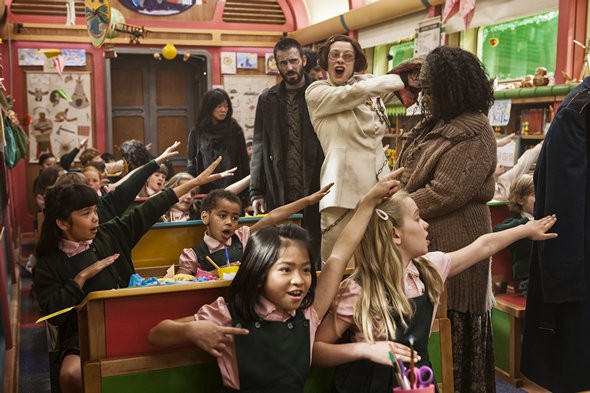
There is a lived-in griminess to the opening act that effectively sets the stakes of the narrative, but it is not until the middle section that Snowpiercer gets truly bizarre and memorable by showing off the elements of society that are not of the sort in constant flux.  One train car that the rebels make their way through features a middle-school classroom, with Alison Pill in a delightfully deranged turn as the gun-toting, pregnant teacher.  The type of education offered aboard the Snowpiercer is indoctrination to the cult of personality of Wilford, the creator of the titular train.  There is no way to physically cordon the revolution from the schooling, nor is there even an attempt to bother to do so.  But really, the most insane thing about this scenario is the illusion that a normal-looking classroom can remain a sensible idea.

The conclusion of Snowpiercer is well worth discussing, but not worth spoiling except in the vaguest of terms.  It features a surprising turn from an Oscar-nominated actor in a narrative turn that diverges sharply from the rest of the film in a way that was reminiscent of William Hurt’s appearance at the end of A History of Violence.  It plays around with the concluding tropes of dystopian films a fair bit.  Ultimately, Snowpiercer is a singularly bizarre action fantasia with a legendary set design that will not soon be forgotten. A-

This Is A Movie Review: Dawn of the Planet of the Apes

Leave a comment

DAWN PLANET APES MOV

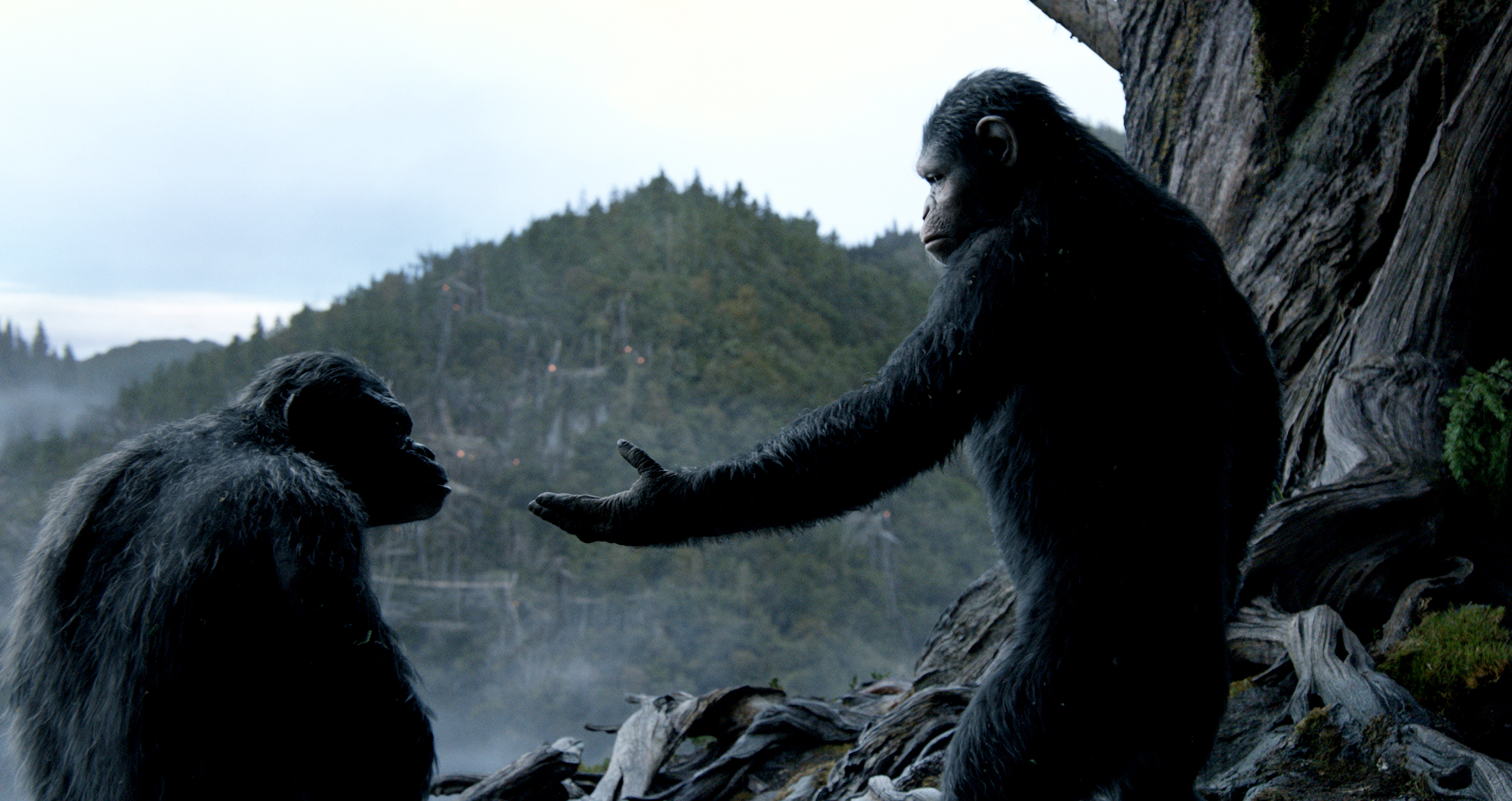
Dawn of the Planet of the Apes doesn’t play by the damn dirty rules of Hollywood blockbuster sequels.  While I currently prefer its predecessor, Rise of the Planet of the Apes, Dawn may yet supplant it, as it is the type of movie that demands mulling over, which is already one way it sets itself apart.  It is also strikingly small-scale.  Your typical action spectacular is about saving the entire world, while Dawn takes place entirely in and around what remains of San Francisco, even though the whole planet has been decimated by the virus that began spreading at the end of Rise.  That tight focus is simply smart storytelling: the audience can keep track of one emblematic storyline and see how it fits into the larger context.

But what is most striking about how Dawn‘s independently-minded m.o. is its thoughtfulness, and this is especially striking considering how singularly action-oriented it also is.  This is essentially a war movie: when a group of humans who are genetically immune to the virus stumble upon the ape community in the Muir Woods, it leads to a series of conflicts that culminates in an apes-vs.-humans battle for the city.  So obviously there is plenty of action (including several lovingly shot sequences of apes riding horseback), but it is complemented with lots of scenes of talking.  Most of this verbal communication involves the apes, providing a mix of sign language, grunts and screams, and some basic spoken English.  The lines that make up the dialogue are not particularly extraordinary, but the fact that so much screen time is spent on what is essentially the development of a new form of communication is extraordinary.

This ape communication is a key component to how Dawn truly excels.  In portraying the evolution of apes adapting human abilities, this movie essentially presents a species unlike any other that we have seen before.  The original Planet of the Apes just had people in ape costumes, which was fine, but what was started in Rise and now fully realized in Dawn goes beyond just people with ape characteristics or apes with people characteristics.  Andy Serkis, reprising his role here as ape leader Caesar, has been rightly praised as the trailblazer of motion capture acting, but this technology is now strong enough that every ape performer is on his level: among others, there is Toby Kebbell going wild as the rebellious Koba, Karin Konoval supplying peaceful energry as Caesar’s trusted orangutan advisor Maurice, and Judy Greer providing plenty of pathos as Caesar’s wife Cornelia.  The combination here of CGI, practical effects, and the presence of actual individuals produces something that is unknown but familiar.  Too many current action blockbusters rely on CGI to fill everything in and come off as painfully fake.  Dawn goes for a more practical approach but recognizes that the CGI can be corralled to achieve the mark of a successful movie: real connection. B+

This Is A Movie Review: Jersey Boys

Leave a comment

jersey-boys

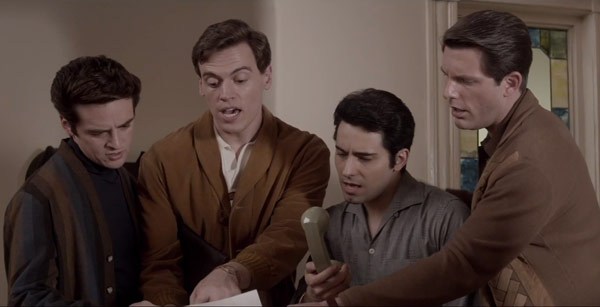
Sometimes a story is just too good to screw up.  The music of The Four Seasons is of the variety that you can’t help but sing along and tap your feet to it, and their backstage drama is of the sort that inspired intense loyalty and profound resentment in equal measure.  Jersey Boys is a loud, boisterous affair, and it is therefore ideally suited to the stage.  I have not seen the original musical version, but I can understand why it has been such a big Broadway hit.  The best elements of the film version worked plenty fine on the screen, but I couldn’t help but thinking during each of those moments, “This surely works a lot better on stage.”  John Lloyd Young, Vincent Piazza, Erich Bergen, and Michael Lomenda are uncanny in their channeling of Frankie, Tommy, Bob, and Nick during the musical numbers, but there is an immediacy lacking without the live element.  The fourth-wall breaking narration is a strong device, and the fact that each band member takes a turn with the dictation plays into one of the film’s stated themes (“everyone remembers it how they need to, right?”), but there is a potential intimacy to this technique that cannot quite be fully conveyed at the multiplex.  There is even an all-cast end credits song-and-dance routine that basically screams “Broadway musical closing number!”  What prevents Jersey Boys from being a classic instead of merely good is the risk-averse style of director Clint Eastwood.  Clint is a competent filmmaker: there is nothing in the frame that doesn’t belong there, nor is there a single bad edit.  But he is too content to let the story just speak for itself.  I think where he truly excels is with more challenging material (such as the racially charged Gran Torino or the underrated, spiritually complicated Hereafter), and the degree of difficulty for Jersey Boys simply wasn’t as high as it needed to be.  Its lasting impression is of a great story, but not quite a great filmic experience. B

This Is A Movie Review: Deliver Us From Evil

Leave a comment

Deliver-Us-From-Evil-Movie-2014-Eric-Bana-Joel-McHale

Deliver Us From Evil repeats – less successfully – the beats of many possession movies that have preceded it.  But that’s not what I really want to talk about.  Director Scott Derrickson has proven himself capable of effective scares before, particularly with 2012’s disturbingly grisly Sinister, and Deliver Us would certainly have been better if it had delivered in this area, but those shortcomings ultimately seem to be beside the point.  Eric Bana plays Ralph Sarchie, an NYPD officer who discovers a series of related crimes that might just have a demonic flavor to them.  It turns out a crew of dishonorably discharged soldiers stumbled upon something supernatural while in Iraq.  The demon they uncovered is using them to create doorways, presumably for the transport of evil spirits.  And, as connoisseurs of the most obvious puns imaginable were hoping, this method is used to justify every possible diegetic inclusion of Jim Morrison, Ray Manzarek, John Densmore, and Robby Krieger.  And as luck would have it, the Doors had a thematically appropriate hit befitting their name, as we are reminded when a possessed woman is babbling the lyrics to “Break on Through (To the Other Side).”  To make it overwhelmingly clear what is going on, whenever a Doors song is playing, just about every other word spoken is “door” or “doorway.”  It’s like product placement run amok, in which the product being promoted is “doors.”  The only reasonable conclusion is that Deliver Us From Evil is some weird experimental tribute to the Doors.

Initially, this film seems like it intends to be more than just your typical exorcism movie.  It opens as a fairly straightforward buddy cop thriller featuring Sarchie and his partner Butler (Joel McHale, who doesn’t even bother to attempt a New York accent).  It has a chance to be a gritty crime/supernatural horror hybrid, but it mostly ignores the former and hews too closely to the formula of the latter: Sarchie is initially skeptical about the demonic explanation, then a priest slowly convinces him, then the demon starts threatening his family, and ultimately there is a climactic exorcism.  Deliver Us is mostly disappointing, though it avoids being simply boring.  It is instead weirdly fascinating, especially insofar as Sarchie and Father Mendoza (Édgar Ramirez, giving a fairly nuanced performance that doesn’t have much of an effect on the overall quality of the movie) seem to exist in a vacuum, as Sarchie’s fellow officers have essentially no idea of the supernatural truth.  Also, his wife (Olivia Munn) and daughter (Lulu Wilson) are placed in peril by the demon, but with tactics that a regular human criminal could have used.  McHale, meanwhile, appears to be in another movie entirely – a much better one, in which he gets to parody cop clichés and crack wise, while the characters in the movie he has stumbled onto stare stone-faced, unable to register humor. C

This Is A Movie Review: How to Train Your Dragon 2

Leave a comment

how-to-train-your-dragon-2-image-7
How to Train Your Dragon 2
, like its predecessor, is not concerned with pop-culture spoofiness or all-around goofiness.  Instead, it is all about the storytelling, and every element that is worth recommending about it comes through in said storytelling.  Now that Hiccup (Jay Baruchel, using his nasally whine to precise effect) has convinced his father and the rest of his Viking village to live in peace with their fire-breathing neighbors, he discovers that the surrounding areas are not equally progressive.  The plot turns upon a dragon army controlled by the villainous Drago (a menacing Djimon Hounsou).  The villainy could be more nuanced, but I always appreciate when a film like this one trusts its young target audience to handle the intensity, particularly when the heroes have to muster their courage to do just that.  Ultimately, HTTYD2 is a sort of throwback, insofar as it is a simple tale told well.  It is most winning with the care placed on its details, with subtly effective animation (dragon Toothless is especially expressive) and strong vocal performances all around – the characters who are meant to be kind of annoying are not too overbearing, while the best performance comes from a hardly recognizable Cate Blanchett (as Hiccup’s previously presumed-dead mother), the weight of so many emotions imbued in her voice. B

This Is A Movie Review: 22 Jump Street

Leave a comment

22-Jump-Street-5
The team behind 21 Jump Street made the ingenious decision of making its ill-advised adaptation of an old TV show about ill-advisedly adapting an old TV show into a movie.  Making 22 Jump Street about the ill-advisedness of sequels is not an ingenious decision; that is not because it is the wrong idea, but because it is the obvious (albeit correct) idea.  That is to say, for 22 Jump Street to work, it has to go beyond that ill-advisedness concept.  This movie does acknowledge the ridiculousness of sending Officers Schmidt (Jonah Hill) and Jenko (Channing Tatum) back to school again to infiltrate a drug ring again.  But whether it acknowledges it or not, being essentially the same movie all over again is bound to induce some fatigue.  There are the same constant jokes about how they look too old to be in school cranked up to 11, as well as the same initial role reversal.    The latter is not as inspired this time around, though, as Jenko joins the football team and is anointed the big man on campus, which is in line with the role he was used to prior to 21 Jump Street.  But at least Schmidt is not with a group of outcasts per se, so much as an alternative crowd, which he wins over with an impromptu performance at a poetry slam that earns him the nickname “Maya Angelou” (which effectively works as a loving tribute to the late poet laureate).

The separation of Schmidt and Jenko works to set up a love story of sorts, in which the former must work through his neediness and the latter his insensitivity.  This leads to the two of them frequently being mistaken for a gay couple, most notably in a therapy session with a psychology professor (a perfectly cast Marc Evan Jackson) who had them pegged as “partners” as soon as he met them.  This could be construed as gay panic, that most tired of bro-comedy gags, but it is actually quite the opposite.  Neither Schmidt nor (the formerly ignorant) Jenko would really mind being mistaken for gay.  If anything, 22 Jump Street emphasizes how okay they are with this a bit too much.  But it does lead to a triumphant moment in which Jenko gets to hilariously display what he has been learning in a human sexuality course and how open-minded he has become now that he he no longer carelessly throws around homophobic pejoratives like he did in high school.

Most of the lampshade-hanging sequel gags are not imaginative enough to make 22 Jump Street an unqualified success.  But there is one crowning success in this regard: the climactic chase scene through campus, which features some of the most conceptual humor in modern mainstream American cinema.  Schmidt and Jenko drive through the most expensive areas of campus, even though they could have very easily taken a route that would have led to far less damage.  Schmidt cries out how upset their superiors will be over having to pay for such expensive damages and the parallel implication here is obviously that movie studios will ultimately regret having the most expensive stunts for their comedy sequels when they are completely unnecessary.  I was cracking up throughout this sequence, though the audience I saw it with responded more vigorously to the broader moments, courtesy primarily of a frighteningly committed Ice Cube (returning as Schmidt and Jenko’s captain).  (SPOILER-Y item of note: Cube’s role is more similar to his in Ride Along than it is to 21 Jump Street, as Schmidt dates a girl who turns out to be the captain’s daughter.  This connection is only magnified by the resemblance between Amber Stevens – who plays his daughter – and Tika Sumpter – who played his sister in Ride.)  A cap is placed on the sequel meta-ness with a montage that plays during the credits that seems to provide a definitive answer regarding any potential further sequels.  It is the strongest sustained segment of the whole film, and it wins my vote for funniest scene of 2014.  That intensity cannot be maintained for the entirety of the running time, but it presents a closing argument of sorts that makes the hour and fifty minutes that precedes it wholly worth it. B

One More Point of Note: For a movie so aware of being a sequel and that even includes a gag about a contract dispute with an actor, it is a bit jarring that Brie Larson does not reprise her role from 21 Jump Street and that her absence is never acknowledged.  Although, I suppose that, as a huge Brie Larson fan, I was just more inclined to notice that than anyone else.

This Is A Movie Review: Edge of Tomorrow

3 Comments

edge-of-tomorrow
Edge of Tomorrow
is a lot like a video game, and this is the first movie for which that is a compliment.  I’m not the first critic to make this observation, but I still feel compelled to mention it, because it is an observation that ought to be repeated.  Tom Cruise plays Major William Cage, who is stripped of his rank and forced into the front lines of battle in a war against an alien race known as the Mimics.  Cage is burned to death by the blood of an unusually large Mimic, and this sanguinary transition grants him the ability to repeat the same day over and over.  It may sound like it is just repeating the same time-looping concept that Groundhog Day perfected over 20 years ago, except with aliens and giant mechanical suits, but it actually proves that this is an idea that is far from exhausted.

Edge of Tomorrow is not based on a video game (in fact, it is adapted from the novel All You Need Is Kill by Hiroshi Sakurazaka), but it feels like it is based on EVERY video game.  Or, at least every video game with a consistent storyline in which you can’t save your progress.  The environment and plot turns of each repeated day remain the same, so Cage knows, for example, after a few loops that a fellow soldier will be crushed by a plane.  So he pushes him out of the way, but that results in Cage being crushed by the plane.  Whenever one challenge is overcome, several more present themselves.  All of his deaths are certainly frustrating, but they are all followed by a more rewarding round through the game.

No effort is spared with the black comedy of Cage’s demises, as a series of whimsically edited montages present him crushed, exploded, run over by a Humvee, and shot in the head several times over.  If you have ever hated Tom Cruise, you will surely enjoy him getting wrung through the ringer, but I implore you to try to actually like him by appreciating his unbridled energy.

I have been a fan of Cruise for a while, so he does not need to win me over, but he hustles as hard as he can to convince everybody else.  The supporting cast shines as well, particularly (obviously) Emily Blunt as Rita Vrataski, a sergeant who was previously infected with the time-looping Mimic blood.  Her heroic exploits have earned her the nickname “Full Metal Bitch.”  It is a somewhat annoying moniker, but she no doubt lives up to it.  After meeting her in battle in the first loop, we are re-introduced to her (over and over) with an admiring shot of her in a one-arm plank in the training center.  The role is a tricky one, as she is expected to take absolutely no gumption from Cage (she’s no GI Jane trying to prove herself, it is just a given how awesome she is regardless of her gender) but also work at a disadvantage, considering that Cage keeps building up experience that she can never match.

Bill Paxton has more fun than any other actor this year as the sergeant in charge of Cage.  He kills it with a relish that suggests he has been waiting years for a role in which he can put Tom Cruise in his place.  Noah Taylor provides some expositional flavor as Dr. Carter, the only character that Cage and Vrataski can confide in regarding the time looping.

With a male and a female co-lead, it would seem inevitable that Edge of Tomorrow would throw romance into the mix.  That did not strike me as the best idea, as the relentlessness of the Mimics made it so that there really could not be enough time to focus on love.  Although, considering that Cage can always start over, he more or less had all the time in the world.  Unsurprisingly, spending the same day again and again with Rita leads Cage to fall in love with her.  So the real issue here with any potential romance is that she only has a day to develop feelings for him.  For the most part, EoT recognizes and abides by this limitation.  It does get around it a little bit in a way that may seem to be forcing the issue but is actually justified by the chemistry between Cruise and Blunt that is informed by the effect that Vrataski has on Cage during all his loops.  A final comparison to Groundhog Day is worth making: Phil Connors’ repetitions allow him to learn how to be the ultimately selfless person that everyone loves, while William Cage is in a lonely endeavor in which he knows that the fruits of his efforts may never be fully recognized by anybody. B+

This Is A Movie Review: The Fault in Our Stars

1 Comment

The-Fault-In-Our-Stars-4.jl.060514
Based on the novel by John Green of the same name, The Fault in Our Stars did not make this reviewer cry (but I would happily admit it if it had).

As Hazel Grace Lancaster would have us believe, The Fault in Our Stars is the REAL version of a sad love story.  So why do the characters in this movie so often talk like no human being I’ve ever met?  (A particularly egregious example comes when Hazel throws out the neological insult “douche pants,” and everyone acts like it is the most clever phrase ever invented.)  And why are the relationships so ill-defined?  The chemistry between Shailene Woodley as Hazel and Ansel Elgort as Gus could be stronger. Their romance appears to be fated as soon as they meet in a cancer support group.  The problem is, Gus is too instantly enthralled by Hazel for it to ever really be clear why, and it doesn’t help that he is the epitome of too good to be true.  I appreciated that TFIOS was not a case of the female lead continuously and ridiculously insisting that she is too awkward for anyone to like her, but this version of instant perfect attraction did nothing to disabuse me of the notion that gradual realization of love is the best route to go with romance.

The actors were mostly fine, but they were hamstrung by a story that stuck to cliché while insisting that it was avoiding clichés.  The best performance comes from Willem Dafoe as Peter van Houten, the author of a novel beloved by Hazel because it so closely matches her own experience with cancer.  But the strength of Dafoe’s performance paradoxically hurts the film overall, because van Houten belongs in another movie entirely, and Dafoe’s conviction highlights that dissonance.  He is bizarrely villainous as a nihilist drunk.  His railing about how the world is an awful, awful place is so over-the-top that he would be more at home on something like American Horror Story, which at least knows how ridiculous it is.

The hype of The Fault in Our Stars has been that there is no way to avoid crying during it.  I was perfectly prepared for it to be a tearjerker, and I was theoretically fine with that, because all movies manipulate, so shamelessly eliciting an emotional response is not an automatic negative in my estimation.  But there was only one time during which I even barely choked up.  And it wasn’t like this was the sort of movie that I was just never going to connect with; I like romance, I like tearjerkers, and I like YA fiction.  I may not be the biggest fan of any of those genres, but I certainly do not dismiss them outright.  But TFIOS was just so predictable with its emotional moments.  I knew somebody was going to die, I knew this love was doomed, and not only that, Hazel and Gus (especially Gus) had either made peace with their fate or were in the process of doing so.  I may be in the minority on this lack of connection, and that would seem to be the case based on all the sniffles in the packed theater, but I wonder if those reactions were based on the connections that had already been established by the novel.  I have to believe that this story was told so much better in the book, because there is a profound connection to this story among its fan base that I just do not get based on the film version.  It is too messy and too accidentally strange and just does not go far enough for a story that insists it is so different. C

This Is A Movie Review: Captain America: The Winter Soldier

1 Comment

Captain-America-Winter-Soldier-23
Am I suffering from Superhero Fatigue?  With at least one new Marvel Universe spectacular being released each year, and with all of them getting good-to-excellent reviews, but my enthusiasm gradually fading, who is at fault here?  Was my relatively muted reaction due to it not being as good as most critics and general audiences thought it was (it’s currently at 89% on Rotten Tomatoes and 8.2 on IMDb), or do I just have a limit to my superhero love?  I have been a comic book nerd my whole life, though I suppose I’m not as nerdy as one can possibly be.  Can only the biggest nerds among us love them all?

Marvel superhero movies are diverse enough that they are essentially offering their own particular spins on various genres.  With The Winter Soldier, it is time for the conspiracy spy thriller.  Comparisons to Winter Soldier have been made to the 70’s heyday of this genre, but I unfortunately have not seen enough of those to know how accurate that comparison is.  (Robert Redford’s presence reminds me that I need to watch All the President’s Men, probably in my top 10 of classic movies I need to see ASAP.)  This can be a confusing genre, and I was accordingly befuddled by the motivations of HYDRA.  It seemed like it consisted of the remnants of Nazism, which isn’t necessarily a bad idea for a villainous entity, but it is weird and could have used some more explanation.  Regardless, Toby Jones gave the performance of the film as HYDRA chemist Arnim Zola, despite acting mostly inside a computer.

(SPOILERS IN THIS PARAGRAPH, EVEN THOUGH THESE ARE PLOT POINTS THAT WEREN’T EXACTLY HIDDEN BY THE MARKETING)  I would have liked more exploration into the psyche of Bucky, and how exactly the brainwashing affected his personality.  Instead, what we got was a rote story of someone being turned into a blank slate assassin and then remembering who he really is thanks to the love of his friend.  The flashbacks with Bucky and Steve didn’t add much, as their relationship was already well-established in The First Avenger.  The reveal of the Winter Soldier as Bucky also didn’t really hit me in any way.  I was familiar with the Winter Soldier storyline from the comics, and it wasn’t like Sebastian Stan’s presence in the cast wasn’t clearly noted on IMDb.

On a positive note, Marvel is continuing its current faultless hot streak with its action setpieces.  The twin street chases – the Winter Soldier’s pursuit of Nick Fury and the climactic highway battle of WS versus Captain, Black Widow, and Falcon – were worth the trip to the theatre.  Directors Joe and Anthony Russo (TV veterans of Arrested Development and Community) earned their cinematic bona fides with those sequences. B

Older Entries Newer Entries