Key & Peele: Season 1 Sketch of the Year

Leave a comment

“Obama’s Anger Translator”


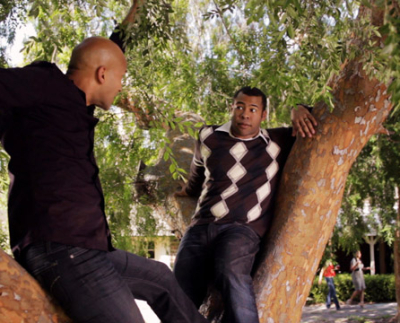
Like many classic comedy sketches, Obama’s Anger Translator germinated from a simple seed of an observation: Barack Obama practically never betrays a hint of heated anger, even though his job has given him plenty to get worked up over.  Jordan Peele’s virtuosic Obama impression and Keegan-Michael Key’s talent for portraying the unrepressed id were the perfect combination for illustrating this point.  One could argue that this was a partisan bit tailor-made for Obama supporters, but whenever your opinion of the President or the job he has done, it ought to be admitted that he has faced an intense amount of disagreement, enough that it would be understandable if he started nonsensically spouting out random Michael Jackson lyrics.

Best Episode of the Season: Key & Peele Season 1

Leave a comment

Season Analysis: Keegan-Michael Key and Jordan Peele, with their astute social and personal insights inspired by their biracial backgrounds, delivered the best new sketch comedy series since Chapelle’s Show.

“Episode 1”
Key & Peele’s first season included an impressive number of sketches that were instant classics or at least very amusing.  However, there was no episode among the first eight that was made up entirely of those sketches that fit those categories; on the other hand, there was also no episode in which it felt like Key and Peele had taken the week off.  Thus, we ended up with a collection of good-to-great episodes, in which none stood out much more than any other, except for the first episode, thanks to its novelty.  Their targets and routines were established quickly and decisively: the roles black/biracial people take on depending on the situation (two black men on their phones toughening up their demeanors as they walk by each other), gender politics (husbands going to great lengths to make sure their wives are out of earshot when they call them bitches), their friendship-based stand-up interstitials, the pop culture parodies for the hell of it (the parody reality cooking show Gideon’s Kitchen), and of course, their take on our first black – but actually, like them, half-black/half-white – president (Obama’s anger translator).  Key and Peele’s comedic voice is practically required listening for members of the American present day.

Best Episode of the Season: The Walking Dead Season 2

Leave a comment

Season Analysis: Was that farm that our survivors spent season 2 stuck on some sort of Möbius strip?

“Beside the Dying Fire”

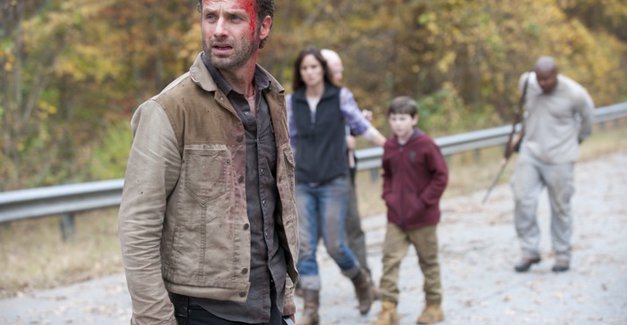
If it wasn’t clear from the series’ beginning, then Season 2 of The Walking Dead made it abundantly clear that a zombie TV show is a very different beast than a zombie movie.  To be able to maintain a reasonable degree of serialization, having a massive zombie attack with the same level of momentum week after week is simply not going to work. So, while The Walking Dead does not have frenetic, claustrophobic horror every single second, it does have decent acting (though spotty characterization) and philosophical explorations of the disintegration of society (though those questions often only scratch the surface).  But when a major zombie horde actually does overrun one of the survivors’ temporary strongholds, it tends to be entertaining.  Hershel’s farm had felt like a town that could not be exited after entering it, so it was a hugely necessary kick in the pants to have it destroyed.  The best moments of “Beside the Dying Fire” – Rick revealing that everyone is infected as well as losing his shit by declaring that this group is “not a democracy”, Andrea getting separated and being saved by the hooded figure with the katana – were satisfying mostly in that they promised new directions for Season 3.  But after a season that chased its own tail, I was happy to have exciting previews.

Portlandia: Season 2 Sketch of the Year

Leave a comment

“Sanitation Twins”


Marcus and Madeleine Harris – the Sanitation Twins! – are here to tell you, Portland, about all the new and exciting recycling bins!  Like many an attempt to ease and simplify, this effort becomes comically complicated, as seemingly everything and anything (broken umbrellas, lotion, fingernails, eggshells, etc.) can be recycled, a bewildering array of colors (periwinkle, fuchsia, rose, canary, chartreuse, cobalt) are required for each particular recycled group, and each individual element of a whole (coffee cup, sleeve, stir stick, and lid – and lids with lipstick are treated differently than lipstick-less lids) must be separated.  The humor of “Sanitation Twins” does not let up for a second, as it is not just about the bizarre complications that can arise from good intentions.  Fred and Carrie have created thoroughly well-thought out characters in Marcus and Madeleine, as demonstrated by their back-and-forth banter when they go off-script – lack of timing issues such as when they fail to say “We’re twins!” in unison, yeller vs. yellow, Marcus holding onto some old tapes that Madeleine is trying to force him to get rid of, and the discussion about whether or not the fingernails could be Einstein’s.  The ending punctuates another joke to the whole affair, sparking the question of, “Isn’t this all so pointless?”, as the recyclables can only become clean air, fresh water, or good vibes, while the other NINETY-SEVEN percent is dumped into the ocean.

Best Episode of the Season: Portlandia Season 2

Leave a comment

Season Analysis: Is hipster culture in Portland too narrow a scope for one show?  Well, that was exactly my fear when I first heard about Portlandia, and Season 2 did not alleviate that fear completely.  So, while Fred and Carrie may struggle to consistently put together great episodes, they still have plenty of great sketch ideas up their sleeves.

“Cat Nap”

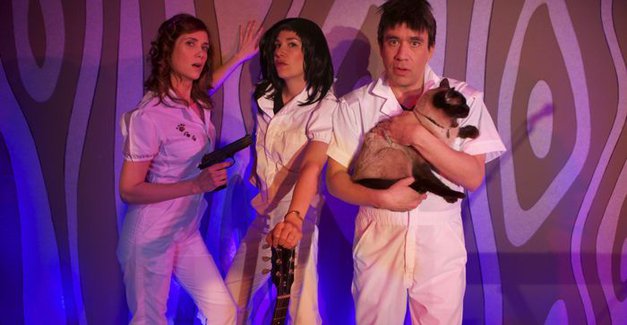
A male-female indie rock duo that dresses like Devo is struggling to break out when they discover success by incorporating their cat in their act and adopt the name “Catnap.”  JAYDE from the band “JAYDE speaks sevYn” uses Kickstarter to ask for donations for her next music video (which features, among other things, “the wise man who knows nothing”) while an ad for Catnap’s album pops up.  Guest star Miranda July stops by to play the co-owner of a boutique shop with only two shirts in its entire inventory.  That band with the cat is kidnapped by an obsessed fan (played by guest star Kristen Wiig) named Gathy.  That’s Gathy, not Cathy.  Gathy with a “G.”  Could there be a more Portlandia-esque episode of Portlandia?  Well, that last part is more of a goofy Kristen Wiig-ism, but otherwise, this episode was so hipsteriffic it hurt.

Best Episode of the Season: Napoleon Dynamite Season 1 (First and Only Season!)

Leave a comment

Season Analysis: Napoleon Dynamite the movie was already cartoonish enough, so the development of an animated series was a natural and pleasant enough transition for the citizens of Preston, Idaho.

“Ligertown”

There is plenty of potential for a momentous occasion when someone finally meets the object of one’s affection.  Ligers had pretty much been Napoleon Dynamite’s favorite animal, believing as he did that they were bred for their skills in magic.  Obviously when actually meeting ligers for the first time, he would discover that they were not in fact magical, but for the sake of good enough television, the ligers needed to be even more disappointing than just “not magical.”  Thus, Napoleon discovered them in an environment in which they were allowed to lie around all day and get their heads stuck in empty chicken buckets.  This episode of the short-lived Napoleon Dynamite TV series is a minor example in the canon of stories of children growing up and learning the sad truths of life, but it did have an enjoyable Napoleon Dynamite-esque oddness that made it a somewhat memorable half hour of television.

Best Episode of the Season: The Increasingly Poor Decisions of Todd Margaret Season 2 (Final Season)

Leave a comment

Season Analysis: More so than even its decidedly idiosyncratic first season, the second and final season of The Increasingly Poor Decisions of Todd Margaret was thoroughly unpredictable from scene to scene, which was generally maddening, but occasionally satisfying, and led to a conclusion that felt like it was planned all along but also felt like it came from out of nowhere.

“The Crime Scene, The Storyteller, and the Sanctimonious Tower of Morality”

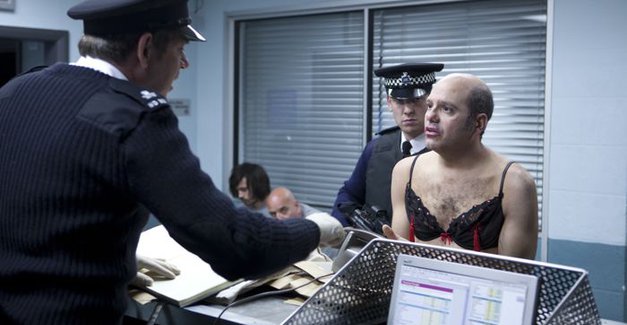
I got the sense about halfway through Todd Margaret’s first season that David Cross did not really know how long he wanted this passion project of his to last.  He had enough ideas to last a few, if not several, seasons, but it seemed to have a small-scale structure appropriate for a one-season miniseries.  Thus, season 2 did not feature any particularly great episode of television, and “The Crime Scene…” was not really an exception, but it is an episode worth highlighting, thanks especially to Graham Duff’s impressively committed performance as Todd’s peculiarly English pedophile cellmate.  Also, there was Spike Jonze getting all Sherlock Holmes-ian.

Best Episode of the Season: Beavis and Butt-Head Season 9

1 Comment

Season Analysis: As simple and as crude as it was originally, but somehow more sophisticated, Beavis and Butt-Head may just be the best example of a show returning after a long hiatus off the air following supposed cancellation.

“Tech Support”
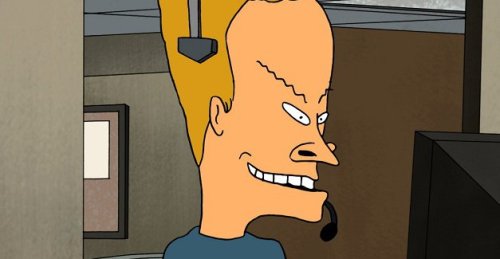
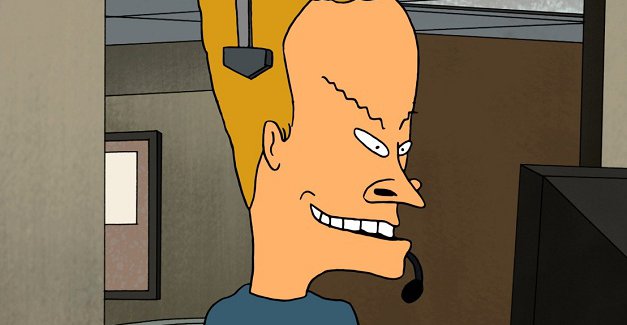
When B & B stumble into a tech support call center while looking for the abandoned drive-in and then discover some computers, they naturally have only one goal: porn.  But since they can’t find what they’re looking for right away, they fit in by acting like children, parroting the stock phrases of stereotypically Middle Eastern call center employee Hamid.  Depending on one’s point of view, their constant refrain of “I understand your frustration” is either plain unhelpful and even infuriating or evidence that they are doing a great job.  When their shenanigans ultimately lead to a power plant meltdown, it is a beautiful illustration of how they are savants at creating anarchy with little effort and zero focus.

Best Music Video Segment: “Cinema”
The video for Benny Benassi ft. Gary Go’s “Cinema” features a series of fantasies that could very well go along with self-pleasure.  Most people are not absolutely consumed with such subject matter, so when they do talk about it, it is often overly crude or overly euphemistic.  But since it is one of B & B’s favorite pastimes, they are veritable poets and cultural scholars when it comes to the topic of masturbation.

Best Reality Show Segment: 16 and Pregnant
What is particularly striking about the 16 and Pregnant clip in the episode “Daughter’s Hand” is not how much of a crisis teen pregnancy can be, but just how mundane and thoroughly unfulfilling the lives of these teen parents appear to be.  As Beavis interprets the mom, “She’s not a bad actor, just a bad person.”  Without its anarchic nature, Beavis and Butt-head would be just as depressing as this clip, and it is thoroughly fascinating that this seemingly hopeless picture of “reality” is what currently dominates MTV’s airwaves.
Best Episode of the Season: It’s Always Sunny in Philadelphia Season 7

Leave a comment

Season Analysis: This was the first season of Sunny that I watched, and I heard from some sources that it was not its best season, but I think that with a show as outrageous as this one, there are bound to be a few clunkers amidst the classics.

“Chardee MacDennis: The Game of Games”

It’s Always Sunny in Philadelphia feels like it is more or less made up on the spot, by insane people.  I could possibly be off a bit in this assessment, as I have only recently become a regular viewer, and there could be foundational elements from earlier seasons that would make it clear that there is in fact some planning involved in this show.  But that improvised feel does work to the benefit of an episode like “Chardee MacDennis.”  On a slow day, the gang has nothing going on, so they decide to play a game, a game that they have not played in a while, a game that they invented.  So what we have here is something that was more or less made up on the spot, by a group of insane people.  Just because Chardee MacDennis is more or less unbridled insanity in game form does not mean it is not satisfying; Charlie, Dee, Mac, and Dennis were not just insane when they created this game, they were also insanely focused.  Thanks to that focus, this episode provides memorable gags such as Frank having to eat a cake (i.e., the ingredients of a cake), Mac drunkenly attempting to lift up a board that has been nailed down despite acknowledging ahead of time how fruitless such an effort would be, and Charlie failing to answer a question that he himself had written (“Dennis is asshole.  Why Charlie hate?”), and there is even a satisfying resolution to wrap up all the chaos, which, appropriately enough, was thought up by Frank while he was imprisoned in a dog crate.

Best Episode of the Season: Futurama Season 6-B

Leave a comment

Season Analysis: The second half of season 6 did not feature any outstanding efforts to stand among the series greats, but it was easily consistently strong enough to justify its continued existence.

“Neutopia”

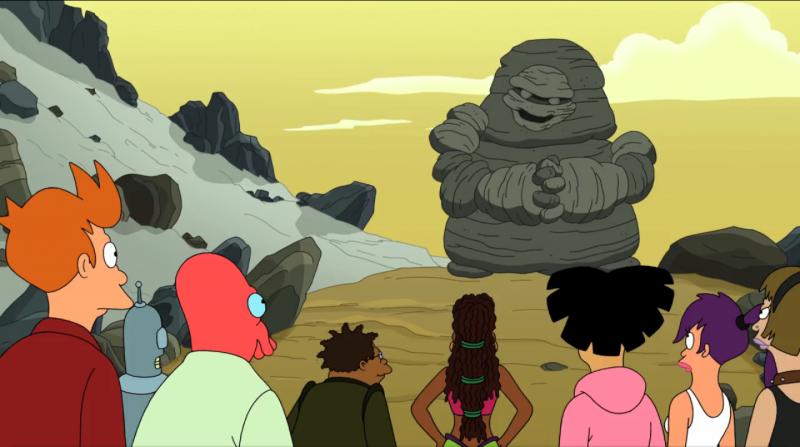
“Neutopia” takes on one of Futurama’s favorite themes: gender relations, perhaps its most favorite non-future-specific theme.  Regarding human affairs, gender relations are a timeless matter, and this episode takes the fitting approach of dealing with the show’s male-female conflicts as poorly as they have always been dealt with.  The male characters are frequently sexist, blatantly and casually so, as if their sexist attitudes simply represent the way things are (“Ladies, here are your demeaning, skimpy stewardess outfits”).  But there is hope, in the form of a bored rock creature alien, who removes the elements of gender from the Planet Express crew with the goal of teaching them … well, it’s not quite sure what it means to teach them.  His attitude is most clearly expressed in lines such as, “So far I have learned nothing.  But that’s probably as much my fault as it is yours,” and, “Perhaps it is I who have learned a lesson.  Or something.”  “Neutopia” does not have much to say about gender relations in general, and it basically does nothing to affect the underlying gender issues on Futurama, nor does it care to.  But it is a funny episode, in that its blasé attitude regarding its ostensible concerns is its own statement: a society that is unwilling – or profoundly unable – to examine its own prejudices is a big joke.

Older Entries Newer Entries