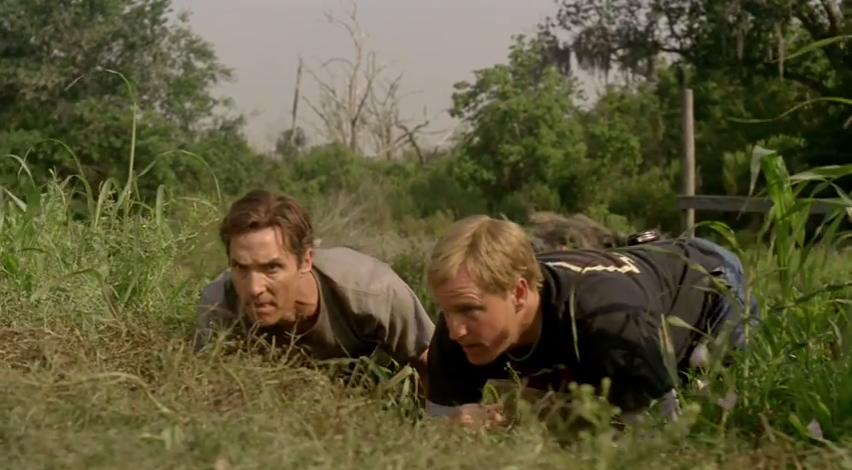
Season Analysis: A mystery that focused on its characters but wisely chose to also allow its mystery to be solved, True Detective succeeded on the strength of its acting, directing, and detours into mysticism.
“The Secret Fate of All Life”
A time jump is a nifty trick employed by television shows that more often than not works to re-energize series that have lost a bit of their edge. This trope has avoided falling into cliché because it still immediately subverts a show’s established expectations. The time jump in “The Secret Fate of All Life” works especially well by taking the subversion even further. A time jump is unexpected with just about any show, but even more so of an anthology series with a narrative contained in one season. Add to that the fact that True Detective was already jumping back and forth between 1995 and 2012; it had not to this point offered any indication that it would be visiting a third period in between those two. Then there was the surprise of Rust Cohle walking out of his interview with Papania and Gilbough. It was almost fourth-wall breaking; the 2012 interviews had seemed to merely be framing devices, but now they were headed in the direction of continuing the narrative. “The Secret Fate of All Life” even subverted the narrative rules TD had set for itself, with the one-two-three punch of Marty and Rust’s covered-up killing of Reggie and DeWall Ledoux in 1995, the introduction of the Yellow King in 2002, and the implication of Rust as a suspect in 2012 leading the show to focus on plot in defiance of the character study established in the season’s first half. It was still a devastating study of tragic personalities, but this was the point when it became clear that it was not satisfied with keeping matters so simple.
Season Analysis: As Axe Cop’s title shot prominently declares, it was co-created by a 5-year-old. Its first season certainly felt like it was, and – thanks hugely to Nick Offerman as the titular hero – it was an ideal realization of a show co-created a 5-year-old.
“The Rabbit Who Broke All the Rules”
An area in which Axe Cop the TV series largely excels is its well-considered mythology, which serves to establish layer upon layer of Axe Cop’s motivations. When Axe Cop becomes a foster father to a strange orphan boy, it is revealed that the boy is possessed by the ghost of the first creature that Axe Cop ever killed: the unconventional titular rabbit. Axe Cop’s opposition to this hind-leg standing, coconut-eating hare is a little fascistic, almost uncomfortably so. But it works as well as it does because it is such a strong character choice. Axe Cop’s black-and-white ethical code may be too simplistic and too intensely applied, but he is committed to it so firmly, and that makes him interesting as a fictional personality. As all-powerful as he may seem, and despite how unassailable his results tend to be, the appropriateness of his methods or lack thereof are worth considering, even though he obviously exists in a fantasy world. Sometimes, dispensing with subtlety proves to be fruitful.
Season Analysis: Season 3 of Billy on the Street leaned a little too heavily on the excessively staged stunts for my taste, but the vast majority of it is still pop culture maestro Billy Eichner interacting with New Yorkers, and thus it is still excellent.
Season 3 Superlatives:
Best Contestant: Elena
The first non-celebrity to return, Season 2 Quizzed in the Face contender Elena is the epitome of the type of New Yorker that Billy on the Street celebrates. She played a round of “Cash Cow” against Lena Dunham (during which she misunderstood Billy’s pronunciation of “Weird Al” Yankovic) and stopped by later for a special round of “For a Dollar,” which featured this classic exchange between her and Billy:
“Annie? They’re making a new movie of it?”
“Yeah, Quvenzhané Wallis, the little girl from Beasts of the Southern Wild, is playing her.”
“Oh, I love her.”
“Yes.”
“She’s not playing Annie!”
“Yes, she is.”
“Oh, Annie! I was thinking of that, what was that Woody Allen movie…”
“Annie Hall?!”
“Yes!”
(runs away) “Elena, never, ever speak to me again!”
Most Prepared Celebrity Contestant: Lena Dunham, who cruised through a round of “Steve Harvey or Harvey Milk”
Most Challenging Celebrity Game: “John Mayer or Pepé Le Pew,” in which Olivia Wilde struggled to identify whether such quotes as “Everyone should have a hobby, don’t you think? Mine is making love” and “I really don’t want to be a hunk” were uttered by the bad boy of pop-rock or a cartoon skunk.
Best New Contestant: David, an aspiring novelist and screenwriter decked out in L.A. Kings gear who won Quizzed in the Face by correctly identifying that Charles Manson would be a fan of Family Guy. When Billy expressed bewilderment about Kristen Chenoweth having sex with Aaron Sorkin, David noted, “She’s a trouper for that.”
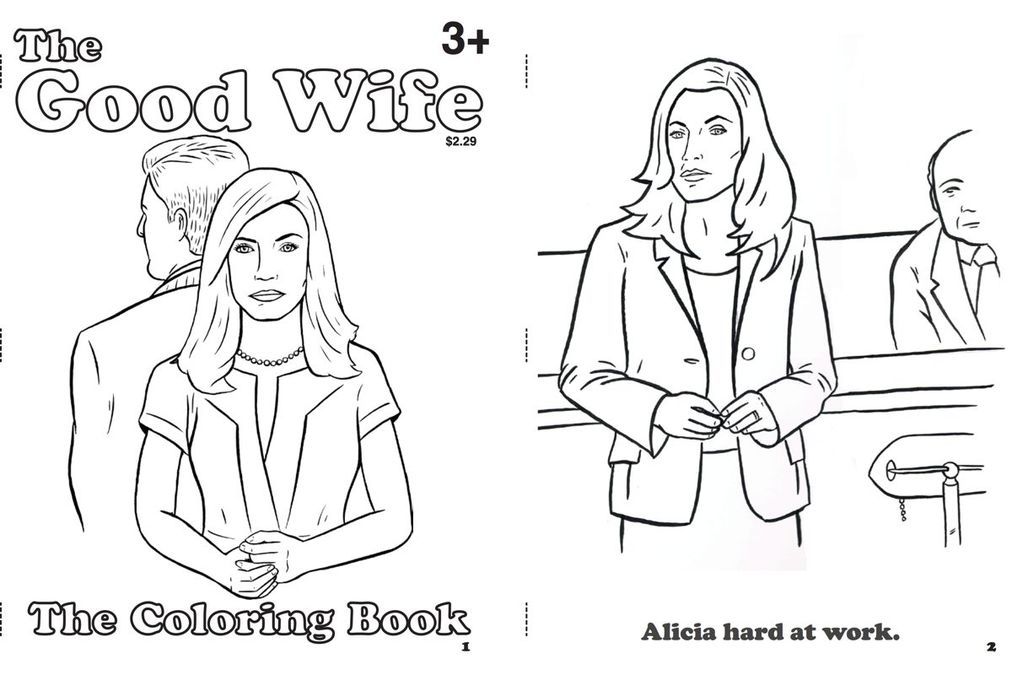
Best Prize: The Good Wife coloring book (I gave one to my mom for Mother’s Day!)
And some more quotables:
From a round of “Humpty Dumpty or Mary J. Blige”
“Sold more than 50 million albums worldwide.” “Humpty Dumpty.”
“Fell off a wall, unfortunately.” “Mary J. Blige.”
“Could not be reassembled, unfortunately.” “Mary J. Blige.”
“Sir, for a dollar, name a movie.” “Uh, RadioShack.”
“Do you think Miley Cyrus is on point?”
“Ummm, I don’t really like her.”
“Why?!”
“I don’t really know, there’s just something about her. I miss Hannah Montana.”
“Oh, come on!”
“I do! I do!”
“She can’t be that forever.”
“I know.”
“She’s a grown-up.”
“She could’ve done what she did so much better, though-”
“Really?!”
“-like she could have done it so much better.”
“What are you talking about? Everybody’s talking about her. How much better can you do that?”
“I don’t know. I just, I don’t know.”
“Okay. What do these bozos think? Do you like her?”
“I do like her. I feel bad for her, though, because-”
“Why?!”
“I feel like she’s going through such a hard time.”
“What do you mean?! She’s so popular! She’s completely in control, the whole thing.”
“She doesn’t have Liam anymore, and like-”
“She doesn’t need him, please. It’s the best thing that ever happened to her.”
“Okay, well, if she’s happy, then that’s all that matters.”
“She’s obviously very happy.”
“Okay.”
“It’s like, this is the most successful she’s ever been. She’s smart, she seems edgy, the music is good. What do you think, idiot?”
“I- I love her.”
“I agree.”
“I think she’s doing a great job at introducing a new style to music.”
“I absolutely agree.”
“Yeah.”
“You look a little like a duck, but I love it.”
“Thanks.”
“Okay, bye.”
“Sir, for a dollar, any thoughts on Kaley Cuoco’s yearly Emmy snub?”
“On whose what?”
“Kaley Cuoco’s yearly Emmy snub.”
“How can I have an opinion? I never heard of it.”
“Kaley Cuoco, she’s on, what, The Big Bang Theory?”
“I don’t have a TV set.”
“You’ve never seen The Big Bang Theory?”
(clears throat)
“BLEGHHH!”
“I wonder what you’ve missed.”
“What?”
“I wonder what you’ve missed.”
“What do you mean, ‘what I’ve missed’? I’ve missed nothing.”
“Muh muh muh muh.”
“Mi mi mi mi.”
“What do you mean, nothing?”
“I’ve missed nothing!”
“Who wrote A World Lit Only By Fire?”
“Huh?”
“Who wrote A World Lit Only By Fire?”
“2 Chainz! Boom!”
“This is- someone’s gonna watch that?”
“Who let the dogs out! Who, who!”
“Goodbye, game over. Thanks very much. Go back to Florida. I mean, I can’t.”
“Miss, I know you’re getting out of a car, but it’s the 10th anniversary of The Passion of the Christ.”
“Miss… Vince Vaughn… What happened?”
“Sir, for a dollar, are you a Key or a Peele?”
“Sir, Meg Ryan said she would consider a return to television.” “I don’t care.”
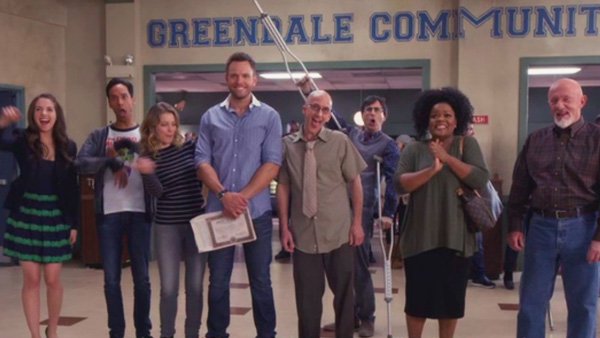
Season Analysis: Community had a lot to accomplish in Season 5: get its narrative back on track after the unfocused Season 4, deliver fitting farewells to Troy Barnes and Pierce Hawthorne, re-orient the rhythm of its ensemble with those departures and the addition of new regulars, once again craft a potential series finale or set out a map for a future beyond Season 5, and on top of all that, continue the storylines of the characters who remained. This was a tall order for 13 episodes to fill, and it did an admirable job of nearly pulling all of it off. Perhaps 3 more episodes would have allowed Shirley an adequate storyline and resulted in a better balance of high-concept and grounded episodes. Season 5’s theme ultimately appeared to be the difficulty of moving on at a time in life when moving on should be natural. This message was not delivered quite as strongly as it could have been, but it was done strongly enough that Community resumed its rightful place as one of the most entertaining and most important shows on television.
“Basic Sandwich”
After my initial viewing of “Basic Sandwich,” I declared that it did a great job of hedging its bets between being a de facto series finale or just another season finale. It put a cap on saving Greendale, while leaving open plenty of storyline avenues that could easily fill out at least another whole year. But I made that statement with a fair degree of confidence in renewal. So once NBC threw down the cancellation decision, I realized just how unsatisfying “Basic Sandwich” really would have been as the absolute end. But then Yahoo! came through in the last minute, and suddenly this was an even more perfect episode. This is the show that refuses to die, the cult favorite that actually will get to end on its own terms despite all the forces that have tried to prevent that from happening, and that defiance was completely woven into the fabric of this episode. Even before the cancellation/renewal whirlwind, the crisis in “Basic Sandwich” of whether or not the study group should move on mirrored the situation that Community fans found themselves in. Annie’s fears of losing Jeff romantically led her to question the value of saving Greendale, as she realized it wasn’t quite the same place it had always been, now that it was missing certain great people and their attendant charms. But Abed proved once again that his meta, deconstructionist nature, and by extension, the meta nature of Community, has never been detached, but always a loving embrace to the people important to Abed and to the fans of the show. Yes, Greendale had changed, and yes, Community will probably continue to change. But that does not mean, as Jeff and Britta almost scared themselves into thinking, that the best option is running away from it all at the end of an era. All good things must come to an end, but they should not be abandoned. Understanding that difference is a major part of what Community is exploring in its latter years, and “Basic Sandwich” presented an episode-length dramatization of that conundrum. And it also managed to make Dave Matthews Band cool.
Runner-up: “Geothermal Escapism”
A game of “the floor is lava” as a send-off for Troy could have been a disappointing paintball knockoff, and at first it did seem to be following the beats of those classics (though with enough dystopian style of its own to make it worthwhile). But it took a third act turn that stunned with a side of Community we had not quite seen before. Abed wanted to let Troy go, but he literally could not help but seeing that as a disaster – the floor actually was lava to him. We had seen Abed’s mental breakdowns before, but never one that he had acknowledged and confronted so head-on. This crisis of wanting to let go but not quite knowing how made Troy’s departure that much more heartbreaking but also that much more satisfying.
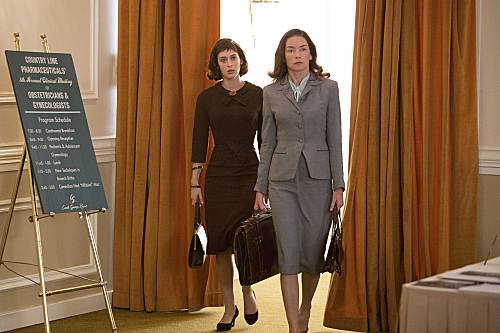
Season Analysis: Masters of Sex proved to be quite sexy in its first season, despite taking the most clinical approach to orgasms and the like. The thing is, when you are interested and as passionate about the boudoir as Dr. William Masters is, there is no way to not be sexy. Also adding to the sex appeal were some sensational actors bringing fascinating historical characters to life.
“Phallic Victories”
Julianne Nicholson was the secret weapon of Masters of Sex Season 1. The show could have very easily worked as only scenes of Michael Sheen and Lizzy Caplan sparring and making verbal and physical love, but it needed a solid supporting cast to take it to the next level. And Nicholson’s character, Dr. Lillian DePaul, could have easily just been an antagonist, serving as a roadblock to Bill Masters’ research because she couldn’t see the big picture. She would have been a sympathetic antagonist, as she had a legitimate beef over not being taken as seriously as her male colleagues. But “Phallic Victories” kicked things into high gear by having Caplan’s Virginia Johnson declare, to hell with double standards! Lillian, woman or no, favoritism or no, needed to present her research with the same zeal and attention-grabbing as Bill Masters. This revelation led only to a small victory initially, but it was satisfactory, thus setting up the perfect narrative occasion to fully humanize Lillian, as she revealed that the cervical cancer she had previously fought off had now returned beyond the point of treatment. This critical moment put a huge personal face on the stakes of the subject matter that Masters of Sex insists be taken seriously by everyone.
Season Analysis: Stephen Merchant’s semi-autobiographical take on the single life in L.A. struggled with its tone in its first and only season, but it was quite lovely when it embraced its heart, and whenever Kyle Mooney was on screen.
“The Drive”
I tend to be wary about unresolved sexual tension that is present right at the start of a new show. It is not that I don’t like romance on my sitcoms, nor that I don’t think it should be drawn out. I like both of those things – when done well. But when there is a mildly combative platonic relationship in a pilot episode, it just screams, “These two are going to end up together, and that is that!” Inevitability – entertaining inevitability – cannot be forced. Luckily, Stephen Merchant and Christine Woods (as Stuart and his roommate/tenant Jessica) had plenty of chemistry right from the start, with a mildly teasing repartee serving as a feature of a real friendship. The problem with Hello Ladies was that Stuart’s shallow ladykilling attempts always felt like an act forced in to ramp up the cringeworthiness. There was clearly a sweet guy underneath all that bluster, and “The Drive” finally allowed that sweetness to shine through. Instead of pursuing a model who was legitimately into him, Stuart chose instead to comfort Jessica after she was devastated by the news that her role on NCIS was being recast, because he simply knew how important it was to be a good friend at that moment. The pathos shined through as Merchant let Hello Ladies settle down and allowed Stuart to just be who he really was.
Season Analysis: I didn’t watch Season 1 of The Eric André Show, mostly because I wasn’t aware it existed. From what I know of it, Season 2 was more accessible, though not by much. After watching one episode, I wasn’t quite sure how to process it, but soon enough, its insane blend of nihilist television felt just like home.
“Scott Porter; Brutus “The Barber” Beefcake”
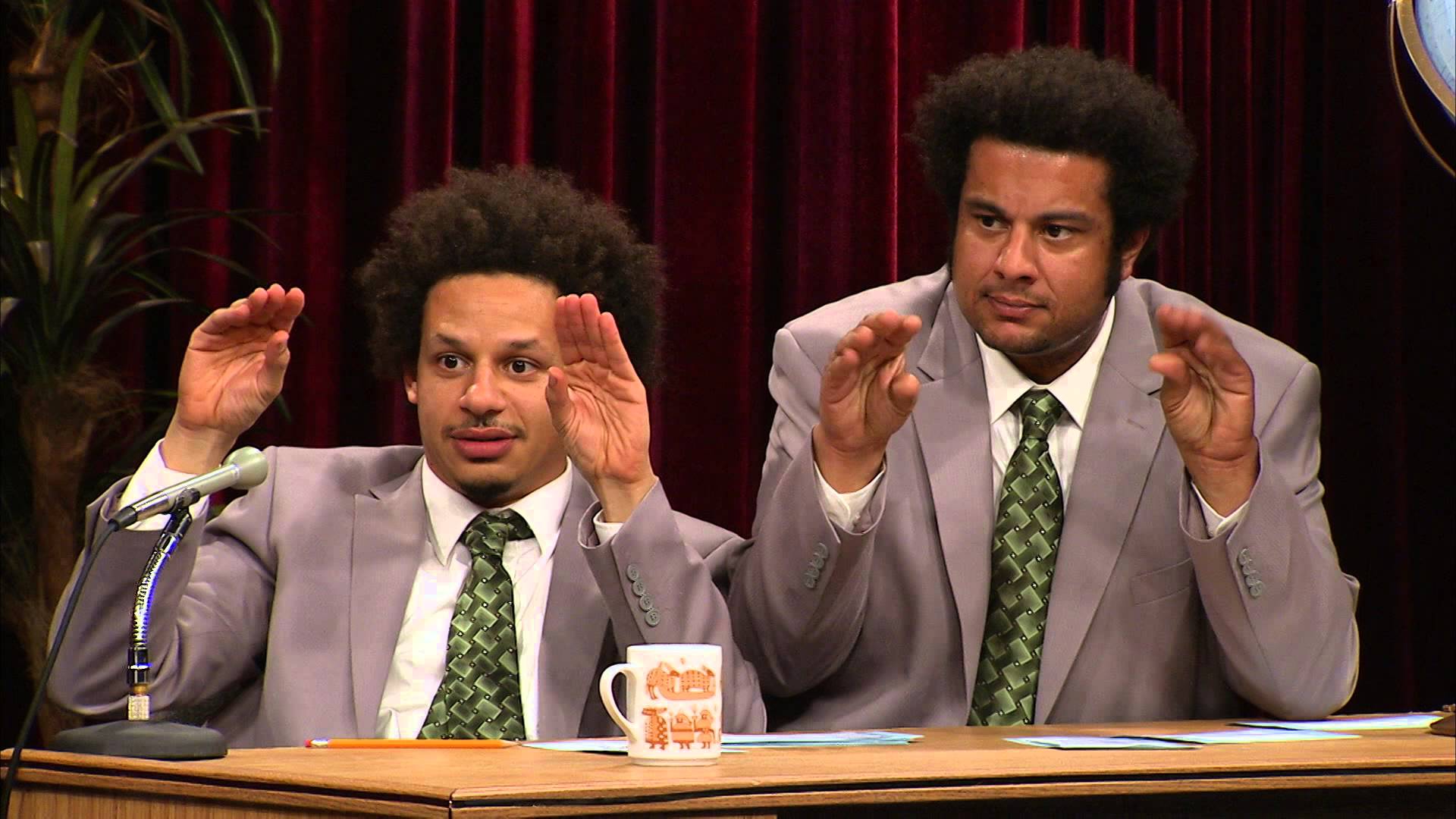
Every episode of The Eric André Show begins with André screaming like a lunatic as he destroys his own set. While this orgy of chaos lasts longer than rationality would dictate, he does eventually settle down and sit at his replacement desk. But in the Season 2 finale, the destruction lasts the entire episode, allowing the show to ramp its incomprehensibility up to 11. While André remains “busy” with his anarchy, an earlier episode from the season is fast-forwarded and overlaid on top of the video of the current episode. Ultimately, what is achieved is nothing less than the fullest realization of Eric André’s pure comedic unpredictability in the barest of structures.
Segment of the Season: “Ranch It Up”
Eric André, dressed in a green tank top, plaid shorts, and a backwards pink hat, confronts random people with a series of made-up, college campus-based slang terms, such as “Oriental background actresses,” “Cherokee chicks on the Trail of Beers,” “’Sup Mello,” and “buzz me, mulatto,” delivering it with the conviction of the fearless lunatic that he is.
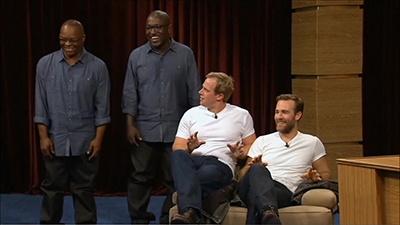
Interview of the Year: James Van Der Beek
Joining Eric, Hannibal, and Eric’s former Bitch 23 co-star are lookalikes brought on to mirror their every move.
Season Analysis: Dino Stamatopoulos’ animated high school sitcom satire by way of Archie was the perfect atonal mix of taboo issues tackled with a straight face.
“Adoption”
Maybe the major reason High School USA! never really captured a sizable audience (besides the fact that it aired in the 11 o’clock hour on Saturday night and was often preempted by sports) was its cognitive dissonance. When Mandy Moore-voiced Cassandra, who is clearly Asian, is shocked to discover that her white and quite old parents adopted her, it is obviously nonsensical, which can work in mainstream comedy, but nonsense tends to confuse when a nonsensical reaction is accepted as a perfectly understandable reaction. So when the rest of the gang are only mildly surprised that their friend doesn’t realize she looks quite different than her parents, it is a strange viewing experience. A world that operates by insane logic isn’t for everybody, but for those who like it, High School USA! hit its insane sweet spot with “Adoption.” A trip to China to find Cassandra’s birth parents results in the gang essentially being treated as visiting dignitaries. That is because in the type of clean-cut shows that HSUSA! takes aim at, the main characters are super-famous and conveniently talented whenever the plot calls for it. To that end, Cassandra and the rest of the gang are, of course, the members of a band. And just for good measure, even though they clearly are wielding instruments like a guitar and a tambourine, the music they play is inexplicably dubstep.
Season Analysis: The League is no longer just about fantasy football (not that it ever really was), and Season 5 was at its best when it most purposefully broke away from its normal routine.
“Rafi and Dirty Randy”
“Rafi and Dirty Randy” has the structure of a backdoor pilot, insofar as it focuses on a couple of ancillary characters removed from the show’s regular action. It begins with a connection to the main characters, with Rafi stealing Kevin’s car for his and Dirty Randy’s trip of vengeance to L.A. But this is a nightmare version of a backdoor pilot. While this episode certainly piqued my interest enough to get me to check out a theoretical Rafi & Dirty Randy series, I do not think that was ever the intention. Maybe this was an actual backdoor pilot in an alternate universe in which psychopathic logic such as “take care of it” meaning “set it on fire” is the normal logic of FXX characters. Although, come to think of it, the characters on The League, and of course It’s Always Sunny in Philadelphia as well, have various degrees of psychopathy. So, come on FXX, let’s get on a spinoff of The League’s two best side characters! Jason Mantzoukas is ready to be a star!
Season Analysis: When you get used to the insanity of Always Sunny, it becomes increasingly difficult to note what is unique about any particular season’s stretch of insanity. And I’m saying this as someone who hasn’t watched all nine seasons, but only the last three.
“Flowers for Charlie”
The lack of hard science in the novel Flowers for Algernon makes it ripe for being picked apart. That story of a man with a low IQ becoming super-intelligent, only to revert to his original state, does not need a detailed explanation, because that is not really the point, but a version of that story that focuses a great deal on the science would be problematic if it did not have an adequate explanation. In It’s Always Sunny in Philadelphia’s version, the scientist (Burn Gorman, who was one half of the best part of Pacific Rim – the other half, of course, being Charlie Day) and his assistant running the experiment to increase Charlie’s intelligence are given plenty to do, so it is only natural that their methods should be explained. And it is perfectly Sunny to have that explanation be a ruse in which Charlie was merely led to believe that his intelligence was increased. His fake Chinese and chess skills were wonderful displays of how confidence and thoroughly realized bullshit can be just as enthralling as actual talent.






 Jmunney's Blog