Best Episode of the Season: Don’t Trust the B—- in Apartment 23 Season 1

Leave a comment

Season Analysis: After a seven-episode first season, Apartment 23 hasn’t met its full potential yet (or at least, I hope it hasn’t met its full potential yet), but it has enough promising elements that it could very quickly become one of the best comedies on the air at some point in its second season just like another ABC sitcom that used to air Wednesdays at 9:30.

“The Wedding…”

Who ever thought that June was boring?  She is uptight, sure (though not uptight as all get out), but uptight hardly means boring.  Uptightness may make someone allergic to fun, but the uptight person could very well be fascinating as far as her uptightness is concerned.  So when June’s former fiancée called her boring, and Chloe’s response to that accusation was, “That’s, like, the worst thing you can say to anyone,” my reaction was, “Yes, it is, especially if you’re a character on a TV show.  So good thing June’s not boring.”  While June set out to show everyone at the wedding that she is an interesting person, Don’t Trust the B—- in Apartment 23 set out to show that it is a program that is putting all of its pieces in order.  Chloe has been rubbing off on June, and June has been influencing Chloe, though not necessarily definitively, but enough so that she cares enough to help June out with the whole charade to prove that she is not boring.  The fact that James van der Beek exists in these characters’ world has become something that is just accepted, which is surely necessary but sort of bittersweet (as June says wistfully, “I used to have a poster of you”).  And Eli is no longer just the creep who masturbates across the hall, with his gig in the wedding band making him more recognizable as an actual person than any other episode thus far.

Best Episode of the Season: Modern Family Season 3

Leave a comment

Season Analysis: During its first season, Modern Family was good – really good, easily one of the best comedies of the season.  In its third season, it wasn’t really bad, but it wasn’t exactly good either.  And the thing is, it still seems like the same show that it always was, which has led me to wonder if Season 1 really was as good as I remember it, or if I just imagined it.

“Treehouse”

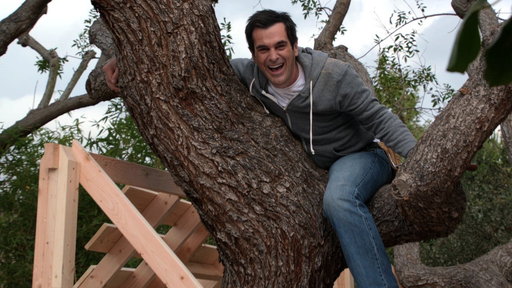
Season 3 of Modern Family did not feature any overall brilliant episodes, but there were some episodes that had their moments.  The B- (or C-) storyline of “Treehouse,” with Cam attempting to prove that he could successfully fake being straight and pick up a woman in a bar, was pleasant enough, especially since it is always nice to see Leslie Mann.  She infused a great deal of personality into what was an otherwise nothing role.  But the best moment of this episode – and of the whole season – came at the very end of the titular A-plot.  I think that most viewers were as disappointed as Phil was that Luke eventually gave up on the father-son treehouse building, but all was forgiven in the sweetest, most unexpected epilogue of perhaps the whole series.  Phil’s interaction with Andre touched on the question of “How well do we really know our neighbors?” (Phil and Andre have lived next door to each other for nearly a decade and this is this their first conversation) as well as the struggles for male adults at making friends (Andre’s declaration of “Honey, the guy in the tree’s cool” represented a delightful overcoming of this struggle), and it also introduced plenty of people to the criminally underused Kevin Hart.

Best Episode of the Season: The Middle Season 3

Leave a comment

Season Analysis: This was the first season that I watched The Middle.  I have heard from other critics who have been watching since the beginning that this was the best season yet.  I won’t argue with that assessment.

“The Play”

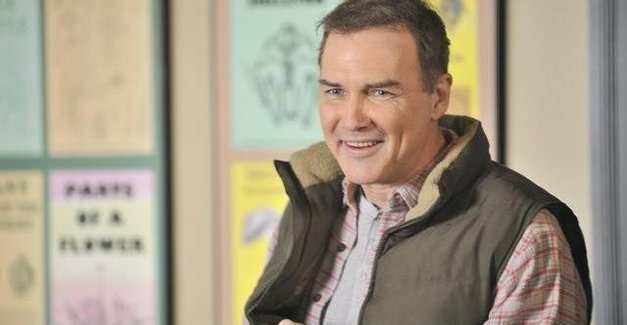
It seems that I have not given myself the opportunity to write articles here relating to Norm MacDonald very often, so let me just make it clear that Norm is by far one of my favorite comedians, so any episode of The Middle with Uncle Rusty is practically guaranteed to be a fine episode in my book.  Norm’s observational, satiric style is different than the normal comedic style of the Heck family’s misadventures, but his persona of being easygoing while also keeping himself at a slight remove actually fits his role of the flaky uncle and the show as a whole quite well.  His memorable quotes from “The Play” are plentiful enough to fill up an entire one of these posts, but let me just point out the one (“Coffee’s bad. Cigarettes are bad, too. I’m gonna go have both, but let me be a cautionary tale for you”) that best exemplifies how it seems like he is on a completely different plane of existence than the rest of the Hecks while actually fitting into their world quite seamlessly (which I guess is pretty much how it goes with absentee family members).  Now, as much as I love Norm and as big as a reason as he was for this episode being the best of the season, I do not want to imply that the usual stable of actors on The Middle are not able to hold their own, because they are, and in fact, they were all quite sharp in this episode.  Neil Flynn particularly raises his game whenever he has to confront Rusty and actually display some emotion.  And in the storyline that this episode gets its title from, Patricia Heaton and Eden Sher bring out the best in each other, as Frankie gets a major role in a community theatre production of The Wizard of Oz, while Sue gets cut from the show due to her crazy eyes.  Frankie is forced to hide the fact that she is still in the show, since this was something that she and Sue were supposed to be doing together.  It was nice to see Frankie actually let loose a bit, and just as amusing to see Sue go a bit dark (in a way that was not very threatening but was completely devastating) upon discovering her mother’s deception.

Best Episode of the Season: Glee Season 3

Leave a comment

Season Analysis: In Season 3, Glee became the worst possible version of itself that its biggest critics think it always has been.  (But the last few episodes were pretty good, so maybe not all hope is lost.)

“Props”

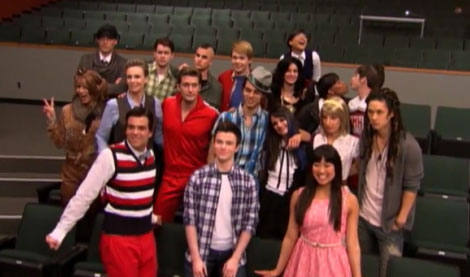
When the “Here’s what you missed on Glee” portion of “Props” focused on consistently neglected Tina, it was clear that Glee was finally responding to its critics, and then some.  Personally, I was so busy criticizing the show’s treatment of the characters that actually were still getting screen time that I did not even realize how underutilized Tina had been – basically, I had barely noticed her at all.  Glee took a bit of a risk by essentially admitting, “We’re even worse than you thought,” but it was the right call creatively.  As soon as Tina hit her head and entered into the body-swap fantasy world, it was clear that the show had turned a corner.  Finally, Glee was willing to try out an unusual idea – the strategy that had made it interesting in the first place.  This sequence allowed the show to address the annoying aspects of its characters in a way that did not break the fourth wall too much for a show like Glee, and everyone in the cast seemed to be having the most fun they’d had in a while.  Jane Lynch and Matthew Morrison particularly seemed to be enjoying themselves, with Morrison more amusing as Sue Sylvester than he’s ever been as Will Schuester.  It was enough to save a show that I was thisclose to giving up on.

Best Episode of the Season: Family Guy Season 10

Leave a comment

Season Analysis: In some corners of the Internet, latter-day Family Guy really gets knocked around.  But I remain an apologist of the present version of the show, although, for the most part, Season 10 did not offer the best representation of what the show still has to offer.

“Back to the Pilot”

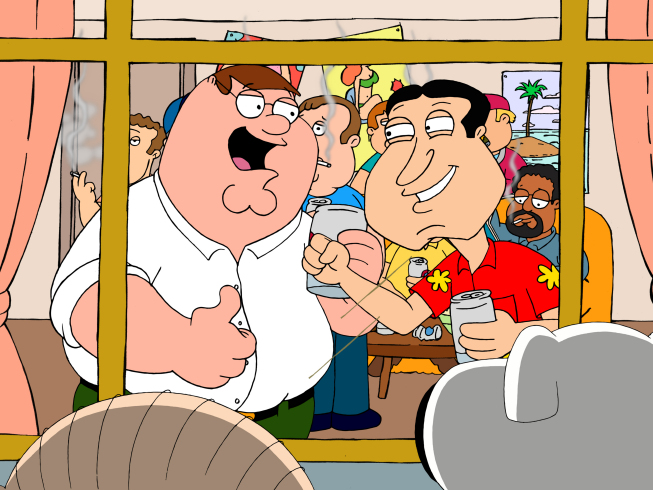
A lot of TV shows look very different when compared to their pilot episodes, animated shows more so than most.  But not too many shows have utilized a time-travel plot to have their characters travel back to the time of the pilot.  Some shows have revisited their pilots from new angles, but none (that I am aware) have used the strategy employed by Family Guy in which the characters notice and comment on the cruder animation, continuity gaps, and other gaffes.  FG’s main hook is its trove of cultural references, and in later years, those references have become self-referential, and those fourth-wall breaking gags, while occasionally funny, have usually been a little too knowing and a little too winking.  But by actually placing its characters in a situation in which it would be logical (relatively speaking) for them to make such references, FG demonstrated exactly the sort of self-awareness that a show should have ten seasons into its run.  Also, the sequence of the dozens of Brian’s and Stewie’s attempting to stop their previous selves from doing whatever it was they were about to do was just a really awesome set piece.

Best Cutaway Gag of the Season: “The end of a depressing 1970’s sci-fi movie starring a guy in a turtleneck” (from “Stewie Goes for a Drive”)

Taking its visual cues mainly from Logan’s Run, this dystopian vision was an original creepy and thought-provoking vision all on its own.

Best Episode of the Season: Bob’s Burgers Season 2

Leave a comment

Season Analysis: Nine episodes were not enough for Bob’s Burgers to have developed much beyond its idiosyncratic beginning, but it’s not like that’s a bad thing.  The bad thing is just that there weren’t more episodes!

“Bad Tina”

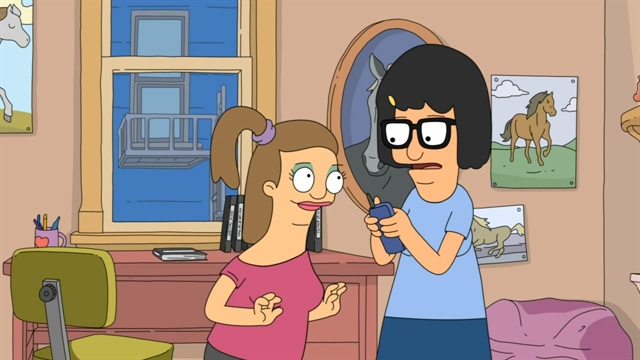
After two short seasons of Bob’s Burgers, Tina Belcher has already become one of the best characters on the FOX network, and her devoted, prolific interest in erotic fan fiction and erotic friend fiction is a significant part of what makes her such an interesting character.  But as great a character as she is, it was a good idea to introduce a foil for her in the form of new girl Tammy (voiced by Jenny Slate) for the sake of mixing up Tina’s world.  Tammy made Tina even more anxious than usual, but also loosened her up a bit, leading her to expand her vocabulary with such phrases as “boob punch,” “crap attack,” and “snoregasm” and also indirectly leading her to read aloud her erotic friend fiction to the whole school, leading to mass butt touching and one of the best – and certainly most unique – parodies of Apple’s “1984” ad ever.  The B-plot of the Stomp knockoff Cake (based on “Patty Cake”) was funny and appropriately small-scale, because there are not too many laughs to wring out of such a concept other than the fact that such a show exists and that Bob, oddly, becomes obsessed with it.

Best Episode of the Season: The Simpsons Season 23

1 Comment

Season Analysis: It’s a post-post-post-Simpsons world, and the show’s best moments sneak in when nobody is paying attention.

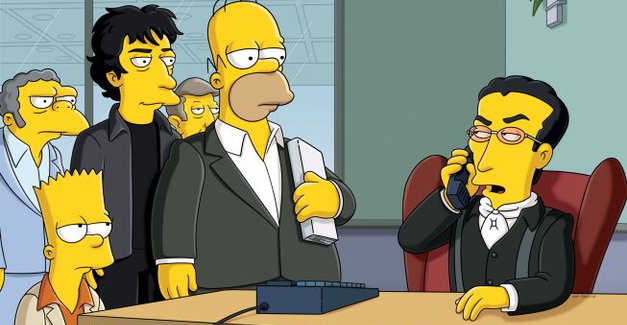
“The Book Job”

Parodies of heist movies (as well as heist movies themselves) have been done plenty of times, satires of the publishing industry – not so much.  That’s probably because satirizing the book world doesn’t sound like that much fun, whereas heists are all about fun.  But, fun or no, there is plenty worth targeting in the literary realm, so the idea of combining a publishing industry satire with a heist parody was an ingenious move by The Simpsons writing team.  The relentlessness of the double crosses in the last act as well as the flashback reveals that the heist had actually worked when it seemed otherwise is the sort of thing that would ruin most heist movies or heist parodies, but it worked because all these elements also served as a satirical knife cutting into the teen fantasy literary genre: the book executives want to replace the trolls in the story with more easily marketable vampires, Lisa just wants her name on a best-seller, ghost written or not, and Neil Gaiman ultimately heists his way to the best-seller list “once again.”  Also, the book titles revealed in the establishing shot at Bookaccino’s were a boon to freeze-frame inclined TV viewers (highlights included Percy Sledge and the Olympians, Are you there Glycon? It’s Me Alan Moore, Chat Roulette with the Vampire, The Girl with the ‘How to Train Your Dragon’ Tattoo, Cocktail Party Make-You-Thinks by Malcolm Gladwell, and of course, Death to Freezeframers).

Best Episode of the Season: The Cleveland Show Season 3

Leave a comment

Season Analysis: Has there ever been a show more satisfied with being slightly better than mediocre than The Cleveland Show?

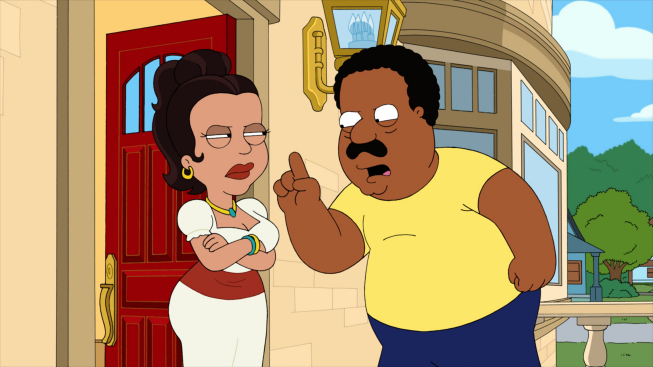
“There Goes El Neighborhood”

There weren’t really any episodes of The Cleveland Show this season that would really qualify as particularly great examples of the television medium.  Thus, my criterion for picking “El Neighborhood” as this year’s best was more or less that I remembered laughing at it more than any other episode this year.  It did show some ambition, in that it continued the storyline from the previous episode (Cleveland, Jr. marrying a Latina girl to get her a green card) on a show that otherwise lacks serialization.  But if forced to pinpoint what really made this episode work, I would have to say, “I doñ’t know,” i.e., when Cleveland is confronted by his new Latina neighbor Choni (voiced by the intensely Latina Rosie Perez) regarding his insensitivity to Latino culture, he starts pronouncing all his n’s as if they had tildes over them, and overcorrection regarding pronunciation is always funny.

Best Episode of the Season: Saturday Night Live Season 37

Leave a comment

Season Analysis: My full SNL Season 37 recap is coming soon.

“716 – Zooey Deschanel/Karmin”

I love Zooey Deschanel, and … well, I’ve already talked about that in my New Girl coverage.  When I heard that Zooey was going to be hosting SNL, naturally I was excited.  And when she ended up being her naturally adorable self over the course of the night, naturally I loved the episode and wanted to give her a hug.  But I contend that even for those who do not like Zooey, there were some things – a lot, actually – to love about this episode.  First off, even though Zooey was a great host, there were plenty of great moments that did not feature her.  Nicolas Cage showed up to square off against Andy Samberg as Nicolas Cage in quite possibly the best example in SNL history of a cast member meeting the object of his impressionism (and in this guest star-heavy season, Jean Dujardin also stopped by for a round of the delightfully light and absurd “Les Jeunes de Paris”).  Then there were Bill Hader’s triumphant appearances as Clint Eastwood in a flipping mad parody of his Chrysler Super Bowl commercial.  Honestly, there were maybe two sketches that traded in on Zooey’s sort-of controversial persona, and one of those – the “Bein’ Quirky with Zooey Deschanel” talk show – was a knowing wink at the excesses of her eccentricities.  In summation, the Zooey Deschanel episode of SNL was for everyone, Zooey lovers and haters alike.

Best Episode of the Season: Community Season 3

Leave a comment

(Thanks to fishsticktheatre for the “Regional Holiday Music,” “Virtual Systems Analysis,” and “Pillows & Blankets” screencaps.)

Season Analysis: It has gotten to the point that the “special” episodes of Community are so frequent and so consistently satisfactory that I do not realize just how special they are until several days after viewing.

“Remedial Chaos Theory”
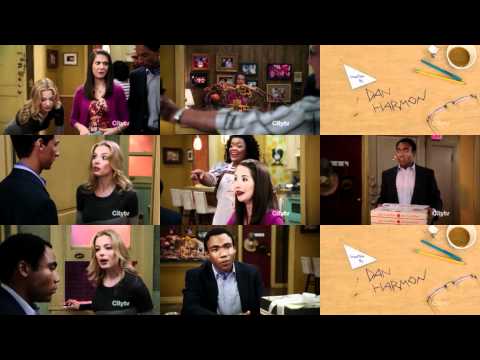
People who have not been won over by Community generally seem to be put off, or scared, or confused by the show’s decided eccentricity.  But perhaps these people would give the best show on television another chance if they knew that the eccentric side of an episode like “Remedial Chaos Theory” is not just eccentric for eccentricity’s sake and that it actually has a purpose, and a profound one at that.  That is not to say that the other “special” or “theme” episodes of Community do not also have a purpose (most – if not all – of them do), but the purpose of the multiple timeline format of “Chaos” is worth giving unique weight to because of how fundamentally it relates to the makeup of the series: the purpose, to spell it out, is to ask the question, “What insight does the multiple timeline conceit give us into what role each character plays in the study group?”  Anyone who has ever had any circle of friends can relate, because, for most – if not all – of us, there have been moments when our entire group has been together, moments when only half the group has been there, moments when one person has been missing, etc.  But we never experience the same moments more than once with a different group makeup each time – maybe we experience something similar, maybe the same type of event, but not the exact same moment.  And so, the metaphysically inclined are left to wonder, “How would this situation have been different if I went downstairs to grab the pizza instead of you, or him, or her?”  This is the sort of question that typically belongs in the domain of science fiction, and the geekiest variety at that.  But Community makes it more universally relatable by utilizing it in the most mundane fashion imaginable and still manages to turn it into one of the most satisfyingly ambitious half hours of television ever.

You didn’t think I was going to just honor one episode of Community this season, did you?  For a show that airs episodes worthy of being most shows’ best of the season on a regular basis, it is practically mandatory to include some Runners-Up:

“Regional Holiday Music”
How appropriate that in the same year that Glee aired one of the worst Christmas episodes in television history, Community made one of the best Christmas episodes out of a Glee parody.  Also, my reaction to Annie’s “Teach Me How to Understand Christmas” routine: “Did that really just happen?!”

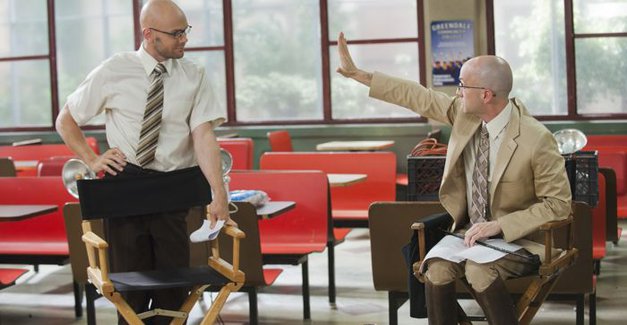
“Documentary Filmmaking: Redux”
An Apocalypse Now/Hearts of Darkness homage turns into a bizarre love letter to the equally bizarre Greendale (with a Luis Guzman cameo to boot).

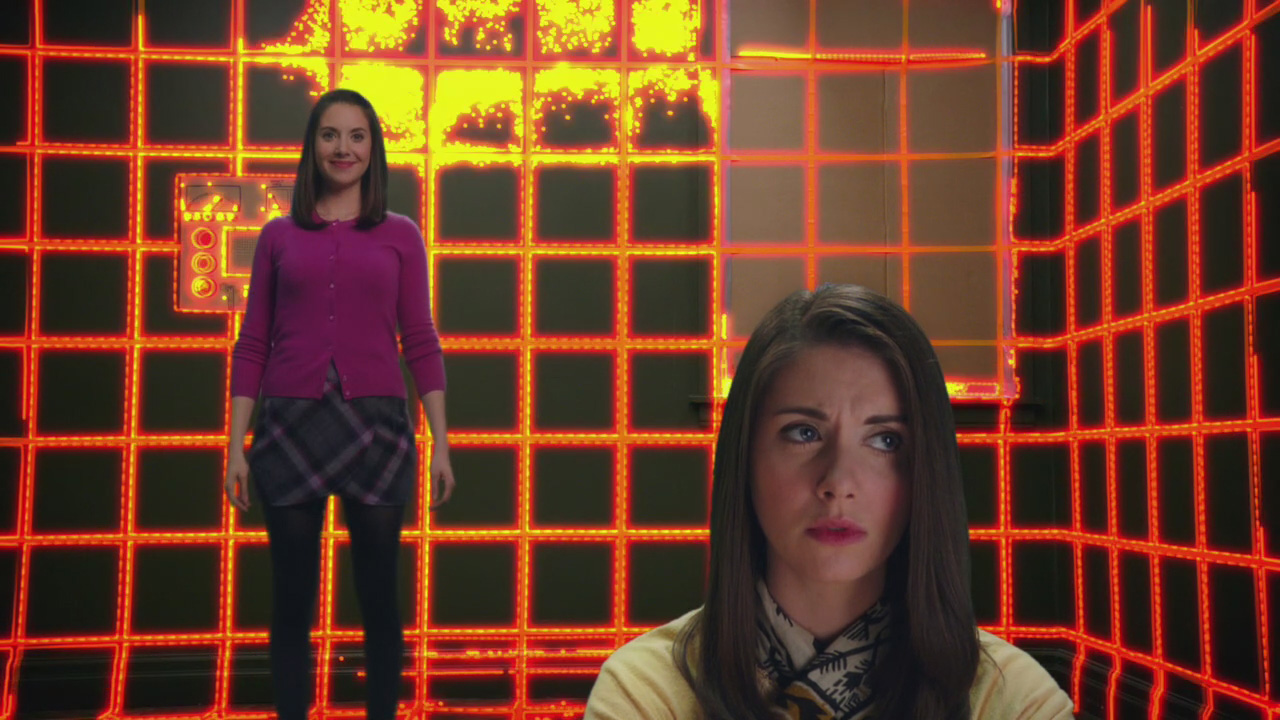
“Virtual Systems Analysis”
An episode that amazed with its ability to spin several plates at once – with some plates spinning on top of other plates – without any of them breaking:  Everybody plays their usual  characters, and … Danny Pudi plays Abed playing Annie, Jeff, Britta, Troy, Pierce, Shirley, and Annie playing Abed; Alison Brie plays Abed playing Annie; Joel McHale plays Abed playing Jeff; Gillian Jacobs plays Abed playing Britta; Donald Glover plays Abed playing Troy; Chevy Chase plays Abed playing Pierce; and Yvette Nicole Brown plays Abed playing Shirley.  Is your brain still working?  Good, then you’ll be happy to watch even more Community.

“Pillows and Blankets”
I was so amused just by the idea that Community would model an episode after a Ken Burns documentary that I was laughing non-stop all the way until the first commercial break.

Older Entries Newer Entries