Community Episode Review: 5.6 “Analysis of Cork-Based Networking”

2 Comments

Community-Season-5-Episode-6-Chang
“Introduction to Statistics,” “Pascal’s Triangle Revisited,” “Early 21st Century Romanticism,” “Herstory of Dance,” meet the newest member of your family – “Analysis of Cork-Based Networking.”  If there is one storytelling well that has not run dry for Community (and probably never will run dry), it’s school dances.  Even the otherwise shaky Season 4 got it right.  And perhaps that’s what the otherwise brilliant, but rather dark, Season 3 was missing.  Community has a tricky history with romance, but dance episodes have an essentially flawless record when it comes to love and relationships.  “Statistics” covered Jeff and Slater (and teased Jeff and Annie way ahead of schedule); “Pascal’s” dealt with the Jeff-Britta-Slater triangle and then snuck Annie in; “Romanticism” covered Abed and Troy with the librarian (“Books!”) as well as Jeff and the whole group; and “Herstory” teamed up Abed and coat check girl Rachel.  Interestingly, this episode only covers the romance in the C-plot, so we’ll get to that discussion a little later.

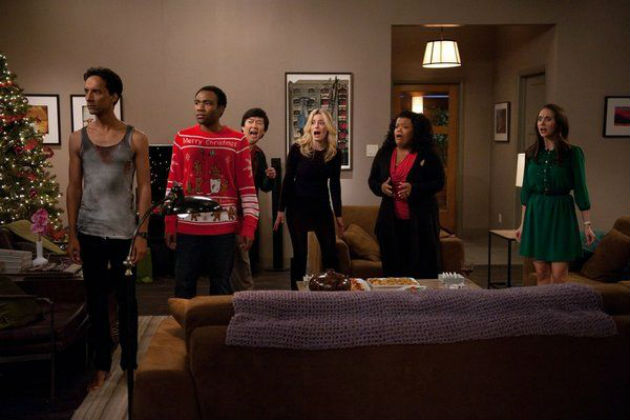
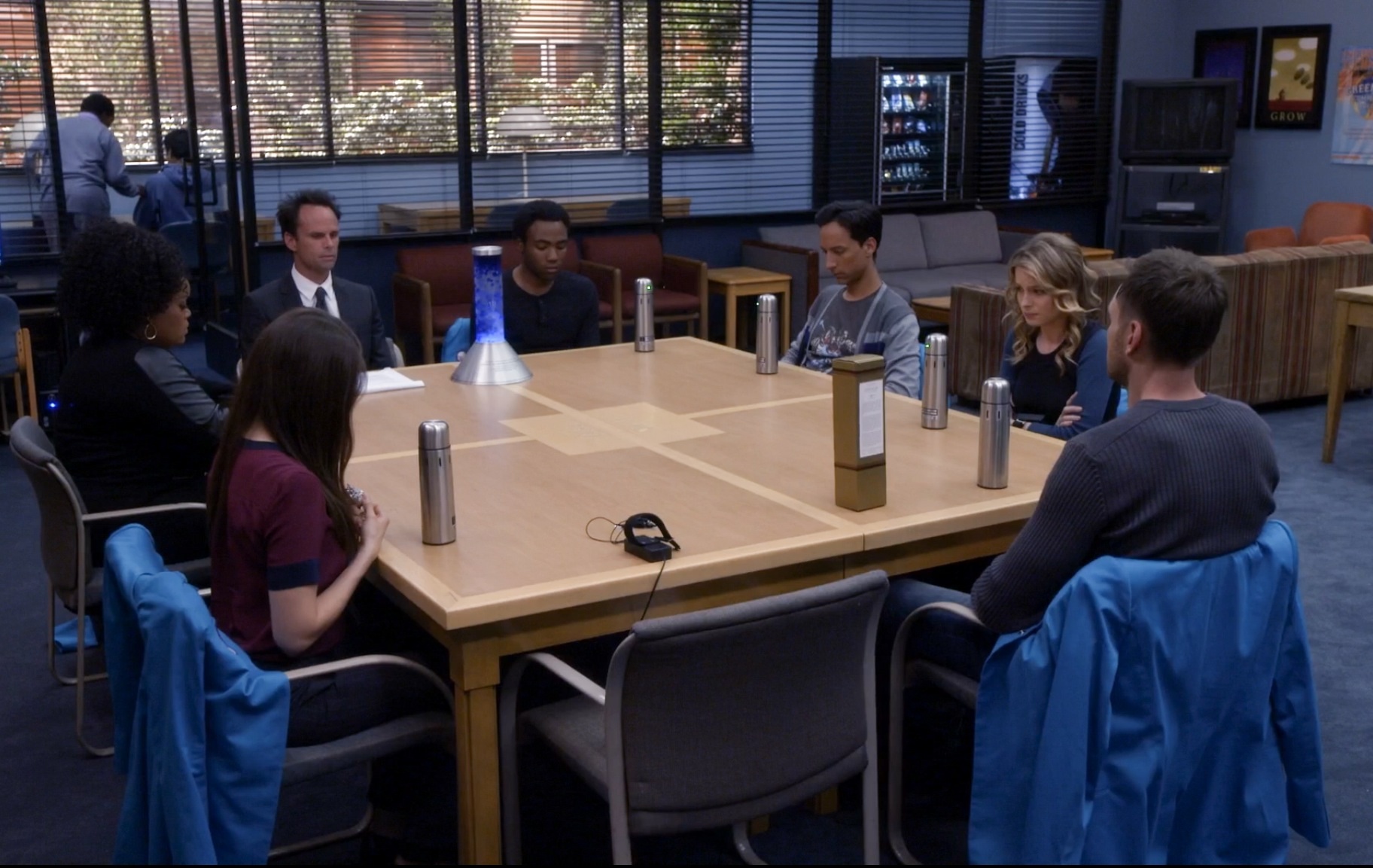
To start off, the Save Greendale committee storyline is finally picked back up, after a few weeks off to take care of saying goodbye to Pierce and Troy.  It begins with that old Community standby: the cold opening study table powwow (or, “prelimawow”).  The roster is a little different, but the dynamic is as strong as ever.  The departed may be gone, and that still hurts, but wisely, the new normal has been established.  And then there is an excellent cut-to-the-credits moment, as Annie punctures wall with a star meant to commemorate accomplishing a task.

The bulletin board A-plot with Annie and Hickey seemed a little lightweight due to a storyline that will probably not be picked up on further from here on out.  Lightweight or not, it was appropriately fun in a byzantine manner – or rather, a labyrinthine manner (it was enjoyable even without puppets or androgynous rock stars).  To get a bulletin board back up somehow involves getting approval from the custodian crew, who must be smoothed over with a favor from Paget Brewster in the I.T. department, who is happy to hear head of parking Robert Patrick might be able to help her out, who makes a demand that requires turning to Dean Pelton.  Hickey makes a big fuss about how all this backdoor deal-making is forcing Annie to compromise her principles, and she does display a worrisome tendency therein as she sets out to prove that “Annie Edison doesn’t get nothing done.”  But this storyline is really more about cutting through Greendale’s red tape, and this plot may not be significant plotwise, but it does have plenty significant to say about long-term characterization.  Annie continues to bust balls this season, and in Buzz Hickey, she has inspired another ally to fight alongside her.

As Annie leaves Jeff, Shirley, Duncan, and Chang to put together the midterm dance, this B-plot ends up being one of the funniest ever Chang-centric plots.  Seriously, his insisting on the “Bear Down on Midterms” theme may have been the funniest scene of the season, and it was quickly topped by the “Fat Dog” dance (“It’s not made up“).  The others are frustrated by Chang’s insistence, perhaps a bit too much, as “bear down” is an actual phrase and it does make sense when applied to midterms.  But Chang really needed to expound how that phrase could apply to a dance, as Duncan made clear (“you can’t just repeat it, you need to explain yourself”).

Ultimately, the midterm dance plot worked as well as it did because it was so thoroughly detailed in a way that was specific to the universe of the show itself: it turns out that Chang was inadvertently inspired by a story of a bear attack in Wisconsin, so to avoid the sensitive topic, the bears are re-fashioned into fat dogs.  And in beautiful, ass-covering fashion, Shirley and Duncan create a fat dog entry on Wikipedia, while Chang composes a fat dog song and dance.  And it all falls apart in the most hilarious way imaginable: Garret yelling “IT’S A BEAR DANCE!”

Finally, we get to the romance, which does NOT focus on Jeff and Annie, despite (or because of?) the fact that they have already had so much screen time together this season.  Instead, Abed stumbles into a day-long affair with a deaf girl, thanks to his wearing noise-cancelling headphones to avoid a spoiler-happy Britta.  Speaking of Britta, geez, did she go a bit too far?  I could understand, though not approve, her getting back at Abed for spoiling her, but how could she justify ruining his time with the cute deaf girl played by Katie Leclerc?  At least it was clear that she wasn’t the right girl for Abed if she was willing to spoil him for cash, and Britta did realize the error of her ways fairly quickly, but still – whoa.  The tension between her and Abed was inexplicably fraught.

The ultimate silver lining here was the return of Brie Larson, which we all know I’ve been anxiously awaiting.  I’ve been wondering how things went on the date that Abed and Rachel decided to have at the end of “Herstory of Dance.”  Apparently, that date never happened!  Or, it did, but they never contacted each other again until now.  That’s a little disheartening after how well they hit it off initially, but at least they were both mature about this second chance, not spending any time getting angry with each other, instead admitting they both should have been more proactive, and then deciding right then and there to get dinner (and apparently watch Rick and Morty – the best new show of 2014!).  I loved that Rachel started a coat check at this dance without any permission – I’m assuming she did so in the hopes of running into Abed again, a tactic reminiscent of Matt Damon pursuing Emily Blunt in The Adjustment Bureau.  As someone who was awaiting this moment with bated breath, I must now ask: that’s not it, right?!  They didn’t get Brie Larson back just for 2 minutes, did they?!  Based on the last shot of the two of them (during the Roxy Music-scored montage – add “More Than This” to the pantheon that also includes “Somewhere Out There” and “Kiss From a Rose”), it looks like she’ll be around a bit longer.  I mean, she was sitting in Troy’s seat.

Speaking of guest stars, this episode sure had a lot of them.  Was it too much?  Or did they satisfy?  Part of that, at least on an initial view, depends on whether or not you knew ahead of time that they were going to appear.  Since I hang out in areas where that sort of thing is revealed ahead of time, and also I can’t help but look it up myself anyway, I already knew about almost all of them.  It was fine knowing that Jerry Minor was going to be there, since he’s already appeared multiple times and this storyline more or less required his presence.  Eddie Pepitone wasn’t announced, but I figured he would show up.  I actually think it was better that I knew about Kumail Nanjiani, because I might have gotten too excited if he showed up unexpectedly and I wouldn’t have been able to settle into his rhythm; he basically played one of his overly officious characters from Portlandia.  Nathan Fillion’s appearance was a little disappointing, but that was more to do with it being so short, and Nathan Fillion is bigger than that, so it would have been a disappointment whether or not I knew he was going to be there.  Maybe he and Kumail could show up again at random points in the future, the way Jerry Minor and Eddie Pepitone have.  Paget Brewster’s appearance was fine for me either way, as I don’t know her that well.  It would have been cool if I didn’t know about Robert Patrick’s appearance, because he’s the sort of guy that I would go, “Oh, wow, Robert Patrick” to if it were a surprise, but it wasn’t that big of a deal.  With Katie Leclerc, it didn’t matter either way, because I’ve never seen her in anything else.  It was probably the most problematic knowing about Brie Larson, seeing as knowing about her made it obvious how Abed’s plot was going to end.  But everyone played their part well – I can’t in good conscience knock the episode for what I knew or didn’t know ahead of time.

This really was one of the most consistently hilarious episodes in a while, so I’ll end my review by listing some great funny moments I haven’t gotten to yet:
-“Is deforestation on the list?”
-“They really get the incest right.”
-“That was gibberish. You’re good.”
-“Yes, that is a Whitney original” – great line thanks to Kumail’s delivery
-Annie yelling “EVVEERRYTHING!” (which seems to have been a reference to Gary Oldman yelling “EVVEERRYONE!” in Léon: The Professional)
-“There was plenty of space to park in dinosaur times.”
-“Whatever you’ve got in your butt, can we get it out later?”
-“But you learned a lesson, and I gave a differently-abled person a job! … Let’s be fat dogs about this!”
-“This got Sorkin-y.”
-The bad sign language was great, and endearing, since Abed was actually making an effort to learn.
-The Dean thinks David Bowie is macho, which, of course he would.  And hey, even though Bowie may be androgynous, he’s got plenty of testosterone, perhaps too much, as his one multi-colored eye is due to a fight in which he was punched in the face.
Community Episode Review: 5.5 “Geothermal Escapism”

Leave a comment

Community - Geothermal Escapism
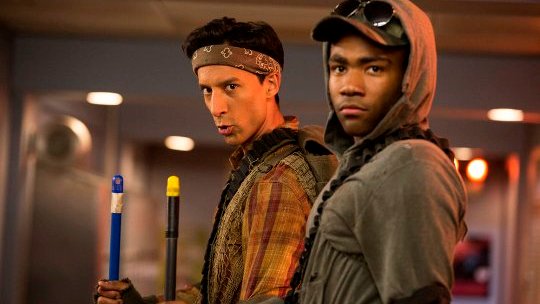
“Geothermal Escapism” started out as a paintball episode in every way except paintball.  But “The Floor is Lava” was close enough to paintball anyway, as it also proved to have the capacity to destroy the entire campus, with thanks also once again to a disproportionately enticing prize.  The possibility that something like this could happen on Community was never in doubt.  Of course Abed would want to give Troy an appropriately massive, campus-wide send-off.  And no surprise that it would call back to their past great adventures.  But for the first half of this episode, I was a little wary.  It wasn’t just that Lava was so similar to paintball (the post-apocalyptic angle was new, but really just a subgenre of the action genre so fully covered in “Modern Warfare”), it was that the character stakes didn’t seem that high.  “Modern Warfare” took place in light of Jeff and Britta’s sexual tension boiling over, and the Season 2  2-part finale was precipitated by the possibility of Pierce being kicked out of the group.  It feels like at this point in the show’s run, these people are too comfortable with each other to have conflicts on those scales.

This is why I kept my eye on Britta, who insisted on everyone having a chance to grieve.  This really seemed unnecessary; nobody wanted Troy to go, sure, but not everyone needs to go through the same grieving process when a friend leaves.  Jeff, Shirley, and Annie at least all seemed perfectly capable of seeing Troy off without too much fuss.  But there was somebody missing from that opening study room scene.  Abed’s absence served both a narrative and a thematic purpose, and this was ultimately all brought together by the end.

It wasn’t just that the creators of Community wanted to re-capture the glory of the paintball episodes.  Abed was the one who orchestrated The Floor is Lava.  He was the one who really wanted to go back to those good times.  Britta may have applied her grief psychology too broadly at first, but she was right to have that mindset.  If genre-savvy Abed – who knows to be wary of sequels – was so focused on making something like a sequel (a spinoff, perhaps), then something had to have been be up.  When the game comes down to Troy, Britta, and Abed, everything is brought into perspective.  Abed knows intellectually that Troy won’t be here forever, but his unique emotional state affects his perception so strongly that he can’t help but see the floor as lava.  This episode had to be so similar to what had come before so that the change of the status quo that came at the end could be felt so strongly.

So I had no trouble feeling the ending of this episode, but it took me some mental aerobics that I more or less just explained to really get on the first half’s wavelength.  Ultimately, I do think it succeeded from start to finish.  It helped that the action was so well-directed.  You really got a sense of how painful some of those falls were.  Annie’s drop especially looked like it hurt.  There was also no shortage of laughs, with highlights including Duncan’s complaint that everyone besides the British cheats, Garrett’s storytelling about Shirley Island, “the reverse Danny Thomas” (whatever the hell that is), Gillian Jacobs’ delivery of “I understand. I lived in New York”, and “Cirque Du so long, you high-stepping acro-bastards,” which was perhaps as funny as it was only because Leonard said it.

For Troy’s last episode, “Geothermal Escapism” didn’t focus as much as one might have expected on Mr. Barnes.  But as I talked about in my review of “Cooperative Polygraphy,” Troy has clearly matured enough to take on this next stage of his life.  It wasn’t necessary to show him preparing, as it was clear that it was time for him to move on.  And so this episode focused more on those saying goodbye, particularly Abed, and here was just the latest example of how much of a classic all-time TV character he is.  It has never been confirmed one way or the other that Abed has Asperger syndrome, or something similar, and I think that has been for the best.  He understands his limitations, and he consistently attempts to work around him, so it is fascinating to see him actually debilitated by his condition.  It is a fitting cap to one of the great friendships in TV history to see Abed be able to be so honest with Troy in that moment.

As Troy is about to set sail, he gets the perfect goodbye from each of his friends.  His moment with Britta interestingly – and poignantly – calls back to their relationship from last season.  Annie eloquently expresses her amazement that someone she could barely talk to at first is now the easiest person for her to open up to.  Shirley is rightly denoted as the badass of the group.  Jeff, who in previous seasons looked to have been threatened by Troy’s heroic rise, is now genuinely impressed by how his protégée of sorts is now more awesome than he is.  And Troy and Abed – Clone Troy and Clone Abed, that is – don’t shake hands.  They hug.

Community Episode Review: 5.4 “Cooperative Polygraphy”

1 Comment

community-cooperative-polygraphy

“Cooperative Polygraphy” is an epic episode of Community, insofar as it is chock full of references to past episodes.  Many thanks to other Community fans on the Internet for pointing out the ones I did not pick up on right away.  A LOT of people noted that part of the freeze-frame epilogue from “The Art of Discourse” came true, as Britta became the (presumably proud) owner of a used iPod nano.  (Others noted that if this means this episode takes place in 2014, then that 3-year-gap that has been cited existing between Seasons 4 and 5 is making less and less sense.)  The reveal that Annie drugged the whole group in preparation for the Anthropology final is especially hilarious if that is in reference to the final from “Applied Anthropology and Culinary Arts,” the most farcical moment from a patently farcical class.  Going even deeper, Troy’s attempt to inhale Pierce’s life vapor perhaps fulfills his wish to “eat a ghost,” which he made in “The Psychology of Letting Go” – the episode that introduced the post-death rituals of Pierce’s religion.

But the episodes that “Cooperative Polygraphy” responds to the most are “Cooperative Calligraphy,” “Intermediate Documentary Filmmaking,” and “Intro to Felt Surrogacy.”  “Calligraphy” is the obvious antecedent here, what with the rhyming titles and shared study room setting.  But “Polygraphy” is more low-key (or less high-key, as it were).  It doesn’t call attention to itself as a bottle episode, unlike the former “Cooperative” episode.  For my money, a pure bottle episode is one that not only takes place in one location, but also one in which the characters are trapped.  In “Polygraphy,” the study group was bound by circumstance to remain in the study room, but not to the degree that they were in “Calligraphy” – one character leaves and then comes back, after all.  The tensions do run high in “Polygraphy” (as they typically do typical Community), but not to the ripping-off-clothes degree of “Calligraphy,” perhaps the most tension-filled episode of the series.

“Intermediate Documentary Filmmaking” is the closest narrative parallel, as that Season 2 classic also saw Pierce playing head games with the specter of his death hanging over.  Between these two, there is a clear progression of significant difference.  Pierce’s premature bequeathals were mostly meant to punish his friends.  His actual bequeathals were genuine and thoughtful, though preceded by head games that he still could not resist.  Pierce never became the kindest friend to any of these people, but he did become a friend whose friendship ultimately could never be in doubt.

The closest thematic parallel is “Intro to Felt Surrogacy,” an episode I enjoyed more than most fans; I even declared it the best of the season – though I have since backed off that opinion.  The major problem with “Felt Surrogacy” was its sense of incompleteness.  Because the study group’s secrets from that episode were all revealed in the final act, there was no chance to resolve the problems presented by them or come to terms with them in any meaningful way.  It feels like Dan Harmon had a similar reaction upon watching this Season 4 episode.

I do not know what Harmon’s exact thought process about Season 4 has been, but I know he has not dismissed it outright, and watching “Cooperative Polygraphy” makes me feel like I kind of do know what he was thinking in this case, because it episode basically directly solves the problem of “Felt Surrogacy.”  The revelation of secrets is the whole narrative thrust of “Polygraphy.”  Community demonstrates the wisdom of caution by showing friends that even when they are perfectly comfortable in their friendship, it is important to consider that there still might be secrets lurking that could deeply hurt their friends.  This is not to say that they might as well end their friendships, but rather, something along the lines of, perfect is the enemy of the good.  That is, if you have already accepted your friends with all their imperfections, you should be able to also accept any previously unknown imperfections.

And oh my God, Troy is leaving.  The circumstances that are drawing him away are random, but also ultimately perfectly appropriate.  Once again, I must extend credit to the rest of the Community fandom for providing examples of how Troy does indeed have the heart of a hero: he was the one who took charge in “For a Few Paintballs More,” and he risked his life by going back among the infected in “Epidemiology.”  Troy’s life did not look as bad as everyone else’s in “Repilot,” so he would be spinning his wheels more than anyone else if he were to remain at Greendale.  No doubt there will be something missing in the heart of the show after the next episode, but at least there will be a way to check up on him occasionally, now that we know about Abed’s tracking devices.

Community Episode Review: 5.3 “Basic Intergluteal Numismatics”

1 Comment

Community_BIN
By my estimation, the best analogue to “Basic Intergluteal Numismatics” is “Basic Lupine Urology” – an intricately well-done, but unnecessary, homage.  (Also, the titles follow the same format: with BLU, it’s “ha-ha, fancy way of saying ‘Dick Wolf'” and with BIN, – it’s “ha-ha, fancy way of saying ‘dropping coins into butts.'”)  I responded better to “Intergluteal,” not necessarily because it was better, but because I am more familiar with David Fincher’s filmography than I am with
Law & Order.  I don’t think I’ve ever seen an episode of L&O straight through, whereas I have seen every Fincher-directed film besides Alien Cubed and Panic Room, and I’ve liked them all (well, Benjamin Button was okay, but kind of weird – but I don’t think it was referenced here anyway).  There were some touches on TV crime procedurals as well, a genre I did not think I was that big a fan of, but I guess I am watching the right ones, because I appreciated the nods to Hannibal (right down to Duncan’s Lecter-esque wardrobe) as well as Abed pointing out the overdone trope of a “special” investigator with the ability to recreate the crime in his head (even though that trope is done perfectly on Hannibal).  Typically, Abed will jump at any chance to recreate fictional tropes in real life, so it was an entertaining change of pace to see him start to act out the Dean’s patronizing request, but ultimately point out how disgusted he was by it, by means of just leaving the room.

Generally, I prefer it when Community‘s homages arise naturally out of the plot machinations and the character dynamics, as opposed to being imposed from the outside.  Now, if it is the latter, I can enjoy it if it is well-done, though it probably will not quite be at the top tier of episodes.  And so it goes for “Intergluteal.”  The dark green tint was fine either way, and I was perfectly happy with it because I loved seeing an episode of Community that looked like Se7en.  Annie and Jeff have teamed up together plenty of times before, so it was certainly believable that they would do so again, and the fact that they so easily slipped into roles typical of Fincher-ian investigators – a mix between the opposing styles of Se7en and the sexual tension of The Girl with the Dragon Tattoo – was more a function of the editing than either of the two of them acting out of character.  And it certainly was not atypical of Abed to give Troy warm beverages and blankets, just like how trauma victims are treated in movies.  Troy committing to the trauma victim bit may have been silly, but it is also something he would do.  Then there was the Dean snapping at Rhonda to trace the call – my pick for biggest laugh of the night (give or take Jeff’s moment with Leonard) – which is something the Dean would absolutely do: emulating a trope in a way that doesn’t quite work.  So, really, it wasn’t so much that this homage felt imposed from above, as much as this whole episode just came out of nowhere.  It was hard to get your bearings regarding what it was trying to do, but that also seemed to be the point – so I guess what I’m saying is, the the justification for this homage was the homage itself.

One element that did not come out of nowhere but felt oddly unattached to continuity was the Jeff and Annie of it all.  I was actually surprised to see these two team up again right after last episode, considering this show has rarely been sure exactly how it wants to treat these two.  It wasn’t exactly sure here, either, though it did seem to start to be saying something, but that something got cut off (like everything else at the end of this episode).  When there has been a mystery to be solved at Greendale in the past – “Conspiracy Theories and Interior Design,” “Basic Lupine Urology” – Jeff and Annie have always teamed up for the investigation, so it made sense that they would do so again.  And it made sense that they have now teamed up often enough that people would start noticing and point it out.  I’m not sure why the Dean referred to it as creepy, though.  I’m not even sure what exactly was “this creepiness” was referring to.  Their age difference wasn’t brought up; it seemed more like the point was that it was weird that the two of them apparently feel the need to justify their spending time together by getting involved with a caper.

The state of their relationship seems to be that they are fine with referring to themselves as just friends.  They are still attracted to each other, but not necessarily enough that they feel a burning desire to act on it.  But that doesn’t quite add up, because in Season 4, their attraction still was clearly present.  There was never really a decisive moment when they said to each other or themselves that they were just friends.  How much time passed between the end of Season 4 and the start of Season 5, again?  Long enough for all the changes in the group dynamic to make sense?  Okay, that sounds about right.  (Looking over comments from around the Internet, it seems like the tension may have been played up and called attention to for the sake of emulating the sexual tension in TV and movie mystery-solving duos – I’ve already mentioned Girl with the Dragon Tattoo, and of course there’s Mulder and Scully, and also probably The Killing [which I’ve never watched].)

Oh, and Pierce died.  This may have struck some as rushed, or not dealt with properly.  The latter should not be too much of a concern, because the next episode will be dealing with it directly.  As for the former, unexpected deaths tend to feel like that.  Did it feel oddly shoehorned into an homage episode, which was also – homage or no homage – exceedingly silly?  Yes.  Was that necessarily a bad thing?  It may have rubbed some the wrong way; for me, it was weird, but in a way that I thought weirdly fit with the weirdness of the whole episode.  The case was closed, but never fully solved, because there are more important things to focus on, but there is still a lingering feeling of “Could it be…”

Oh, and I’ve barely been able to talk about the return of Ian Duncan.  It felt a little strange to have to explain his return, instead of just letting him be there.  Ultimately, though, by episode’s end, he was essentially just there, back in the Greendale swing of things.  His interactions with Britta were charmingly creepy.  There might have been a bit of overkill with the fake Britishisms, but his delivery was spot-on (“Oh, American high-five” was probably my favorite of the bunch).  The scene with him and Annie in his office also delivered the tension, and apparently it was a perfect homage to a scene in Zodiac that I don’t remember all the details of, but people who have seen Zodiac more recently than I have sound confident that it hit the mark.

I know I liked this episode, but

Community Episode Reviews: 5.1 “Repilot” and 5.2 “Introduction to Teaching”

1 Comment

CommunityRepilot

“Repilot”
“Francis Ford Repo Man” – so this is the first joke of Dan Harmon Community 2.0.  It’s irrelevant to everything else going on in that scene, and it’s not even a very good pun (unless I’m missing something).  But it works – because it is not lingered upon.  I constantly argued that the major problem with Season 4 wasn’t the What, but the How.  There were plenty of good ideas, but too many of them were not executed well.  This falls to the editing, an area that Dan Harmon-run Community was strong in, and Harmon-less Community so clearly was not.  Last season, shots were cut away from too fast, there were awkward lingering stretches, and overall episodes (and the whole season) just weren’t that well-constructed.  It is immediately clear that that has been rectified, and that makes jokes that aren’t very good actually kind of work.

I have a bone to pick with a few TV critics (but maybe it’s not their fault, because there appears to be some confusion): in some of the pre-show reviews, they said this season was taking place three years later.  I assumed that that meant there was a time jump between the end of Season 4 and the beginning of 5, but that is clearly not the case.  Jeff mentions that the rest of the study group “just” got sprung from Greendale, and last year is referred to as the “gas leak” year.  I guess the “three years after” actually refers to three years after the beginning of the show – but that doesn’t work either, because then it would be four years.  This three-year figure just doesn’t seem to work at all, and I don’t know where it came from.  It does seem like a lot has happened to everybody, more than would be expected over the course of just a few months, but all references to events of Season 4 make it seem fairly recent.  Umm… I guess it’s not that important.

To continue this review on a technical standpoint, this episode was dark – one of the most dimly lit of the series.  It was hard to get comfortable with, but it was on purpose.  The past four seasons have seen these people bettering themselves, but apparently it has not been enough.  Jeff is able to be manipulated by his skeevy former partner, and the study group is still able to be manipulated by Jeff at his most manipulative.  But, there is a sense of righteousness to the destructive decisions everyone is making.  In the pilot, we saw a Jeff Winger making the right choices for the wrong reasons, and in “Repilot,” we see him making the wrong choices for the right reasons – but he ultimately comes around to the right choices for the right reasons thanks to the support group he has cultivated.  When he confronts Dean Pelton about his indecency, what he is so angry about is that the people he cares most about could be so easily taken advantage of.  He does not really want to destroy Greendale; he is just screaming about how unfair it is that he and his friends aren’t succeeding.

It was wise for this season to be a revamping year, not just because last year was a relative disappointment, but also because it is a general rule of thumb that sitcoms need a major shakeup here and there to remain worthwhile as they get older.  With its multiple callbacks to the pilot, “Repilot” made it clear that it was a new beginning but also not as much of a clean break as I thought it was going to be.  Is Greendale like the Lost island in that the study groupers cannot leave it (until they are truly ready)?  Or maybe it is a Möbius strip, in that every exit is also an entrance.  This is all to say, Abed repeating “I see your value now” and Jeff repeating “It’s the coolest” underscored how much this episode did not have the shiny newness of the very first episode.  The repeated lines were said by changed people, though.  So there was a changed tint to it all.  I need help reacting to it because it is a just bit uncanny – so familiar, yet so not the same.

Ultimately, “Repilot” portends greatness to come but struggles with dusting off stray plot points that were left dangling unresolved last season.  It was the right decision to make Season 4 canon, but that led to some awkward moments here.  When Annie asked, straight-faced, “Chang was faking Changnesia?”, was that supposed to be a joke?  And if so, what was the joke?  Anyway, a big Season 4 issue was that, even though it had plenty of great individual moments, it was never clear that the writers knew where they were heading towards.  Right now, I only have a vague sense of where this season is headed, but that is fine because I feel like the creative team has figured out where it is headed.

I also feel compelled to mention the surprise cameos: first off, a recycled J.D. voice-over from Scrubs takes the place of a wrap-up Winger speech, and it was looped in so perfectly that I almost thought Joel McHale was doing a Zach Braff impression.  Also, it added to Troy’s slam on Zach and made that crack funnier retroactively.  Also … Pierce appeared?  While watching, I was thinking, “Okay, sure, Pierce left Greendale, but he can still appear as a hologram.”  It didn’t hit me until later that Chevy Chase – you know, the actor who plays Pierce – had left the show, and thus no appearances should have been expected, and certainly not in the first episode.

CommunityIntroToTeachingAnnie

“Introduction to Teaching”
When friends become lovers, the dynamic of the relationship changes in some ways, but my gut instinct tells me that the way they interact stays a great deal the same and that it is a less awkward transition than some movies and TV would have us believe.  Why am I bringing this up while discussing an episode in which no romantic relationship is begun, ended, or really addressed in any way?  Because should Jeff Winger and Annie Edison ever make the transition from friends to lovers, then their interactions with each other should remain as they are in an episode like this one.  This was not a romantic storyline (at least not directly), but I have seen positive reactions to it from everybody – shippers, non-shippers, and neutrals alike.  This is the Annie Edison that so many Community fans fell in love with – the go-getter who admires Jeff Winger but won’t put up with any of his bullshit.  And this is why Jeff is such good friends with Annie: she challenges him when just about everyone else lets him slide by, and he throws those challenges right back at her.  The scene in which Jeff causes Annie to lose an argument with herself is a thing of beauty.  It is a prime example of how they are such a dynamic duo: they constantly criticize each other, but not to put each other down – they are both so right, and they are both doing it because they know the other can be better.  It can hurt a little bit, and they both hurt each other enough to lead to the other storming out of the classroom, but it hurts so good.  So, let me get a little personal with this analysis, and mention that I am rooting for Jeff and Annie to end up together, and this episode affirmed my faith in their relationship, despite the lack of romance (but certainly not lack of chemistry).  Let me be clear that if they do happen, I want formidable Annie to survive.  (And really, friends or more, that’s what Jeff wants, too: that much was clear by his smile when he saw the newspaper in the trophy case for the debate championship, probably my favorite moment of these two episodes.)

As for the rest of the teaching plot, Jonathan Banks is a rare breed among the Greendale faculty as criminology professor Buzz Hickey.  I mean, who’s mean to Leonard?  Sure, everybody makes fun of him, but that’s always after he gets a dig in at them, and he’s never been embarrassed by it.  But Hickey not only wants to humiliate Leonard, he wants there to be no confusion as to his intentions.  I saw some reactions from people who were profoundly disturbed that Leonard was treated so harshly.  And, true, it was a little rough to watch, but it made it clear that Professor Hickey is for real, like him or not.  And then he settled down at the study room table as a member of the student-teacher Save Greendale Alliance, and he fit right in, despite not being like Pierce at all, except for the oldness part.  I suppose he also plays a similar mentor-to-Jeff role, in which he gives good advice mixed with words that should definitely be avoided.  But this is a personality this crew is not used to, and it looks exciting.

As for the B-story, there were plenty of wonderful words of wisdom, as there tends to be with discussions of Nicolas Cage.  Highlights included Shirley hypothesizing that she might also “accidentally win an Oscar” if she were in 70 movies in 30 years and spoke at random volumes, Shirley, again, figuring out that it is Nic Cage’s role in life to work in mysterious ways, and Abed’s explanation of the different kinds of good and bad regarding Robert Downey, Jr., Jim Belushi (man, that guy is still taking a beating), JCVD, and Johnny Depp.  Danny Pudi’s Nic Cage impression was also excellent (especially “I’m a sexy cat”), but I’m not sure this storyline said that much about Nic Cage that the Internet hasn’t already figured out.  Call me crazy (please do), but I think this storyline could have been an entire episode.  It would have had more room to truly be inspired by Cage at his Cagiest.  Like a Nic Cage movie at his best, it could have made no sense and the most sense.

It is always nice to see Kevin Corrigan.  His appearance here certainly was not as memorable as “Conspiracy Theories and Interior Design,” but it didn’t need to be to work.  With his encouragement to just let the craziness play out – but also his warning to be careful – he may just be the best Greendale professor of them all.  With Jeff’s status as a teacher apparently making the faculty a stronger emphasis, it would be nice if we saw Garrity (and others) just hanging out occasionally.

As this new era moves forward, let’s take stock of where these characters are.  Jeff and Abed both look great, but they’ve never had more than minor problems.  Annie looks more promising than she has since Season 2 (and I thought she was pretty damn good in Season 3).  Britta hasn’t done much yet, but her defiance and her overeagerness (which sometimes resembles ditziness) have been harmonized quite nicely.  Shirley hasn’t had a major plot of her own yet, though she did play an interesting key part in the Nic Cage storyline.  Craig not quite fitting into the student world or the teacher world is being intriguingly emphasized.  Most worrisome, though, is Troy, who probably did the least of anybody these two episodes, and will only be appearing in three more!  I won’t get overly worried, though, because there is a strong sense of directionality, so I don’t think the short shrift will be dealt to anyone for too long.

Community Episode Review 4.13: “Advanced Introduction to Finality”

Leave a comment

community_advanced_intro

“Remedial Chaos Theory” – still the high water mark of the series for me and many others – presented a series of alternate timelines that diverged from one seemingly minuscule moment.  Though the potential reality of alternate timelines may appeal to theoretical physicists, the argument has been made that the alternate timelines actually all only took place in Abed’s head.  At least as far back as “Debate 109” (Season 1, Episode 9), Abed has displayed such a deep understanding of the group as to practically be able to predict the future.  So it is a little odd that the timeline that has been revisited on occasion – the one in which Troy got the pizza, i.e., “the darkest timeline” – has become so decidedly unrealistic.  And each time it has been revisited – the tag of “RCT,” the Season 3 finale, the tag of “Intro to Knots” – it has been clear that it was in Abed’s head.  As demonstrated in “Virtual Systems Analysis,” Abed has become so close to his friends and therefore too emotionally invested to be able to always have the wherewithal to make the accurate predictions he has made before.

But the return of the darkest timeline in “Advanced Introduction to Finality” is not a look into the head of Abed Nadir, but that of Jeff Winger, he who has constantly repeated, “Abed, there are no other timelines.”  Jeff is finally set to graduate, he’s ready to get back to his old life, and his friends are supportive of him – but something doesn’t feel right.  The “It Was All Just a Dream” trope is one that should be used with great care, as it can come off as little more than a “get out of a jail free” card.  The just a dream reveal in this episode gets away with that by making it immediately clear that the darkest timeline plot is a dream, or, more specifically, a daydream (and therefore Jeff has more control over how the fantasy goes than he would if he were asleep).  Jeff indicates as much when he declares, “I just need to give Abed a chance” – for his own sake, he needs to examine his role within the group by considering an alternate timeline, the way Abed does so so readily.  Jeff has a nagging fear that going back to his old life will lead him to also go back to his old jerkass ways.  Thus, the alternate timeline that Jeff uses to work through this issue in his head is the darkest timeline.

Since Jeff is not as practiced as Abed at considering alternate timelines, the Evil versions of everyone in Jeff’s head are wildly cartoonish and huge exaggerations of each character’s trademark characteristics.  This would be a problem if this were all supposed to actually be taking place in reality (or the reality of Community, that is, a reality which is … not most of this episode).  Luckily, it is a fantasy, and we are allowed to laugh at it.  The repartee between Evil Jeff and Evil Annie – as previewed in the “Intro to Knots” tag – wins my vote for the funniest element of Season 4.  Their passion for each other is thrilling, while their deviousness towards everyone else is entertaining – it’s like a more insane version of “Conspiracy Theories and Interior Design.”  Actually, scratch that, “Conspiracy Theories” was already plenty insane – “less grounded” is a better description.  Evil Jeff wishing that Evil Annie were even younger really seems to get some people’s goats – too bad that their prudishness gets in the way of appreciating something so hilarious.  Seeing Evil Abed – who is not evil anymore – as a sci-fi shaman was also a treat.  True, Abed is already a shaman anyway, but it was nice to see him in the shamanistic beard and robe.  Unfortunately, all the other evil iterations of the study group amounted to little more than a few quick gags.  And Abed’s declaration that they finally made paintball cool again was a bit premature – if something is truly cool, it should not have to be announced so baldly.

As for reality, Jeff’s graduation ceremony was nicely understated but also a little oddly extravagant.  With the theme of “marriage,” Jeff being wed to the Human Being was certainly a memorable sight gag. The presence of Leonard, Quendra, Neil, Vicki, Todd, and Magnitude was a little strange, and strangely heartwarming.  And of course, the use of the “Greendale Is Where I Belong” musical cue is guaranteed to always tug at my heartstrings.  And finally, Pierce also graduates, which was was probably the most decent way possible to finish up Chevy Chase’s run on CommunityB+

Community Episode Review 4.12: “Heroic Origins”

Leave a comment

“What I do know is that the way our paths crossed, even when they were bad, all led us to this point, and I wouldn’t have it any other way.”

Community_Heroic_origins_promo_photo

One of the unique aspects of the group of friends on Community compared to other shows is that the Greendale Seven did not just come together by circumstance.  They’re not related, they’re not colleagues, and they’re not in a band together.  True, they are classmates, but they probably would have remained nothing more if one of them hadn’t been putting together an homage to one of his favorite movies.  When Abed turned Jeff’s scheme of passing himself off as a Spanish tutor to Britta into his own Breakfast Club-style band of misfits, he was ignoring his past friendless years and taking control of his own destiny.  What others would have considered a pointless tribute has led to the most meaningful relationship of his, and all of their lives.

So to say that the study group was destined to be together, as “Heroic Origins” does, seems to take away from the credit that should go to Abed.  It is often fun when our favorite shows present glimpses of our favorite character’s pasts. With Community, a show whose characters have been so decidedly shaped by their past traumas, it is both fun and unusually meaningful.  But it is not so meaningful as to suggest that their friendship was inevitable.  But, inevitability is not the same as destiny.

Abed did not set out to prove his “destined to meet” theory right from the start.  Like discovering the receipt from the Love Hut in Shirley’s sock drawer, it was just a happy coincidence that so many of the tidbits he uncovered happened to be connected.  Since he has a robotic memory and he sees life as a movie and/or TV show, he could not help but interpret his findings as the makings of a superhero origin story.  As for the matter of this story being one of destiny, a useful comparison is Man’s Search for Meaning by Viktor Frankl, who posited that the meaning of one’s life cannot really be known until one has started living.  Put another way, meaning comes from within, not without.  With that outlook in mind, Abed is right to say that the group was destined to be.  Taking stock of the community they have created and how it has changed their lives for the better, it is right to call it their destiny because it is what it is.  That does  not take away from Abed’s doings in the pilot – he created his own destiny, and in so doing gave the whole group the chance to create this destiny with each other.

The actual moments of the study group’s past interactions may have struck some as too coincidental, but life is coincidental.  Besides, Greendale may be a small enough town that it is logically possible that their paths would cross.  And they must have had some motivation in common that led them all to Greendale.  The fact that the Dean and Chang were handing out Greendale fliers at the mall lent some explanation to everyone being at the fro-yo place the same day.  Their actual interactions with each other did not ensure that they would meet again, just as surely as random interactions they had with other people did not ensure that they wouldn’t meet those people again.   Despite that lack of ensurance, they did meet each other (but not those other people) again.  Thus, Troy was given the chance to make up for never noticing geeky Annie (who proved that it’s impossible to uglify Alison Brie), Jeff was given the chance to make up for carelessly defending the stripper who went on to break up Shirley’s marriage, Abed was given the chance to make up for freaking out Shirley’s kids and ratting out Annie, etc.  They did not need to make any grand gesture to rectify these issues in this episode – they had already done so by being good friends.

As for the Chang resolution, it was not surprising.  City College Dean Spreck was on the other end of the phone, of course.  And Chang’s ultimate decision to go Greendale, though heartwarming, also was not surprising.  But Ken Jeong and Danny Pudi played it beautifully.  Abed’s incredibly straight-faced insistence that “only you know who you really are” was exactly what Chang needed to hear and a great statement of where Community itself is at this point.  Our destiny is what we are doing now, and whatever we do from here on out. A-

Community Episode Review 4.11: “Basic Human Anatomy”

Leave a comment

Community - Season 4

While I have mostly enjoyed Community Season 4, I have been consistently critical of its tendency to do too much in any give episode.  The pacing and the editing have been noticeably off compared to the first three seasons.  In “Basic Human Anatomy,” however, each subplot sprang from the same source, intersected nicely, and dovetailed for a satisfying finish.  So what does that leave me to criticize?  There is really only one major aspect of this episode that I can think of to criticize, but it is not necessarily that important, and I am coming around to thinking that there may be a way to explain it and/or that it doesn’t really matter if there’s a logical explanation.

One thing I will not be criticizing is the logic of this episode’s premise, in which Troy and Abed swap bodies in the hopes of recreating the scenario of Freaky Friday and its ilk.  I have been wary of some of the concept episodes of Community when I knew the premises ahead of time, because I worried that the homage would not be integrated in a way that made sense within the show’s universe, because the good homage episodes have been memorable because they were so good at that integration.  A body-swapping concept may at first glance seem like it would not work on a show that does not really have any sci-fi or fantasy, but that is exactly why I was not worried.  I was sure that Community‘s writing staff (led by Oscar-winning screenwriter Jim Rash on this one) would know not to have Troy and Abed actually switch bodies.  They were just committing to a bit, and they know each other so well, and they’ve logged so many hours in the Dreamatorium that they knew exactly what to do with hardly any setup.

It turns out – and there is a nice, foreboding sense of inevitability leading up to this moment – that Troy has realized he needs to break up with Britta and the best way he can think to do it is by going high concept.  Tritta has seemingly been neglected for much of this season, and while one might think that would dull the emotional impact of their breakup, it actually lent this moment an appropriate feeling of melancholy.  Considering the lack of evidence this season, Troy and Britta just have not had as many sparks since becoming official.  That lack may have seemed to indicate neglect on the part of the writers, but this episode made it feel like it was all part of a bigger plan.  Would it have been worth it to have a moment in an earlier episode of Troy expressing doubts about this relationship (maybe one of the conversations of him confiding to Abed referenced in TroyAbed and Britta’s date)?  Perhaps, but if anything, that is a knock on the season overall, not on this particular episode.  “Basic Human Anatomy,” in and of itself, gets the emotional beats so right.  Danny Pudi plays TroyAbed a little broad at first, but once on the date with Britta, he gets into Troy’s sensitive soul.  Gillian Jacobs plays the dawning realization of what is going on smoothly, and the hug at the end is so sweet.  (Too bad these kids haven’t fully realized that friendship is  a strong – perhaps the strongest – basis for a good romantic relationship.)  Donald Glover gets a chance to show off his logical side as AbedTroy, but interestingly enough, that side is what he is using to work through his most difficult emotions.  And Joel McHale, even with a sore throat, gets the chance to dispense some real wisdom – not just Jeff Winger Wisdom – by praising the value of commitment – even commitment to a stupid bit – and the importance of being a man in the biggest moments of one’s life.

Meanwhile, Annie and Shirley’s quest to uncover the truth to how Leonard has ascended to valedictorian position crisscrosses with the other body-swapping part of the episode.  Jim Rash’s commitment to his performance as JeffDean is uncanny: he captures the cadence and body language of Jeff Winger in scary fashion.  Annie’s attraction to DeanJeff was more overwhelming than I would have recommended, but it did make sense that she would be attracted to him, just as she has been attracted to similar masculine icons, like Jeff himself, Abed as Don Draper, Abed as Han Solo, and Abed as Jeff in “Virtual Systems Analysis.”  The exposure of the truth about Leonard was small-scale, and it was resolved with appropriately relative else.  Can’t argue with a subplot like that.  Pierce was little-seen in this episode, but the fact that he was able to complete their history banner project by himself in 25 minutes, tops, offered an excellent example of how working alone is often more productive than working in large groups.

The one thing that bothered me about this episode was that it was supposed to have taken place one year after “Virtual Systems Analysis,” as it was the one-year anniversary of Troy and Britta’s first date, at Señor Kevin’s as seen in “VSA.”  “VSA” did air approximately one year before “Basic Human Anatomy” (April 19, 2012, to be exact).  But because this season’s premiere was delayed, its episodes have been airing later than they are taking place.  This episode was the first one after Christmas.  But let’s also keep in mind that the second half of season 3 was delayed, so “VSA” maybe was not supposed to take place in April.  I find it hard to believe that it was taking place in January, but February seems possible.  The thing that is really hard to figure, though, is why everyone is talking about the events of last episode as though they just happened, when there must have been a jump into the next semester.  At least there is a precedent to the Greendale Seven apparently taking two-semester classes each year (without ever specifically indicating that is what they are).  Also, whatever happened to Jeff trying to graduate a semester early?  Did he just decide to not do that anymore and forget to tell the audience?  I guess that will be dealt with in the last two episodes.

With characters getting into other characters, and the callbacks to Troy and Britta’s beginnings and Señor Kevin’s, “Basic Human Anatomy” worked as a sequel to “Virtual Systems Analysis.”  It did not reach the level of that classic, but I will say that I did not love “VSA” as much as I love it now the first time I watched it, so maybe I will similarly warm up to “Anatomy” eventually.

The tag was great, a classic fake-out routine.  At first, I was disappointed, thinking, “Outtakes?  I want a real tag!”  Then it turned out to be a real tag with pretend outtakes, and it was glorious. A-

Community Episode Review 4.10: “Intro to Knots”

Leave a comment

Community-Intro-to-Knots

Those first two minutes were something else, huh?  Community has always had a more cinematic feel than most shows on TV, not just in terms of all the films it has made homages to, but also in terms of the way it is shot and the detail of the set design.  So, as the camera darted back and forth from Jeff’s living room to his door, it was surprising that it had taken this long for the show to have a long unbroken shot like that one.  The only bad thing about it was that it did not last any longer than two minutes.  There was another one soon after that also lasted about two minutes, but then that technique just stopped for the rest of the episode.  Sure, that was disappointing, but that was only in comparison to how awesome it was while it was happening.  Besides, they were doing different things the rest of the episode that would not have necessarily worked with a long unbroken shot.  But it would have been nice if it could have lasted the whole first act, or at least until the opening credits.  That is how all of “Intro to Knots” ultimately went down: a lot of promise that was met a little, making the whole episode disappointing, but only insofar as it could have been even more awesome.

With the entirety of the episode taking place in Jeff’s apartment in real time, the entire study group (minus Pierce, unfortunately, but plus Chang, oddly, though somewhat fortunately) is in close proximity, a formula for everything to beautifully bump into each other.  Combine that with the Hitchcockian plot – which references in particular the real-time murder mystery Rope – in which Professor Cornwallis is tied to a chair so that the study group will have him at their mercy to force him to bump up their group paper to a more favorable grade, and this is quite a simmering cauldron of angst.  It has been disappointing that Cornwallis has been more heard than seen this season, but Malcolm McDowell made the most out of finally getting significant screen time, offering up the best ass-kissing removal tell-off I have seen in a while.  (Even though, oddly enough, there was still some showing when there could have been telling, such as when Annie tells Jeff that Cornwallis just told her to get her “fit bum” into the kitchen to refill his drink, instead of actually pointing the camera on him being the cad that he has been established by everyone else as.)  Cornwallis promises an A to whoever unties him, but an F to everyone else, and then proceeds to pick at the scabs of the group dynamic, and he also manages to act as a voice of a typical Community fan within the show, speaking to several of the common criticisms of Season 4.  He sniffs out trouble in the Tritta romance and posits that there is a triangle with them and Jeff, and he demands to know why everyone puts up with “that idiot,” i.e., Chang.  He even manages to bring to light a previously latent tension – the Annie-Shirley valedictorian rivalry – that should affect the group dynamic in an entertaining fashion in the future.

Cornwallis is ultimately unable to get anyone to break, because despite their problems, they really are united and their friendship is so strong and all that good stuff.  The Winger speech hits on forgiveness and loyalty, and it isn’t his best, but it does the trick.  So Cornwallis acquiesces because his daughter never visits him, and being at the gang’s Christmas party actually kept him away from working on his suicide note.  And this revelation kind of lands with a thud.  Perhaps it is logical enough to explain his behavior, and it fits with the Greendale ethos of the entire series of accepting lonely people.  But since Cornwallis is not that significant a character, it is hard for a secret of his to bring much heft to the proceedings.  And then this episode just ends.  That lacking ending doesn’t take away from the tension of the rest of the episode, but it sure doesn’t live up to it, either.

Of course, the Jeff-Annie business of this episode must also be touched upon, thanks in no small part to Ms. Edison so assuredly swooping in and putting her stamp all over Mr. Winger’s place.  She is also aggressive by showing up with gifts after they had all agreed against that (although everyone else brought gifts as well – I imagine Jeff insisted on no gifts and then they together decided to ignore him).  It all seems like another example of Annie wanting to play house with Jeff (which apparently bothers some people), and while there is certainly part of that to it, her main point of the night seems to be teaching Jeff that “the obligation [of gift-giving] is the gift.”  While her phrasing may sound bizarre, she actually raises an interesting point: the bonds formed by being indebted to others and others being indebted to you can be quite rewarding.  Then there is the tag, which seems designed to enrage just about every segment of the Community fandom: shippers, anti-shippers, and those who think the Darkest Timeline should be left well enough alone.  I basically agree with the sentiment that the Darkest Timeline has no place outside of “Remedial Chaos Theory,” but if its placement in the tag is, as I suspect, an indicator that it won’t affect what is really going on, then I will be happy to see the occasional riff on the evil versions of these characters.  And while I would actually like to see Jeff and Annie together in the Prime Timeline, I am not sure I want the official version to be as carelessly passionate as on display here.  But that does not mean it wasn’t a hell of a lot of fun to see that kiss, and that hair, and to hear Jeff say that he actually wishes Annie were younger. B+

Community Episode Review 4.09: “Intro to Felt Surrogacy”

Leave a comment

Community - Season 4

When I heard that Community was doing a puppet episode, it did not seem like it was going to be like other theme episodes, i.e., a full-on pastiche of a particular film, or genre, or trope.  It seemed like they were just doing it for the hell of it.  In the past, I would have been disappointed by just-for-the-hell-of-it reasoning, but at this point, I am confident enough in the cast and the show’s structure that I think any wild concept on Community will at least be interesting.  But it turned out that the promotion had actually been a little secretive, and this episode was actually a full-on homage of the greatest puppet act of all time, the Muppets.  But even though “Felt Surrogacy” was just as committed as past homage episodes, it was right to think of it as different than those past iterations.  The Muppets and Community do share a similar tone: positive, but with a melancholic streak.  But seeing Community go Muppets-style, it’s striking just how different they really are.  The Muppets are so much more earnest.  Community is earnest as well, but the Muppets might be the most earnest group of entertainers ever.  The Muppets are referential, and of course Community is, too, but the Muppets’ references are more oblique, and more decorative as opposed to integral to the plot.

Just as the Community creative team committed to the Muppet style, so too were the Greendale Seven attempting to break out of their routine.  With this whole season assuming the theme of history, it has been fascinating to see the gang confront their own personal history.  The study group bingo was a clever method for demonstrating how well these people know each other and commenting on how TV shows in general have a tendency to fall into easy patterns in their later seasons.  So, in the spirit of mixing up their routine, and in the spirit of the Muppets, the gang’s balloon adventure captured several hallmarks of Muppet adventures.  There was the hyped-up celebrity appearance (Jason Alexander) that turned out to be not much more than a cameo.  There was the other celebrity appearance that we didn’t know we needed – Sara Bareilles, setting the right musical tone.  And there was the joke – where’s Professor Duncan been? – snuck into the most high-pressure of moments.  And, of course, the songs – bouncy, catchy, describing everything that’s going on with a bounding joy.  They were almost transcendent (“could we fly to heaven?”).  When too much cultural referencing threatened to sneak in – Abed noting the similarities to Lost – it was promptly shot down.

The best Community episodes are marked by risk-taking.  The Muppet homage was certainly a risk, but any homage is basically expected of Community at this point.  But there are the other classic risks beyond the homages – the big emotional revelations.  The best secrets to reveal are those that are perfectly in line with who the characters are but that still have the power to change everything.  Shirley’s lingering doubts about herself as a mother and a wife and Jeff’s regret about the one that got away tied up with his daddy issues both had this impact.  Some of the other confessions were softer, though amusing.  Troy starting the Greendale fire of 2003 was a little shocking, but he would have only been 13 or 14 and I imagine it might not have been as much his fault as he believes.  Britta only ever voting for The Voice more or less confirmed what people already think of her.  Abed has no secrets, but it was satisfying to hear him confirm that he mirrors the expressions of those around him.  [EDIT: I forgot to initially include the end of this paragraph when initially posting.]  On the subject of revelations, Britta and Jeff teasing each other about their lovemaking behavior was also chuckle-worthy, and I always appreciate it when characters are that open when talking about sex.  The reactions of Annie’s intrigue, Shirley’s disgust, and Troy’s confirmation were also worthwhile.

Risk is the best word for Annie’s confession, which was a bit problematic.  “Intro to Felt Surrogacy” is the first episode getting an A from me in which I had a significant problem with something.  It is not that I thought that past A-caliber  episodes were perfect; there may have been a few imperfections, but harping on them would have been nitpicking.  Harping on Annie’s confession about letting Professor Cornwallis rub her feet to give her answers to a test is not nitpicking.  Like a good secret, it was shocking, but unlike a good secret, it did not sound like the person who was revealing it.  There were parts of Annie to that confession, but overall it did not feel right.  She does have a history of being overwhelmed by school that did lead to desperate measures (an Adderall addiction).  And she has used her budding sexuality to her advantage before, but for cheating on a test?  Maybe if it had been set up in some way earlier in the season, it might have been more palatable.  But I always prefer when my favorite shows err on the side of ambition and risk-taking.  Making Annie go this far is a huge risk.  I am interested to see what it leads to, and I am hoping that it can be resolved in an intriguing fashion.  But because it is presently problematic, I will give this episode a conditional A, a sort of A-/A.

One last thing: the show has been struggling with a shrunken budget this season.  The opening shot of the second act right after the first commercial break of the balloon in flight made me wonder if the budget was higher for this episode.  It was the most beautiful shot of Season 4 thus far.

Older Entries Newer Entries