‘TÁR’ Pulls You Down the Rabbit Hole of Egomania

1 Comment

Covered in TÁR (CREDIT: Courtesy of Focus Features)

Starring: Cate Blanchett, Noémie Merlant, Nina Hoss, Sophie Kauer, Julian Glover, Allan Corduner, Mila Bogojevic, Mark Strong

Director: Todd Field

Running Time: 157 Minutes

Rating: R for A Few Swears and Some Weird Incidental Nudity

Release Date: October 7, 2022 (Theaters)

What’s It About?: Lydia Tár is one of the greatest living conductors. Does that sound like a role that Cate Blanchett was born to play? Todd Field apparently thought so, to the point that TÁR is the first movie he’s directed in sixteen years. Anyway, we’re introduced to Lydia at a live New Yorker interview, and it looks like it’s mostly going to be about her preparing for her next great orchestra performance. You know, one of those “process of genius” chronicles. But a messy personal life, and an even messier series of scandals, lurk barely underneath the surface. If you’re getting a sense that Lydia’s about to alienate all of her colleagues, friends, and family members, then you might be onto something.

What Made an Impression?: I’ve lately been reading Classical Music for Dummies, so I was all primed for TÁR to be more viscerally thrilling for me than it would have been, say, a year ago. But as it turns out, the classical setting is more or less incidental. Oh sure, there’s plenty for aficionados to dig here, as it’s likely to inspire passionate debates about the relative merits of Mahler and Bach, or someone more contemporary like Anna Thorvaldsdottir. But this is a story of the ego destroying everything else, which can happen in any high-powered artistic pursuit.

Lydia’s downfall could be read as a portrait of cancel culture, but that term is a bit too charged and complicated to be the most accurate description. For a good chunk of the movie, I found myself thinking, “She’s not guilty of exactly what she’s being accused of. Although, she is guilty of a lot.” Her instincts are to retreat, hide, get back to work, and in the process fail to acknowledge the humanity of pretty much everyone around her. What happens after that alienation? As TÁR posits, your whole world becomes warped beyond recognition, resulting in a wild fish-out-of-water conclusion and one of the most unexpectedly goofy final shots I’ve ever seen.

TÁR is Recommended If You Like: Geniuses losing it all, Finger dexterity, EGOT discussions

Grade: 3.5 out of 5 Symphonies
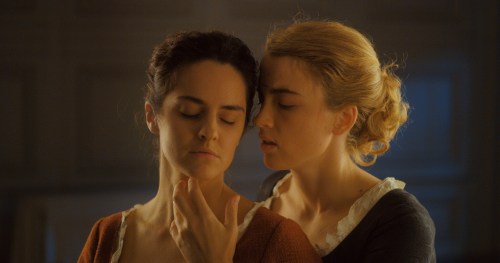
Bring the Extinguishers When You See ‘Portrait of a Lady on Fire’

3 Comments

CREDIT: Lilies Film

Starring: Noémie Merlant, Adèle Haenel, Luàna Bajrami, Valeria Golino

Director: Céline Sciamma

Running Time: 120 Minutes

Rating: R for The Nudity That Emerges When Two Young Women Discover Their Passion for Each Other

Release Date: December 6, 2019 (Limited)/Expands February 14, 2020

When I saw the title Portrait of a Lady on Fire, I had a feeling this was going to be a passionate love story. That sense was certainly bolstered by a poster that showed exactly what was being advertised, as the embers whipped at the bottom of Adèle Haenel’s luscious green dress. Then as I finally began to watch the actual movie, I was introduced to the painting entitled “Portrait of a Lady on Fire.” To which I thought, “Oh, is this the literal story behind the creation of the portrait?” And indeed it is, but that doesn’t mean the metaphorical meaning doesn’t also apply, and oh my, this movie is so very ravishingly inflammatory.

Héloïse (Haenel) is the titular lady on fire, but honestly, a more accurate title would have mentioned the second lady who is equally engulfed by a burning desire: Marianne (Noémie Merlant), the woman who has been commissioned to paint Héloïse. Taking place in the eighteenth century, this film is almost a two-hander, with Haenel and Merlant sharing the vast bulk of the screen time and just a couple other characters popping in occasionally. The settings are equally tight, as most of the running time takes place in a few locations that are not very far from each other on a remote island: the painting room, the bedroom, and the beach. These circumstances of close quarters make it feel almost inevitable that Héloïse and Marianne will develop a deep passion for each other. They also warp any sense of temporality. You might find yourself wondering how much time passes while they’re together. Days? Months? Hours? Weeks? Or maybe even decades, and they only appear to remain the same age because they are slipping through various dimensions.

Writer-director Céline Sciamma references and draws heavily upon the myth of Orpheus and Eurydice, the story of two lovers separated by death and fleetingly working their way back to each other through the whims of the underworld. Héloïse and Marianne are fully aware of the impernance of their entanglement, but they still enter into with the entirety of their souls. They take an almost Buddhist approach to their situation, existing both fully within and outside of time. It’s a fitting achievement for a film taking place within a painted portrait.

Portrait of a Lady on Fire is Recommended If You Like: Persona, Cold War, Carol, Orpheus and Eurydice

Grade: 4 out of 5 Sitting Sessions