This review was originally published on News Cult in June 2017.
Starring: Ahn Seo-hyun, Tilda Swinton, Jake Gyllenhaal, Paul Dano, Steven Yeun, Giancarlo Esposito, Lily Collins, Shirley Henderson
Director: Bong Joon-ho
Running Time: 120 Minutes
Rating: Not Rated, But Watch Out for Factory-Grade and Mano-a-Mano Violence
Release Date: June 28, 2017 (Theatrically in New York and Los Angeles/Streaming on Netflix)
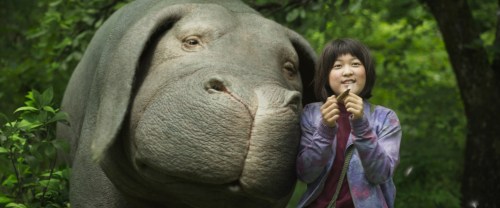
There are some people who are perfectly fine with consuming animal products, and then there are others who are staunchly vegan. If a multinational conglomerate were to engineer adorable giant pigs to cure world hunger, I do not imagine that most people would change their stances. Nor, if his latest film Okja is any indication, does Bong Joon-ho. But we are not here to focus on the masses (save for a decadent prologue that establishes that they are here to lap up whatever innovation/new species is fed to them). This is a story about a girl and her super pig, and all the zany, brainy, insane-y forces of the world that get in her way.
It might be possible to find Okja – who looks like a land-dwelling hippo with big ol’ floppy ears and a stretched-out porcine face – completely adorable and still be okay with eating bacon. I know I certainly do. Or perhaps this film will convince to swear off all pork products forever. No matter where you fall on this spectrum, it cannot be denied that Okja’s young farmgirl companion Mija (newcomer Ahn Seo-hyun) has been done wrong in so many ways. Her grandfather sells Okja to the Miranda Corporation, which will purportedly parade her around as the winner of a Super Pig contest, but of course that is just a distraction away from how the sausage is made. A visit to the factory makes it look practically genocidal. A group of activists known as the Animal Liberation Front teams up with Mija to expose Miranda for what it really is, but their motives may not fully align with each other, as Mija just wants to take Okja back home. And taking it all back to the beginning, Okja and Mija’s friendship was practically engineered by Miranda for its marketability.
Despite how grossly its animal characters are treated, Okja is not about shaming its audience. Its purpose is holding up a cracked funhouse mirror to global capitalism. Or is it just a normal mirror? In which version do we ravenously consume faces and anuses? (They’re American as apple pie!)
Befitting a Bong Joon-ho film and a world in which people feel that they can get away with anything, the production design is a beautiful and lavish rainbow, but also probably extravagantly wasteful. The characterization is similarly outsized, with the heroes, villains, and half-hero/half-villains alike displaying a range of delectable behavior. As the braces-wearing Miranda CEO, Tilda Swinton is an anxious mix of demonstrating her power and proving that she does in fact have power. Her underlings include the preternaturally calm Giancarlo Esposito and the bizarrely squeaky-voiced flibbertigibbet Shirley Henderson. Jake Gyllenhaal is deep in character work as usual as a sweaty, shorts-sporting zoologist TV host. And as the head of the ALF, Paul Dano offers up scary commitment. His brand of ethics is admirable, but not above violent enforcement. Okja asks: do we really want to free the animals if it requires such militancy?
When the film gets into specifics, though, the questions are never that simple. It all rests on the shoulders of little Mija, who has the most clear-cut motivation of anyone. Her focus and resolve allow her to achieve her purpose, but it is not clear that that result makes the world a better place. What do we make of life when every individual story is a MacGuffin?
Okja is Recommended If You Like: Orphan Black, Free Willy, The Hunger Games
Grade: 4 out of 5 Magical Animals
 Jmunney's Blog