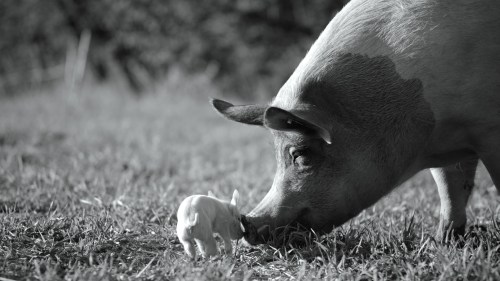
Gunda (CREDIT: NEON)
Starring: Pigs, Chickens, Cows, Bulls
Director: Viktor Kossakovsky
Running Time: 93 Minutes
Rating: G
Release Date: April 16, 2021 (Select Theaters)
I first stumbled upon Russian documentarian Viktor Kossakovsky’s work a few years ago when I saw Aquarela, which was just an hour and a half of H2O doing what it does. Now his subject matter is fully alive (instead of life-sustaining), as he takes us to the farm in Gunda. Shot in stunning black-and-white cinematography, this is a meditative document of swine, poultry, and bovines going about their day. There’s no on-screen human presence in any capacity, but this isn’t strictly cinema verite. As straightforward as the presentation is, you can sense the pulse of mediation. Watching Gunda isn’t the same as visiting a farm. It may be simple and no-frills, but I don’t think anyone else quite has the capacity to make it the way that Kossakovsky did.
Fair warning: if you’re going to watch Gunda, you absolutely have to be comfortable with maximum levels of snorting. The biggest star of the show is a momma pig who spends a significant portion of the runtime suckling her piglets, and simply put, she makes the sounds that pigs make, and she’s not ashamed to do so. That’s the general vibe of this entire film. Farm animals typically aren’t ashamed to be themselves, but that seems especially true here. While watching, I felt like I was stumbling upon personal moments that I wouldn’t have otherwise have had access to. Or maybe I’m just noticing things that I’ve never noticed before because presenting it all in a feature format forces me to pay attention. I’m pretty sure I’ve never seen cows and bulls whipping their tails against each other, for example, but that’s what they’re doing here.
Overall, there’s a bit of unexplainable magic at play in Gunda that makes it all so very compelling. I could do my best to break down how Kossakovsky managed to pull off such stunning cinematography, or take inventory in quotidian terms of everything that the animals get up to over the course of 93 minutes. But I don’t know why a pig walking around in the grass managed to transport me as much as it did. And yet somehow it did, and I’ve gotta respect her for that.
Gunda is Recommended If You Like: A day at the farm minus all the smells
Grade: 3.5 out of 5 Snouts

 Jmunney's Blog