Viggo Mortensen Confronts Abusive Parenting in His Directorial Debut ‘Falling’

Leave a comment

Falling (CREDIT: Brendan Adam-Zwelling/Quiver Distribution)

Starring: Viggo Mortensen, Lance Henriksen, Sverrir Gudnason, Laura Linney, Terry Chen, Hannah Gross, Gabby Velis

Director: Viggo Mortensen

Running Time: 112 Minutes

Rating: R for Just About Every Ethnic and Gendered Slur You Can Think Of (and Brief Nudity)

Release Date: February 5, 2021 (Theaters and On Demand)

I’m generally not terribly excited to watch movies about emotionally abusive parents, whereas I am generally excited to watch the directorial debuts of actors whose work I consistently enjoy. So I find myself internally conflicted at the prospect of Falling, in which Viggo Mortensen directs himself as John Peterson, a family man attempting to deal with his profoundly irascible father Willis (Lance Henriksen). Surprisingly enough, while watching I didn’t find myself entirely anxiety-ridden by all the familial strife on display. Perhaps my mood just happened to be in enough of a state of equilibrium to handle it, and quite possibly I wouldn’t have reacted as keenly on a more stressful day. Or maybe it had something to do with the variety of ways (frustration, gritted teeth, amusement, insults, etc.) that Willis’ kids and grandkids employ to respond to his provocations and declining mental health.

If there is one major takeaway above all others to Falling, it is the Power of Patience. John appears to be genuinely happy that his dad is spending the weekend at his house with his husband Eric (Terry Chen) and daughter Monica (Gabby Velis), but we know that his feelings can’t possibly be all (or even mostly) positive, as childhood flashbacks present a father-son relationship in which Willis browbeats his son over every single major or minor decision that he makes. And yet for all the decades of turmoil he’s endured, John is still conscientious enough to honor his own internal sense of familial loyalty. I wouldn’t judge him if he were to instead decide that the healthiest choice would be to cut his father off, but I’m glad that he tries to keep the peace with him long enough so that we have a family dinner scene in which John’s sister (Laura Linney) and her kids show up so that everyone can have a chance to declare what they really think about Grandpa.

The final act of Falling is a little more slow going, as it departs from John’s place on the West Coast back to Willis’ farm in Upstate New York. John is helping to put the property on the market, but Willis is deeply connected to his horses and intent on spending more time with them. At least that’s what I think is going on. Frankly, the story becomes significantly less dynamic when John and Willis are away from the rest of the extended Peterson clan, and I must admit that my sense of connection to what I was watching started to drift during the farm scenes. But overall, this is still a fairly compelling piece about how intergenerational trauma has a long tail but also about how it can be digested and rejected for a different approach.

Falling is Recommended If You Like: Angsty family dinner scenes, White horses

Grade: 2.5 out of 5 Pathological Insults
The Hysterical ‘Bliss’ is Here to Warn Us That Reality Isn’t Real, and I Cannot Look Away

1 Comment

Bliss (CREDIT: Hilary Bronwyn Gayle/Amazon Studios)

Starring: Owen Wilson, Salma Hayek, Nesta Cooper, Bill Nye

Director: Mike Cahill

Running Time: 103 Minutes

Rating: R for Some Very Kooky Violence, Profanity, and Sexuality

Release Date: February 5, 2021 (Amazon Prime Video)

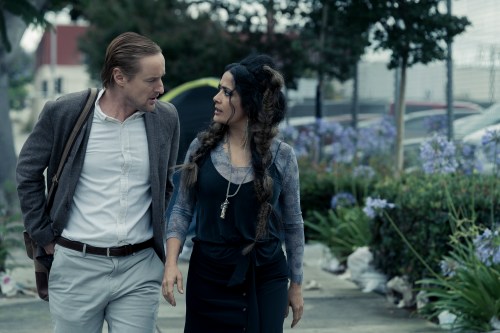
Man, how are we so lucky as to get a movie like Bliss? It stars a totally wigged-out Salma Hayek trying to convince Owen Wilson that they’re living in a simulation. And quite frankly, the evidence is immediately pretty convincing, as they seem to be the only people in the world with telekinetic powers, which manifests by them popping their hands out with authority, Bruce Almighty-style. Seriously, there’s an entire scene in which they go to a roller rink and make everyone fall on their asses just for the hell of it. And on top of all that, Bill Nye has a pretty significant part, not as himself, but as a very Bill Nye-type who keeps strong-arming Wilson with some important information. And for all you hardcore perverted philosophy geeks, Slavoj Žižek shows up just long enough for anyone who recognizes him to go, “Oh snap! Slavoj’s in this, too?!”

The only other film directed by Mike Cahill that I’ve seen besides Bliss was 2011’s similarly mindbendy-wendy Another Earth, which I found infuriatingly pretentious. Honestly, Bliss isn’t necessarily any less pretentious in its eagerness to dive into a trendy sci-fi premise in its own vaguely intellectual way. So what’s the difference? Has my cinematic tolerance level just increased significantly in the past ten years? Perhaps, but there’s also the fact that Hayek and Wilson are such inspired left-field casting choices. She is always indefatigably dynamic; give her something to rant about, and you’re not going to be able to keep your eyes off her. As for Wilson, I don’t think he ever utters his signature “Wow,” but that low-key sense of being perpetually stunned is indeed the vibe he gives off the whole time. This is a “two-very-different-tastes-that-go-great-together” situation that we never could have expected would work out as beautifully as it did.

Overall, though, I’m not sure if the ideas of Bliss really come together into anything substantial, and that’s partly because I’m not entirely sure what Cahill is trying to say.  But – and this is important – I don’t particularly care. This is an incorrigible movie, and I’m such a sucker for that sort of energy. While watching, I said to myself, “What is going on?!” a healthy number of times, and I must admit that is a feeling I enjoy experiencing. It’s too often in short supply, but it most certainly is not when Salma Hayek and Owen Wilson are questioning reality, creating their own realities, buying into fake realities, and just generally enjoying free rein to do whatever the hell they want to do.

Bliss is Recommended If You Like: The Matrix but wish it had less kung fu and more makeshift homes on the side of a highway, The “Downtime” episode of the recent Twilight Zone revival, The parts of the X-Men movies where they wave their hands around

Grade: 3.5 out of 5 Blue Crystals

‘Two of Us’ Offers a French Spin on a Late-in-Life Queer Romance

Leave a comment

Two of Us (CREDIT: Magnolia Pictures)

Starring: Barbara Sukowa, Martine Chevallier, Léa Drucker

Director: Filippo Meneghetti

Running Time: 95 Minutes

Rating: Unrated (I’d give it a PG-13 – it’s not too explicit)

Release Date: February 5, 2021 (Theaters and On Demand)

Sometimes I like to offer my skewed take on movie reviews by asking, “Does the title of this movie have something to do with this random connection I’m making?” So with that in mind, does the contemporary French romance Two of Us have anything to do with that scene from the 1932 horror flick Freaks in which a bunch of characters chant “One of us! One of us!”? It almost certainly doesn’t. The French title, after all, is Deux, which translates to just “Two” without the “of us.” And I can’t say that I detect any references to circus folk, literal or metaphorical, in Two of Us. But there may be one notable similarity, insofar as Two of Us is also concerned with the outcasts of society.

Early on in Two of Us, a woman named Nina (Barbara Sukowa) is getting annoyed at her neighbor Madeleine (Martine Chevallier) as they attempt to sell Madeleine’s home. So Nina blows up and shouts at the realtor, “Mr. Bremond, do you have a problem with old dykes?” Mr. Bremond is unsure how to answer, but it’s made perfectly clear that no, in fact, he has no problem with lesbians of a certain age (and if he did, he would probably be too afraid of Nina to say so). The actual problem is with Madeleine, who doesn’t exactly want to tell her family about Nina, who’s been her secret lover for decades. What’s notable about Two of Us compared to most other queer cinematic romances I’ve seen is that the society we see doesn’t much care that there’s a same-sex couple in their midst. This is very much an intra-family conflict, nothing more.

But within that straightforward setup, Two of Us offers surprises. Because of Madeleine’s health struggles, the narrative isn’t so simple as “secret romance” or “one lover tries to convince partner to be honest to family.” Madeleine suffers a stroke, rendering her unable to speak for herself, which has the oddly slapstick-y effect of making the subterfuge somewhat reminiscent of a heist caper, while also throwing in elements of blackmail amidst the emotional land mines. In life, plenty of people really have to fight to be allowed to love the people they love. Sometimes that fight is silly, sometimes it’s infuriating, sometimes it’s profoundly unpredictable, and sometimes it’s quite touching, and maybe most of the time, it’s a mix of all of the above. That’s certainly the case in Two of Us.

Two of Us is Recommended If You Like: Senior cinematic romances,

Grade: 3.5 out of 5 Old Dykes

Newer Entries