This Is a Movie Review: ‘Lady Bird’ Will Speak Volumes to Anyone Who Went to Catholic High School in the Early 2000s, or Anyone Who Was Ever a Teenager at Any Time

Leave a comment

CREDIT: Merie Wallace/A24

This review was originally posted on News Cult in November 2017.

Starring: Saoirse Ronan, Laurie Metcalf, Tracy Letts, Lucas Hedges, Beanie Feldstein, Timothée Chalamet, Odeya Rush, Jordan Rodrigues, Laura Marano, Lois Smith

Director: Greta Gerwig

Running Time: 93 Minutes

Rating: R for Brief Pornographic Images, But Otherwise It Should Be PG-13 for Teens Being Teens

Release Date: November 3, 2017 (Limited)

It makes sense that much of Lady Bird takes place in a Catholic school, as both the Church and Greta Gerwig’s directorial debut strongly advocate for the inherent dignity of the individual human being. Christine McPherson (Saoirse Ronan), who prefers to go by “Lady Bird” (which still counts as a given name because she gave it to herself), is a high school senior in Sacramento (“the Midwest of California,” as she puts it) in 2002 (according to her, the most exciting thing about that year is that it is a palindrome) who dreams of escaping to a liberal arts college on the East Coast, despite her thoroughly average academic résumé. There is a hint that she is an underachiever (an offhand comment notes that her SAT scores are surprisingly high), but no matter the why of her being in the middle, her life struggle is still compelling. It is not so much that she has a particularly unusual personality or worldview by teenage millennial standards; she doesn’t really. Rather, she is worth paying attention to because someone bothered to tell her story.

The most filling narrative meat involves Lady Bird’s interactions with her mom Marion (Laurie Metcalf). Anyone who has had constant drag-out cutting fights with their own mother despite both sides wanting to get along will recognize this impasse. Metcalf is an expert at navigating the fluid dynamics of parent/child relationships, while Ronan is heartbreaking as she attempts to reconcile forging her own identity with pleasing the people she cares about. And let’s not sleep on Tracy Letts as Lady Bird’s dad Larry, her quiet ally making his own way through job insecurity and depression. His is a notably un-showy performance surrounded by a couple of demonstrative women, but his quiet embodiment of personal dignity still comes through loud and clear.

For a 90-minute film, Lady Bird has a remarkably deep bench, but that is just natural for a film that values dignity so highly. As Lady Bird’s best friend Julie, Beanie Feldstein could have easily been the wacky sidekick, but instead she’s a supportive, goofy pal who also has her own stuff going on. Lucas Hedges slots in nicely as the first boyfriend who turns out to be closeted – his story is familiar, but deeply felt. We do not see as much of Timothée Chalamet and Odeya Rush as an alternate love interest and the popular girl, respectively, but we get enough that their characterizations go beyond “Strokes-esque rocker boy” and “airhead in advanced placement classes.” All the kids speak in the faux-profundity typical of adolescence (“very baller” is spouted in the same breath as “very anarchist), a touch that is both mocking and respectful, taking these kids to task but also treating them honestly. And special mention must also be made of Lois Smith as a nun who loves a good prank, surprisingly enough.

Gerwig fills in this world with a lot of well-observed details that give a natural sheen to post-9/11 American reality. Lady Bird rebukes a classmate for being “Republican” when bringing up concerns about terrorism in New York. The soundtrack draws from five years earlier more so than it does the hits of 2002, recognizing the eclectic nature of Gen Y (that has only grown more eclectic). Lady Bird is simply a sharply observed film about one voice and many voices, and all anyone has ever asked for is that they be given a chance for their voices to be heard.

Lady Bird is Recommended If You Like: Saved!, Adventureland, An Education

Grade: 4.5 out of 5 Communion Wafers

This Is a Movie Review: Takashi Miike Has a Bloody Good Time with ‘Blade of the Immortal’

Leave a comment

CREDIT: Magnet Releasing

This review was originally posted on News Cult in November 2017.

Starring: Takuya Kimura, Hana Sugisaki, Sōto Fukushi, Hayato Ichihara

Director: Takashi Miike

Running Time: 140 Minutes

Rating: R for Swordplay Between Hard-to-Kill Individuals, Which Means Extra-Extra Blood

Release Date: November 3, 2017 (Limited)

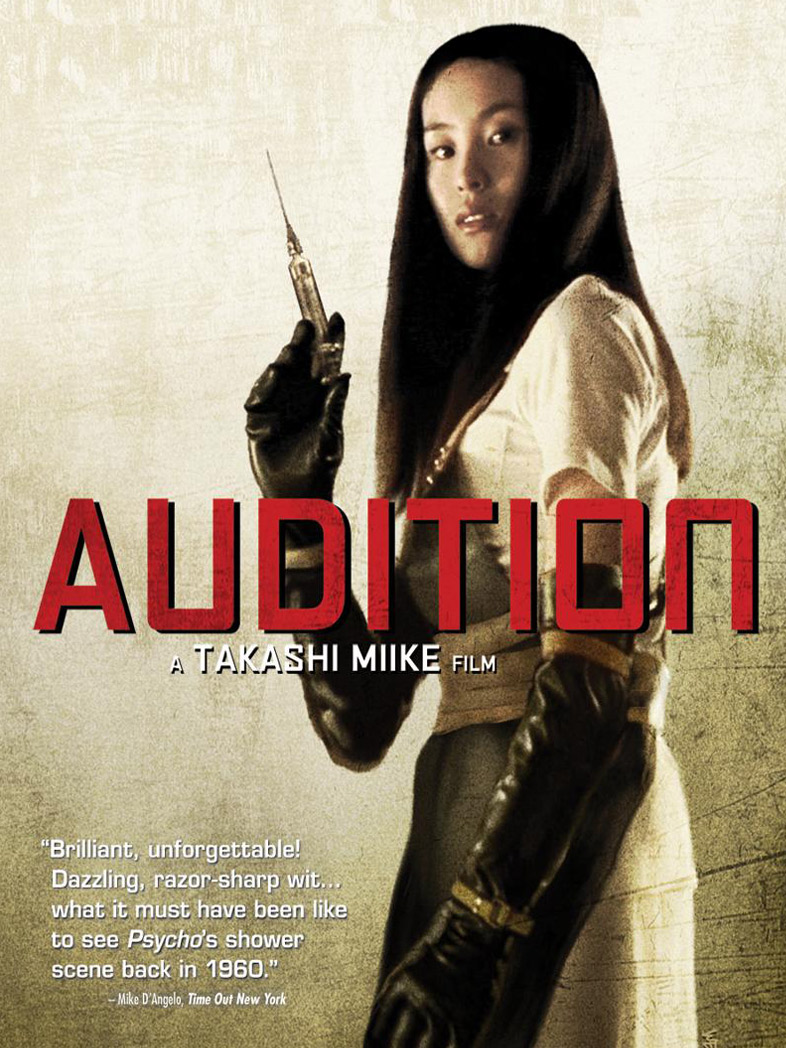
Blade of the Immortal is the latest feature from Takashi Miike, the legendary Japanese auteur behind cult classics like Audition and Ichi the Killer who has somehow managed to amass over 100 directing credits in a little under 30 years. Blade is my first exposure to a work by Miike, or perhaps it is more accurate to say, it is my first exposure to his work in full. The posters and DVD cover art for Audition and Ichi are equal parts entrancing and disturbing, enough to make you almost feel like you’ve experienced an entire movie just by sneaking a glance. Blade keeps things just as sensuously luscious, thoroughly maintaining Miike’s extreme reputation (he did direct a segment of the anthology film Three… Extremes, after all).

Miike takes quite naturally to the samurai genre, unsurprisingly reveling in a blood-soaked tale of vengeance. After the murder of her parents, Rin (Sugisaki) is out to track down the syndicate behind the killing. To help mete out her revenge, she partners up with Manji (Kimura), a local immortal samurai, who definitively considers his inability to die a curse. For all you comic book aficionados out there, he’s basically a Japanese Wolverine (which isn’t too hard to fathom considering Logan’s own occasional trips to Japan). Blade does not too get detailed in its thematic take on revenge, though it is worth noting that Rin believes there is a proper way to carry out the deed (one-on-one combat is preferable to an army massacring an individual).

The main purpose of watching Blade of the Immortal is to see how Miike indulges his gory appetite. And indeed, there is plenty of twisting of swords, splatter of blood, and hacking of limbs. Without getting too spoiler-iffic, a death at the end is absolutely perfectly explosively sanguinary. The mechanics of Manji’s self-healing are also memorable, driven as they are by so-called “bloodworms” residing in his circulatory system. It is worth noting that I was able to admire the many closeups of the bloodworms at work despite a personal history of physiologically involuntary squeamishness. But the strongest technical triumph is actually auditory. Every thud and thump on the jungle ground is mixed just so. At the end of the day, this is a movie that is just lovingly devoted to its craft.

Blade of the Immortal is Recommended If You Like: Samurai movies with maximum gore, Kill Bill, The Handmaiden

Grade: 3.5 out of 5 Bloodworms

‘I Love You, Daddy’ Was Already Creepy Before the Louis C.K. Allegations Broke. Now It’s Totally Inexplicable

Leave a comment

CREDIT: YouTube Screenshot

This essay was originally posted on News Cult in November 2017.

After multiple women came forward with stories of sexual misconduct perpetrated against them by Louis C.K., The Orchard pulled his film I Love You, Daddy (written, directed by, and starring C.K.) from its release schedule, just a week before it was set to come out. Considering the nature of the accusations, C.K. confessing to their truth, and the subject matter of the film, there was really no other choice for The Orchard to make, despite having paid $5 million for the distribution rights. Whenever entertainers get caught up in scandal, the viability of their projects is called into question, both financially and ethically. In this case, that is especially true, as I Love You, Daddy is astoundingly reflective of C.K.’s own experiences.

I Love You, Daddy will likely never see the light of a full theatrical release, but it was screening for press up until just a few days before it was pulled from the schedule. It offers plenty that is worth discussing, but I cannot imagine it is something that any potential viewer could ever unabashedly enjoy, even if C.K. had never masturbated in front of women without their consent. The premise reads like the worst possible idea that can be conceived in light of this story coming out. C.K. plays Glen Topher, a TV writer/producer (he’s pretty much basically playing himself) who tries to prevent his 17-year-old daughter China (Chloë Grace-Moretz) from dating 68-year-old filmmaker Leslie Goodwin (John Malkovich), who is infamous for his predilection for younger women and has been dogged for years by rumors of sexual abuse.

Did C.K. mean for I Love You, Daddy to be some sort of elaborate confession/apology? (At one point, Glen literally says, “I’m sorry, women.”) Or is he just baiting us, as The Huffington Post’s Matthew Jacobs suggests, into thinking it is something more substantial than it actually is? I can only speculate at his motivation. Perhaps he will speak to that publicly at some point. I often make a point when discussing controversial films to emphasize that portrayal does not equal endorsement, but in this case, that maxim falls short. I can describe for you the specific events that happen in I Love You, Daddy (like one character aggressively miming masturbation in front of others), but I am struggling to figure out what message, if any, it is portraying or endorsing. But considering the subject matter and the real-life context, that ambiguity cannot be defended.

Even if C.K. were not guilty of sexual misconduct, I Love You, Daddy would still be a dicey proposition. Leslie is clearly a stand-in for Woody Allen, who started his relationship with his wife, Soon-Yi Previn, when she was still a teenager and he was in his fifties and who has been accused of sexual abuse by his own children. The film is also a clear homage to Allen’s Manhattan, in which he plays a 42-year-old dating a 17-year-old. Let’s suppose a hypothetical in which Allen and C.K. are both free of controversy, rendering Glen and Leslie both wholly fictional creations. Even in that case, I Love You, Daddy is still creepy and misguided. In its best possible version, it could have seriously grappled with whether or not human beings’ most socially unacceptable urges can ever be morally defended. But that would require a delicate touch that this film simply does not have.

This Is a Movie Review: ‘Last Flag Flying’ Hashes Out the Personal Effects of War with Endless Conversations

Leave a comment

CREDIT: Wilson Webb/Lionsgate

This review was originally posted on News Cult in November 2017.

Starring: Steve Carell, Bryan Cranston, Laurence Fishburne

Director: Richard Linklater

Running Time: 124 Minutes

Rating: R for Dropping Some Profanity with Your Buds

Release Date: November 3, 2017 (Limited)/Expands Nationwide November 17, 2017

Richard Linklater’s Last Flag Flying is a sequel to Hal Ashby’s 1973 film The Last Detail, but you wouldn’t know that from any of the promotional materials, which make no mention of the earlier flick. You also wouldn’t know it from looking at the character names, which are not consistent between the two films. I have not seen The Last Detail, but as far as I can gather, Bryan Cranston is playing a version of a character played by Jack Nicholson, Laurence Fishburne is doing a spin on Otis Young, and Steve Carell is updating a role by (of all people) Randy Quaid. Anyway, as for the actual narrative of Last Flag Flying, all this background info is basically just as a curiosity, as this unofficial sequel stands perfectly well enough on its own.

If you were to go into Last Flag Flying completely unaware of The Last Detail (and presumably many people will), you would possibly find yourself thinking, “Hey! There’s plenty of room to craft a prequel out of this story.” Vietnam War veterans Larry “Doc” Shepherd (Carell), Sal Nealon (Cranston), and Richard Mueller (Fishburne) are psychologically torn asunder but forever bound by an incident at the end of their time in the same Marine unit. Doc committed a petty crime, Sal and Mueller helped discipline him, and he spent a couple years in a military prison. There is no ill will between the three of them, but they have gone decades without seeing each other. Now they are reuniting in a way that reunions so often unfortunately happen. Doc’s son has followed his father into the Marines, enlisting for the Iraq War, where he has died in an ambush. With few close family or friends, Doc turns to his old service buddies to help escort his son’s body to the funeral.

What follows is a trip from Virginia to New Hampshire. Instead of wide open shots of the open road we get cramped moments along the heavily trafficked Mid-Atlantic and northeast United States. Also, talking. Lots and lots of talking. Doc, Sal, and Mueller shoot the shit, air out grievances, ask pressing philosophical questions about their country and life and death, and generally strengthen an eternal bond of friendship.

While it may not necessarily be their most well-known trademark, all three stars are notable for their oratory. Just consider Cranston’s deadly commands as Walter White, Carell’s wild verbal dexterity in the likes of The Daily Show and Bruce Almighty, or Fishburne’s spellbinding declarations in The Matrix. For the most part, Last Flag plays its conversations in a much more mild key than those examples, but the effects are still quite pressing. There are questions about the point of even venturing into Iraq. It’s still 2003, thus before the falsification of evidence that led to this war has fully been revealed, so these worries are not about especially particular objections, but they are no less pressing. Running through the bloodstream of this film is a very human desire for simple respect, to be told straight what is actually going on. Last Flag Flying is for anyone who values forthrightness, and for anyone who can share in the joy of three middle-aged guys buying their very first cell phones in the middle of Manhattan.

Last Flag Flying is Recommended If You Like: The Big Chill, My Dinner with Andre, Catching up with old friends.

Grade: 3.5 out of 5 Black Men Named Richard

This Is a Movie Review: The God of Thunder Gets Stranded in the Louche ‘Thor: Ragnarok’

Leave a comment

CREDIT: Disney/Marvel

This review was originally posted on News Cult in November 2017.

Starring: Chris Hemsworth, Tom Hiddleston, Cate Blanchett, Idris Elba, Jeff Goldblum, Tessa Thompson, Karl Urban, Mark Ruffalo, Anthony Hopkins

Director: Taika Waititi

Running Time: 130 Minutes

Rating: PG-13 for Colorfully Stylized Action Violence and a Glimpse of Hulk Butt

Release Date: November 3, 2017

Even in its stronger outings, the Marvel Cinematic Universe has consistently exemplified the distressing 21st century trend of “franchise film as trailer for its upcoming sequels.” But putting at the helm Taika Waititi, the New Zealand director behind vampire mockumentary What We Do in the Shadows and coming-of-age charmer Hunt for the Wilderpeople, would perhaps signal a willingness to kick back with an idiosyncratic one-off effort. And indeed, Thor: Ragnarok is not particularly burdened by setting up the next “phase” for all the other Marvel heroes, save for the mandatory post-credits scene as well as an early rendezvous with Doctor Strange that at least has the courtesy to be completely ridiculous. But as Waititi is not creating something out of whole cloth, it is still a bear of a job to wrap his sensibility around Thor’s personal history and Asgard’s extensive mythology.

One of the biggest disappointments of most MCU films, and what made Doctor Strange so satisfying when it bucked this trend, is their lack of imagination in design and music. Their craft is far from ugly, but it is no more than workmanlike. Ragnarok has plenty of personality, but it kind of gets in the way of itself. Mark Mothersbaugh’s prog-rock synth score is entirely fitting, but it never really fully rocks out until the end credits. All the new supporting characters make a convincing case to be the breakout star, but there is only room for so much of that in a busy 2 hours. I would never willingly sacrifice Cate Blanchett’s evil diva goddess Hela, or Jeff Goldblum’s eccentric sensualist Grand Master, or Tessa Thompson’s hard-drinking and unapologetic Valkyrie, or the most hedonistic version of the Hulk we have yet seen on screen. But this is a series of solo acts, not a supergroup. They play nice together, but they only intermittently gel as a unit greater than the sum of its parts.

The plot of Ragnarok is fairly straightforward, but a little overwhelming in its climax, due to the surfeit of moving parts. The titular end of Asgardian days is threatening to come to pass with the return of Hela, the long-imprisoned goddess of death and sister of Thor. Thor and Loki broker one of their many peaces to team up and save their home realm, but they are first waylaid onto the Grand Master’s home planet, where they get caught up in some gladiatorial combat.

By the end of it all, I found myself confused about who was defeated and who was victorious, and how much so on either count. Frankly, I am perfectly willing to forgo any prosaic interpretation for the sake of embracing a more expressionistic experience. This is not hard to do, as there are plenty of blasts of pure imagination (punneriffic reference perfectly intended). Trouble is, the story does matter to the people who made this movie, and even if it did not, it is too imposing to disregard. By the end of all these affairs, Ragnarok is the type of feast that overloads you with deliciousness but leaves you crashing instead of the kind that fills you up and floods you up with endorphins. It is adequately cromulent, but not very transcendent.

Thor: Ragnarok is Recommended If You Like: Doctor Strange, ’70s Glam Rock Stars, Kiwi accents

Grade: 3.5 out of 5 Nonsense Circles

This Is a Movie Review: Palme d’Or Winner ‘The Square’ Skewers the Art World Savagely But Also Kind of Lovingly

1 Comment

CREDIT: Magnolia Pictures

This review was originally posted on News Cult in October 2017.

Starring: Claes Bang, Elisabeth Moss, Dominic West, Terry Notary

Director: Ruben Östlund

Running Time: 142 Minutes

Rating: R for Tourette’s-Fueled Potty Mouth, Outrageously Offensive Violence, and Dangerous Handling of a Condom

Release Date: October 27, 2017 (Limited)

A chimpanzee roommate walks around the apartment right before some hanky-panky is about to go down. A tug-of-war over a condom very nearly leads to some messy results. A shirtless performance artist acts like a gorilla for sanctioned live theater at a fundraiser dinner. For all the merciless weirdness that occurs in The Square, it is ultimately rather on-the-nose with the point it sets out to make.

The Palme d’Or winner at this year’s Cannes Film Festival, The Square is the latest satire from Swedish writer/director Ruben Östlund. To American eyes, it may at first glance seem like the latest case of the Europeans going full-bore with their European wackiness. But to Scandinavian viewers who are likely more familiar with Östlund’s sensibility, this probably looks like a straightforward comedy of manners, if perhaps a bit overlong. Plus, if you can get past the subtitles (and a good chunk of the dialogue is in English anyway), it becomes a lot more accessible. Besides, there is a hardcore zing directed at Comic Sans, so it cannot be completely incomprehensible.

The major conflict involves the testing of museum curator Christian’s (Claes Bang) ideals after his wallet and cell phone are stolen. This actually serves as the perfect opportunity to test out the message of the installation piece by American artist Julian (Dominic West) that Christian is currently presenting. The piece, which gives the film its name, is designed as an area where trust between patrons is binding. It is a slice of society in which everyone is looking out for each other. When Christian distributes a letter throughout an apartment building requesting the quick return of his possessions, his thief actually complies, thus fulfilling the promise of The Square. Alas, as Christian has given his letter out to all the building’s residents, the parents of a preteen boy wrongfully punish him for the same theft. In turn, the boy becomes a steady vengeful thorn in Christian’s side, constantly threatening to “make chaos.” In addition to all that, Christian must deal with a viral video campaign to promote The Square that gets out of hand, as well as the fling he gets into with Anne (Elisabeth Moss), a journalist covering the opening, that develops beyond his emotional comprehension.

The Square is much stronger in its outsize moments of satire than in its more intimate moments. From the viral video that exploits the plight of the homeless by exploding a baby, to the man shouting misogynistic obscenities during an interview at the museum who claims to have Tourette’s, to the aforementioned ape-man performance artist who takes his routine way too far, these set pieces are all steady and effective in their outrageousness. But Christian’s more personal moments of crisis are harder to unpack for a clear meaning. His fight with the non-thief boy putters out unsatisfyingly and a little sickeningly, while his situation with Anne is just plain impossible to define, with Moss giving a performance that is solid but hard to pin down. Overall, The Square is an adventure of morality that will have you asking “How would I act in that situation?” and also, “Is it even worth it to entertain the possibility that I could ever end up in that situation?”

The Square is Recommended If You Like: The Discreet Charm of the Bourgeoisie, The Art World but also making fun of the Art World

Grade: 3.5 out of 5 Dirt Piles as Art

This Is a Movie Review: ‘Suburbicon’ Pokes at the Myth of a Utopian America by Exposing Both Latent Criminality and Racism to Chaotic, Intermittently Thrilling, Results

Leave a comment

CREDIT: Paramount Pictures/Black Bear Pictures

This review was originally posted on News Cult in October 2017.

Starring: Matt Damon, Julianne Moore, Noah Jupe, Oscar Isaac, Glenn Fleshler, Jack Conley, Gary Basaraba

Director: George Clooney

Running Time: 105 Minutes

Rating: R for Wiseguy-Style Punching, Stabbing, Explosions, and Poisoning and Some Slap-Happy Hanky-Panky

Release Date: October 27, 2017

In the perfect mid-20th Century American town of Suburbicon (basically Leave It to Beaver sprung to life), the dream of raising a family with no worries and getting along with all your neighbors has been fully, uniformly realized. Or at least, that’s how it’s being sold. Whenever a movie begins with a montage praising picture-perfect suburbia, it is clear that we are actually in for satire. In this case, it is a violently screwball riff on Double Indemnity.

The idea that a utopian town can really exist is punctured fairly immediately when the home of Gardner Lodge (Matt Damon) and his wife Rose (Julianne Moore) is invaded by a couple of goons intent on thievery and terrorizing. Rose ends up dying at the hands of the thieves, leaving Gardner to raise their son Nicky (Noah Jupe) with the help of Rose’s twin sister Margaret (also Moore). But it soon becomes clear that Gardner and Margaret were behind Rose’s death, for the sake of paying off Gardner’s mob debts and so that they can cash in on the life insurance policy on Rose and escape to a Caribbean paradise. So this really is 100% Double Indemnity in the Cleavers’ neighborhood.

Ultimately, though, Suburbicon does not offer much new to say with its recontextualization, save for Matt Damon riding a comically undersized bicycle. Considering the talent assembled, that is notably disappointing. But it is not entirely surprising, as the array of violence involves the Coen brothers (who wrote the script along with Clooney and Grant Heslov) indulging in their most outrageous tendencies. At least Oscar Isaac livens things up quite a bit as the claims adjuster of claims adjusters, though his appearance is all too brief (somewhat necessarily so).

But wait! If that narrative disappoints you, why not check out the other fully fleshed out story existing within the very same movie? Suburbicon has just welcomed its first black family, although “welcomed” is far from the right word for many residents. It seems that this town’s ideals are false not just because it cannot keep the mob at bay but also because its lily-white identity includes a big hunk of racism.

If this sounds like two completely different movies, that it is in fact how much of it plays out. But that is also kind of the point. The racism portion gets relatively short shrift, but the idea does seem to be that Suburbicon, and in turn America, would like to pretend that this problem does not exist. That is a tricky point to make, though, and Suburbicon’s touch is not exactly delicate. Ultimately, then, the film is well-intentioned, but its tone is too all over the place for those intentions to be as clear as they need to be.

Suburbicon is Recommended If You Like: Anything and everything influenced by Double Indemnity, The Coen Brothers at their most cartoonishly violent, Two movies with starkly different focuses smooshed together

Grade: 2.5 out of 5 Explosions

This Is a Movie Review: The Writer of ‘American Sniper’ Says ‘Thank Your for Your Service’ with a Deep Dive Into PTSD

Leave a comment

CREDIT: Francois Duhamel/DreamWorks Pictures/Universal

This review was originally posted on News Cult in October 2017.

Starring: Miles Teller, Haley Bennett, Beulah Koale, Amy Schumer, Joe Cole, Keisha Castle-Hughes

Director: Jason Hall

Running Time: 108 Minutes

Rating: R for PTSD Hallucinations and the Resultant Anger

Release Date: October 27, 2017

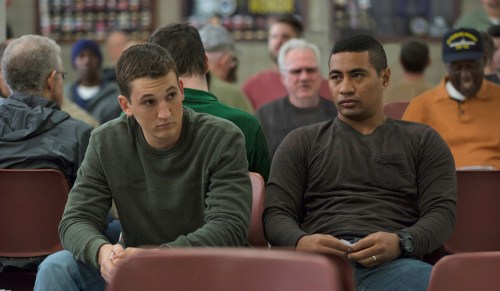
When American Sniper racked up over $300 million at the domestic box office, it wasn’t shocking just because it featured zero comic book superheroes or animated talking animals, but also because of how focused it was on the homefront. Its Iraq-set sequences were generally not very memorable; instead, its main purpose for existing was to bring to the fore the scourge of post-traumatic stress disorder on U.S. soil. I doubt that Thank You for Your Service, written and directed by Sniper screenwriter Jason Hall, will rake in similarly huge bucks, but it has learned the right lessons from its predecessor of where to place its focus.

Thank You is primarily concerned with the perpetually overburdened Department of Veterans Affairs, which is trying to offer psychiatric help for its returning soldiers, but the soonest it can offer appointments is 12 weeks, but sometimes no earlier than nine months. For vets like Adam (Teller), Aieti (Koale), and Will (Cole), that is just as life-threatening as combat in Iraq. This might not sound like the most rousing of cinematic premises, but the way it plays out is quite thrilling. PTSD episodes exist as disorienting hallucinations that are the more surreal for just how minimally they depart from reality. A fallen comrade suddenly appears and seems to be perfectly corporeal but then lets out a blood-curdling scream, inciting a burst of uncontrollable violence. It plays out as horror that will hit too close to home for many.

Anchoring the whole endeavor and preventing it from becoming too overwhelming is Teller, who has developed a knack for playing characters with plenty of hustle who take on much more weight than anyone has asked them to. Adam’s burden is less PTSD and more survivor’s guilt. He struggles to atone for a squadmate he attempted to save but who ended up partially paralyzed, and he can barely face the widow of a fellow sergeant who died after taking his place on one coincidental day. That he ultimately does face his fears provides some hope that maybe this system is not entirely broken. As a narrative machine, Thank You for Your Service is a little creaky, but it pulls through with astutely observed interactions between soldier and soldier or soldier and spouse, and brings it all home with a gentle catharsis.

Thank You for Your Service is Recommended If You Like: American Sniper, Jacob’s Ladder

Grade: 3 out of 5 PTSD Hallucinations

This Is a Movie Review: ‘All I See is You’ is a Sensuous Feast Hobbled by an Inconsequential Narrative

Leave a comment

CREDIT: Roland Neveu/Open Road Films

This review was originally posted on News Cult in October 2017.

Starring: Blake Lively, Jason Clarke, Danny Huston, Ahna O’Reilly, Wes Chatham, Miquel Fernández

Director: Marc Forster

Running Time: 110 Minutes

Rating: R for Sex Ranging From Passionate to Frustrated to Illicit to Voyeuristic

Release Date: October 27, 2017 (Moderate)

A couple is in the throes of passion, nearing climax. The woman is blind, but that does not mean she lacks vision entirely. For her, this moment is like a kaleidoscope of rapture, the embrace between her and her husband replicated throughout her entire field of perception. It is a euphoric start for All I See is You, whose aesthetic ambitions far outstrip its narrative ones.

Gina (Blake Lively, rarely better) is the victim of an accident that stripped her of her eyesight. Her husband James (Jason Clarke) has remained a steady presence during her time of darkness. The part of her brain meant to interpret the work of her eyes is still working, so instead of pitch black, she is treated to a constant laser light show. For about the first half hour, director Marc Forster and his design team revel in the opportunities to render the subjective experience of blindness in cinematic terms. But then, her doctor (Huston) promises a procedure to restore her sight, which proves to be a liability for both the film’s creativity and Gina and James’ relationship. Despite how trustworthy as his character is meant to be, it goes to show you that anyone played by Danny Huston cannot help but be ominous.

With Gina on the road to a full recovery, the film takes a swerve into a dour drama about love on the rocks, and not a very interesting one. James proves to be too prudish and unadventurous for Gina, but the real problem is his controlling nature. It was easier when he could be the steady hand when she was blind, but now he is practically useless. It does not help that they are struggling to have a baby, with James likely lashing out due to his own impotence. There is perhaps a story worth exploring here about how this relationship was kept afloat by a disability, but any conclusions drawn therein are rather vague. Besides, it feels pointless to even bother what themes the film is trying to touch on here (something about voyeurism?) when it abandons its best feature way too quickly.

All I See is You is Recommended If You Like: Terrence Malick-ian visuals, Leaving 30 minutes after the movie starts

Grade: 2.5 out of 5 Lasers

This Is a Movie Review: ‘Novitiate’ is the Latest Harrowing and Also Inspiring Peek at the Inner Workings of the Catholic Church

Leave a comment

CREDIT: Sony Pictures Classics

This review was originally posted on News Cult in October 2017.

Starring: Margaret Qualley, Melissa Leo, Julianne Nicholson, Dianna Agron, Denis O’Hare

Director: Margaret Betts

Running Time: 123 Minutes

Rating: R for Sexuality and Profanity-Laced Anger That Can Be Suppressed for Only So Long

Release Date: October 27, 2017 (Limited)

An institution as massive and long-lasting as the Catholic Church is bound to be filled with corners that many of its members are completely unfamiliar with. Sometimes those areas are not even the ones that are shamefully hidden. They may actually be intrinsic features, but if allowed to function independently, they can involve into a weird hybrid of both doctrinaire and renegade. I was raised (and remain) Catholic, but I was born decades after the reforms of Vatican II, which rendered the most extreme practices of convents as seen in Novitiate verobten. But even if I had been a churchgoer in the ’60s, I doubt I would have been familiar with the ins and outs of the nuns’ rigorous training. And yet, this story does not feel fully alien, nor should it feel so to anyone of any background who has ever desired feelings of deep love and devotion.

This examination of religious life is mainly told through the story of Sister Cathleen (Margaret Qualley), who in 1964 is one of the convent’s new class of postulants (candidates to become nuns) who eventually become novitiates (nuns-in-training). Margaret’s ready acceptance of the convent’s extreme practices, e.g. self-abnegation, has nothing to do with lifelong indoctrination, as she comes from a family of bitterly divorced, agnostic parents (at least Mom is agnostic, Dad is never much around). Her attraction to marrying God is perhaps a desire for stability, but it is also more than that. Stirring in her is an aching for transcendence that cannot easily be explained by nurture (or lack thereof). Setting her up as the novice character to follow in this secretive world is crucial, because otherwise the convent’s frightening elements would feel almost abstract and theoretical.

As the convent is resisting the reforms of Vatican II that were then being enacted, the message is clear that this is not the right way to practice religious devotion. But that historical background of rebuke is unnecessary to make that point, except perhaps for viewers with the most hardened of souls. The training and practices – oppressive silence, avoidance of eye contact, asceticism, confession in a group setting – are reminiscent of the auditing of Scientology, so memorably approximated in The Master. Ostensibly designed to make its adherents better people and closer to God, its true effects are vulnerability and surrender to authority. Overseeing all this is the Mother Superior (Melissa Leo), who while sitting on her throne of a central chair, is reminiscent of Pan’s Laybrinth’s Pale Man.

Novitiate is powerful grist for the mill for those who decry the problems inherent to all religions and for those who remain religious but point to this as an example of the wrong way of doing things. And quite frankly, it may very well also make such a connection to the ultra-traditionalists and reactionaries, who might see this as a lament for the old, better way. It is a fascinatingly human look at all those urges, appealing both to a desire to connect to a higher power and a desire to not be wrong.

Novitiate is Recommended If You Like: Spotlight, The Master, Silence

Grade: 4 out of 5 Grand Silences

Older Entries Newer Entries