‘I Play Rocky’ Would Like Us to Know That the Making of a Classic Had a Lot of the Same Themes as That Classic

Leave a comment

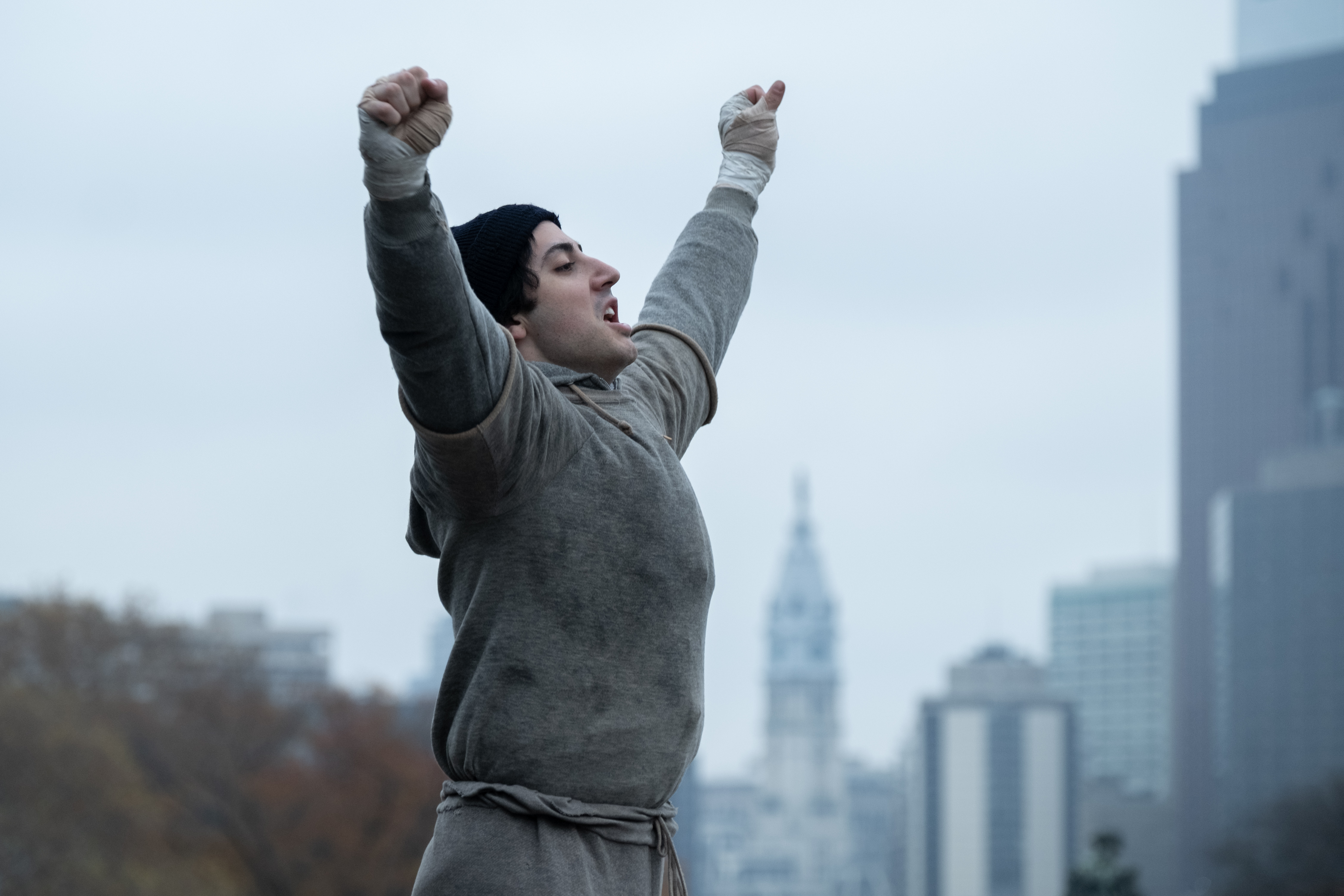
The Guy Who Plays He Who He Plays Rocky (CREDIT: Claire Folger/© 2026 Amazon Content Services LLC. All Rights Reserved.)

Starring: Anthony Ippolito, AnnaSophia Robb, P.J. Byrne, Toby Kebbell, Tracy Letts, Jay Duplass, Matt Dillon, Stephan James, Kiki Seto, Nikki Flynn, Michael Fuchs

Director: Peter Farrelly

Running Time: 128 Minutes

Rating: PG-13 for Some Language, Smoking, and an X-Rated “What If?”

Release Date: November 6, 2026 (Limited Theaters)/November 20, 2026 (Expands Nationwide)

What’s It About?: Before he starred in one of the most beloved underdog sports stories of all time, Sylvester Stallone was a struggling actor who occasionally had to resort to sleeping on the street, appearing in softcore porn, and even selling his dog. When we meet the version of him played by Anthony Ippolito in I Play Rocky, he’s going by the decidedly less Italian “Mike” and romancing his soon-to-be-wife Sasha (AnnaSophia Robb), who encourages him to give his career a boost by writing his own parts. So they move to L.A., where he cranks out screenplays in between working as a valet. His scripts catch the attention of producing partners Irwin Winkler (P.J. Byrne) and Robert Chartoff (Toby Kebbell), who want to buy his tale of a pugilist who goes all the way. However, they’re not so keen on his insistence that he play the lead role, but that’s a demand he won’t back down from easily. They eventually let him play Rocky, but every single circumstance of the production conspires to make it as much of an underdog tale as what’s on the page.

What Made an Impression?: He Plays the Guy Who Plays Rocky: During the requisite moment when Sasha convinces her almost-husband to go by his real name, she insists that “there’s only one Sylvester.” But of course, the fact that that line is in a biopic makes it inherently ironic, as Anthony Ippolito would appreciate it if we could make room for at least one more Sylvester. His take on the Italian Stallion goes deeper than impression, though he does take great care to make sure that he gets the voice and the mannerisms just right. But that polished approach also lovingly reminds us of the soulfulness that the real Stallone is capable of but doesn’t always show off. Furthermore, it allows the too-good-to-be-true elements of his backstory to go down more powerfully than they would otherwise.
They Play the Other Guys: I Play Rocky doesn’t entirely consist of recreations of cultural touchstones. (In fact, I would say it’s not even mostly that.) We also get to see the machinations of names that are more familiar than their faces, with Byrne and Kebbell delivering a perfect level of smooth operating as Winkler and Chartoff, while Nikki Flynn adds plenty of zest as their secretary Linda. But threatening to upstage them all is Jay Duplass as Rocky director John G. Avildsen. Avildsen is not always mentioned prominently in the Balboa mythos, but Duplass fleshes him out as the sort of guy who avoided being simply a hired hand by pure force of personality.
Playing Our Heartstrings: You remember when I said that this movie doesn’t completely rely on recreating its source material? Well, at a certain point, it can’t resist presenting its own versions of Rocky and Adrian’s private ice rink date or Rocky yelling at Mickey in the doorway. But the buildups to those moments are generally patient and meaningful enough to make plenty of us raise our fists in celebration, just like the guys cheering “Yeah, Rocky!” during the climactic movie premiere scene. It’s predictable emotional manipulation, but when it works, it works.

I Play Rocky is Recommended If You Like: Being reminded how you fell in love in the first place

Grade: 4 out of 5 Screenplays

Fair Warning, ‘Rosebush Pruning’ is Now in Theaters

Leave a comment

A rose by any other bush… (CREDIT: MUBI/Screenshot)

Starring: Callum Turner, Jamie Bell, Tracy Letts, Riley Keough, Lukas Gage, Elle Fanning, Pamela Anderson, Elena Anaya

Director: Karim Aïnouz

Running Time: 95 Minutes

Rating: Unrated

Release Date: July 24, 2026 (Theaters)

Rosebush Pruning is a movie that does feature some literal rosebush pruning, but that titular gardening activity is also a metaphor for something else. Anyway, what you really gotta know about this flick is that Callum Turner, Jamie Bell, Riley Keough, and Lukas Gage play a quartet of adult siblings who still live with their father (Tracy Letts), and let’s just say that they’re a little bit too close to each other. Longtime readers of my reviews will surely know that I often like to ask myself if I would like to live in the world of the movie that I’m reviewing. In this case, that answer is: Oh, definitely not! Unless, that is, we zoom out a bit. While I certainly don’t want to be a member of this family, I wouldn’t mind spending a decent amount of time in beautiful Catalonia, which is where they currently live. So I guess the moral of the story is: when in Spain, don’t be these people

Grade: Hide Your Rosebushes!

Boo! October Movie Catch-Up

Leave a comment

Good Boy, Good Times at the Movies (CREDIT: Ben Leonberg/Independent Film Company and Shudder)

Okay, here we go. It’s time for me to release my thoughts about the new movies that I saw in the month known as October 2025 that I haven’t explicated until now. Trick-or-treat furever!

More

Greta Gerwig’s ‘Little Women’ Demonstrates the Power of Renewed Resonance Through Reorganizing

3 Comments

CREDIT: Wilson Webb/Columbia/Sony Pictures

Starring: Saoirse Ronan, Emma Watson, Florence Pugh, Eliza Scanlen, Laura Dern, Timothée Chalamet, Meryl Streep, Tracy Letts, Bob Odenkirk, James Norton, Louis Garrel, Chris Cooper

Director: Greta Gerwig

Running Time: 135 Minutes

Rating: PG for A Few Bloody Knuckles and General Adolescence

Release Date: December 25, 2019

I’m a big advocate for the value of consuming a story in whatever order you damn well please. If you get engrossed in a movie halfway through and then watch the beginning at some future point, then bully on you. If you watch the last season of a popular TV show first and then catch up on previous seasons in a random zigzagging order, that sounds fascinating. If you always skip ahead to the last paragraph of a novel and also reread your favorite chapters before you’re done the whole thing, then it sounds like you’re someone who enjoys experimenting. To all of you who fit in any of those categories, you’ve got a kindred spirit in Greta Gerwig, who plays mix-and-match with her rendition of Louisa May Alcott’s 1868 semi-autobiographical novel Little Women, one of the most beloved and oft-adapted works of American fiction.

If I were to extend my advocacy for watching something in whatever order you like to its logical end, then I could say that you could watch this Little Women in an even more chronologically mixed-up fashion than it already is. (Or you could go in the opposite direction, and I bet there is someone out there who will one day re-edit this film into a more temporally linear fashion.) But Gerwig’s chosen order of events is far from arbitrary. The opening scene and one of the final moments especially underscore the themes that she wants to bring to the surface.

There is a general air of light postmodernism to this movie, in the sense that there is a tacit understanding that the majority of the audience is already familiar with the story. Thus, Gerwig begins with scenes in which the little women are closer to, if not already, grown adults. The most iconic episodes from earlier in the March sisters’ lives do not need to be rehashed, at least not right away. Instead, Jo March (Saoirse Ronan) kicks things off by bounding into a publishing office to sell a story she’s written. It’s bought by a Mr. Dashwood (Tracy Letts), but he also tells her that if her main character is a girl, she must be married (or dead) by the end. Chances are that most viewers know that these are indeed the fates that await the March sisters, but a collective smirk is likely to form across the crowd at this moment, because we also know that the entire purpose of Little Women is that these significant lives are not just reduced to their expected conclusions.

The other essential moment comes when the far-flung temporal settings have caught up with each other, and Jo is fretting to her sisters that her completed novel, based on her own family life, is about a trivial topic and nothing important. Even though she is mightily invested in her own work, she is still subscribing to the idea that only “important” subjects are really worthy of being written about in novels. But then her youngest, always fiercely opinionated sister Amy (Florence Pugh) insists that the mere act of writing about a subject confers importance upon it. And so, because Gerwig is telling this story once again, and because it is clearly a labor of love for her, and because Emma Watson and Eliza Scanlen are there alongside her and Ronan and Pugh to round out and bring to life the March sisterhood, all of that is the reason why Little Women is important in 2019.

Little Women is Recommended If You Like: Revisiting the classics

Grade: 4 out of 5 Adaptations

Ford v Ferrari = Friendship!

Leave a comment

CREDIT: Twentieth Century Fox

I’m not sure what the message of Ford v Ferrari is, and I’m not sure if that’s a mostly good or mostly bad thing. (We could be doing a lot worse in this world!) Is it about how you can’t ever stop American individualism from being as individual as possible? Or is it about how the United States won’t ever stay an underdog for long, even in pursuits usually dominated by the Europeans? If it’s either of those, then why is the main character an Englishman? Maybe it’s about how teammates stick with each other no matter what, and the whole American-ness of it all just be how it be. Certainly what stuck with me the most is the friendship between Christian Bale’s vroom-vroom-goer Ken Miles and Matt Damon’s vroom-vroom-guider Carroll Shelby. It’s an oft-contentious relationship, which only makes sense when you’re gearing up for a race that lasts a full day. Such competition, such support, such politics behind the whole affair – I saw it all!

I give Ford v Ferrari 240 out of 360 Laps.

This Is a Movie Review: The Defense of Journalism Mounted by ‘The Post’ is Admirable and Often Rousing, But Almost Quaint

Leave a comment

CREDIT: Niko Tavernise/Twentieth Century Fox

This review was originally posted on News Cult in December 2017.

Starring: Tom Hanks, Meryl Streep, Bob Odenkirk, Tracy Letts, Bruce Greenwood, Matthew Rhys, David Cross, Alison Brie, Sarah Paulson, Bradley Whitford, Jesse Plemons, Carrie Coon, Zach Woods

Director: Steven Spielberg

Running Time: 115 Minutes

Rating: PG-13 for Deadline-Related Light Profanity

Release Date: December 22, 2017 (Limited)/Expands Nationwide January 12, 2018

The First Amendment of the United States Constitution guarantees some fundamental freedoms, but certain limits on those freedoms are understood. Hate speech is not protected by free speech, for example, and human sacrifice is not protected by freedom of religion. But there is not quite the same shorthand for limits on a free press. Publishing anything demonstrably libelous is certainly unacceptable, but when is it inappropriate to print what is in fact true and has hitherto been hidden? This question is at the heart of so many present-day media matters, so in comes Steven Spielberg’s The Post, which examines a time when this conflict was a momentous occasion and not an everyday one.

In 1971, The Washington Post finds itself in possession of the Pentagon Papers, a trove of documents detailing the United States’ involvement in Vietnam over the past few decades. Executive editor Ben Bradlee (Tom Hanks) and his team of journalists think the public deserves to know this information. The federal government says it would be a felony to print it. There is no mistaking where The Post (both the paper and the film) comes down on this conflict. This is not new information and thus serves no imminent threat to American troops in Vietnam. The only harm it can cause is embarrassment for former presidents. The actual conflict that The Post grapples is the attempted reconciliation between ethical and business concerns.

The constant struggle of press outlets, even institutions as big as The Washington Post, is figuring out how to make money by delivering the truth. That struggle is writ large when making a public offering, which is what we’ve got here. Do you make a stronger case to your investors by laying low or by making a ruckus in the course of standing up for your principals? As publisher Katharine Graham, Meryl Streep is all contorted faces and knotted anxiety as she takes the lead to make the decision of printing the Papers or not. The drama is wrung in screwball fashion, with Bradlee appealing to her over the phone at the last a minute, as a gaggle of other interested parties hop on the line.

For as grand as The Post’s ambitions are, it is strange to consider that most of it takes place over the course of just one day. It all then feels almost inconsequential, but of course, certain individual moments can change the course of everything. When that is the case, there has probably been months, or even years, of work behind the scenes setting up those moments, as conveyed by an early scene of Daniel Ellsberg (Matthew Rhys) gathering and absconding with the Papers. Also delivering the dynamic agita is Bob Odenkirk as Ben Bagdikian, an old buddy of Ellsberg’s who tracks down the delivery. Odenkirk’s comedic background is an asset – he moves about with a paranoid shuffle that is somewhere between absolutely necessary and hilariously unnecessary. Also rousing is a typesetting montage following the decision to publish the Papers. This mechanical peek at how things are done is a valuable reminder of underlying structure in much the same way that Michael Mann’s Blackhat spent so much visual space on the wires that undergird the Internet.

Ultimately, while The Post’s advocacy for journalism is timeless, its story feels small-scale, a prelude to the much bigger fallout of Watergate and all the modern-day scandals that use -gate in their nomenclature. The Richard Nixon of The Post is only ever seen from behind and through a window. His fight against the press was fought in the shadows, but today his same tactics are being employed right out in the open. The Post’s lessons are ones I hope everyone takes to heart, but I wonder (despair?) how useful they are when the sorts of secrets exposed by the Pentagon Papers are now nonchalantly tweeted every day.

The Post is Recommended If You Like: All the President’s Men, Spotlight, a Free Press

Grade: 3.5 out of 5 Sealed Documents

This Is a Movie Review: ‘Lady Bird’ Will Speak Volumes to Anyone Who Went to Catholic High School in the Early 2000s, or Anyone Who Was Ever a Teenager at Any Time

Leave a comment

CREDIT: Merie Wallace/A24

This review was originally posted on News Cult in November 2017.

Starring: Saoirse Ronan, Laurie Metcalf, Tracy Letts, Lucas Hedges, Beanie Feldstein, Timothée Chalamet, Odeya Rush, Jordan Rodrigues, Laura Marano, Lois Smith

Director: Greta Gerwig

Running Time: 93 Minutes

Rating: R for Brief Pornographic Images, But Otherwise It Should Be PG-13 for Teens Being Teens

Release Date: November 3, 2017 (Limited)

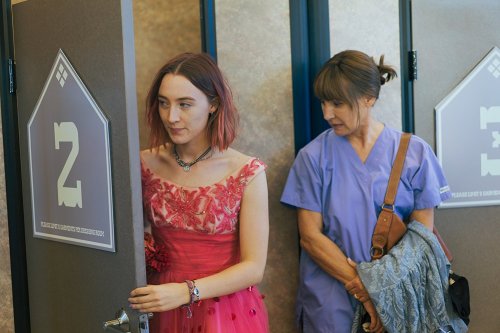
It makes sense that much of Lady Bird takes place in a Catholic school, as both the Church and Greta Gerwig’s directorial debut strongly advocate for the inherent dignity of the individual human being. Christine McPherson (Saoirse Ronan), who prefers to go by “Lady Bird” (which still counts as a given name because she gave it to herself), is a high school senior in Sacramento (“the Midwest of California,” as she puts it) in 2002 (according to her, the most exciting thing about that year is that it is a palindrome) who dreams of escaping to a liberal arts college on the East Coast, despite her thoroughly average academic résumé. There is a hint that she is an underachiever (an offhand comment notes that her SAT scores are surprisingly high), but no matter the why of her being in the middle, her life struggle is still compelling. It is not so much that she has a particularly unusual personality or worldview by teenage millennial standards; she doesn’t really. Rather, she is worth paying attention to because someone bothered to tell her story.

The most filling narrative meat involves Lady Bird’s interactions with her mom Marion (Laurie Metcalf). Anyone who has had constant drag-out cutting fights with their own mother despite both sides wanting to get along will recognize this impasse. Metcalf is an expert at navigating the fluid dynamics of parent/child relationships, while Ronan is heartbreaking as she attempts to reconcile forging her own identity with pleasing the people she cares about. And let’s not sleep on Tracy Letts as Lady Bird’s dad Larry, her quiet ally making his own way through job insecurity and depression. His is a notably un-showy performance surrounded by a couple of demonstrative women, but his quiet embodiment of personal dignity still comes through loud and clear.

For a 90-minute film, Lady Bird has a remarkably deep bench, but that is just natural for a film that values dignity so highly. As Lady Bird’s best friend Julie, Beanie Feldstein could have easily been the wacky sidekick, but instead she’s a supportive, goofy pal who also has her own stuff going on. Lucas Hedges slots in nicely as the first boyfriend who turns out to be closeted – his story is familiar, but deeply felt. We do not see as much of Timothée Chalamet and Odeya Rush as an alternate love interest and the popular girl, respectively, but we get enough that their characterizations go beyond “Strokes-esque rocker boy” and “airhead in advanced placement classes.” All the kids speak in the faux-profundity typical of adolescence (“very baller” is spouted in the same breath as “very anarchist), a touch that is both mocking and respectful, taking these kids to task but also treating them honestly. And special mention must also be made of Lois Smith as a nun who loves a good prank, surprisingly enough.

Gerwig fills in this world with a lot of well-observed details that give a natural sheen to post-9/11 American reality. Lady Bird rebukes a classmate for being “Republican” when bringing up concerns about terrorism in New York. The soundtrack draws from five years earlier more so than it does the hits of 2002, recognizing the eclectic nature of Gen Y (that has only grown more eclectic). Lady Bird is simply a sharply observed film about one voice and many voices, and all anyone has ever asked for is that they be given a chance for their voices to be heard.

Lady Bird is Recommended If You Like: Saved!, Adventureland, An Education

Grade: 4.5 out of 5 Communion Wafers