This Is a Movie Review: ‘Only the Brave’ Admirably Portrays an Elite Firefighting Crew

Leave a comment

CREDIT: Richard Foreman/Sony Pictures Entertainment

This review was originally posted on News Cult in October 2017.

Starring: Josh Brolin, Miles Teller, Jeff Bridges, James Badge Dale, Taylor Kitsch, Jennifer Connelly

Director: Joseph Kosinski

Running Time: 133 Minutes

Rating: PG-13 for the Conflagrations and References to Past Drug Use

Release Date: October 20, 2017

It is a frequently stated and generally accepted claim that mothers have the strength to lift a car when their children are in danger. Perhaps we need a similarly illustrative example for people who are naturally drawn to extreme situations in service of others. How else can we explain how relatively few people become firefighters but those who do must necessarily be dangerously committed? It is a little abstract to put in these terms, as the threat is often not immediate and it can be difficult for the human mind to comprehend the scale of the population that is being protected. There is also the fact that we already can explain firefighters’ ability via hardcore training and acclimation exercises. But the ever-present life-threatening nature of this calling earns it a more intense appraisal.

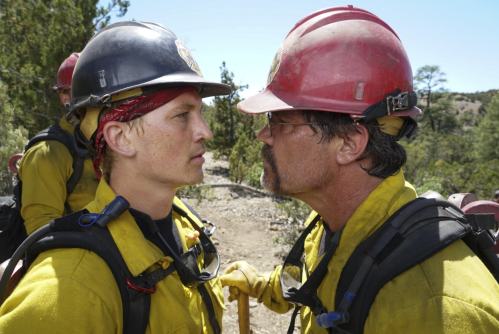
With that in mind, the best way to watch Only the Brave is by appreciating a group of experts performing their jobs exceptionally well under pressure. The film tells the story of the Granite Mountain Hotshots, an elite Arizona firefighting crew, and the events leading up to their battle with the Yarnell Hill Fire, one of America’s deadliest wildfires in decades. The two most compelling performances come courtesy of Josh Brolin and Miles Teller. The former is the crew’s head, Eric “Supe” Marsh. We’ve seen his type before: when he isn’t physically out in the forest (which he almost always is), his mind is still there, dreaming about a charging bear drenched in flames. He is the kind of guy whose wife (Jennifer Connelly) must bear hearing clichés like “It’s not easy sharing your man with the fire.” Supe’s characterization comes nowhere reinventing the wheel, but Brolin imbues him with plenty of dignity.

More unique is Teller’s role as Brendan “Donut” McDonough, the crew’s newest recruit, a former addict genuinely trying to improve himself. When introduced, he in no shape to be a firefighter, puking and nearly dehydrating on the first training run. Back home, an ex-girlfriend has just given birth to their daughter, and he is making a genuine effort to earn a place in her life. There are plenty of moments that Brendan could relapse, or abandon his crew, or give up on being a dad. But he always sticks it through, proving his mettle as a man with willpower that is rare and admirable. Dramatic heft is often achieved through fighting past bad decisions, but Only the Brave manages to earn plaudits by continually keeping Brendan on the up-and-up.

Ultimately, I admire the story of Only the Brave more than I enjoy it as a film. Partly, I believe that is due to the narrative’s episodic sensibility, which is an odd choice, considering that it is leading up to a huge climax. Of course, that decision makes a certain sense, in that day-to-day life, no matter how dangerous, is usually unspectacular until the one day that it is unpredictable. This may not be as much of a problem to other viewers, but I do wish the editing had been as compelling as the performances.

Only the Brave is Recommended If You Like: Real Life Bravery

Grade: 2.5 out of 5 Fire Bears

This is a Movie Review: ‘The Killing of a Sacred Deer’ is Disturbingly Unforgettable Horror From the Director of ‘The Lobster’

1 Comment

CREDIT: Jima (Atsushi Nishijima)/A24

This review was originally posted on News Cult in October 2017.

Starring: Colin Farrell, Barry Keoghan, Nicole Kidman, Bill Camp, Raffey Cassidy, Sunny Suljic, Alicia Silverstone

Director: Yorgos Lanthimos

Running Time: 109 Minutes

Rating: R for Bluntly Presented Gore and Nudity

Release Date: October 20, 2017 (Limited)

Yorgos Lanthimos’ specialty as a writer and a director of actors is strange and disturbing dialogue delivered bluntly and clinically. Given the setting and characters in The Killing of a Sacred Deer, it makes a kind of sense that this behavior is typical (due to a combination of professional desensitization and psychopathy), but it is never not unnerving. It works to provide a sense of foreboding for what initially presents itself as a slice-of-life tale that will soon give way to a domestic thriller. But really, what we are being primed for is much more sinister and much more terrifying and in fact qualifies as full-on horror.

Steven Murphy (Colin Farrell) is a cardiac surgeon who takes under his wing Martin (Dunkirk’s Barry Keoghan), the teenage son of a patient who died on his operating table. Martin seems interested in medicine himself, spending significant amounts of time shadowing Steven in the hospital. Steven invites him over to the house for dinner, where he charms his wife Anna (Nicole Kidman), becomes friendly with his son Bob (Sunny Suljic), and grows romantic with his daughter Kim (Tomorrowland’s Raffey Cassidy). The Murphys seem to notice Martin’s odd behavior, but they never fully acknowledge it. For a while, it seems that this film is just taking place in a world of lunacy, where announcing statements like “our daughter just started menstruating last week” are perfectly natural to declare in public. But once Steven recoils at Martin’s mom’s (Alicia Silverstone) attempt to seduce him by aggressively licking his fingers, it becomes clear that this is terrifying for both the audience and the Murphys.

The foreboding is realized hard and unsettlingly, as Bob and then Kim become paralyzed from the waist down without any clear physical explanation. Martin reveals in great detail to Steven what is going on, apparently confirming that he is the source of this ailment. He could be poisoning them, but it is so supernatural that “hex” or “plague” would be a better word. The obvious motivation here is revenge for the death of his father, but Martin’s unflappably flat speaking voice makes it impossible to get a perfect read on him. Lanthimos may or may not be speaking in metaphors; if so, I am not sure what the message is, but if not, the film is disturbing enough that it works on its own terms.

Ultimately, though, The Killing of a Sacred Deer might end up too untethered from its starting point to be an unqualified success. Indeed, it begins to lose me around the point that Steven is firing a shotgun at his family with a bag over his head. That particular scene – and others like it – are filled with fantastic tension, but they feel like Lanthimos is just filling his thirst for demented horror set pieces instead of focusing on the premise he has already established. Maybe that dissociation is the point, but sometimes the heightening of scares can use a firm direction.

The Killing of a Sacred Deer is Recommended If You Like: The inexplicableness of The Happening but not the cheesiness, The Lobster, Funny Games

Grade: 3 out of 5 Bleeding Eyeballs

This Is a Movie Review: Blade Runner 2049

Leave a comment

CREDIT: Stephen Vaughan/Alcon Entertainment/Warner Bros.

When I write pre-release reviews, I include a list of similar titles, genres, etc. to indicate whether or not the movie being reviewed is worth recommending. I do not usually do that for my quicker reviews, but I feel compelled to do so for Blade Runner 2049. To wit: Blade Runner 2049 is recommended if you like Fringe, Orphan Black, the Futurama episode “A Clockwork Origin,” and of course, the original Blade Runner. They all play around with questions of identity and being godlike in the creation of new life. I wonder if they influenced Denis Villeneuve and company. Of course, they were all probably influenced by the original. Except for Blade Runner itself. Although that would be an interesting philosophical claim to say that a movie influenced itself.

I loved the hologram sex scene.

I give Blade Runner 2049 80% Existence out of 100 Replicants.

This Is a Movie Review: Noah Baumbach and Adam Sandler’s Sensibilities Align Perfectly in ‘The Meyerowitz Stories (New and Selected)’

1 Comment

CREDIT: Atsushi Nishijima/Netflix

This review was originally posted on News Cult in October 2017.

Starring: Adam Sandler, Ben Stiller, Dustin Hoffman, Elizabeth Marvel, Emma Thompson, Grace van Patten, Judd Hirsch

Director: Noah Baumbach

Running Time: 110 Minutes

Rating: Unrated, But It Would Probably Be (a Soft) R for Intrafamily Yelling and Artistic Nudity

Release Date: October 13, 2017 (Limited Theatrically and Streaming on Netflix)

It’s tempting to say that The Meyerowitz Stories (New and Selected) is Noah Baumbach’s version of an Adam Sandler comedy. That’s a good starting point, though it isn’t exactly right. It is most accurate to say that Baumbach happened to write a character that just happened to perfectly align with Sandler’s sensibilities. The same can also be said to a certain degree for Dustin Hoffman and Ben Stiller, two of the other Meyerowitzes with distinct styles, but it is Sandler’s shtick that leaves the most telling impression. This film could hardly be mistaken for a Happy Madison production, but it is a sort of cinematic half-sibling.

Hoffman is Harold Meyerowitz, a sculptor and retired art professor whose lack of greater commercial success is constantly referenced and bemoaned. His adult children Danny (Sandler), Jean (Elizabeth Marvel), and Matthew (Stiller) are all sorts of messed up. Danny and Jean are still recovering from all the time they didn’t have with their dad while growing up after he divorced their mother, while their half-sibling Matthew is still recovering from all the time that he did spend with Dad.

Each Meyerowtiz actor is aces in pulling off their own unique form of neuroticism, but this is primarily Sandler’s forte. It plays into his pet interests of fraught but tender father-son relationships and lovable man-children. Danny is probably talented enough to have been a professional musician, but instead he is terminally unemployed, though he occasionally crafts goofy piano-based tunes with his teenage daughter Eliza (Grace van Patten). But this is not really a matter of arrested development, as Danny tracks as a genuine adult, just one who never had to accept professional responsibility, especially because he could still manage to be a great father while retaining a childlike disposition. And I haven’t even mentioned all the moments of that patented Sandler yelling put to good use. In fact, the film opens with Danny and Eliza attempting to find a parking spot in Manhattan, a premiere situation for Sandler frustration if ever there was one.

The main narrative thrust involves the Meyerowitz siblings dealing with Harold’s extended critical hospital stay. Considering all the tension in these relationships, this could be a recipe for disaster. And while a few scuffles do break out, Danny, Jean, and Matthew instead mostly bond over their shared screwed-up natures and resolve to embrace forgiveness and gratitude. Plus, they also all get to gather around and watch Eliza’s work as a film student at Bard College, which consists of the surreal sexcapades of “Pagina Man.” It features a fair bit more nudity than you might think an 18-year-old would be comfortable sharing with her family, but despite any discomfort, they all agree she has talent. And since she comes from a family that is so naturally entertaining, how could she not?

The Meyerowitz Stories (New and Selected) is Recommended If You Like: Noah Baumbach’s New York, Big Daddy, Goofy student films

Grade: 4 out of 5 Ex-Wives

This Is a Movie Review: It’s Chan vs. Brosnan in Revenge Thriller ‘The Foreigner’

Leave a comment

CREDIT: STX Films

This review was originally posted on News Cult in October 2017.

The Foreigner – It’s Chan vs. Brosnan in Revenge Thriller ‘The Foreigner’

Starring: Jackie Chan, Pierce Brosnan

Director: Martin Campbell

Running Time: 113 Minutes

Rating: R for Frequent Explosions, Booby-Trap Puncture Wounds, and a Bit of Scheme-Based Shagging

Release Date: October 13, 2017

At age 63, Jackie Chan is still allowed to shimmy down roofs, walls, and pipes. And good for him, because while what he pulls off stunt-wise in The Foreigner is nowhere near as relentless as his early films, his twists, spins, and rolls still look like the most natural things in the world for him to be doing. But this revenge thriller places a new skill at the top of Chan’s repertoire: survivalism. As a meek London business businessman, Ngoc Minh Quan’s (Chan) knack for springing camouflaged traps with tree branches and leaves is in the key of a doomsday prepper, but actually they represent the horrors of a native land he would rather forget but will summon if he has to.

Quan’s journey for vengeance is set off by a bomb that detonates in a busy street, killing his daughter Fan (Katie Leung, aka Cho Chang from Harry Potter). But he has had the capacity for a long time to go off on a one-man spree to make terrorists pay. He was a trained killer in his home country (it is a little confusing whether Quan is supposed to be Vietnamese, or ethnically Chinese but born in Vietnam, or something else) who sought a more peaceful life by moving to England, but lost two of his children along the way. To further ramp up the tragic backstory, his wife died while giving birth to Fan. So when Fan dies, it is the classic revenge setup of the man who has nothing left to lose. The Foreigner does not add much to this genre, save for Chan’s heavily haunted performance, his eyelids and hair permanently weighed down by the debris of the blast.

Those responsible for the bombing are certain members of the IRA attempting to stir up trouble, which Quan does not much care about, but the film certainly does. There is a sense of a bigger conflict swallowing up a few small people, similar to Edge of Darkness, director Martin Campbell’s last entry in the revenge field. But where that earlier film had an easily identifiable conspiracy hook, The Foreigner’s political conflicts are much more convoluted. For the uninitiated, it is hard to make heads or tails of what the IRA’s issues with the UK are, and why they should be flaring up now. That confusion is papered over a bit by the compelling presence of Pierce Brosnan as government official Liam Hennessy, whose association with the IRA may not be as reformed as he would like to pretend. The cat-and-mouse struggle between Chan and Brosnan is a high-quality white-knuckle battle between two vets who know exactly what they’re doing. But they are surrounded by a hodgepodge of other goings-on that do not come together for a clear message or purpose.

The Foreigner is Recommended If You Like: Apocalypse Prepping, Rambo, Edge of Darkness

Grade: 3 out of 5 Tree Branch Traps

This Is a Movie Review: The Paradox of Life is That a ‘Happy Death Day’ Makes a Happy Birthday Worth Celebrating

6 Comments

CREDIT: Universal Pictures

This review was originally published on News Cult in October 2017.

Starring: Jessica Rothe, Israel Broussard, Ruby Modine, Rachel Matthews, Charles Aitken, Rob Mello

Director: Christopher B. Landon

Running Time: 96 Minutes

Rating: PG-13 for Cheekiness Towards Violence and Sex

Release Date: October 13, 2017

Legitimately great remakes can come from both good or bad originals. The key is to offer a fresh spin. Happy Death Day is not officially a remake of Groundhog Day, but the influence is obvious (and cheekily acknowledged within the narrative). So I can believe that this new splashy horror flick was conceived as a redo of the Bill Murray time loop classic but with a slasher spin, and if indeed it was, that reveals a lot about why it succeeds as well as it does.

The film jolts into its adrenaline-fueled default as college student Tree Gelbman (Jessica Rothe, probably best known as the roommate in the green dress from La La Land) shoots awake on the morning of her birthday in an unfamiliar bed after a night of blacked out debauchery. The day ends with her stabbed to death by a killer in a creepy baby mask (which is inexplicably also the school mascot). But it’s her lucky day, or her eternally unlucky day, as she then wakes up in the same spot on the same date and meets her demise all over again, and then comes back to life again and repeats it all for an endless cycle of death and rebirth. But living like a phoenix ain’t so fire when you’re stuck in an eternal loop of cattiness, superficiality, and a refusal to confront lasting emotional pain.

Tree’s story matches up with that of Phil Connors not just in terms of mechanics but also spiritually. Ultimately, Groundhog Day is about the path to becoming a better person by unavoidably being confronted with past mistakes. Happy Death Day’s purpose is very much the same, surprisingly so for its genre but undeniably so regardless. A little more specifically, it examines how the ever-lingering possibility of death can spur someone on to living her best life by being the best possible version of herself. Death also has a major presence in Groundhog Day, but mostly on the edges (Phil’s resets don’t require him to bite it); in Happy Death Day, it is writ large.

Grief and loss loom uncomfortably in Tree’s life. Her mother, with whom she shared a birthday, passed away a few years earlier, and she has refused to really confront her lingering emptiness. Instead, she hides behind drinking, random hookups, and catty banter with her sorority sisters. Initially, she comes off as a typical slasher archetype: the superficial queen bitch whose demise the audience craves. But the loop is utilized to crack away at that cliché and uncover the genuine person underneath, allowing the audience to instead fall in love with her.

If this all sounds unwelcomingly weighty, it should be noted that the emotional import is handled efficiently and entertainingly enough that it does not get in the way of the wildly intense horror camp. The rating may be PG-13, but there is little restraint in the dialogue’s colorfulness. Scott Lobdell’s witty script displays influence from the likes of Mean Girls, Heathers, nighttime soaps, and other self-aware horror films. A few choice lines include “Would you please stop staring at me like I took a dump on your mom’s head?” or surmising that déjà vu means that “someone’s thinking of you while they’re masturbating.” Even sillier outbursts like, “Show your face, you pussy!” earn their stripes with the power of convicted delivery.

Happy Death Day wisely leaves out any prosaic explanation about why Tree is stuck in the loop. There is some exploration about how the injuries of each death carry over into the new repeated day, but that thread is ultimately discarded. Focusing on that element only when it is useful is a bit of a cheat, but an understandable one. From a mystery standpoint, Happy Death Day is much better at investigating the killer’s identity than it is at examining metaphysics. Like a lot of great twisty thrillers, the narrative leads you right to the culprit but then swerves into a detour. It is enough to make you hysterically scream right along with Tree at the big philosophical questions of a life gone topsy-turvy.

Happy Death Day is Recommended If You Like: Scream crossed with Mean Girls but wish both of those films had been influenced by Groundhog Day

Grade: 3.75 out of 5 Tylenols

This Is a Movie Review: ‘Breathe’ Advocates Overcoming Polio for the Sake of Picnics

Leave a comment

CREDIT: Laurie Sparham/Bleecker Street/Participant Media

This review was originally posted on News Cult in October 2017.

Starring: Andrew Garfield, Claire Foy, Tom Hollander

Director: Andy Serkis

Running Time: 117 Minutes

Rating: PG-13 for the Medical Realities of Treating Polio

Release Date: October 13, 2017 (Limited)

It’s amazing what a change of scenery can do. After Robin Cavendish (Andrew Garfield)  is confined to a hospital bed due to paralysis from polio, he is all set to be resigned to a quick death. But then his wife Diana (Claire Foy) springs him out against doctor’s orders and gets him set up more permanently with a ventilator at home. They gradually become even more adventurous, lugging Robin (and the machine keeping him alive) along on a vacation to Spain and a medical conference in Germany. With Diana, their son Jonathan, dog Bengy, and plenty of other friends and family accompanying him on all these experiences, polio is no big whoop. He has plenty of reasons to live and remains unfailingly his slyly humorous self, now with an extra added gallows edge.

As dramatized in the film, Cavendish died in 1994 at the age of 64, 36 years after contracting polio, making him one of the longest-living responauts in British history. “Responaut” refers to someone who is permanently dependent upon a ventilator for breathing. It is also just a cool word in and of itself. Unfortunately, Breathe only uses that word once. It is simply an unconscionable fail to leave that opportunity on the table. This could have been a much more twisted and radical movie if its most commonly used word were “responaut.” I think the real Robin would have approved.

As it is, though, it is a perfectly agreeable film about defying the medical status quo and basking in the English countryside. The latter especially. Breathe would probably claim its raison d’ȇtre is the power of convincing medical professionals to go deeper and see towards the future. And indeed there are so many scenes of people being amazed that polio patients are actually able to go outside. But I see what Englishman Andy Serkis, in his directorial debut, is really up to. His message is clear: if you’re a Brit, paralysis is no big deal, so long as you can go out and picnic while taking in all the lush greenery, dense trees, beautiful fountains, and cricket matches. Do we have some stealth environmentalism going on here? Let’s learn from the past and not let Mother Nature contract polio!

Breathe is Recommended If You Like: Beautiful vistas, A Beautiful Mind, Inspiration to get yourself through medical school

Grade: 2.75 out of 5 Disabled “Prisoners”

This Is a Movie Review: ‘Human Flow,’ Ai Weiwei’s Refugee Documentary, is Oddly Constructed, But Still Essential Viewing

Leave a comment

CREDIT: Amazon Studios

This review was originally posted on News Cult in October 2017.

Documentary

Director: Ai Weiwei

Running Time: 140 Minutes

Rating: PG-13 for the Realities of Refugee Life

Release Date: October 13, 2017 (Limited)

Chinese artist/activist Ai Weiwei has extensive documentary experience, but mostly in the form of long-form video pieces. With Human Flow, a portrait of refugee life in the 21st century, he approaches feature documentary (and cinema in general) with a distinctly non-traditional visual grammar. Certain flourishes border (or cross fully into) the amateurish, particularly a bizarrely intrusive TV news-style scrolling ticker. Perhaps Ai is ahead of his time with this technique, but right now it is definitively awkward. That is not to say the whole endeavor is unprofessional. Rather, the unfailingly beautiful cinematography only serves to further highlight the unfairness of the plight of refugees. Still, it is clear that this is the work of someone not exactly fully acquainted with (or not beholden to) the norms of feature filmmaking.

Despite any technical weirdness, I would still recommend Human Flow to all audiences. Roger Ebert famously called the movies “a machine that generates empathy,” and there are few groups more in need of empathy than refugees. With its sprawling, ambitious nature, with footage filmed over the course of a year in 23 countries, Human Flow’s primary purpose is familiarizing the settled with the stories of the displaced. It is impossible (I hope) to spend two hours immersed in their experiences and not come out at least a little more concerned. From an efficiency and entertainment standpoint, Human Flow could be a lot tighter, but if it can lead to solutions for worldwide instability, then those issues don’t much matter.

Human Flow is Recommended If You Like: Looking out for the most vulnerable among us

Grade: 3 out of 5 Evil People Sent Into Space

This Is a Movie Review: ‘Marshall’ is an Electric Portrait of the Supreme Court Justice as a Young NAACP Defense Lawyer

Leave a comment

CREDIT: Barry Wetcher/Open Road Films

This review was originally posted on News Cult in October 2017.

Starring: Chadwick Boseman, Josh Gad, Sterling K. Brown, Kate Hudson, James Cromwell, Dan Stevens, Ahna O’Reilly

Director: Reginald Hudlin

Running Time: 118 Minutes

Rating: PG-13 for the Dangers of Being And/Or Defending a Black Man in Mid-Century America

Release Date: October 13, 2017 (Moderate)

I almost feel like it is my Professional Critical Duty to take Marshall to task for its most straightforward biopic tendencies. In that vein, while Marcus Miller’s jazzy score that just won’t quit is agreeably toe-tapping, it does indeed make it consistently clear when you are supposed to feel angry, or concerned, or shocked, or stirred to pride. But I can live with one element being on the nose, especially if it is enjoyable in and of itself. Besides, Marshall mostly sidesteps biopic clichés (save for one silly moment of epiphany). It only just superficially feels cliché because justice prevails so rousingly. But it deserves to prevail because its subject is kind of one of the best lawyers in American history.

Reginald Hudlin’s film wisely opts for the surest path to biopic success, i.e., focusing on one chapter in the subject’s life. In 1940, more than two decades before he ascended to the U.S. Supreme Court, and twelve years before he argued before that same court in Brown v. Board of Education, Thurgood Marshall (Chadwick Boseman) was a lawyer working for the NAACP, whose mission was to represent wrongfully accused African Americans across the country. One of those wrongfully accused was Joseph Spell (Sterling K. Brown, cast both for and against his type of commonly decent men), a driver for a wealthy Connecticut family on trial for raping the woman he works for (Kate Hudson). Marshall’s co-counsel is insurance lawyer Sam Friedman (Josh Gad), but since Sam is the only one certified to practice law in the state, only he and not Thurgood can speak during the trial, thanks to the ruling of a possibly racist or perhaps just frustratingly strict judge (James Cromwell).

Marshall is not out to score liberal brownie points, though it could easily settle for that. What it is more interested in, and what makes it so valuable, is examining why systems and social norms exist, and exploiting them for the best possible solution. A man like Joseph can find himself unfairly fighting for his life not just because he is black, but also because he is not entirely innocent. He has been guilty of unfaithfulness, petty theft, and absentee parenting. None of this makes him a rapist, but it is the conflation of all crimes that has been used and continues to be used as faux justification for the endurance of institutional racism. Marshall the film, and Marshall the man, say that yes, there is racism here, but there’s more to it than that. When it comes down to it, judge, jury, and opposing counsel are all people, and they can be appealed to if you know how to wield the truth properly and effectively, and are willing to take a few shots from those who aren’t ready yet.

Marshall is Recommended If You Like: To Kill a Mockingbird, Conviction, Selma, 42

Grade: 3.5 out of 5 Pebbles

This Is a Movie Review: ‘Professor Marston and the Wonder Women’ is a Love(s) Story Like No Other

Leave a comment

CREDIT: Claire Folger/Annapurna Pictures

This review was originally posted on News Cult in October 2017.

Starring: Luke Evans, Rebecca Hall, Bella Heathcote, Connie Britton, Oliver Platt

Director: Angela Robinson

Running Time: 108 Minutes

Rating: R for Getting It On Unapologetically

Release Date: October 13, 2017

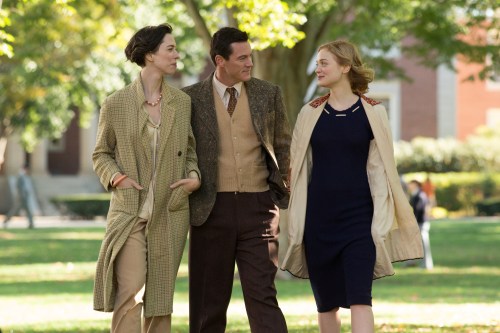
I think every man, woman, boy, girl, or whatever personal nomenclature you prefer should go and be inspired by Wonder Woman. I also want to recommend just as wholeheartedly Professor Marston and the Wonder Women, the story of Wonder Woman’s creator and his inspiration, but fair warning: William Moulton Marston (Luke Evans) lived an unprecedented life, by any era’s standards. His biography is not absolutely necessary to understand the context of Diana Prince, but it is enlightening. His story is also alarming, but also ultimately joyous, and that is true especially in light of the Wonder Woman film so pointedly emphasizing Diana’s prerogative to protect all life.

To get right into it: Marston did not come into comic books through publishing or 9-to-5 hackery, but rather psychology and academia. He is noted for developing DISC Theory, which proposes that all human behavior can be categorized as either dominance, inducement, submission, or compliance. To be clear, this is not just sexual behavior he is talking about, but all human behavior. If you’re wondering if a guy like this would be intrigued by sexual bondage, then your instincts are correct. However, if you’re also thinking that this part of the story has nothing to do with the creation of Wonder Woman, you clearly have not read her early issues. Marston is also famous for inventing an early lie detector prototype, and now that are you are remembering the Lasso of Truth, it should be abundantly clear how his ideas have lived on.

But while all that history is important to the film, Professor Marston and the Wonder Women is a love story through and through, and an unapologetically nontraditional one. Marston and his wife Elizabeth Holloway Marston (Rebecca Hall), a fellow psychologist, lived with another woman, Olive Byrne (Bella Heathcote), lover to them both. If this arrangement sounds like misogyny lurking underneath a supposed ally of women, well, this staunchly feminist does not see it that way, and neither do its staunchly feminist characters. Instead, Bill, Elizabeth, and Olive, in their decision to live together in defiance of society’s standards, are positioned as self-sacrificing heroes ahead of their time. This is true perhaps in the sense that as the inspirations of an iconic fictional character, the ladies’ legacy lives on. But it is not exactly true (at least not yet) in the sense that polyamory is still far from normal.

Personally, I do not object to polyamory on any moral grounds, but rather, because I find the prospect emotionally exhausting. But damn if Professor Marston doesn’t have me cheering for those who believe in it. There is no doubt that this trio are in fact deeply in love with each other. A series of lie detector scenes make that effervescently clear. These moments may be cinematic contrivances, but I don’t care, as they are so entertainingly bold! Indeed, it is rare to find any major theatrical release whose social and romantic politics are so unapologetic, and for that, it should be cherished.

Professor Marston and the Wonder Women is Recommended If You Like: Wonder Woman comics – the classic and the obscure stuff, Jules and Jim, Shakespeare in Love, Secretary

Grade: 4 out of 5 Lie Detectors

Older Entries Newer Entries