This Is a Movie Review: Terminator Genisys

2 Comments

Arnie-Smile-Genisys

Terminator Genisys basically ignores the third and fourth movies in the series, but it should be noted that 3 and 4 do not really grapple with their predecessors, at least not very meaningfully. T3 backtracks on the message of T2, while Salvation merely fills in the blanks in a way that mostly stands on its own. Genisys, meanwhile, crisscrosses 1 and 2, while new machinations try to prevent or delay the victory or defeat of Skynet. It does not completely stand as its own thing, but there is so much thrown together (mostly gracefully), that it works as something. It manages to be fascinating, at least in an academic sense.

Sarah Connor and Kyle Reese’s interactions are colored by the knowledge of destiny, as they grapple with how to or how not to fulfill the roles that have already been set for them. It is a fairly effective treatise on the nature of stories in which the characters “know” what they are “supposed” to do. Emilia Clarke and Jai Courtney’s performances are not much more than serviceable, but maybe that is the point. Maybe in being locked into their roles, they cannot add too much extra color.

The most consistent draw of this series remains The Terminator himself. Arnold Schwarzenegger has been on a bit of a hot streak in finding relaxed, playful subtleties in his performances, and that continues here, as his awkward cyborg smiles are just exactly right. Also, J.K. Simmons shows up as a beat cop who gets caught up in everything, and he is completely superfluous but very much welcome.

This Is a (Quickie) Movie Review: Magic Mike XXL

1 Comment

MAGICMIKE-WANT-IT-THAT-WAY

If the Amber Heard subplot had been scuttled, Magic Mike XXL would have been all set to go. To be fair, though, her last scene, in which she is gyrated upon by Mike at the stripper convention, loosens up that stiffness.

The top highlights belong to Joe Manganiello. Of course, we have all already heard about his gas station convenience store performance to “I Want It That Way,” and it is worth the hype. But watch out for the transition from Bruno Mars’ “Marry You” to Nine Inch Nails’ “Closer” in the finale and the discussion about how every inch of BD Richie fit in Andie MacDowell’s “glass slipper.”

This Is a Movie Review: Me and Earl and the Dying Girl

Leave a comment

me-earl-dying-girl-popsicle

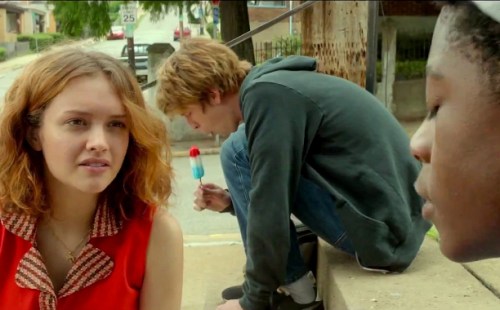
Greg Gaines (the titular “me”) is reminiscent of Community‘s Jeff Winger. In the beginning of his story, he puts a great deal of effort into proving that he does not care, only for his ending to underscore the lengths to which he does care.

Greg defines himself by how detached he is from the high school clique system. He affects a dispassionate disposition, but he puts so much effort into being on amicable terms with every group. He goes so far as to devise a taxonomy that is thorough enough to include “Boring Jewish Senior Girls, Subgroup 2A.”

Every other major character is presented through Greg’s limited perspective, and accordingly they register as if they are all in their own distinct movies. Nick Offerman and Connie Britton play slightly against type/slightly extending from their types as Greg’s parents, making for a pretentious art flick and a slightly overbearing dramedy. Molly Shannon is right in her wheelhouse in the overbearing comedy portion as the mother of the girl with cancer. Jon Bernthal is Greg’s history teacher in the slightly dangerous bildungsroman. And Katherine C. Hughes, as Madison, the hot girl who means well but makes Greg feel terrible by virtue of being a hot girl, prompts the animated fantasy sequences.

Fuller portraits of Earl and Rachel (the titular girl) manage to shine through, thanks to their significant screen time. Greg refers to Earl, his filmmaking partner, as his “co-worker,” but Earl is quick to point out that they are in fact friends. There is a bit of a magical Negro vibe at play, which could have been unfortunate save for RJ Cyler making Earl so strong-willed and the narrative presenting plenty of personal background.

Rachel could have very well been the embodiment of cancer-related epiphanies or just one half of a typical teenage weepie romance. Indeed, Greg often suggests that the story seems to be going in that direction, only to immediately rebuke that idea. Instead, Olivia Cooke keeps Rachel appropriately grounded, as she comes across as just a person dealing with her illness on her own terms. As far as Greg and Rachel’s relationship goes, they develop a true friendship as a result of spending a lot of time with each other. Potential interpretations of the exact nature of their friendship are left wide open.

Madison represents an intriguingly unique story tack. She emerges as another love interest for Greg, which – for a character with only a handful of scenes in a movie with a more expected potential romance – is disconcerting, but also resonant. Greg assumes that Madison’s attention towards him is just pity, but there are enough subtle tells to suggest that her interest is genuine. What emerges is a film accomplished in its thorough commitment to taking on the subjective perspective of a protagonist so insecure that he cannot imagine that anyone would actually think highly of him. As Me and Earl and the Dying Girl is stuck in Greg’s head for so long, it is cathartic when he is finally able to get out of it.

A few words must also be devoted to Greg and Earl’s parody films (with dumbly brilliant pun titles like “Eyes Wide Butt,” “My Dinner with Andre the Giant,” and “Pittsburghasqatsi”). Because Greg is so unassuming regarding their quality, they come off as more charming than annoying. And based on what footage is actually shown, there appears to be decent composition and editing. It helps that Earl’s committed performances consistently shine through. Much of the story is leading up to the premiere of the film that the duo are making for Rachel, which could have ended up as so many clichés, but instead emerges as an idiosyncratic vision (regardless of quality level) and hardly what anyone could have possibly expected.

This Is a (Quickie) Movie Review: Spy

Leave a comment

Spy Movie
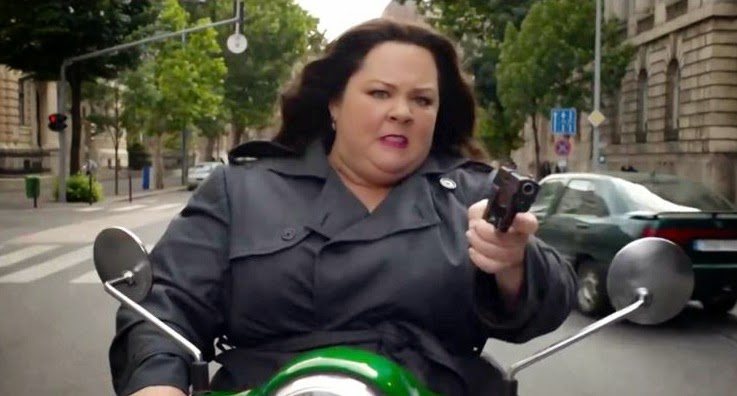
In the beginning of Spy, it makes sense that everyone underestimates Susan Cooper. She’s never been out in the field, and she does not look like the typical secret agent. But at a certain point, when her quick thinking and physical training gets her out of trouble for the umpteenth time, it is a little hard to believe that everyone has not noticed. But it also seems like everyone has noticed, whether or not they’ve said so. After all every major male character seems to have fallen in love with her by the end.

Since the message of Spy is so tangled, its success rests on the strength of its comedy. That aspect is rather mean-spirited, but understandably so, because the insults tend to come from some clearly terrible people. It would have added welcome depth if Rose Byrne’s Rayna Boyanov were more than cartoonishly evil, but she did relish yelling that she was surrounded by idiots.

This Is a (Quickie) Movie Review: Ex Machina

Leave a comment

EX-MACHINA

Ex Machina posits that A.I. is most convincing when you can see that it is a machine and yet it still registers as human consciousness. This is also the formula of a certain strain of great magic: the magician explains the trick to the audience, but the illusion still stands. Accordingly, Ex Machina is interested in magic, what with the main characters thoroughly expositing their ruses. But who will prove to be the master of misdirection: A.I. impresario Nathan, his employee/mark Caleb, or shiny new robot Ava? The twists are predictable, but the exploration upon getting to them is deeply fascinating.

Oscar Isaac has given the best performance of the year so far, and not just because of this:

This Is a (Quickie) Movie Review: Unfriended

3 Comments

unfriended-horror-movie

Unfriended, at heart, is a typical one-by-one mystery killer story. Ergo, it is not particularly scary. So when a horror movie is not very scary, it needs to be interesting. And boy, is it interesting. Essentially the entire running time takes place on an Apple laptop. With all the Chrome tabs, Skype windows, Spotify’s, Messenger’s, Recycle Bins, and desktop icons, I at first thought it was going to be exhausting, but then I soon remembered that I am used to all that.

It succeeds at relentlessly exploiting its killer premise and withholding information until the most effective moments. While I very much enjoyed it, it is not something I would jump at watching again, as all the characters are just terrible friends to each other. The best word to describe this movie is “nasty.” It’s a cautionary tale, a nasty movie for nasty people.

This Is a Movie Review: As Above, So Below

Leave a comment

as-above-so-below-movie-poster-16

As Above, So Below has one of the most unique horror premises in a while: a team of explorers go spelunking in the catacombs below Paris and as they enter rarely-explored sections, they discover that they might be in a portal to Hell, or something like it.  Too bad it takes forever for the story to actually get around to exploring that premise.  The lead spelunker is multilingual, multi-degreed Scarlett (Perdita Weeks), who is carrying on the work of her late father of finding the Philosopher’s Stone, a legendary substance said to have alchemical and life elixir powers.  A prologue of Scarlet searching for clues in an Iranian cave suggests that the hellish nature of underground locations may not be limited to one place, as she sees a vision of a man hanging himself that serves as a bit of foreshadowing.  Following this prologue is approximately 45 minutes of Scarlet and her crew in Paris figuring out how they are going to enter the catacombs, and it is just as boring as it sounds.

Much has been made of the fact that As Above, So Below is yet another in horror’s found-footage sub-genre, and the talk I have seen is generally bemoaning that there is yet another fake documentary in the arena.  As Above would have worked perfectly fine without this gimmick, even though it actually does attempt some interesting techniques with it, such as placing mounted cameras on everyone’s cave headgear, which solves the problem of limited realistic camera angles.  But, ultimately, this movie does not make sense as found-footage because there is no reason for this footage to be found, because (SPOILER ALERT) multiple characters survive and presumably hold onto the footage.

The failing of As Above, So Below is that all of its worthwhile elements are crammed into the last act.  This is either a failure of pacing, or a failure of not having enough ideas to fill out a feature length.  I actually think it is mostly the former, as the last 15 minutes or so show the weird, exciting adventure that this film could have been all along.  Ultimately the catacombs are less Hell but something closer to purgatory.  It is a gauntlet that can be survived, if those who pass through it prove worthy.  Scarlet and her crew are haunted by terrible memories of their past, specifically, moments when a loved one died that they fear they could have done something to prevent. The ghosts of these loved ones can serve as agents of either retribution or forgiveness, which could have led to some fascinating psychological territory.  But this pattern is a little inconsistent, and it takes too long for it to become clear for it to have its fullest effect.  As Above, So Below does, however, feature a first-person perspective of Scarlet punching not one, but two, monsters in the head, after more than an hour of everyone having no idea how to fend off the evil creatures. C+

This Is A Movie Review: Boyhood

Leave a comment

Boyhood

I don’t know if the filming-over-11-years gimmick made this happen, or if it was just Richard Linklater’s sensibility, but Boyhood avoided just about every coming-of-age cliché it possibly could.  And let’s be clear: the 11 years of filming was a gimmick.  That’s not a knock – I love gimmicks.  You just gotta commit to them.  And the very nature of this gimmick required commitment.

There are so many moments in Mason Evans, Jr.’s boyhood that seem like they are heading towards the typical melodramatic formula of getting into trouble, followed by confrontations, and then tearful apologies.  Take, for example, Mason drinking beer in his friend’s family cabin, or watching porn with his stepbrother.  These are things that could get him into trouble, but instead, they are just things that happen.  These moments are typical of most boys’ lives.  What is important in portraying them is how each particular boy experiences them.  This extended filmmaking technique proves to be a successful experiment in exploring these moments as they pertain to the meaning of growing up.  A decade on one project has led to wonderfully internalized character work, resulting in one-of-a-kind performances from Ellar Coltrane (Mason), Patricia Arquette (Mason’s mom), Ethan Hawke (Mason, Sr.), and Lorelei Linklater (Mason’s sister). A-

This Is A Movie Review: Guardians of the Galaxy

1 Comment

GuardiansOfTheGalaxy

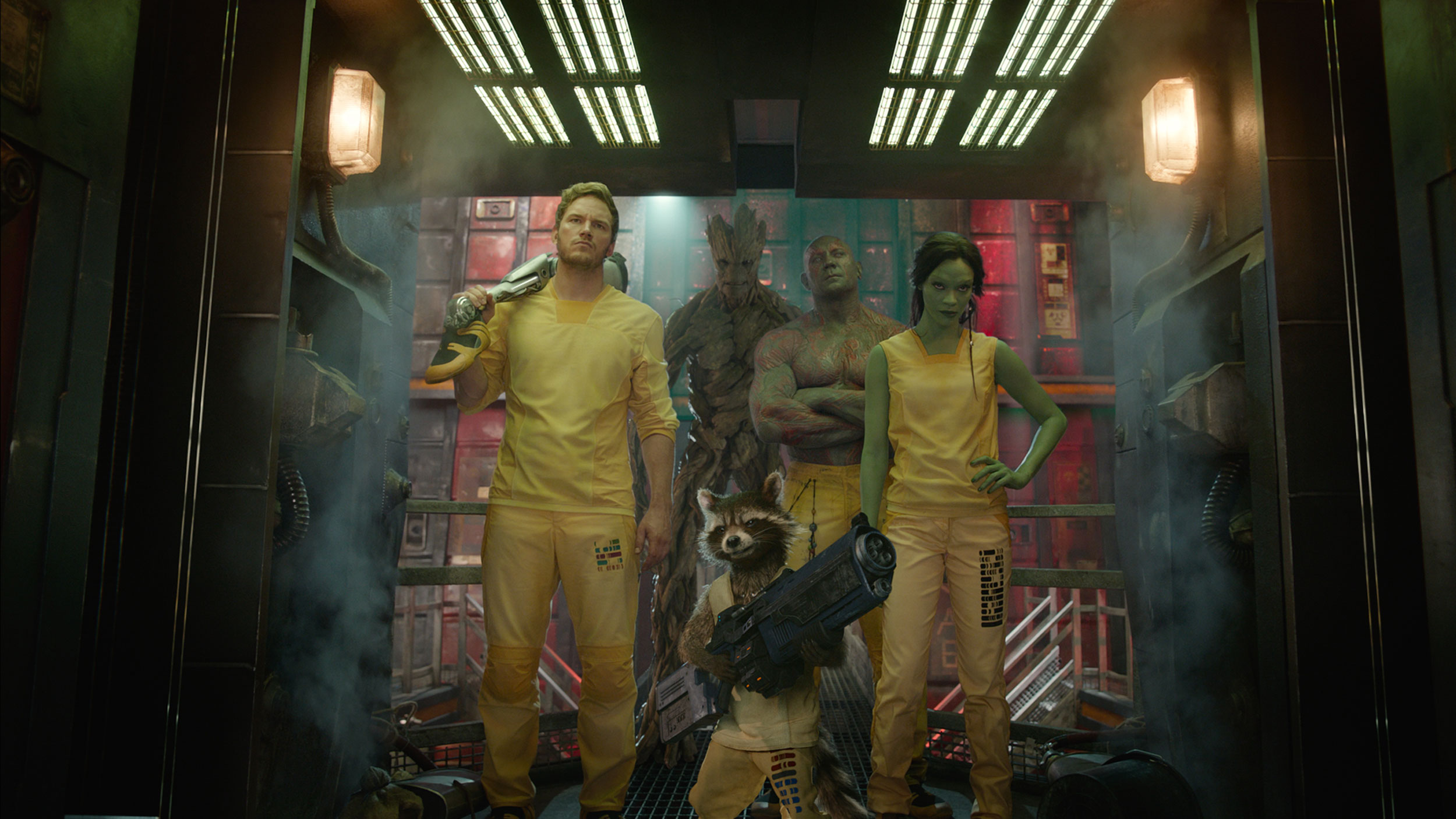
When reviewing the latest Captain America, I diagnosed myself with Superhero Fatigue.  Marvel’s cinematic output has lately been consistent, but safe.  So kudos to them for going unpredictable with Guardians of the Galaxy.  This one is different insofar as it is not really a superhero movie at all, but insted a goofy romp through the universe starring roguish Earthling Peter Quill (Chris Pratt), roguish green woman Gamora (Zoe Saldana), roguish vengeful warrior Drax the Destroyer (Dave Bautista), roguish tree-like humanoid Groot (Vin Diesel), and roguish talking raccoon Rocket (Bradley Cooper, in one of the great voice acting performances of all time).  The “space opera” is a longstanding genre, but it has been a long time since it has been presented as imaginatively and thoughtfully as it is here.

The plot revolves around a MacGuffin: an orb stolen by Quill that is sought by the genocidal Ronan the Accuser (Lee Pace) of the Kree race.  Like other MacGuffins, this orb may not be what the movie is really about, but it is a bigger deal than most MacGuffins.  Ronan means to use the orb to destroy an entire rival race, and the fight for possession of the orb lasts until the very end.  Thus it is strange – though not necessarily problematically – that the tone remains so lighthearted throughout.  Actually, the mix of light and dark that Guardians pulls off is often a highlight of great adventure films.  It is just too bad that every discussion explaining the orb – and there are a lot of them – is a bunch of gobbledygook.  It also would have been more engaging if Ronan and the other villains (save for Michael Rooker as the bandit Yondu, who was more antagonist than villain) had felt more like characters instead of just pure forces of evil.  Ultimately, Guardians is inconsistent about conveying a high-stakes tone, rendering its thrills not quite as viscerally satisfying as they could have been.  Still, it does pull off the fun side of the adventure genre with no problem, and I imagine it might grow on me, because I could watch a baby tree dance to the Jackson 5’s “I Want You Back” all day long. B

This Is A Movie Review: The Purge: Anarchy

Leave a comment

THE-PURGE-ANARCHY-1

The first Purge (2013) had an intriguing (albeit patently ridiculous) premise: what if all crime were legal for one annual 12-hour period?  As that movie and its sequel, The Purge: Anarchy, would have it, this tradition has reduced all crime for the rest of the year and unemployment to negligible levels.  It is never clear how those results are effected, but that is besides the point.  The premise is just an excuse to create a horrific landscape of lawlessness.  The first Purge squandered that opportunity by limiting itself to a typical home-invasion flick.  This sequel, which is essentially a do-over, has the right idea by setting its protagonists loose on the streets of Los Angeles the night of the Purge, but its execution is lacking.

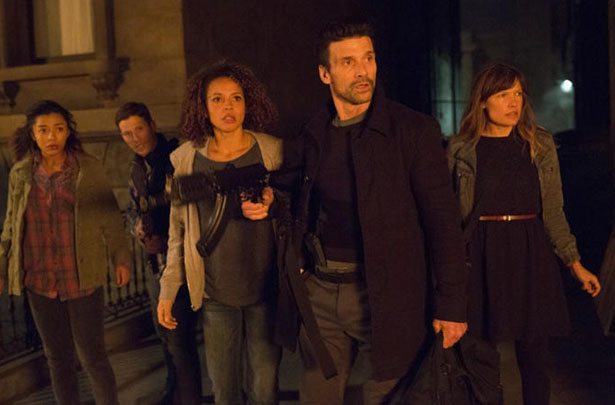
The thing is, a B-movie that runs about an hour and a half is always going to have to ultimately limit its focus, even when its premise suggests a context with a much wider scope.  Anarchy, like its predecessor, offers an intriguing milieu, with a strange cult-like adoration of the “New Founding Fathers of America” regime and the inevitable class warfare.  But the actual characters that the narrative follows do not offer much in the way of exploration of these themes, and the casting does little to help.  Frank Grillo provides decent screen presence as a police sergeant apparently seeking vengeance for the events of a previous Purge.  Carmen Ejogo and Zoë Soul, as a persecuted mother-daughter duo, are too thinly sketched to be memorable for the right reasons and too adequate to be memorable for the wrong reasons.  Zach Gilford and Kiele Sanchez struggle to elevate the typical horror roles of a couple who make dumb decisions and give us little reason to sympathize with them.

Anarchy only comes alive when the electric Michael K. Williams appears intermittently as the leader of an anti-Purge resistance group.  His fight-the-real-enemy ethos kicks the proceedings into the gear of a thematic focus that the rest of the film sorely lacks. C+

Older Entries Newer Entries