‘Chemical Hearts’ Alternates Between Low-Key and a Cascade of Emotions

Leave a comment

Chemical Hearts (CREDIT: Cara Howe/Amazon Studios)

Starring: Austin Abrams, Lili Reinhart

Director: Richard Tanne

Running Time: 93 Minutes

Rating: R for A Sex Scene, I Guess, But It’s Restrained Enough That It Really Should Be PG-13

Release Date: August 21, 2020 (Amazon Prime Video)

Oh, adolescence, when our lives really begin AND end. We don’t fully become who we truly are until we reach our teenage years, and adults are still basically teenagers who somehow managed to make it out of high school intact. Or so Chemical Hearts would have us believe. For all its talk of full-to-bursting emotionality, though, this movie is actually fairly low-key relative to other flicks about teens enduring love and trauma. It’s a young person’s film, with a young person’s sense of the world, but it keeps its head on straight and its feet planted securely.

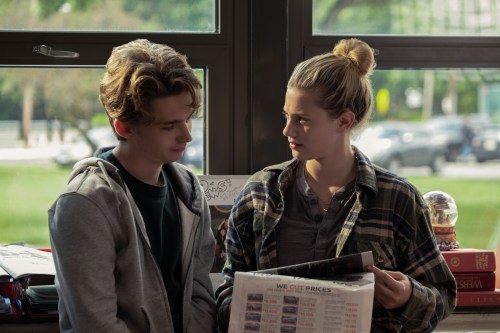
The action starts out at the school newspaper and expands from there. A few minor conflicts are introduced, but they’re soon handled efficiently to everyone’s liking, and I certainly appreciate the maturity on display. But some potential mysteries linger for longer. Will they come to a head? Before we find out, we must first get to know Henry Page (Austin Abrams), who’s all set to be the editor of the paper and eager to learn about his new transfer classmate/colleague Grace Town (Lili Reinhart). She gets around with a cane and says little about her past, but she’s willing to let a friendship blossom as she and Henry walk to her house every day after school so that he can then use her car to drive himself home.

It’s no surprise that Henry and Page’s hearts gradually become bound up in each other. They initially bond over his attempts to sound like a cool literate soul (he mispronounces the last name of her favorite Chilean poet) and ultimately they just realize how much they support each other. But what is surprising, considering the genre and both lead characters’ penchants for overdramatization, is how understated their courtship plays out. There’s a sex scene at one point that is especially tender and sweet, focusing as it does on these two lovebirds doing their best to be present for each other.

If Chemical Hearts had ended right at that happy point without delving too much into Grace’s backstory, I think I would have been generally satisfied. But of course, it is impossible to completely avoid massive drama rearing its insistent head. It’s revealed along the way that Grace was in an accident and that she lost someone very close to her and has a rocky relationship with her mother. She lives with the post-traumatic stress that comes with all that in her own unique way, and as it may appear to Henry and some viewers, it feels real. This strain of practically operatic emotional pain isn’t exactly my cup of tea, but in this case, it at least doesn’t feel like the cosmos is cruelly toying with these young people. I’m not sure I buy Henry Page’s thesis that you’re never more alive than when you’re a teenager, but I can buy that his story is sufficiently worthy of my attention and my affection.

Chemical Hearts is Recommended If You Like: The Fault in Our Stars, Paper Towns, Five Feet Apart

Grade: 3 out of 5 School Papers

‘Skin: A History of Nudity in the Movies’ Provides Exactly What it Promises

1 Comment

Starring: Veterans of Cinematic Nudity

Director: Danny Wolf

Running Time: 130 Minutes

Rating: Unrated (But Take a Guess What It Would Have Been Rated)

Release Date: August 18, 2020 (On Demand)

You might look at the title “Skin: A History of Nudity in the Movies” and bemoan, “Isn’t that just the way to be academic and stuffy and take all the fun out of a pleasurable topic!” But you should know that pretty much all the nude scenes that are discussed are shown in their full, uncensored glory. If on the other hand you’re worried that this endeavor is a little too prurient for its own good, then it should be said that this is far from a Mr. Skin-style supercut (although it’s worth noting that Mr. Skin founder Jim McBride is an executive producer). There are PLENTY of interviews to contextualize what all these examples of cinematic bare skin have meant for the individuals involved, the industry in general, and society at large. We all have bodies, and private parts on those bodies, and those parts have been featured in movies for as long as movies have existed, so it’s worth discovering the stories behind those parts.

Skin clocks in at a dense two hours and ten minutes, which sounds like it might be a bit overloaded for a documentary that’s just a mix of talking heads and film clips. But director Danny Wolf and company have about a hundred years of history to cover. No chapter is lingered upon or indulged in any longer than it needs to be. As a piece of entertainment, this thing just cooks. Nobody is shy about sharing what they have to say, and what they have to say is interesting and illuminating. Actors who have famously appeared nude like Pam Grier and Borat‘s Ken Davitian (and many others) provide illuminating storytelling, while critics and film historians identify contextual landmarks, like the looming specter of the Hays Production Code or the first appearance of pubic hair in a mainstream film.

If this is an underlying question to this whole pursuit, it is the eternal one: when is cinematic nudity essential, or at least justifiable? The answer that multiple interview subjects offer is, “when the movie calls for it.” Which is fair enough, but also decidedly non-specific. The objections to onscreen nudity that we see raised throughout this historical survey are a mixture of perfectly reasonable and protective, hyperbolic and hypocritical. Overall, Skin posits that nudity is a foundational fact of cinema. As society has evolved, so have movies, and so therefore has nudity in the movies. Perhaps an examination like this documentary can help ensure that all future onscreen nudity will be the kind that everyone can feel comfortable with and enjoy.

Skin: A History of Nudity in the Movies is Recommended If You Like: Intolerance, And God Created Woman, Psycho, Blow Up, I Am Curious (Yellow), If…, Greetings, Drive, He Said, Midnight Cowboy, Women in Cages, A Clockwork Orange, Alice in Wonderland (1976), I Spit on Your Grave, Fast Times at Ridgemont High, Showgirls, American Pie, Something’s Gotta Give, Borat, Zack and Miri Make a Porno, Fifty Shades of Grey

Grade: 4 out of 5 Private Parts

Well, Pickle Me American: ‘An American Pickle’ Review

Leave a comment

CREDIT: YouTube Screenshot

Starring: Seth Rogen, Sarah Snook

Director: Brandon Trost

Running Time: 89 Minutes

Rating: PG-13

Release Date: August 6, 2020 (HBO Max)

I recently started a review strategy in which I determine the success of a movie according to whether or not it makes me want to do the thing that it’s about. So I asked of Eurovision Song Contest: did it make me want to watch the actual Eurovision? And now I ask of An American Pickle: does it make me want to become pickled and wake up without having aged a day one hundred years later?

To which I answer! … Maybe, kind of?

I’m pretty sure that’s not how the pickling of humans works, but hey, this is a fantasy, so let’s roll with it! The movie certainly does. Seth Rogen is basically the perfect choice to capture that vibe as he plays opposite himself as his great-grandfather and goes, “Hey dude! You’ve just woken up in the future! How crazy is that?!”

Rip Van Winkle-style stories tend to play up the confusion of the man out of time, but Herschel Greenbaum, the titular pickled man, figures out a way to get along more easily than most. Which just goes to prove my suspicion that people from any time period understand that life in the past used to be different and that life in the future will also be different. With that perspective in mind, I believe I could be resilient enough to get on with an unexpected time leap, just as Herschel is. But also like Herschel, I would be quite emotional over not being able to see my kids and grandkids grow up. Pickles are great, but they’re not a panacea!

Grade: 3 Pickles out of 5 Glasses of Seltzer Water

‘The Secret Garden’ is Back for a New Generation

Leave a comment

The Secret Garden 2020 (CREDIT: Studiocanal)

Starring: Dixie Egerickx, Colin Firth, Julie Walters, Edan Hayhurst, Amir Wilson

Director: Marc Munden

Running Time: 100 Minutes

Rating: PG for Some Kids and a Dog Running Around Like They Own the Place

Release Date: August 7, 2020 (On Demand)

I contend that The Secret Garden is best experienced at a young age and then remembered as some half-formed dream. I’m pretty sure I saw the 1993 adaptation of Frances Hodgson Burnett’s novel that starred Maggie Smith, but I don’t have any specific memories of it. (Furthermore, I don’t really remember seeing Smith in anything before Harry Potter.) When I heard that a new Secret Garden was arriving in 2020, I thought of A Little Princess, the other mid-90s adaptation of a Frances Hodgson Burnett book. With all that scrambling going on in my head, it’s important to identify one key difference, as the 2020 Garden shoots the setting ahead to 1947, as opposed to the early 20th century when the book was published.

That update doesn’t make a huge difference to me, an American who considers the vast English estates of 1947 to be pretty dang similar to the vast English estates of 1911. But it certainly makes a difference to the orphaned Mary Lennox (Dixie Egerickx), who was born in India to English parents who now finds herself adrift much as the British Empire was adrift in the buildup to the Indian Partition. She is sent to live with her uncle Archibald (Colin Firth) in a mansion that seems to have no geographic connection to the rest of the world. When she arrives, she attempts to cajole her wheelchair-bound cousin Colin (Edan Hayhurst) out of bed, but since he seems to have forgotten how to experience the joys of childhood, she must venture outside on her own to the estate’s seemingly infinite grounds. There she befriends a scruffy dog and the unsupervised Dickon (Amir Wilson) and also becomes entranced by the most sun-dappled vegetation in all of England.

For my money, The Secret Garden is about the restorative power of nature. Mary and Dickon are the only characters with any sense of joy for most of the film, while Archibald and Colin seem to be spiraling headlong into depression by spending all their time inside. When you’re a kid, the value of getting out of the house can seem like magic, especially in a setting as sublime as this movie’s. Mary certainly displays some magical thinking, both positively and negatively, as she believes herself responsible for her ill mother’s death. Whenever she views things that way, it is obvious that there is some rational explanation. Indeed, with adult eyes, the secret garden does not feel all that secret, and any magical occurrences that take place there probably only look that way from a child’s perspective. But I can see how much May, Colin, and Dickon are enraptured by their wonder of the place, and I hope there are some five-year-old kids out there who see this film and have it stick in a hidden corner of their subconscious that reminds them forever that magic is real.

The Secret Garden is Recommended If You Like: The vast English countryside

Grade: 3 out of 5 Blooms

‘She Dies Tomorrow,’ and You Just Might, Too

1 Comment

She Dies Tomorrow (CREDIT: NEON)

Starring: Kate Lyn Sheil, Jane Adams, Kentucker Audley, Chris Messina, Katie Aselton, Tunde Adebimpe

Director: Amy Seimetz

Running Time: 84 Minutes

Rating: R for Sexual and Drug-Fueled Weirdness

Release Date: July 31, 2020 (Drive-In Theaters)/August 7, 2020 (On Demand)

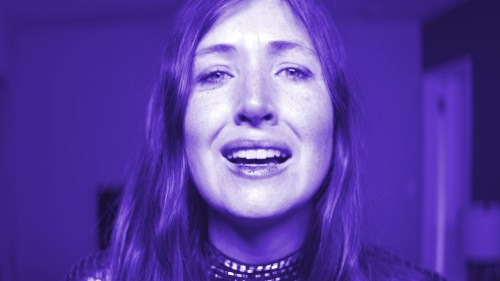
It’s hard to get your bearings straight when watching a movie like She Dies Tomorrow. The main characters have a profound lack of charisma, the protagonist seems to keep changing before any sort of story arc has been completed, and the tone and genre are more or less impossible to pin down. There’s an early scene in which initial protagonist Amy (Kate Lyn Sheil) plays a recording of Mozart’s Lacrimosa over and over to the point that it feels like the film is skipping and repeating. This is all part and parcel of the premise, in which people are overcome by a contagious feeling in which they are convinced that they will no longer be alive come the next day. Weirdly, this doesn’t result in despair so much as a strikingly unique form of negatively focused enrapturement.

I’ve read other reviews of She Dies Tomorrow that describe it as scary in an existential sort of way, though not really a horror movie. But I’m not sure how else to categorize it. It may not be populated by goblins or ghouls, but a persistent sense of ennui crossed with enveloping paranoia sounds to me like just about the most terrifying thing anyone could possibly conceive of. It didn’t exactly feel that way while watching it, though, at least not the whole way through. The illness at the heart of the film is so low-key that the people who aren’t yet infected with it react to those who are mostly as they would to annoying social behavior. At those moments, it feels like a purposely off-putting comedy of manners. But now that I’ve had some room to process everything, I am struck more fully by the loneliness and miscommunication infused throughout.

Director Amy Seimetz works prolifically on both sides of the camera, and she has a tendency to pop up in blockbuster fare like Alien: Covenant and more straightforward horror pics like You’re Next. The budget for She Dies Tomorrow came from the paycheck she earned for acting in last year’s Pet Sematary remake, and this is definitely the work of someone confidently following her own particular muse with the financial freedom to do so. What we’re talking about here is a creator making an appeal for human connection via cinema, and I’m willing to answer the call.

She Dies Tomorrow is Recommended If You Like: Upstream Color, Jean Paul Sartre

Grade: 3.5 out of 5 Requiems

‘The Rental’ Has Rented Some Space in My Brain

Leave a comment

The Rental (CREDIT: IFC Films)

Starring: Dan Stevens, Alison Brie, Sheila Vand, Jeremy Allen White, Toby Huss

Director: Dave Franco

Running Time: 88 Minutes

Rating: R

Release Date: July 24, 2020 (On Demand and Select Theaters)

While watching The Rental (in which Dan Stevens, Alison Brie, Sheila Vand, and Jeremy Allen White play a couple of couples who rent a big ol’ house for a weekend getaway), I had a thought that I anticipate is going to stick around in my movie-watching approach for quite a while: at what point do I stop thinking of the cast members as the actors and start thinking of them as the characters they’re playing?

In this case, that question most saliently applies to Brie, whose career I’ve followed closely and who I’ve watched give countless interviews. As for the others, I’m not too familiar with Vand, I’ve only seen bits and pieces of White, and Stevens is always so twisted right off the bat that I don’t need to ask. So back to how I would answer that question in Ali Brie’s case, and it happens about forty minutes in, as she really starts to doubt the trustworthiness of  her husband (as played by Stevens), and I start to realize we’re not going to see her patented bubbliness anytime soon. (Not to mention she appears to be happily married in real life, and her husband even directed this movie!)

But then this question is much, much trickier as it applies to Toby Huss, who I tend to generally think of as a lovable, avuncular mentor-type. He plays the guy who coordinates the house rental, and there are implications that he might be racist or otherwise non-avuncular. But that could all be a misunderstanding! So, I’m left wondering, am I willing to give Toby the benefit of a doubt because he’s usually such a cool dude? Or does he actually deserve the benefit of the doubt? The freaky-deaky ending doesn’t give us enough time to sort that all out. How dare you make me doubt Toby Huss’ thoughtfulness, Dave Franco!

I give The Rental a Good Review on the High-End Pacific Coast Version of Yelp.

I Have My Doubts That Anyone Thought ‘The Secret: Dare to Dream’ Into Existence

Leave a comment

The Secret: Dare to Dream (CREDIT: Lionsgate)

Starring: Katie Holmes, Josh Lucas, Jerry O’Connell, Celia Weston, Sarah Hoffmeister, Aidan Brennan, Chloe Lee, Katrina Begin

Director: Andy Tennant

Running Time: 107 Minutes

Rating: PG for Life in Debt

Release Date: July 31, 2020 (Premium Video on Demand)

If I follow the advice of Rhonda Byrne’s 2006 best-selling self-help book The Secret, then it shouldn’t be too difficult for me to write a great movie review. All I have to do is think about it and it will surely come to be if I want hard enough. But I’m not sure I want to write a great review about The Secret: Dare to Dream, the thoroughly blah adaptation of Byrne’s book. I’d much rather visualize myself watching any other movie and writing a review about that instead. What does The Secret have to say about how to power yourself through a less-than-inviting obligation? Based on Dare to Dream, I have no idea. But I can tell you for sure that this wasn’t the movie I visualized when I heard they were making another fictional narrative out of an advice book.

There’s one scene early in the film in which a pizza delivery arrives after everyone else imagines it. (It turns out that someone they know sent it as a surprise.) But other than that moment, I don’t see how this adaptation demonstrates the principle of its source material. That’s not necessarily a problem. Even if it fails in that regard, it can still be entertaining. But alas, it fails in that regard as well, as it is a rather mundane story about a down-on-their-luck family who experience a little bit of luck after a stranger (who maybe isn’t a stranger) suddenly arrives in their lives.

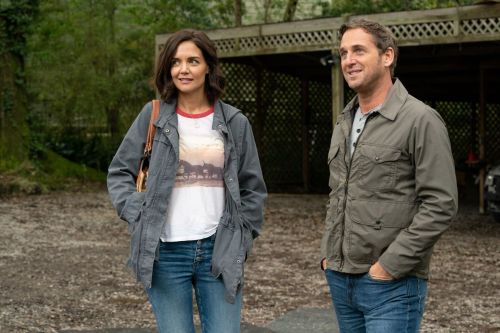
That family would be the widowed Miranda (Katie Holmes) and her three kids, who find themselves wondering what the deal is with wandering handyman Bray, who is played by Voice of Home Depot Josh Lucas. Bray carries with him some Very Important Documents that almost definitely have something to do with Miranda’s dead husband. He was planning on showing them to her as soon as they met, but he decides instead to hang around for a bit and fix up her house after a hurricane tears through it. He also stays because he just has a … feeling. You know, one of those “the universe is trying to tell me something” feelings. That contrivance lasts long enough for Miranda to realize that she isn’t in love enough with her boss (Jerry O’Connell) to marry him, even though he’s a swell guy who looks after her and the kids. Then when the truth comes out about why Bray is really there, Miranda feels betrayed, which I guess makes sense, but it also comes off as overwrought and perfunctory. Even more perfunctory is the moment when she sees the whole picture and decides to give Bray another chance.

To make a movie actually come into being, it really does require a lot of believing that it can actually happen. Considering that The Secret: Dare to Dream is based on that very principle, it’s a little sad to see that the result is so thoroughly right-down-the-middle.

The Secret: Dare to Dream is Recommended If You Like: Pretending you’re watching another movie so hard that it actually happens

Grade: 1.5 out of 5 Banalities

Documentary Review Time: The ACLU Keeps Bringing ‘The Fight’ to the Trump Administration

Leave a comment

Dale Ho in “The Fight” (CREDIT: Magnolia Pictures)

Starring: The ACLU

Directors: Elyse Steinberg, Josh Kriegman, and Eli Despres

Running Time: 96 Minutes

Rating: PG-13 for Legal Stress

Release Date: July 31, 2020 (Theaters and On Demand)

Documentary feature film productions typically shoot many more hours of footage than they could possibly include in the final product. With that in mind, organization is an incalculably important virtue during the editing process. I always greatly appreciate it when a (non-abstract) documentary concretely guides where my attention should go. Thus, The Fight is the beneficiary of my filmgoing gratitude, as it cleanly divides its narrative into four sections, each covering one lawsuit brought against the federal government with the support of the American Civil Liberties Union in the wake of the election of one Donald J. Trump. The cases and their primary issues are as follows: Garza v. Hargan, abortion rights; Stone v. Trump, transgender military ban; Department of Commerce v. New York, the census citizenship question; and Ms. L. v. ICE, separated families at the border.

In a country as famously litigious as the United States, it makes sense to expect that there would be plenty of legal challenges whenever a new administration takes office. That is exponentially true in the case of Trump, who promised to make any sense of political decorum a permanent thing of the past. As an organization dedicated to protecting legally guaranteed rights, the ACLU set itself in ready-position in 2017. But really, that was already their default status – this historical moment merely amplified that.

As is often the case in these multi-part documentary narratives, one character emerges as the most compelling among the rest. This time, it’s the constantly agitated but charming Dale Ho, who takes the lead in the census case. He finds himself uncomfortably thrust into the moment as he prepares to argue in front of the Supreme Court for the first time in his life. All of the lawyers we meet in The Fight focus on keeping their arguments soundly intellectual, but that cannot stop them from having intense physiological reactions to what they’re stepping into, and that’s especially true in Dale’s case.

The title of this film implies an eternal battle that has been going on before Trump’s election and that will likely continue after he leaves office. There are a few victories here and there, but it is made perfectly clear that they could very well be minor and short-lived in the grand scheme of things. If The Fight has one underlying message that synthesizes everything else it has to say, it is that we must be continuously prepared for these battles. The title could have been “The Struggle,” which is my go-to word for something that requires persistence. But instead we have something that’s just as eternal, but more pugilistic. That feels like the right call. These cases are wading through forces that affect and disrupt wide swaths of society. It’s rough out there, and it’s important to be reminded of that.

The Fight is Recommended If You Like: Recent Left-Leaning Political Documentaries

Grade: 3.5 out of 5 Lawsuits

‘Amulet’ Joins the Long Line of Creepy Cinematic Abodes

Leave a comment

Amulet (CREDIT: Rob Baker Ashton/Magnet Releasing)

Starring: Carla Juri, Alec Secareanu, Imelda Staunton, Angeliki Papoulia, Anah Ruddin

Director: Romola Garai

Running Time: 99 Minutes

Rating: R for Freaky and Disturbing Images

Release Date: July 24, 2020 (Theaters and On Demand)

It’s nice when people open their houses up to someone who doesn’t have anywhere else to stay. But it’s not so nice when there’s something demonic lurking within that house. Not to mention all the structural problems that often go hand-in-hand with supernatural occupancy. Maybe the guest can summon some exorcism skills, but when the pipes are leaking and the walls are cracking, it can be tough to get in a good night’s sleep. This is the predicament that the homeless Tomaz (Alec Secareanu) finds himself in in Amulet, Romola Garai’s feature directorial debut. He’s given an offer he’s not in much of a place to refuse: to stay at the home of Magda (Carla Juri), a young woman who seems entirely cut off from the rest of the world as she cares for her dying mother.

As Amulet starts up, it strikes me as a slow-burn horror in the vein of It Comes at Night, where it’s not clear that we’ll ever fully see what’s causing all the commotion. I also detect notes of The Innkeepers, in terms of a general feeling of spookiness instead of any fully present monsters. If anything, it seems for a while that the scariest figure could be a stern nun played by Imelda Staunton. (And by Imelda Staunton standards, she’s actually fairly nice.)

But then a bat shows up in a toilet. I thought it was a pig at first. But no, it’s very much a bloodsucking mammal, and it’s in a foul mood. And that description would also accurately describe Magda’s mom and the whole house itself (not so much the mammal part for the latter). In the final act, Amulet ruthlessly turns macabre and baroque right quick. It’s a little overwhelming and presumably would have been even more so if I had seen it in a theater instead of at my home. Thie go-for-broke set design would almost certainly be more enveloping on a bigger screen, but its boldness is at least still impressive no matter what the scale. And that’s important, because that is pretty much where Amulet pulls all of its eggs in the basket when everything is said and done.

Amulet is Recommended If You Like: Vampire bats

Grade: 3 out of 5 Home Repairs

‘Radioactive’ is a Curie-ous Biopic

Leave a comment

Radioactive (CREDIT: Amazon Studios)

Starring: Rosamund Pike, Sam Riley, Anya Taylor-Joy, Aneurin Barnard

Director: Marjane Satrapi

Running Time: 110 Minutes

Rating: PG-13 for A Little Love and Some Death

Release Date: July 24, 2020 (Amazon Prime Video)

Is there anyone who has been more iconic in the annals of both science and romance as Marie Curie? Her research has had far-reaching effects on human society, she was the first woman to win a Nobel Prize (and the first person of any gender to win a second Nobel), and she was married to a fellow scientist who by all accounts greatly respected and encouraged her work. Considering all that, a biopic about her ought to be pretty wondrous, and that does seem to be what the Marjane Satrapi-directed Radioactive is after. As Marie, Rosamund Pike delivers an appropriately ethereal and almost supernatural performance. But like many true life cinematic stories that cover a wide range of time, the film struggles to focus on its strongest elements.

The Curie love story is sweet as Marie and Pierre (Sam Riley) find their way to each other via their own peculiarities. Their courtship is marked by lines like, “How do I look at you? Like a fermenting brain?” She initially holds him at arm’s length, worried that he will expect her to be the sort of wife who gives up her own pursuits for the sake of marriage. Of course, dramatic irony and the historical record assures us that isn’t the case, and it is lovely to see how the mutual respect of these two played such a big part in influencing the future of the whole planet.

Alas, the Curies’ marriage lasted barely more than a decade, as Pierre died in an accident at the age of 46. That leaves a pretty good chunk of movie left, during which Marie and Pierre’s elder daughter Irene (Anya Taylor-Joy), yet another scientist in the family, ascends to fill the role of her mother’s on-screen partner. During this back half, we get plenty of foreshadowing of the deadly fate that awaits Marie due to her years of exposure to radiation. Satrapi and screenwriter Jack Thorne could have played up this element a bit more to achieve more of a horror bent. It probably wasn’t what they were aiming for, but it would’ve made the film more distinct.

Beyond all that, the most effective element of Radioactive is the handful of flash-forwards we get to demonstrate the influence of Marie’s work: a doctor employing an experimental treatment on a young boy with cancer, the bombing of Hiroshima, a nuclear test explosion in Nevada, and a visit to the Chernobyl disaster. I wish there had been more of these moments, as they’re where the message really hits home the hardest. If the movie were structured more thoroughly around them, it could have made for a fully affecting film instead of an intermittently affecting one.

Radioactive is Recommended If You Like: Science, Feminism, Colleague Spouses

Grade: 3 out of 5 Radiums

Older Entries Newer Entries