‘Terminator: Dark Fate’ Stands Out From Its Predecessors in Mostly Superficial Ways

Leave a comment

CREDIT: Skydance Productions and Paramount Pictures

Starring: Natalia Reyes, Mackenzie Davis, Linda Hamilton, Gabriel Luna, Arnold Schwarzenegger, Diego Boneta

Director: Tim Miller

Running Time: 128 Minutes

Rating: R for Signature Time-Travel Nudity, Yelling Profanity at Killing Machines, and Throwing Punches and Explosions and Gunfire at Metal

Release Date: November 1, 2019

I’m going to be straight with you, folks: as far as Terminator sequels go, I think Genisys is kind of okay! At the very least, it’s fascinating, as it attempts to assemble a sort of synthesis out of a knotted mess of time travel and criss-crossing timelines. But I am perfectly fine, at least theoretically, with the fact that the next edition, Dark Fate, ignores the events of Genisys (as well as Salvation and T3), instead opting to be a direct sequel to the first two, generally-agreed-upon-classic Terminator flicks. When making a Terminator sequel in this day and age, you have the advantage that the premise of this series allows you to ignore as much of what’s come before as you see fit. But you also have the disadvantage that the premise of this series allows you to ignore as much of what’s come before as you see fit. The makers of Dark Fate seem to understand this paradox, but they don’t do much to mitigate it. So we end up with a film that is decently thrilling, but not terribly interesting.

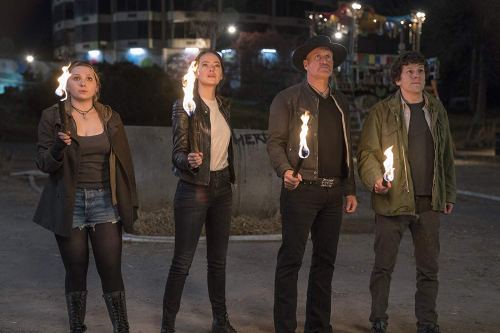
Up until now, every Terminator film has focused on some variation of Sarah and/or John Connor and an Ah-nuld android. But the future run by Skynet has officially been prevented, although another, very similar artificial intelligence has risen/will rise in its place. So Dark Fate at least mixes up the formula by giving us a new messiah of humanity in the form of Natalia Reyes’ Dani and a new time-travelling future fighter in the form of Mackenzie Davis’ Grace. And of course we get a new Terminator prototype in the form of Gabriel Luna’s Rev-9, who can pull off the admittedly cool trick of temporarily separating his bio-synthetic husk from his robotic endoskeleton. It’s a nice idea to see how the looming apocalypse affects someone else for a change, but this is all ultimately a story we’ve seen played out before.

CREDIT: Skydance Productions and Paramount Pictures

Of course, the real draw here is the return of Linda Hamilton to the role that made her an icon nearly thirty years after she last played her. She hasn’t missed a beat, which is important because the world keeps demanding that she kills Terminators. She is ready to dig into the emotional meatiness, but the script is not doing her any favors. There are lots of instances of characters dropping variations of the f-bomb, which is no replacement for the Spanglish sublimity of “Hasta la vista, baby.” Weirdly enough, or perhaps totally unsurprisingly, the weightiest moments come courtesy of Schwarzenegger, who has never completely left the franchise, and yet somehow he is still able to spin new golden variations as a sort of legacy act.

The underlying problem with Dark Fate is that while it makes sure to take care of the action choreography, it never figures out what it really wants to be about. There is a feint towards some sort of metaphor about automation taking over human workers, but that doesn’t amount to much of anything. And there is a key sequence of traversing the border from Mexico to Texas, which is plenty meaningful on its own but is never really incorporated into anything relevant to the looming apocalypse. Maybe the real-life version of the rise of the machines was just a never-ending addiction to Terminator sequels all along?

Terminator: Dark Fate is Recommended If You Like: Action set pieces doing their best to paper over weak spots

Grade: 2.5 out of 5 Apocalypses
‘The Current War’ Offers a Few Sparks of Electricity Here and There

Leave a comment

CREDIT: 101 Studios

Starring: Benedict Cumberbatch, Michael Shannon, Tom Holland, Nicholas Hoult, Katherine Waterston, Tuppence Middleton, Matthew Macfadyen

Director: Alfonso Gomez-Rejon

Running Time: 107 Minutes

Rating: PG-13 for Big Egos Occasionally Misbehaving

Release Date: October 25, 2019

Note: This release of The Current War includes the subtitle “The Director’s Cut,” which is a rare thing for a movie in its original commercial theatrical release. But it’s arriving under unusual circumstances, as it was originally supposed to come out two years ago, but then it was one of the movies orphaned by the dissolution of The Weinstein Company. Since then, director Alfonso Gomez-Rejon assembled a cut that is ten minutes shorter than the version that premiered at the 2017 Toronto Film Festival. (He spoke about the experience with Deadline.) I have not seen that cut, so this review is based solely on “The Director’s Cut.”

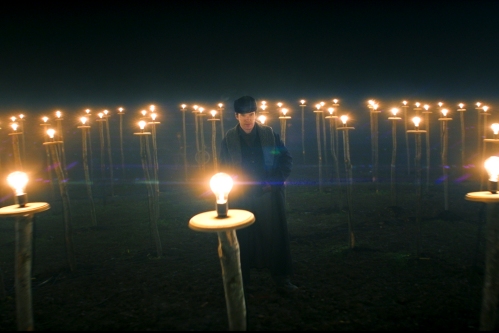
I’m by no means a huge history buff, but that doesn’t mean an anti-history buff. So I’m at least open to the possibility of being entranced by stories from the past, and cinemas certainly has the power to do that entrancing. The war of the currents would seem like an ideal subject to be powerful in just that way – it is about electricity after all! In the late nineteenth century, Thomas Edison and George Westinghouse were jockeying for position to be the providers of electric energy to the burgeoning United States power grid, with Nikola Tesla popping in to alternately work for both of them. There is plenty of energy and spirit to these characters, but overall The Current War is a little more subdued than might be expected.

CREDIT: Dean Rogers/101 Studios

Much of The Current War follows this formula: the principal players head to meetings, buoyed along by the invigorating score by Dustin O’Halloran and Hauschka. Then they sit down … and the music peters out. That sense of the oomph escaping is a major issue. You get the feeling that Edison and Westinghouse don’t really want to be enemies. True, they have a major fundamental disagreement: Edison advocates for direct current, believing that alternating current is way too potentially lethal, while Westinghouse thinks that alternating is the only option powerful enough to get this project on a country-wide scale. But by the end, you get to a sense of “what was all that fuss about?”

As individuals, these men are fascinating to witness. Benedict Cumberbatch’s Edison is given to bombastic statements like making this counteroffer during a negotiation: “I give you nothing you want, and you give me everything I want,” while Michael Shannon’s Westinghouse is certainly hungry for victory, but he is also mellowed by an anti-materialist streak, noting of his company’s AC, “It’s not my electricity. It’s electricity.” That offers plenty to chew over, and there’s also a fantastic bit of filmmaking set at the 1893 World’s Fair in Chicago that achieves a bit of transcendence. Maybe if we could have literally spent some time in the heads of Edison, Westinghouse, or Nicholas Hoult’s Tesla instead of the snatches of subjectivity that we do get, then we could have truly been electrocuted.

The Current War is Recommended If You Like: Watching clashing egos duke it out

Grade: 2.5 out of 5 Horses

‘Zombieland: Double Tap’ is at Its Best When It Fully Embraces Its Possible Irrelevance

1 Comment

CREDIT: Sony/Columbia Pictures

Starring: Jesse Eisenberg, Woody Harrelson, Emma Stone, Abigail Breslin, Zoey Deutch, Rosario Dawson, Luke Wilson, Thomas Middleditch, Avan Jogia

Director: Ruben Fleischer

Running Time: 93 Minutes

Rating: R for All the Fluids That Spew Out in the Zombie Apocalypse

Release Date: October 18, 2019

There’s a running gag throughout Zombieland: Double Tap in which Tallahassee (Woody Harrelson) attempts to secure the title of “Zombie Kill of the Year.” He can never seem to quite pull it off, as his companion Columbus (Jesse Eisenberg) is on hand to helpfully inform us of some other recent dispatch of the undead that was just a little more impressive. This begs the question, in a post-apocalyptic world in which all mass communication has been decimated, how is word about these kills spreading so quickly and seamlessly? By Columbus providing this info via voiceover narration, there is an implication, perhaps unintentional, that he is somehow omniscient. Or maybe the conceit is that he is telling us this story years later, although that does not appear to be the case, what with the sense of immediacy to his dictation.

This is not the most worrisome concern to have, but it does stand in contrast to the original Zombieland, in which everything clicked into place just so, both comedically and logically. Double Tap has several elements like this that feel important but ultimately aren’t terribly so. The jokes are given greater emphasis, but even more essential is an investigation into a nagging sense of malaise. How do you go on living in a world overrun by zombies when killing zombies has become second nature? In addressing this question, the ten years that have passed since the first Zombieland are actually an advantage.

While people do die and new zombies are turned in this world, we are never worried that the makeshift family of Columbus, Tallahassee, Wichita (Emma Stone), and Little Rock (Abigail Breslin) will fall victim to the carnage. And they seem to know it. They’re living it up in the White House, treating every day like it’s Christmas, but that sense of security is only engendering mid-life, or quarter-life, crises. Columbus and Wichita especially are struggling with the realization that they have already accomplished all they need to in life by their thirties. I wish that the script had dug into these neuroses a little more deeply, but this movie works as well as it does because this malaise is the foundational conflict.

Now, to fully enjoy Double Tap, you’ll have to have a pretty big appetite for the same self-aware self-deprecating jokes being told over and over and a full embrace of certain stereotypes that have already been thoroughly deconstructed. But there’s a lot more melancholy than you might expect from a past-it-sell-by-date carnage-filled zom-com. If that’s not quite a Zombie Endorsement of the Year, it’s at least enough to assure us that our undead imaginations haven’t been fully depleted yet.

Zombieland: Double Tap is Recommended If You Like: Staring into the void, while repeating your favorite jokes over and over again

Grade: 3 out of 5 Rules

‘Jojo Rabbit’ Never Met Any Tonal Disparity It Wouldn’t Embrace

2 Comments

CREDIT: Fox Searchlight

Starring: Roman Griffin Davis, Thomasin McKenzie, Taika Waititi, Sam Rockwell, Scarlett Johansson, Archie Yates, Rebel Wilson, Alfie Allen, Stephen Merchant

Director: Taika Waititi

Running Time: 108 Minutes

Rating: PG-13 for Children Getting in the Line of Fire and Witnessing Victims of Public Hanging

Release Date: October 18, 2019 (Limited)

If a ten-year-old boy declared that his best friend is Adolf Hitler, would his story be embraced by the masses? Apparently so, apparently especially if he hangs out with an imaginary version of the Fuhrer played by Taika Waititi, seeing as Jojo Rabbit won the People’s Choice Award at the Toronto International Film Festival. When I first heard the premise of Jojo, I thought, “Wow, really? Okay.” Now, that initial bit of shock is by no means a dismissal. I encourage all filmmakers (and indeed, all people in any profession) to embrace a challenge, and this is certainly A CHALLENGE. The potential pitfalls go beyond the difficulty of trying to make a mockery out of the Nazis. That really isn’t a problem, as there have been numerous memorable spoofs of Hitler over the decades, from Charlie Chaplin to Mel Brooks, and comedy can be one of our most potent weapons against hate. Ultimately, the possibility for trouble comes in the form of the whimsical tone, which does not promise to mix so easily with the deadliness of the wartime setting.

My verdict is that Jojo Rabbit does not fully overcome its inherent tonal disparity, though I appreciate its audacity. There is something to be said for the value of presenting a violent world through a child’s perspective. However, it’s a little harder to justify constantly placing preteen characters in the path of gunfire and explosions (while insisting on drawing out consistent guffaws), which Jojo Rabbit does a distressing number of times. And on top of that, the adult actors are so uniformly goofy. Their performances indicate that this is a straight-up parody, while the effects work counter that no, this is actually supposed to be harrowing and realistic.

I’m almost willing to forgive, or at least overlook, that tonal whiplash, because the inner conflicts at the heart of this film are actually rather affecting despite the tightrope they must walk. Young Jojo (Roman Griffin Davis) fully embraces Nazism, though he does not really grasp what that means. He buys into the nastiest stereotypes of Jews, believing that they are horned, scaly creatures who hang upside-down like bats. But it turns out that while his mother Rosie (Scarlett Johansson) has enthusiastically been sending him to a Hitler Youth camp, that’s all a ruse, as she’s secretly been working against the Nazis, even hiding a Jewish girl (Thomasin McKenzie) in her house. Jojo discovers her and naturally develops a crush, as he gradually realizes that his anti-Semitism is not sincere but rather based on some fanciful lies that were attractive to a kid with an active imagination. If Jojo Rabbit is trying to teach us that hate can be cured if the disease is detected early enough, and especially if the antidote is love, well, that’s true, but no great revelation. But if it’s trying to remind us that a childlike perspective of the world is chaotic, but also somehow fun, and weirdly revelatory, well, that’s a useful reminder. Although, maybe sometimes movies should be less messy than real life.

Jojo Rabbit is Recommended If You Like: Life is Beautiful, Monty Python crossed with Schindler’s List

Grade: 3 out of 5 Grenade Explosions

‘The Lighthouse’ is a Terrifying Portrayal of Isolation That May Just Be Too Much to Bear

2 Comments

CREDIT: A24

Starring: Robert Pattinson, Willem Dafoe

Director: Robert Eggers

Running Time: 110 Minutes

Rating: R for Sexual Content and Violence Covered in Mud and Seawater, and Uniquely Accented Profanity

Release Date: October 18, 2019 (Limited)

Very scary quite contrary. Ooey gooey muddy yucky.

Movies like The Lighthouse make me wonder if it should be standard practice to hand out programs to filmgoers as they enter the theater. While there is no shortage of assets in 2019 to consult to help with any cinematic confusion, there’s a big difference between visiting Wikipedia or Reddit afterwards and actually having a booklet in hand while watching. (It might be too dark to read during the actual show, but there’s something to be said for the security blanket quality of its mere presence.) Director Robert Eggers’ last film, The Witch, had the very helpful tone-setting subtitle “A New England Folktale,” which calibrated my filmgoing faculties exactly where they needed to be. Meanwhile, The Lighthouse, featuring Robert Pattinson and Willem Dafoe as a couple of lighthouse keepers struggling with isolation and their growing antagonism twoards each other, is a much more throw-you-over-the-edge-without-a-life-preserver affair.

That’s not to say that I need, or even want, my hand held throughout The Lighthouse. It’s fine, and probably better, that certain things remain a mystery. Like the mermaid that Pattinson gets it on with that’s probably just a vision, though it’s hard to tell for sure in this landscape. Also, why is that seagull so angry? These are discussions I’m happy to have after watching a sensorially pummeling movie like this one! But while watching, I’d prefer it if I wasn’t constantly asking myself, “Where am I?” If Eggers had just given us one little crumb, like a subtitle along the lines of, for example, “A Sea Shanty,” I think I would have been able to digest this one a little more properly.

But despite this major reservation, I cannot dismiss The Lighthouse entirely. I will always encourage visionary cinema, even if I’m not a fan of the particular vision. And this black-and-white freakout about the horrors of isolation, presented in a claustrophobic 4:3 boxy aspect ratio, certainly qualifies as a vision. So I’ll remain open-minded to re-evaluating this ish in the future, but for now it feels like a silly slosh through the mud and an overindulgent assault on our senses.

The Lighthouse is Recommended If You Like: You Were Never Really Here, Mandy, The Witch

Grade: 2.5 out of 5 Seagulls

With ‘Parasite,’ Bong Joon-ho Weaves Together an Explosively Satirical Meeting of the Haves and Have-Nots

3 Comments

CREDIT: NEON/CJ Entertainment

Starring: Song Kang-ho, Jang Hye-jin, Choi Woo-shik, Park So-dam, Lee Sun-kyun, Cho Yeo-jeong, Jung Ji-so, Jung Hyun-joon, Lee Jung-eun, Park Myung-hoon, Park Seo-joon

Director: Bong Joon-ho

Running Time: 132 Minutes

Rating: R for Language, Bruising Brawls, and Surprising, Surreptitious Sex

Release Date: October 11, 2019 (Limited)

When I see movies in the theater, I unfortunately find myself nodding off more often than I’d like to. I suppose it has something to do with the combination of the darkened setting and the sluggishness that comes with (as is often the case) having just eaten a meal. It gets even worse with foreign films, as hearing people talk in another language is a natural lullaby and also because my brain has to do the extra work of reading the subtitles. That’s especially bad news, because I usually need to devote more mental energy to foreign films to keep straight in my head all the actors that I’m unfamiliar with. So as I was nodding off a half hour into Parasite, I was so worried that I would miss essential information. But then, miraculously, my bout with Mr. Sandman ended at the perfect time, right as the major twist was about to re-establish everything. This is the latest from Bong Joon-ho, and on the basis of his earlier films like Snowpiercer and Okja, I was primed for Parasite to eventually reveal more ambitions than its modest beginnings. I never could have guessed just how right I was.

We meet the Kim family of four living in a ridiculously shabby semi-basement apartment where they have to deal with a wealth of indignities that would be depressing if they weren’t so comical (like a hooligan who keeps urinating on the road outside their window). They’re all struggling to get any work better than folding a bunch of pizza boxes as fast as humanly possible, but then a bit of luck allows Ki-woo (Choi Woo-shik) to get a job tutoring the teenage daughter of the wealthy Park family, though he does have to fudge his credentials a bit. He’s then able to land his sister Ki-jung (Park So-dam) a gig teaching art to the Park’s young son. Pressing forward, the Kim siblings next scheme to get the Park’s driver and housekeeper fired so that their father Ki-taek (Song Kang-ho) and mother Chung-sook (Jang Hye-jin) can take over in those positions. And all this time, the Parks never realize that they’re now employing the entire Kim family.

It seems that the Kims have pulled off their little scam flawlessly, but what was the purpose of it exactly? They do not seem to have any intention of robbing the Parks, but rather, the relative security of a set of service jobs is the end goal. (It makes you wonder, if infamous fraudster Frank Abagnale were a young man today, would Catch Me If You Can have been about him forging his credentials to secure lower-paying jobs like housekeeping and food delivery?) When Chung-sook is tasked with house-sitting as the Parks head out for some overnight camping, the Kims use the opportunity for the fanciest (but also sloppiest) night of drinking they’ve probably ever had, and it’s almost charming how much more they could be taking advantage of their employers. But it turns out that they’ve already pushed things too far, as the old housekeeper (Lee Jung-eun) shows up at the front door that night to ask the Kims for a little favor.

At this point, Parasite reveals itself to be the latest of Bong’s teardowns of modern capitalism, as a major secret reveals what, and who, society buries and pushes aside to prop up its pockets of wealth. Bong has been consistently interested in exploring what happens when people are pushed to the brink and stowed away from the levers of power. Parasite presents that arrangement about as literally as possible. When the hidden contents are unleashed, they spill out to create an unclassifiable mix of satire, chaotic action, and poignant melancholy. This is fascinatingly revealing cinema that won’t soon be forgotten by anyone lucky enough to see it.

Parasite is Recommended If You Like: Movies that resemble Russian nesting dolls

Grade: 4.5 out of 5 Falsified Credentials

‘Gemini Man’ Review: Will Smith is the Clone Daddy, and I Feel Fine

1 Comment

CREDIT: Paramount Pictures/Skydance/Jerry Bruckheimer Films

Starring: Will Smith, Mary Elizabeth Winstead, Clive Owen, Benedict Wong

Director: Ang Lee

Running Time: 117 Minutes

Rating: PG-13 for Scrapes and Bruises from a Variety of Guns and Errant Motorcyles

Release Date: October 11, 2019

Gemini Man is about Will Smith confronting a younger version of himself, so naturally enough, while watching Gemini Man, I found myself confronting my memories of earlier films that it reminded me of. Smith plays Henry Brogan, a sharpshooting government assassin who’s got retirement on the mind. In his own way, he’s as remarkable a human specimen as Nelson Mandela, except that, as one character helpfully informs us, “Nelson Mandela couldn’t kill a man on a moving train two miles away.” Smith also plays what appears to be a younger version of himself sent to kill Henry, which obviously calls to mind Looper (which I dare say is way up there among the best sci-fi movies of this century). It turns out that that young’un (who goes by Jackson, or more often “Junior”) is actually a clone, which puts me in the mind of Never Let Me Go or even the MST3K-spoofed Parts: The Clonus Horror. Henry and Junior’s well-choreographed fight scenes feature them anticipating each other’s every move, and their subsequent description of each other as a “ghost” had me thinking about Mario Kart‘s Time Trial mode. Even Henry’s choice of dockside retirement locale is strangely evocative of this year’s bizarre head-spinner Serenity.

While at first (and second and third) glance, Gemini Man appears rather derivative, it’s got a big idea on its mind that’s significantly different than its forebears. Although oddly enough, the reason why Henry has been cloned and Junior’s been sent to kill him isn’t revealed until the end, so I guess it counts as a spoiler. I’ll keep it a secret then, but it would have made sense to reveal it earlier and allow the movie a chance to really dig into the ethical conundrums it suggests. Because without the clarity of that thematic schematic, Gemini Man is an oddly limp storytelling endeavor in which globetrotting and lethal situations feel like no big deal when they should feel like kind of a big deal. Furthermore, the script features some stunningly unnatural dialogue, but honestly, those moments are the highlights of the film because that’s when personality (unintentionally [?] offbeat as it may be) shines through. Gemini Man‘s premise and the talent involved suggest the height of ambition, but the execution offers the counter-narrative that this is actually just a goofy little lark.

Note: The screening I attended was projected in the high frame rate of 120 frames per second, five times film’s usual 24 FPS. This is how the film was shot, though only 14 theaters in America will be showing it in 120 FPS. The major noticeable difference between 120 and 24 is the level of detail on human skin (in 120, you can pretty much see every pore and sweat gland). It’s slightly surreal, though I don’t think it’s because 24 is more natural, but rather because that’s what we’re used to, and anything different is going to feel odd.

Gemini Man is Recommended If You Like: Feeling Ever So Slightly Off

Grade: 2.5 out of 5 Clone Ghosts

‘The King’ is a Slog Through Shakespearean Henriad History

Leave a comment

CREDIT: Netflix

Starring: Timothée Chalamet, Joel Edgerton, Robert Pattinson, Ben Mendelsohn, Sean Harris, Lily-Rose Depp, Tom Glynn-Carney

Director: David Michôd

Running Time: 133 Minutes

Rating: R for Messy War Combat

Release Date: October 11, 2019 (Limited Theatrically)/November 1, 2019 (Streaming on Netflix)

Once more unto the breach, dear friends? It’s awfully muddy in that breach. That seems to be the big advantage of turning Shakespeare’s Henry IV (Parts 1 and 2!) and Henry V into a movie in 2019: you can make it as muddy as you need it to be! And director David Michôd sure wanted that breach to be muddy. And Falstaff (Joel Edgerton, who co-wrote the script with Michôd) won’t let us forget it. Not that we would have been able to miss it anyway.

I majored in English literature in my undergraduate days, so watching The King is like revisiting old friends for me, but excessively grim versions. I know right from the get-go that wary-of-the-crown Prince Hal will soon enough become King Henry V, Beloved War Hero. But even if I’d never read one verse of Shakespeare, I would have been able to figure that out easily enough. That’s how these narratives tend to play out after all, and also Timothée Chalamet is so hot right now. But that predictability is not necessarily a problem. Shakespeare did not establish his reputation on twisty plots, but rather on wonderfully poetic language. Alas, The King does not have the wit to match. I of course do not demand nor expect that every new Shakespeare adaptation feature iambic pentameter, but if there is going to be as much dialogue as there is in The King, it would be nice if it were at least somewhat exciting. But alas, it seems that war is not only hell, it’s also boring.

As we make our way through the muck into the Battle of Agincourt, The King eventually comes alive somewhat in the form of Robert Pattinson as the Dauphin, the French side’s secret weapon, at least in terms of charisma. He seems to have been warped by the warring status quo between France and England into some sort of almost inhuman, devious little sprite. He is less interested in victory or survival than he is into sucking out the life force of his rivals. I haven’t seen any of those Twilight movies, so for me, this feels like the first time Pattinson has ever played a vampire on screen. If only the other combatants had the verve to match.

The King is Recommended If You Like: Shakespeare minus the poetry

Grade: 2 out of 5 Chainmail Suits

Tim Heidecker Expands His Empire with the Political Mockumentary ‘Mister America’

Leave a comment

CREDIT: Magnolia Pictures/YouTube Screenshot

Starring: Tim Heidecker, Gregg Turkington, Terri Parks, Don Pecchia, Curtis Webster

Director: Eric Notarnicola

Running Time: 89 Minutes

Rating: R for Language, Mostly and Some Drug Use Apparently

Release Date: October 9, 2019 (One Night Only)

Mister America is the latest, and perhaps most ambitious, entry in the Tim Heidecker/Gregg Turkington Fictional Universe. Now either that sentence is meaningless to you, or you’ve already made plans to see Mister America. For the uninitiated, the backstory is more ridiculous and labyrinthine than you could possibly imagine. Starting in 2011, Heidecker and Turkington started the podcast On Cinema, in which they review films as fictionalized, mostly incompetent versions of themselves. A couple of years later, the show became the webseries On Cinema at the Cinema on AdultSwim.com, and it’s since gone on to spawn spin-offs, like the action spoof Decker on Adult Swim proper, and then “The Trial,” an extended courtroom saga in which Tim was charged with murder following the overdose deaths at a music festival he organized. Mister America is a mockumentary that directly springs from “The Trial,” chronicling Tim’s revenge-fueled campaign to become district attorney of San Bernardino, California.

If you’re a fan of Heidecker (and his frequent partner Eric Wareheim), you’re probably automatically loyal to whatever weird project he’s committed 100%. But if you’ve instead been traumatized by just one moment of exposure to his brand of purposeful amateurism, you probably have no intention of ever giving him another chance. I’m certainly in the former camp, but I do worry how someone who usually works in 5-to-20-minute bursts will handle a feature length space with the same shtick. As amused as I am by Heidecker’s clueless right-wing blowhard altar ego, it can be patience-testing to endure him spouting a bunch of gussied-up nonsense over and over again. Luckily, Turkington is on hand to occasionally lighten up the proceedings with his trademark banal movie trivia “facts.”

Much of the action of Mister America takes place in the drab hotel setup that Tim has made his campaign headquarters (it was necessary to establish residency in San Bernardino). This soul-killing setting reminded me of The Brink, the recent actual documentary about Steve Bannon that was similarly trapped by temporary lodgings. That film had a decently keen insight into the former White House chief strategist, but it was a tough watch because its subject is so devoid of charisma. So with that contrast in mind, Mister America kind of works because it’s about an idiot who’s nonetheless charismatic in a through-the-looking-glass sort of way. If only all the racist dog-whistlers out there were this clueless, the world would be a much better and more amusing place.

Mister America is Recommended If You Like: Tim Heidecker Unbound

Grade: 3 out of 5 Crime Eliminators

Scorsese Influences + Clown Makeup = Todd Phillips’ ‘Joker’

1 Comment

CREDIT: Niko Tavernise/Warner Bros.

Starring: Joaquin Phoenix, Robert De Niro, Frances Conroy, Zazie Beetz, Brett Cullen, Glenn Fleshler, Bill Camp, Shea Wigham, Marc Maron

Director: Todd Phillips

Running Time: 122 Minutes

Rating: R for Inappropriate Laughter and Shocking (in Many Senses) Violence

Release Date: October 4, 2019

Can’t a man just get attention for wearing a wonderfully colorful suit without having to also go through the trouble of becoming an unpredictable, violent criminal? With his forest green shirt and tie, goldenrod vest, and maroon jacket and pants, Gotham’s Clown Prince of Crime has never looked better than he does in Todd Phillips’ Joker. That outfit is a welcome bit of unique playfulness in a film that easily could have been a thoroughly dark slog. I’m very ready to embrace Joker’s continued relevance as a style icon, but as for what this particular origin story has to say about him, I’m a little conflicted, though generally impressed by everything that made it to the screen.

All new Joker portrayals now live in the shadow of Heath Ledger’s rendition in The Dark Knight, which I, and many others, consider to be the epitome of the character. That chapter may be the best way to tell a Joker story, but it’s not the only way to tell a story about a villain, and by corollary, it’s not the only way to tell a Joker story. But the prospect of a Joker origin is nonetheless concerning, as his most striking power lies in the nihilism matched with his thoroughly ambiguous beginnings. Ledger played him like an elemental force who was somehow also a human being even though it felt like he sprung from nothingness. Any origin would seem to be the antithesis of that, no matter how much mystery Joaquin Phoenix might bring to his performance.

Ultimately, though, Joker somehow mostly works despite all this baggage. That’s mostly because by the end it rejects its own origin story, or at least the one-to-one explanation of “difficult upbringing = supervillainy.” True, Arthur Fleck, the man behind the persona in this iteration, has been beaten around by a thoughtless society that doesn’t understand him, but his propensity for violence isn’t about revenge or the fame that comes with notoriety, or at least not only and not primarily those things. No, he just has an insatiable appetite for crime, the more shocking and well-timed the better. He gets his first lick almost by accident, when he protects himself against some fratty Wayne Enterprises employees with a pistol that a co-worker lent him. From this moment on, you can see the euphoria rising within him as he begins to shed any desire for normal human connection.

I am thoroughly impressed by Joker‘s craft, though I’m a little hesitant to embrace it fully. That’s not out of any discomfort with the message of Arthur’s transformation. It’s clear that he’s not meant to be emulated, despite how intoxicating his act can be once fully embraces his true self. What’s really nagging me is that this is a film that is a little too indebted to its influences. The premise is very much “What if Joker, but Taxi Driver?” Although, unlike Travis Bickle, Arthur isn’t interested in cleaning up the streets so much as making them his own. That’s different enough that Joker can fairly say that its overall tapestry is a new creation, but it never breaks fully free of its constituent parts. It’s like one of those magic eye posters, but in this case you can see the individual pieces whether you’re looking close or from a distance.

Joker is Recommended If You Like: It If Every Movie is a Direct Response to Taxi Driver

Grade(s): 4 out of 5 for the Craft/3.5 out 5 for the Message

Older Entries Newer Entries