This Is a Movie Review: ‘The Rider’ Presents a Cowboy Who Cannot Imagine Life Outside the Rodeo

1 Comment

CREDIT: Sony Pictures Classics

This review was originally published on News Cult in April 2018.

Starring: Brady Jandreau, Tim Jandreau, Lilly Jandreau, Cat Clifford, Lane Scott

Director: Chloé Zhao

Running Time: 105 Minutes

Rating: R for Mumbled Cowboy Profanity

Release Date: April 13, 2018 (Limited)

I’m not too familiar with the South Dakota rodeo scene, and I’m guessing that before she wrote and directed The Rider, Chloé Zhao wasn’t too familiar with it either. I make that assumption based on the fact that she grew up in China, a country that, as far as I know, is not noted for its rodeo culture. But if I had no idea about her background, I would have guessed that she in fact had grown up in the scene that her film portrays. The production notes recount how she immersed herself in the world of a group of Lakota cowboys, and that is clear from the results on screen. This is intimate, realist cinema, gently revealing profundity within a boy, his horses, and the land.

As Brady Blackburn, Lakota cowboy Brady Jandreau essentially plays himself: a rising rodeo star whose career is cut short, possibly permanently, by a fall that leaves him with a nasty head injury. (The entire cast basically themselves, in fact.) This makes his story more reflective than he ever intended his life to be, as he reckons with the consequences of not defining himself beyond anything other than a rodeo rider. If he is fundamentally a rider, but he cannot ride, then how can he even be? Many of the film’s shots are Jandreau looking off into the distance, as he delivers a perfectly fine example of face acting.

Where I think The Rider ultimately sets itself apart is its treatment of economic reality. Because Brady must give up the rodeo, he is forced to take a job as a grocery store stock boy. But this is not, as one might expect, cause for humiliation or depression. Ultimately the message of the film, at least as Brady is concerned, is: don’t give up. Any setback is an opportunity for him to keep his head up. Foolhardy though he may be, every decision he makes is so that he can get closer to getting back on the horse. When horses suffer an injury as debilitating as Brady’s, they are put to death out of mercy. Brady’s single-mindedness almost makes you wonder if that should also be an option for humans. But it is also inspiring to behold someone so sure about himself. Mostly, it is heartening to see someone’s story treated with such thorough, deep respect.

The Rider is Recommended If You Like: Realist cinema

Grade: 3.5 out of 5 Ten Gallon Hats
This Is a Movie Review: The Death of Stalin

Leave a comment

CREDIT: IFC Films

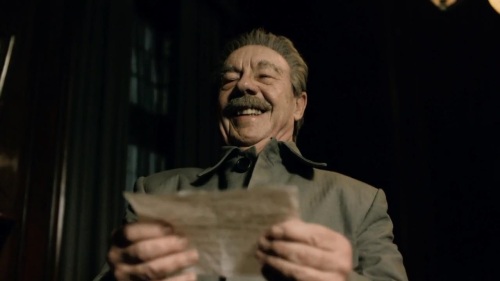
When it comes right down to it, people are just people. This is the thought I have when watching the scene in The Death of Stalin in which a group of officials bumblingly drop the body of the dying Soviet Premier onto a bed. No matter how despotic things get, we are still beholden to our embarrassing physical realities. Alas, when the film starts to regularly show people shot in the head without a second thought, it is hard to remain Zen about the situation.

I saw Death of Stalin at the Alamo Drafthouse, and the pre-show programming included parts of the Monty Python’s Flying Circus episode “The Cycling Tour,” which features Michael Palin bungling his way into being the target of a Russian firing squad, who famously misfire at him from only a few feet away. As I prefer my gallows humor with plenty of goofiness, “The Cycling Tour” is definitely more comfort food for me than The Death of Stalin. That is not to say the latter is unsuccessful. I see what Armando Iannucci is doing, I acknowledge that he has met his goals, I laugh where I can, and then I move on, newly grateful that I live in a society that is not quite so dangerous as 1950s USSR.

I give The Death of Stalin 4 Impossible Promises out of 5 Buggings.

This Is a Movie Review: Three Teenage Girls Make a Sex Pact, But It is the Parents of ‘Blockers’ Who Are Behaving Badly

2 Comments

CREDIT: Quantrell D. Colbert/Universal Pictures

This review was originally posted on News Cult in April 2018.

Starring: Leslie Mann, John Cena, Ike Barinholtz, Kathryn Newton, Geraldine Viswanathan, Gideon Adlon

Director: Kay Cannon

Running Time: 102 Minutes

Rating: R for Girls Talking About Sex Without Any Shame, Butt Chugging and the Like, and a Concerning Amount of Drug Use

Release Date: April 6, 2018

What to do with a movie that has a really great message but that plays fast-and-loose with any sense of realism? You take the good, you take the bad – the facts of life! I didn’t go into this meaning to name-check a classic ’80s TV theme song, but as it popped into my head, it just felt remarkably right. At its core, and at its best, Blockers emphasizes the fact that teenage girls have sexual desires and treats that truth as matter-of-factly as it deserves to be treated. This isn’t some “girls can be gross, too!” twist on a “boys will be boys” classic. The sex here approached with maturity and it is often romantic. Any grossness in Blockers is due to insecurity or lapses in plausibility.

Have sex pacts ever occurred in real life? If so, I hope they are as supportive and sweetly motivated as the one in Blockers. On the occasion of her senior prom, Julie (Kathryn Newton) announces to her lifelong friends Kayla (Geraldine Viswanathan) and Sam (Gideon Adlon) her intention to lose her virginity tonight to her boyfriend. Sensing an opportunity for a shared anniversary, Kayla and Sam declare that they are in as well. They may not be in as serious a relationship as Julie is, but they’ve got guys who they like well enough and who have the necessary equipment. But when Julie’s mom Lisa (Leslie Mann), Kayla’s dad Mitch (John Cena), and Sam’s dad Hunter (Ike Barinholtz) catch wind of the pact, they are not going to stand idly by as their girls become women.

It is distressing that these parents have such regressively protective attitudes, though it is encouraging that they are presented as the ones so clearly in the wrong. And what’s more, their motivations are more complicated than not trusting their daughters. Lisa is a single mom who has raised Julie alone her whole life. She is struggling through deep-seated separation anxiety, worrying that Julie getting closer to her boyfriend means she will attend college thousands of miles away, which means that she could disappear forever. Director Kay Cannon and her team of screenwriters handle this unflinchingly, and I wish they would have devoted even more time to it. Hunter, meanwhile, knows that Sam is gay and is worried that her friends are forcing her to do something she doesn’t really want to do. Originally introduced as a deadbeat screw-up, he ends up coming off as the most open-minded of the trio, though the film does lose focus a bit on that tack for the sake of gags. Mitch is really the only one who comes as the stereotypically overprotective parent, and though Cena does imbue him with a fair amount of sweetness, he feels out of place in what the film is ultimately saying.

Blockers’ message that teenage girls should be allowed to make their own sexual decisions, especially if they are with boys (or otherwise) who they like and respect, is indisputably valuable. While it may be underlined a little too obviously, perhaps it is a message that needs to be repeated. It is also heartening to see a group of supportive teenage female friends on screen. Julie, Kayla, and Sam have their stark differences, but their loyalty runs deep. That well of positivity offsets a bit the parents’ surplus of bad behavior, which stretches the bounds of credulity a bit too much. Seriously, Blockers, you’re plenty funny without having to resort to butt chugging beer. That is to say, this is a movie that is much more sure-footed when it comes to romance (somehow making licorice the perfect food for declaring love) than when it swerves into the territory of illegal behavior.

Blockers is Recommended If You Like: Superbad and other Judd Apatow productions, particularly if they feature insecure parents, The Sisterhood of the Traveling Pants, Clueless

Grade: 3.5 out of 5 Sex Pacts

This Is a Movie Review: Only the Most Hardened of Souls Should Trek Into the Stylistic Bloodbath of ‘You Were Never Really Here’

1 Comment

CREDIT: Amazon Studios

This review was originally published on News Cult in April 2018.

Starring: Joaquin Phoenix, Ekaterina Samsonov, Alex Manette, John Doman, Judith Roberts

Director: Lynne Ramsay

Running Time: 89 Minutes

Rating: R for In-Your-Face Bloody Violence, Some Disturbing Behavior, and a Little Bit of Nudity

Release Date: April 6, 2018 (Limited)

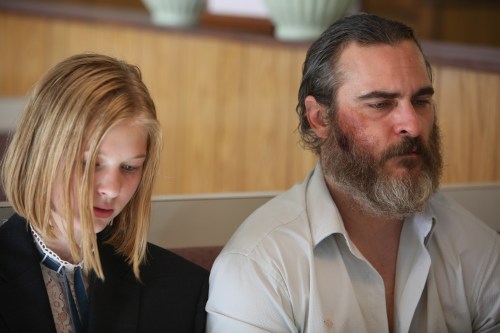
As my moviegoing has evolved over the years, I have come to appreciate, even love, films that are more sensory experiences than narrative adventures. But that positivity does not extend to Lynne Ramsay’s latest, You Were Never Really Here. Joaquin Phoenix stars as Joe, a combat veteran suffering from PTSD, and the film seems to have adapted his mental state. The editing is jarring and cacophonous, which is an effective stylistic choice, but after a while it becomes exhausting.

Joe makes his living now as a specialist in the field of rescuing young girls from trafficking. His latest assignment is Nina (Ekaterina Samsonov), a state senator’s daughter who he seems to have a spiritual connection with, or at least that is how it plays out in this film’s dreamy environment. He saves her, but then they get separated, then a conspiracy that I cannot begin to make sense of is uncovered, people get shot in the head, he saves her again, more people get shot in the head. It is all a bloody mess, both literally and metaphorically. We the audience are all stuck in this with no room to breathe, just like Joe with his face under a plastic bag in the opening shot.

I appreciate the thoroughness and relentlessness that Ramsay has applied to this experience, but she is on a frequency that I am just not on. Phoenix reliably gives the kind of intense performance that makes you worried about his mental health, and that only adds to the despair. There is no grappling with the oppressiveness, nor is there much in the way of relief. The final scene does provide a notable exception, though, as it at first appears to underscore the endlessness of the violence, but it then pulls off a trick to suggest that there might be a light at the end of the tunnel.

You Were Never Really Here is Recommended If You Like: Jacob’s Ladder, Stylization above all else

Grade: 2.5 out of 5 PTSD Flashbacks

This Is a Movie Review: ‘The Endless’ Upends Tropes About Cults and Then Melts Your Brain

Leave a comment

CREDIT: Well Go USA

This review was originally published on News Cult in March 2018.

Starring: Justin Benson, Aaron Moorhead, Tate Ellington, Callie Hernandez, Lew Temple, James Jordan

Directors: Justin Benson and Aaron Moorhead

Running Time: 111 Minutes

Rating: Not Rated, But I Would Peg It at PG-13 for General Eeriness and Some Unhinged Behavior

Release Date: April 6, 2018 (Limited)

I am writing this review about a month after seeing The Endless. I knew that it was probably going to be a while before I got around to this write-up, so to remind myself what I wanted to say, I left myself the note “Big ideas that might or might not be fully fleshed out.” And now that I have had extra time to mull it all over, I have come to the conclusion that those big ideas were indeed successfully fully fleshed out. Justin Benson and Aaron Moorhead, who co-directed and co-star, are a dynamic duo here to upend your genre expectations.

The pull of religious cults has been a major part of American culture and history, and its portrayal in film and TV has been more or less codified into a particular routine. And at first, it seems like that is what The Endless is going for. Benson and Moorhead play brothers Justin and Aaron Smith; the actors and characters sharing the same first names lends a sort of faux true-life docudrama feel that low-budget indies often aim for. They grew up in a commune that has survived living off the grid by brewing and selling its own beer. Justin eventually wised up to the brainwashing that he was certain was going on and pulled himself and Aaron out of the commune and into a life on their own. But that has come to mean frequent joblessness and dire financial straits.Aaron yearns to return to the bonhomie and relative security of the commune, questioning whether or not it really is a cult. Nudging him along is a videotape they have just received featuring a woman from the commune (Callie Hernandez) prophesying the imminent arrival of “the Ascension,” the type of mysterious, perhaps apocalyptic event that cults tend to prophesy about.

Justin concedes to Aaron’s request, with the firm caveat that this will be a quick visit. Justin’s warnings are seemingly confirmed by the cultish welcoming vibe spiked with an undercurrent of creepiness and manipulative tests of character. But a few foreboding signs that could just be illusions – a tossed baseball stuck in the air, a rope pulled by an unseen force, two moons in the sky – suggest that something stranger and more sinister is actually going on. Some of the phenomena that takes place cannot be explained by human trickery, and at a certain point The Endless swerves hard (but naturally) into a completely different movie – something much more mind-bending and uniquely satisfying. The commune appears to have established in another realm of existence where the laws of time and space have been folded in on themselves. To go into more detail would ruin much of the fun of discovery, but suffice it to say this is a sort of Twilight Zone of indie film, and perhaps the best example of that description that I have ever seen.

The Endless is Recommended If You Like: The pipes from Super Mario World, Another Earth, Primer

Grade: 4 out of 5 Multiple Moons

This Is a Movie Review: ‘A Quiet Place’ Reveals That John Krasinski is a Master of Relentless Horror

2 Comments

CREDIT: Jonny Cournoyer/Paramount Pictures

This review was originally published on News Cult in April 2018.

Starring: John Krasinski, Emily Blunt, Millicent Simmonds, Noah Jupe

Director: John Krasinski

Running Time: 95 Minutes

Rating: PG-13 for Nightmare-Inducing Creature Design and Quickly Edited Disemboweling

Release Date: April 6, 2018

Effective horror movies are often built around a simple hook, and A Quiet Place has a doozy: a family must remain ever silent because they are being terrorized by something that strikes whenever it hears the merest peep. It is such a doozy, in fact, that a very similar setup was employed just a couple of years ago in Don’t Breathe (wherein a crew of burglars had to escape the detection of a blind man). Do we have a boomlet of the “silence is golden” horror subgenre on our hands? The results thus far are encouraging. There is plenty of variation possible in turning away from modern cinema’s default reliance on dialogue, with A Quiet Place exploring the effect it has on nuclear family dynamics.

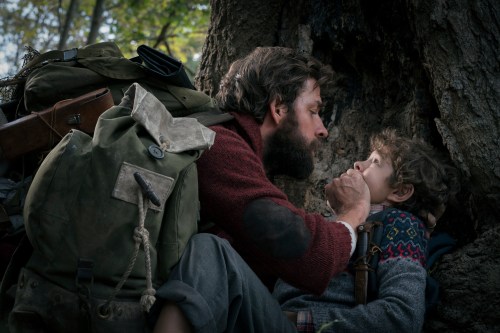
It has been about a year since these sound-seekers have begun their attacks, and life on Earth has adjusted accordingly. It is unclear how much of the world’s population has been decimated, but even if it is a relatively small percentage, it might as well be just about everybody, as survival requires solitude. This particular family has lucked out in a way, as they have a deaf daughter (played by deaf actress Millicent Simmonds) and are accordingly all fluent in sign language. It is another simple but effective flip: turning a disability into a strategic advantage.

John Krasinski, directing and playing the father, trains us to become fully absorbed in every frame, thus allowing A Quiet Place to pull off killer set piece after killer set piece. From 30 minutes in all the way to the conclusion, this is a non-stop nailbiter. Father and son (Noah Jupe) head off to gather up some food, while daughter revisits a scene of tragedy, leaving pregnant mom (Emily Blunt, Krasinski’s real life wife) home alone to deliver the most silent natural birth ever. There is a lot of resourcefulness on display in keeping the attackers at bay. It is almost a sort of Home Alone-style boobytrapping ingenuity, but the kind that minimizes pratfalls and nut shots.

While A Quiet Place consistently pulls off the visceral thrills, it is not quite as satisfying when it attempts to examine the why and the how. That is not because the answers it offers are unsatisfying per se, but rather because they end up working out a little too perfectly. These creatures are the type that are mostly indestructible but have that one little weakness. In many ways, A Quiet Place resembles Signs, particularly the method for defeating the creatures. It is not quite as ridiculous Shyamalan’s “you gotta have faith” randomness. A Quiet Place’s resolution that is fairly set up and is actually reasonably clever. But it leaves me weirdly disappointed that the terror has been deflated seemingly so thoroughly. I am left in a paradoxical state, as it gives me the rousing resolution I wanted while depriving me of a continued pounding heartbeat as I walk out the theater. Perhaps if the ending had swerved into a Mars Attacks!-style comedic turnaround (with which it shares some DNA), I would have forgiven the excess perfectness. But I can settle for the steady relentlessness that the majority of A Quiet Place delivers.

A Quiet Place is Recommended If You Like: Don’t Breathe, Alien, Signs

Grade: 3.5 out of 5 Shushes


This Is a Movie Review: ‘Ready Player One’ Wrings Some Beauty and Profundity Out of Empty Calorie Storytelling

Leave a comment

CREDIT: Warner Bros.

This review was originally published on News Cult in March 2018.

Starring: Tye Sheridan, Olivia Cooke, Ben Mendelsohn, Lena Waithe, Mark Rylance, T.J. Miller, Simon Pegg

Director: Steven Spielberg

Running Time: 140 Minutes

Rating: PG-13 for Explosions (Both VR and Real Life), Threats of Gun Violence, Partial Referential Nudity, and PG-13’s One Free F-Bomb

Release Date: March 29, 2018

The premise of Ernest Cline’s 2011 novel Ready Player One is basically nerd wish fulfillment writ large: in a dystopian future, a gamer completes a series of puzzles based on pop culture touchstones in a massive virtual reality simulation for the prize of a billionaire’s inheritance. As it plays out, though, (in both the book and Steven Spielberg’s adaptation) it is more of a Robin Hood fantasy, with the winnings serving as the golden ticket to end income inequality. The improbability and the wish fulfillment are all well and good, but they do mean that everything wraps up a little too perfectly, so satisfaction must be found in the details and the execution. Spielberg has remained a proficient craftsman his entire career, so even though Ready Player One’s separation between right and wrong might be a little too stark, it still pulls off some genuine wonder.

The film keeps the same basic outline at the novel, save for switching out some of the homages, both because Spielberg wanted to limit references to his own past work and presumably because of rights issues. Wade Watts (Tye Sheridan) spends most of his time as his avatar Parzival in the VR world known as the OASIS, partly because his real life is situated in a ugly heap of metal, literally, as his home, like many in 2045, exists within one of many trailers stacked on top of each other. He hangs out with his crew of fellow gamers, whom he only knows virtually, which frankly isn’t all that different than how it is for some folks already in 2018. Wade of course falls in love with Art3mis (Olivia Cooke), a bit of a legend in the OASIS, who feels like she is specifically engineered to be the perfect girl for him, which is a bit of a pain, but at least Sheridan and Cooke keep it charming.

This crew’s quest finds them at odds with Nolan Sorrento (Ben Mendelsohn), the brazenly stereotypical asshole CEO of a global conglomerate who employs an army of corporate drones to win the inheritance because he wants to turn the second biggest company in the world into the biggest company in the world, and he’s not averse to killing to get his way. He is plenty scary, but RPO could have benefited greatly from actually exploring what makes him tick.

It is appreciated that Wade is not a chosen one archetype so typical of the genre. The reason he succeeds is because he puts in the relentless work to understand the parameters and intricacies of the journey. That we get to see his process makes his racing a DeLorean around King Kong actually thrilling instead of just a prompt for ticking boxes off the reference checklist.

It is well worth noting that while the references draw from decades of pop culture, they are primarily based around the touchstones of the 1980s. That decade was partly defined by Spielberg, and it consisted of Cline’s formative years, but they are very much not the formative years of RPO’s main characters, nor much of the target audience. But within the narrative, they are the formative years for James Halliday (Mark Rylance), the OASIS co-creator who designed the game and bequeathed his fortune. Thus, the hours of study that Wade and his crew put in resonate in the way of culture being a way in to understand one’s fellow human beings.

With wizardly blond locks and profound diffidence, Rylance plays Halliday a lot like Garth Algar, but if Dana Carvey had envisioned the Aurora metalhead as the greatest tragic figure of all time. Ready Player One works best as an exploration into this one man’s psyche. His social awkwardness goes beyond any simple diagnosis, and Rylance does not shy away from the discomfort. Creating an all-encompassing VR world may be a bit of an overcorrection to his loneliness, but it is heartwarming that Halliday finds a way to make a genuine connection with the world, though it is more than a tad bittersweet how he accomplishes it.

Bottom line: with so much of Ready Player One rendered as virtual reality, it is frequently an off-putting eyesore. But it has moments of beauty, like Parzival and Art3mis’ free-floating dance; as well as strokes of demented remix genius, as when zombies overrun a rendering of Kubrick’s The Shining. Weirdly enough, the references actually end up having more soul and thoughtfulness than the characters (with the exception of Halliday).

Ready Player One is Recommended If You Like: Heavy referentiality whether justified or shameless, Mark Rylance getting deep into character work, The dance scene from WALL·E

Grade: 3 out of 5 Omnidirectional Treadmills

This Is a Movie Review: ‘Gemini’ is a Satisfying Light-and-Dark Neo-Noir

Leave a comment

CREDIT: NEON

This review was originally posted on News Cult in March 2018.

Starring: Lola Kirke, Zoë Kravitz, John Cho

Director: Aaron Katz

Running Time: 92 Minutes

Rating: R for Easygoing, Friendly Profanity and a Bloody Crime Scene

Release Date: March 30, 2018 (Limited)

What if you suddenly discovered that your life has turned into a movie? That’s essentially the same question as: what if you found yourself in the most extreme and unusual of circumstances? As one character in the neo-noir murder mystery Gemini puts it, the most likely culprit is the one with the motive, the opportunity, and the capacity. And there just so happens to be a perfectly creepy guy who fits all the criteria. But if this is a movie, then it might be the craziest, least obvious suspect who turns out to be the culprit. Occam’s razor may give you the right answer nine times out of ten, but that other 10% is where lies the basis for exciting, unpredictable films. Gemini is kind of enjoyably self-aware about that, but only as much as it can be when its leads are a couple of way-out-of-their-depth young adults.

Heather (Zoë Kravitz) is a young actress who is burnt out by the business in her twenties. The presentation of her world is vague to the point that we never get a full sense of just how famous she is, but we do know that she is enough of a star to have a sizable Instagram following and overaggressive fans approaching her in diners. Gemini could have just been a hangout movie depicting the carefree days of Heather and her assistant Jill (Lola Kirke), who are referred to as “freaky, fucked-up best friends,” the kind who “kill each other all the time.” But really, their friendship is genuine and supportive, and while they may keep secrets from each other, that is to be expected when living in a mostly empty mansion in a populous but often lonely city and working in a frequently soul-sucking industry. So when Jill finds Heather dead by gunshot wound, what should be a personal tragedy instead plays out as a hazy detour into purgatory.

If this were a film about millennial self-actualization, Jill would probably be a total boss, and Heather would be right by her side for the majority of the runtime. But instead, Jill does her best to adapt to her new noir status quo. She does some fine investigative work of her own and her psyche holds up well against the withering glare of the lead detective (John Cho, giving an intense performance marked by enigmatic motivation) who clearly suspects that she might be the killer. But she also has moments of silliness, like adopting a disguise that really doesn’t help her out in any capacity, and she gets called out for that pointlessness. Overall, writer/director Aaron Katz pulls off a remarkable tonal balance, utilizing Keegan DeWitt’s jazzy trip-hop score and Andrew Reed’s oppressive cinematography to firmly establish the devastation inherent in the premise while also maintaining a comedic lightness drawn from basic truths of characterization and performance. There is a lot of self-confidence on display here, and that goes a long way.

Gemini is Recommended If You Like: Mulholland Drive, Nerve, References to ’90s pop culture touchstones

Grade: 3.75 out of 5 Blond Wigs

This Is a Movie Review: ‘The China Hustle’ Exposes a Fraudulent Scheme That is Obscure But Possibly Affecting Everybody

Leave a comment

CREDIT: Magnolia Pictures

This review was originally posted on News Cult in March 2018.

Starring: Dan David, Matthew Wiechert, Carson Block, James Chanos, Soren Aandahl, Maj Soueidan

Director: Jed Rothstein

Running Time: 84 Minutes

Rating: R for Profanity That is Surely a Lot Less Offensive Than the Crimes on Display

Release Date: March 30, 2018 (Limited Theatrically and On Demand)

If you loved The Big Short, The China Hustle is now here to give you the same semi-invigorating feelings of cynical helplessness, but with more of a obscure bent. This is a documentary, as opposed to a based-on-real-events fictionalized narrative with frequent fourth-wall breaking, but everything is still plenty topsy-turvy. Docs about global financial fraud have been a bit of a staple at least as far back as 2005’s Enron: The Smartest Guys in the Room (Enron’s director, Alex Gibney, serves as an executive producer on China Hustle). So, disgusting corporate behavior has been going on for a while now, but at least as of 10-15 years ago, it seemed like it was easy to understand. Back then it was just about cooking about the books and reporting false profits. But now, the reporting in The China Hustle is needed not just to expose today’s malfeasance but also to explain what the hell it even is.

The fraud at the center of The China Hustle is the reverse merger, wherein Chinese companies replace defunct, but still existing, American companies and then take their place on the stock exchange. They then have the cachet of a name and stature that allows them to be traded like hot commodities without having to be profitable or even really conducting themselves like an actual business. A trip to one supposedly booming Chinese company turns up little more than a trash heap. With the tension simmering at a steady boil the whole running time, the proceedings are wrapped up with pronouncements about how it is “not illegal to steal from foreign investors” in China and that the country is “fundamentally a broken or fucked-up society.” I would be interested in a response from within China to all this, but when you have two societies playing by profoundly different rules tangled up with each other, these dirty tricks are bound to happen.

The China Hustle is primarily a talking heads doc, and most of the interviewees come off as shell-shocked at the fraud they have mucked through. The main personality that emerges is Philadelphia-area investor Dan David, who intones at the start, “There are no good guys in this story. Including me.” He plays much the same role as Steve Carell in The Big Short, making a killing off shorting the Chinese junk but turning into an activist once he reckons with the consequences that so many individuals have suffered at the hands of a rigged system. The most resonant moment involves David explaining the whole mess to his family during a backyard barbeque. These globalized schemes have not ruined good simple family hangout time, but they have occasionally cast an absurd, ethereal pall over them.

The China Hustle is Recommended If You Like: Enron: The Smartest Guys in the Room, The Big Short, Inside Job

Grade: 3.5 out of 5 Reverse Mergers

This Is a Movie Review: ‘Game Over Man’ Posits: What If ‘Die Hard,’ But with a Scene of Analingus?

Leave a comment

CREDIT: Cate Cameron/Netflix

This review was originally posted on News Cult in March 2018.

Starring: Blake Anderson, Adam DeVine, Anders Holm, Utkarsh Ambudkar, Neal McDonough, Jamie Demetriou, Aya Cash, Rhona Mitra, Sam Richardson, Daniel Stern

Director: Kyle Newacheck

Running Time: 98 Minutes

Rating: Not Rated, But It Would Be a Hard R for Nudity Leading to Violence, Leading to More Violence (Basically Both Naked and Clothed Bodies Are Mutilated and Exploded)

Release Date: March 23, 2018 (Streaming on Netflix)

Suppose you want to shamelessly rip off Die Hard. It’s a reasonable enough desire. Plenty of folks have done it already. It was practically its own sub-genre for a while there. The knockouts have tapered, but the original is still there for new generations to discover and grow up loving. Thus the Workaholics trio of Blake Anderson, Adam DeVine, and Anders Holm have delivered to the bowels of the Netflix original realm Game Over, Man! in which the height of action thriller cinema is crossed with video game excess. What results is less a narrative movie and more a bizarre wish fulfillment fantasy.

Instead of off-duty cop John McClane, Game Over, Man! gives us The Dew Crew, three hotel workers thus named because of their affinity for a certain soft drink (even though we almost never see them drinking any Mountain Dew). Fashioning themselves entrepreneurs, they attempt to get financing for their “Skintendo Joysuit” (basically a full-body video game controller) from a vulgar celebrity (Utkarsh Ambudkar) partying at the hotel, but that is all derailed, of course, by a team of big-time thieves.

The Dew Crew get the McClane role by virtue of happenstance keeping them away while all the hostages are rounded up. So of course we know they will end up saving the day, but it is a wonder that they do not end up killing themselves instead. DeVine, for one, can never get beyond the mindset that they are in a real-life video game, as he remains singularly focused on getting the kill that the other two have already achieved. Anderson and Holm manage to have a little more awareness of the severity of the situation, but their survival is still mostly attributable to coincidence.

Anderson, DeVine, and Holm have clearly been given free rein to be as graphic as possible, and they take full advantage o. Body parts are variously mutilated and exploded, while there is plenty of male nudity, including one detached member that plays a pivotal climactic role. The shock routine is clearly meant to draw the laughs out, but the trouble is, there is no zest, no finesse to the deployment. Extremity for extremity’s sake can serve the purpose of disrupting snobbish tastes, but when you have an already receptive audience (which the Netflix algorithm will work to ensure), the effect is just numbing.

Game Over, Man! is Recommended If You Like: Excessive Violence and Excessive Comic Nudity

Grade: 2 out of 5 Vapes

Older Entries Newer Entries