Season Analysis: This was my first season watching Justified, and the large cast was difficult to keep track of, and I am not sure watching the first three seasons would have necessarily all helped all that much in that regard. I ultimately figured that the best way to enjoy the show was to focus on the strong character moments, which there are plenty of, especially because of two excellent leads in Timothy Olyphant and Walton Goggins.
“Get Drew”
There was a lot to keep track in Justified Season 4, for both the audience and the characters to the point where the Marshals eventually did not care if Shelby was really Drew Thompson or Drew Thompson was really Shelby – all they needed to know was that there was someone who had they take into custody. So considering all the time that was spent on staying on top of things, it was nice that the end of the season was mostly things just happening, and that really started to kick into gear with the anteantepenultimate episode, “Get Drew.” Boyd and Ava try to keep Drew stashed away until the Detroit toughs can pick him up, Johnny gives up Boyd to the Marshals, the Marshals show up just as the Detroit crew is touching down, and then it’s off to the races!
Season Analysis: At least stuff happened in Season 3, unlike in Season 2. So why did I so regularly feel disengaged? And if I felt that way, why did I keep watching?
“Clear” Midway through Season 3, I had pretty much given up hope that anyone on The Walking Dead besides Daryl (and Hershel, I guess) would ever really be interesting. But surprise, surprise, TWD actually took a page out of the TV Show Improvement Playbook and mixed things up a bit. “Clear” told a more or less self-contained story but managed to actually have the most significant developments of the season. With the three of them on a run for supplies, Rick gets his own subplot, while Carl and Michonne get their own as well. The latter sounded like a recipe for disaster, but its moments of genuine pathos and dark humor actually managed to work wonders on the show’s two most problematic characters. Isolating Rick didn’t sound all that promising either, considering his motivations had become as fuzzy as his mental state. It certainly helped that the return of Morgan ensured Rick wasn’t the craziest one around this week. And a revisited piece of Season 1 like that made it clear how wise the show would be to restore some hopefulness to these characters – however desperate that may be, there has got to be something to fight for.
Season Analysis: Raising Hope was not complacent in Season 3, but it never felt like it was pushing anything forward, which isn’t that big a deal because I don’t think it ever said that’s what it was trying to do.
“Making the Band”
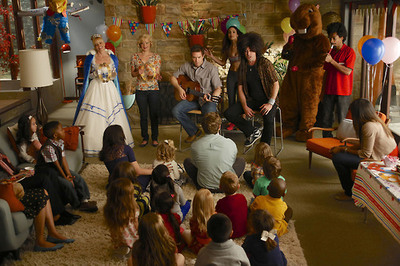
Reuniting the cast of one show on the creator of the old show’s new show sounds like a stunt, and in the case of reuniting the My Name is Earl cast on an episode of Raising Hope, it is a stunt, but this episode proves that that is not necessarily a bad thing. Luckily, Jason Lee, Jaime Pressley, Ethan Suplee, and Eddie Steeles had already played guest characters on Hope, so their presence on another episode did not feel shoehorned in. The idea that their characters (along with those of Nadine Valezquez and Tim Stack) would team up with the Chances to form a rock band that flirts with the brink of success does not make a whole lot of sense. Honestly, though, the idea of anybody teaming up with the Chances to find success as a rock band doesn’t make sense, but who cares when the results are this fun? Besides, when life most seems to be working out, that is when life seems to be making the least sense. That is what “Making the Band” demonstrated. Raising Hope is a positive show of its era, one of optimism despite (constant) hard times – that is to say, hope.
Season Analysis: It feels like The Neighbors slipped through a portal from the 80’s, looked around, realized it was the 2010’s, and decided to stay the same anyway. After a rough start of inconsistent storytelling and characterization, it eventually figured itself out and utilized one of the best casts around (believe it or not) to become the most consistent comedy on television.
“Halloween-ween”
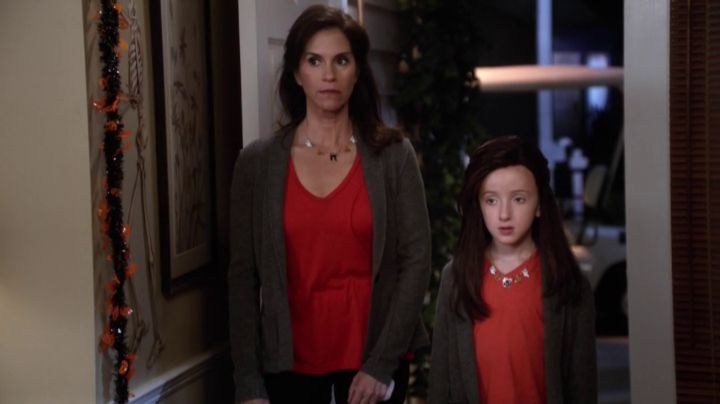
Precocious children are a staple of television, and while precocious children also exist in reality, their small screen counterparts may sound just a little bit too much like adults. But lack of believability can be okay as long as the hilarity is delivered in abundance. In the case of Dick Butkus, The Neighbors easily takes care of the latter and actually may have an explanation regarding the former. Dick is an alien, and perhaps it is natural for a Zabvronian to talk as he does at his age. Perhaps he is even actually older than he appears to be, considering that his parents are apparently hundreds of years old. Whatever the explanation for Dick’s precociousness, his Halloween costume of Debbie Weaver with Marty Weaver puppet was a perfectly clownish representation of his neighbor’s marriage. Ian Patrick’s performance in “Halloween-ween” had me laughing more than just about any other sitcom moment from the 2012-13 season.
Season Analysis: Newsreaders is adequately amusing, but it feels a lot less significant than its fellow Adult Swim Abominable Pictures brethren.
“Hair Razing”
I am definitely in favor of openness when it comes to sexuality, but too much openness can lead to unintended consequences. This is often represented by the spread of STD’s that occurred in the decades following the sexual revolution of the 1960’s. In that vein, too much openness and willingness regarding grooming one’s pubic hair can lead to something like a huge chunk of pubes polluting the ocean and threatening the life of the great tufted warbler, in a silly sort of way. To explain why “Hair Razing” was more amusing than the rest of the premiere season of Newsreaders, it may be more relevant to mention that this was one of the episodes that featured Kumail Nanjiani reporting as Amir Larussa. Seriously, any time Kumail has appeared on my TV screen the past few years, it has been a good deal. His naturally incredulous but also fantastical voice makes him THE natural to report the fake news on a fake newsmagazine.
Season Analysis: Girls consciously remained unlike most anything else on TV, and it was fitfully successful in doing so. This season, I often found myself fascinated by the show instead of enjoying it. This isn’t to say that Girls is that bad … in Season 1, I know I liked it; in Season 2, I’m not always so sure what I thought.
“It’s a Shame About Ray”
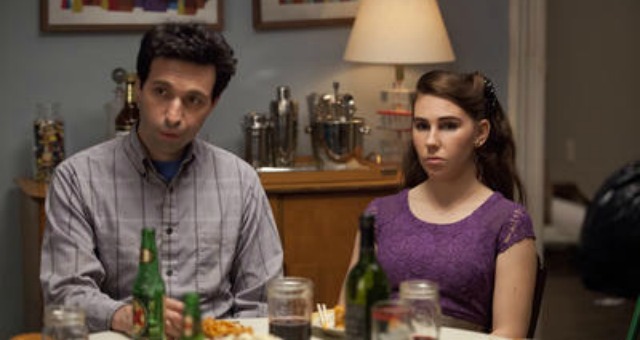
Shoshanna Shapiro has been the most consistently strong character on Girls, and Ray Ploshansky was the most improved in Season 2, so it should be no surprise that an episode that featured a major plot development regarding Ray and Shoshanna’s relationship stood out as the best of the season. “It’s a Shame About Ray” was already looking like a great episode before Zosia Mamet and Alex Karpovsky even had any screen time. Hannah was hosting a dinner party at her apartment with a group of friends who currently were not on the best terms with each other – getting a group like that together in a room is always a recipe for entertaining drama, and this episode did not disappoint in that regard, as Charlie’s new girlfriend Audrey spits fire upon Marnie, and the Charlie and Marnie confront their lingering feelings for each other. When Ray and Shosh show up, it’s not clear how well they are working as a couple, but there is definitely something there. At least they communicate more openly than all the other characters on the show (with the possible exception of Adam). I always appreciate when people talk openly about sex, so it was a nice moment when Ray clarified that their reason for lateness was lovemaking. And the discussion about Ray’s homelessness goes about as well as that discussion could possibly go, because, even though there is a lot of work to get through Ray’s insecurities, these two actually talk and actually listen to each other.
Season Analysis: Billy on the Street still makes me laugh more than anything else, and it shows no signs of slowing down.
Best Episode: Episode 6 (1/25/13)
I was not planning on picking a best episode of the season for Billy, because it is not exactly a show that makes sense to think of on an episode-by-episode basis. But then Episode 6 of Season 2 happened, and it was undoubtedly the most satisfying half hour thus far of the entire series. It featured excellent editions of “For a Dollar” and “Lightning Round,” as well as the best “Quizzed in the Face” contestant of the season – Samantha, who likes black guys – as well as the best celebrity guest – Nas, who stopped by for a round of “Media Mogul or Rabbi.”
Here are some other highlights from the season:
“Quizzed in the Face” contestant runner-up: Elena, who really needed to get on the subway
Best prize: A big picture of James Franco and Anne Hathaway hosting the Oscars
“Miss, miss, for a dollar are you gonna miss the show Weeds?”
“What?”
“Weeds.”
“What is that?”
“Weeds.”
“What is Weeds?”
“Weeds, with Mary-Louise Parker.”
“Mm-hmm.”
“It’s going, it’s ca-, it’s going off the air.”
“Ohhh, so I give you a dollar?”
“Yes.”
“Oh, all right.”
“Okay, yes.”
“I don’t know-”
“Give me a dollar because Weeds is going off the air, and-”
“Where does this goes, oh the dollar?”
“Yes, I’ll give it to Mary-Louise Parker.”
“Ah, all right.”
“Thank you.”
“Sir, for a dollar, do you consider Bethenny Frankel our Golda Meir?” “I don’t even know who the f*** that is.”
“Miss, Hobbit got you down?” “Get down, yourself, ma-”
“Miss, for a dollar, who farts more: Whoopi Goldberg or Blake Shelton?”
“I don’t know.”
“Take a guess.”
“Guess?”
“Whoopi Goldberg or Blake Shelton.”
“I don’t like burgers.”
(to an Indian family) “Are you guys Mumford & Sons?”
“Sir, sir, for a dollar, imagine Kathy Bates on a bicycle.”
“Miss, I hate Claire Danes!”
(takes off headphones) “What’s that?”
“I hate Claire Danes.”
“Why?”
“She’s scary.”
“Why?”
“She is.”
“You want some pizza?”
“NO! GOD, NO! I’M LACTOSE-INTOLERANT!”
“Miss, for a dollar, can you be intelligent and be named Cheryl?” “No.”
(cut to next clip)
“Miss, for a dollar, scream the name of your mother.” “CHERYL!”
“Sir, do you love Leonardo DiCaprio?”
“What?”
“Leonardo DiCaprio.”
“Yeah?”
“You love him?”
“No.”
“Why not?”
“He’s okay.”
“For a dollar, who do you love better: Brad Pitt or Leonardo DiCaprio?”
“Neither.”
“Why neither?”
“They don’t turn me on.”
“Who turns you on?”
“A friend of mine sent me, put a Valentine-”
“Yes. I’m so glad I’m hearing this story.”
“And with a piece of chocolate, he must have given out 30, he must have given out 300-”
“Such a good story.”
“And it had a picture of Superman on it.”
“I love Superman.”
“And he said, and it said on the thing, ‘May you have a Super Valentine’s Day.’ In other words, if I’m gonna find someone, it’s gonna be from another f***in’ galaxy.”
“According to the TV show, what city is it always sunny in?
A) San Francisco
B) Sunny von Bülow
C) Philadelphia, or
D) (turns to camera and smiles) Louie!”
“Miss, miss, for a dollar, would you leave your family just to be able to smell Ryan Gosling’s balls?”
“Miss, for a dollar, who do you think is more sophisticated: Daniel Tosh or the stork from the Vlasic pickle commercials?”
“Miss, here we go, for a dollar: Do me baby
Do the Humpty Hump
Watch me do the Humpty Hump
Sing. Sing. Do me baby
Do the Humpty Hump”
“I don’t speak Eng-”
“‘Humpty Hump.’ ‘Humpty Hump’”
“Humpty Hump?”
“Yes. Do me baby
Do the Humpty Hump”
“Humpty Hump”
“Watch me, watch me, watch me do the Hu-umpty Hump.”
“Humpty Hump”
“Yes, do me baby
Do the Humpty Hump
Watch me do the:”
“Watch me do the.”
“Hum…”
“Humpty Hump.”
“Yes, here you go (hands dollar), th-thank you.”
“Sir, for a dollar, who’s the most famous ugly person?”
“Sir, do you think Gwyneth Paltrow will ever be happy.” “No, she’s too thin.”
“Sir, for a dollar, do you think Gisele Bündchen understands the jokes on Portlandia?”
“Sir, seriously, isn’t it time for an ABC Family original movie starring Anna Kendrick called WPE: Worst Passover Ever?” “I have no idea what you’re talking about.” “Thank you very much.”
Season Analysis: A new sketch show that revolves around one person tends to be a comedic expression of that person’s worldview. That is not really the case with Nick Kroll, who has instead used Kroll Show as a platform for showing off his vast repertoire of characters. Or, the show really does present his worldview, in which case, he watches a lot of reality TV.
“San Diego Diet”
The premiere episode of Kroll Show set the tone for the first season with the initial appearance of Kroll and Jenny Slate’s Liz and Liz characters in PubLizity, which captures the Bravo reality show style a little too well (Jenny is adorable as Liz, but Kroll’s Liz is a bit of a pain to listen to). But Episode 1 manages to stand out among the Season 1 batch thanks to the runner sketch Wheels Ontario, a Degrassi parody in which every student at a high school besides Kroll’s newcomer is in a wheelchair. That premise alone should be enough to make the sketch a winner, but there is thankfully a lot more to it in that, as every possible Canadian stereotype is included and Kroll’s character is taunted with the nickname “Legs” and it is all wisely played straight, with the improbability of the situation never questioned.
Sketch of the Season: “Electricity”
The joke of “Electricity” – a male stripper routine designed around the theme of electricity – at first seemed to be that guys who aren’t necessarily all that attractive stripping is funny, which would have been a bit too cruel. But then it turned out to be too strange and elaborate (the guys dress up as, and then out of, Benjamin Franklin, Thomas Edison, and Steve Jobs) to be cruel. And then the whole thing turns out to be a birthday present made at some place that produces cheap videos starring customers, and I don’t even know if places like that even exist anymore.
The best Portlandia sketches lovingly satirize the most indulgent aspects of modern interaction. “Spoiler Alert” takes long-overdue aim at today’s culture of spoiler avoidance and demonstrates that refusing to set any time limit on spoilers threatens to reduce the viewing public to a squawking, incoherent mess, in the same style that was warned about regarding readership one-upmanship in the Season 1 classic, “Did You Read?” This sketch also manages to deepen the show’s mythology, as it revisits characters from the Battlestar Galactica-inspired “One Moore Episode,” AND it manages to present the best homage to the series finale of Newhart that I’ve ever seen.
Runners-Up:
“Renaming NE 15th Avenue” – “Call me a traditionalist–” “You’re a traditionalist.”
“Unconventional Art” – “Anything can be art!” taken to the nth degree is kind of hard to think about, if you think about it.
“Birthday Loan Application” – The latest appearance from one of Kumail Nanjiani’s painfully officious bureaucratic types.
Season Analysis: I was generally satisfied with the first two seasons of Portlandia, but I could understand if the show wasn’t catching on with a large general audience, but with Season 3, it has gotten more and more accessible to the point at which it deserves full mainstream recognition.
“Take Back MTV”
The whole “dream of the 90s is alive in Portland” ethos of Portlandia suggests a constant spirit of social activism. It is not always put to use, because in a relative utopia like Portland, actually active activism does not seem all that necessary. Furthermore, the daily routine of many Portlanders is already plenty activist enough. So when a Portlander goes out of the way to really be an activist, it is for a cause like … reclaiming MTV. Spike gathers up a crew of his friends to restore the days when MTV played music 24/7 and was the height of cool. Like the good old days that conservatives pine for, this time never actually existed. But Kurt Loder, Matt Pinfield, and Tabitha Soren are still alive, and they’re still cool people and seeing them reunited in this episode was a victory unto itself. The cold opening sketch worked hand in hand with the take back MTV runner, as an attempt at a modern-day protest song keeps getting overtaken by a dance party vibe.
Honorable Mention: “Blackout” was a brilliant season finale, serving as the fullest realization yet of the show’s attempts at increased serialization.





 Jmunney's Blog