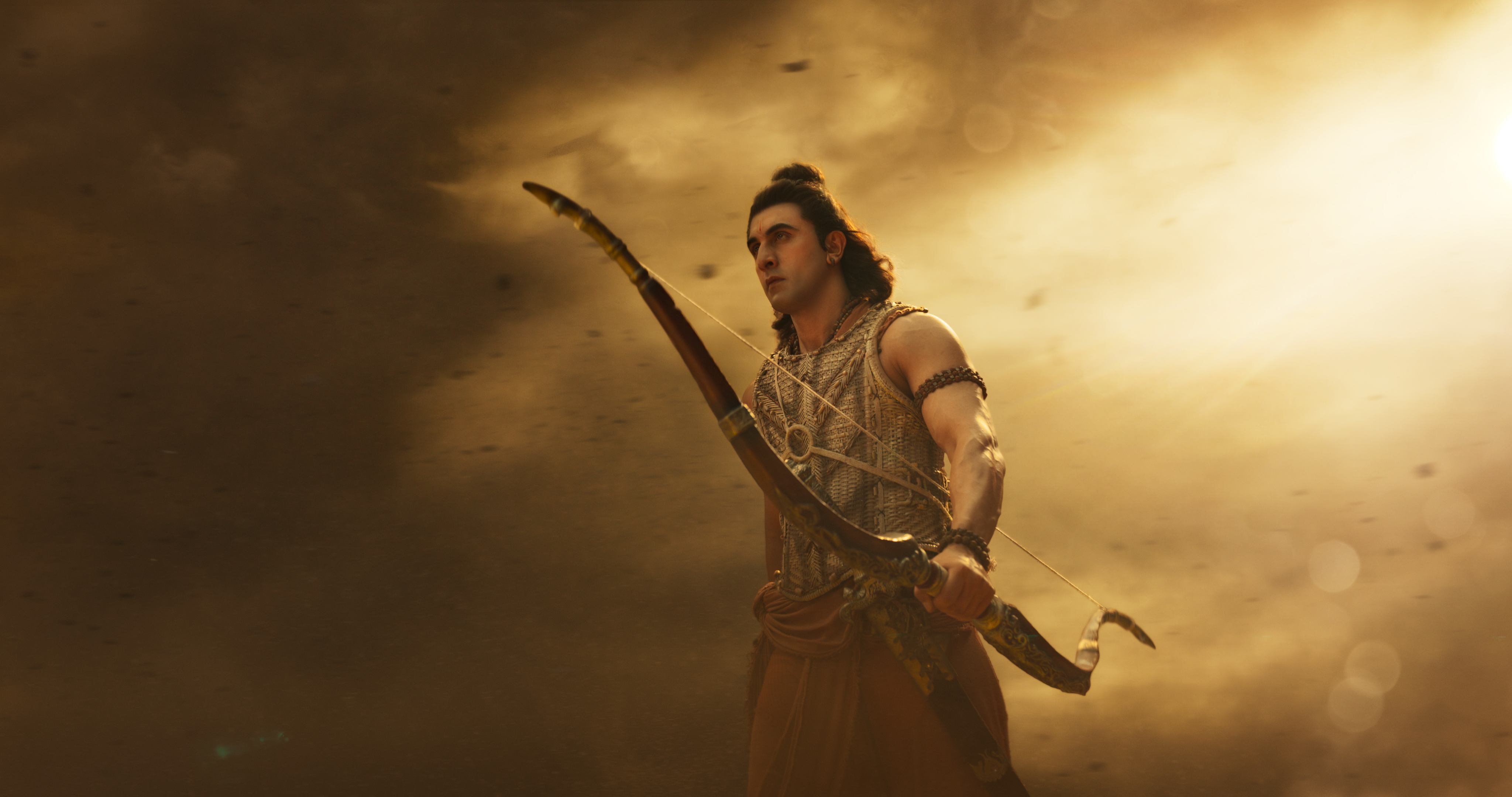
Get Your Ram On (CREDIT: Sony Pictures)
Starring: Ranbir Kapoor, Yash, Sai Pallavi, Ravi Dubey, Sunny Deol, Arun Govil, Lara Dutta, Indira Krishnan, Sonal Jha, Rajiv Kumar, Adinath Kothare, Nitish Sharma, Kajal Aggarwal, Rakul Preet Singh, Anupam Kher, Vivek Oberoi, Harish Uthaman, Kunal Kapoor, Suhail Nayyar, Sheeba Chaddha, Shishir Sharma, Ajinkya Deo, Mukesh Tiwari, Sonia Balani, Riya Kapoor, Surabhi Das, Shobana, Faisal Malik, Parminder Chhada, Saurabh Sachdeva, Kanchan Chetal, Chetan Hansraj, Rhyah Narasimhan, Dishita Sehgal
Director: Nitesh Tiwari
Running Time: 165 Minutes
Rating: PG-13 for God-Like Action Violence
Release Date: November 6, 2026 (Theaters)
What’s It About?: Based on the ancient Indian Hindu epic, Ramayana: Rise of a Legend (aka Ramayana: Part 1) chronicles the rise of Prince Rama (Ranbir Kapoor) in a world on the verge of being torn apart. From the moment of his royal birth, he was fated to lead his kingdom to glory. With his brother Lakshmana (Ravi Dubey) and the sage Vishvamitra (Ajinkya Deo) constantly by his side, he dutifully follows the calls of dharma. On the bright side, this means marrying the beautiful princess Sita (Sai Pallavi). On the less bright side, this means agreeing to be exiled for fourteen years because of palace intrigue orchestrated by his stepmother. While living alongside Sita and Lakshmana in the forest, Rama is tempted by trickster forces, while battles of cosmic significance loom on the horizon.
What Made an Impression?: For Fans Only?: My familiarity with ancient Hindu texts consists of having read the Bhagavad Gita (or at least part of it) a couple of decades ago in high school. I thought I may have read some of the Ramayana as well, but none of this movie felt familiar. So while it was occasionally hard to keep track of this dense milieu, I found it generally rousing and intimate enough in parts to keep me entertained. If you, however, are coming at this from the opposite end of the familiarity scale, perhaps it will be easier to feel connected to it. Or perhaps instead you’ll be more easily disappointed by how it doesn’t live up to the source material. Either way, it’s probably best to think of this story the way my plus-one described it: i.e., this culture’s version of a superhero tale.
Modern Storytelling: Ramayana looks like it has the budget and scope to stand alongside Hollywood blockbusters in American multiplexes without having to succumb to an inferiority complex. But there are plenty of moments (particularly in crowd shots) when it looks like the visuals have been generated by an algorithm. To be fair, that’s a scourge of much of modern cinema. And the entire movie isn’t plagued by that, as the smaller-scale scenes offer much more satisfying effects. Nothing groundbreaking, but sufficiently charming.
Smoothed in Translation: This American release of Ramayana features English dialogue with artificial intelligence-lip syncing, presumably to prevent any outrageously mismatched mouth movements. I’m not an absolutist about completely keeping AI out of movies, but this approach does feel rather soulless. I’d much rather watch a subtitled version, or an even a dubbed edition that hilariously misses the mark in terms of matching the lips to the phonemes. But I guess the makers of Ramayana were going for something a little more polished. They accomplished that, but that means that this journey really only truly comes alive in fits and starts.
Ramayana: Rise of a Legend is Recommended If You Like: Morphing, Ancient soap operas, Being dutiful
Grade: 3 out of 5 Dharmas


