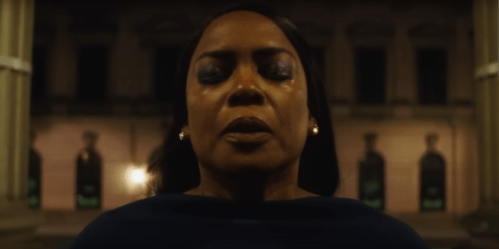
‘Origin’ Brings Isabel Wilkerson’s ‘Caste’ to Vibrant Cinematic Life

1 Comment

CREDIT: NEON/Screenshot

Starring: Aunjanue Ellis-Taylor, Jon Bernthal, Niecy Nash-Betts, Emily Yancy, Vera Farmiga, Audra McDonald, Blair Underwood, Donna Mills, Leonardo Nam, Connie Nielsen, Finn Wittrock, Victoria Pedretti, Jasmine Cephas Jones, Mieke Schymura, Isha Blaaker, Myles Frost, Gaurav J. Pathania, Suraj Yengde, Nick Offerman

Director: Ava DuVernay

Running Time: 135 Minutes

Rating: PG-13 for Historical Discrimination

Release Date: December 8, 2023 (Awards-Qualifying Run)/January 19, 2024 (Theaters)

What’s It About?: Perhaps you read the 2020 nonfiction book Caste: The Origin of Our Discontents and found yourself wondering how the author, Isabel Wilkerson, went about crafting such a book. Well, it’s your lucky day, because in the grand tradition of Adaptation, Ava DuVernay has written and directed Origin, a big-screen version that reveals the story behind the story. Aunjanue Ellis-Taylor plays Isabel, whom we’re introduced to in the buildup to Caste‘s publication. We also get to know her ailing mother Ruby (Emily Yancy), her protective husband Brett (Jon Bernthal), and her cousin Marion (Niecy Nash-Betts). Interspersed within are some stories that demonstrate Isabel’s theory about how American racism is a classic example of social stratification seen throughout human history.

What Made an Impression?: Hung Up in Jargon: Since it is the story of a writer’s life, I was a little worried that Origin would be a little too talky for its own good. And for the first third or so, my fears were well-founded. As Isabel has polite debates with her editor and fellow cocktail party attendees, I realized why these conversations are not usually considered especially cinematic. These moments might be interesting to literature grad students, but for the rest of the population, they could come off a little dull and impenetrable.
Compelling Turning Point: Fortunately the rest of the movie does not maintain that overly literary veneer. And there’s one crucial scene that spells out a change in priorities. Isabel and Marion are hanging out together at a family cookout while Isabel explains the premise of her new book. Marion is initially bewildered by her rather abstract explanation, but then Isabel gets down to brass tacks with a more concrete example of what she’s getting at. Marion then assures her that this sort of storytelling ability is exactly how she should write her book, and the movie wisely follows that cue as well.
The Points Become Salient: Isabel’s journey of writing Caste takes her to the American Deep South, Nazi Germany, and India, with historical re-enactments illustrating how each of these societies have been shaped by strikingly similar caste systems. These segments are fairly straightforward, but what pushes them over the edge are Isabel’s reactions of inspiration. Ellis-Taylor is a subtle master at quiet euphoria. (That quality also serves as a counterpoint to the deep wells of sadness she must convey.) By the end of the movie, you’ll hopefully be able to feel as hopeful as Isabel appears to be. Not because these intractable problems will be solved anytime soon, but at the very least because someone is able to identify and explain them.

Origin is Recommended If You Like: Anti-racism, Listening to people who have liberal arts degrees

Grade: 3.5 out of 5 Castes

How Much and in What Ways Does ‘Respect’ Respect Aretha Franklin? Let’s Find Out!

Leave a comment

Respect (CREDIT: Quantrell D. Colbert/Metro-Goldwyn-Mayer Pictures)

Starring: Jennifer Hudson, Forest Whitaker, Marlon Wayans, Marc Maron, Audra McDonald, Tituss Burgess, Saycon Sengbloh, Hailey Kilgore, Tate Donovan, Mary J. Blige, Gilbert Glenn Brown, Skye Dakota Turner

Director: Liesl Tommy

Running Time: 145 Minutes

Rating: PG-13 for Abusive Relationships and Racial Tension

Release Date: August 13, 2021 (Theaters)

Aretha Franklin biopic Respect keeps harping on the idea that the Queen of Soul didn’t start having hits until she focused on her own original efforts, and I kind of wish the movie had taken its own advice. Now, it obviously couldn’t be a completely thorough original. It is a biopic, after all. But Jennifer Hudson is talented enough to make me think that this movie isn’t really going to sing until she’s allowed to break free and offer her own unique interpretation. The most rousing moment of the whole film comes during the end credits when we get to see the real Aretha bring the house down at the 2015 Kennedy Center Honors with a rendition of “(You Make Me Feel Like) A Natural Woman.” (President Obama was having a GREAT time.) To be fair, Hudson and the makers of Respect are more interested in exploring the behind-the-scenes of Franklin’s story, but it is telling that they never quite achieve something as triumphant as the real deal.

The challenge of so many music biopics is combining idiosyncrasy with reverence. Those two impulses don’t really mix, and oftentimes biopic makers are much more interested in the latter than the former anyway. The title of Respect indicates that that’s very much the case here. That’s especially clear in one scene when Aretha attempts to perform a song by family friend Dinah Washington (an intensely regal Mary J. Blige) while Dinah is in attendance. It absolutely does not go so well, thanks to Dinah’s insistence that you don’t play the Queen in front of the Queen. That deference marks the entire movie. Within that boundary, Hudson is able to successfully explore Franklin’s trauma and resilience, but she doesn’t have room to leave her own inimitable signature.

I found the portrayals of the main men in Aretha’s life much more compelling, perhaps because their public personas are much less set in stone and thus the actors don’t have to feel beholden to icons. I’m talking Forest Whitaker as her iron-willed minister father C.L., Marlon Wayans as her controlling and abusive manager-slash-husband Ted White, and Marc Maron as Jerry Wexler, the producer who’s actually committed to letting Aretha be Aretha. Respect gives us a full picture of all the big, often controlling personalities in Aretha’s life, and so it works in painting that picture and in that way it fulfills the promise of its title. If you’re in the mood for that sort of contextualization, you might be satisfied, but don’t expect the house to be brought down the way that Aretha so often did.

Respect is Recommended If You Like: Behind the Music, Deferential covers

Grade: 2.5 out of 5 Chains of Fools

This Is a Movie Review Review: Beauty and the Beast (2017)

1 Comment

What up with Disney ransacking its vault to remake its own animated hits into (mostly[-ish]) live-action versions? This is not an inherently bad idea. These are stories that have been told over and over (often in fairy tale form) and will continue to be told over and over, so why not spruce them up with some 21st Century Pizzazz?

What does new-flavor Beauty and the Beast offer over the 1991 toon? Belle’s an inventor, but that does not factor in too much. There is an “exclusively gay moment” for Le Fou, but it is so inconsequential that you might need a study guide to locate it (I certainly did). So ultimately, this is about some legends of acting and singing giving it a whirl. Nothing earth-shattering, but we’re in good hands.

I give Beauty and the Beast 3 Rose Petals out of 5 Snowy Days in June.