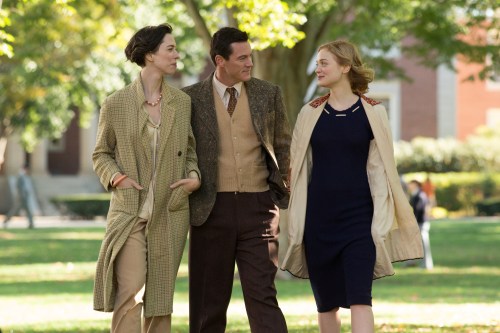
CREDIT: Claire Folger/Annapurna Pictures
This review was originally posted on News Cult in October 2017.
Starring: Luke Evans, Rebecca Hall, Bella Heathcote, Connie Britton, Oliver Platt
Director: Angela Robinson
Running Time: 108 Minutes
Rating: R for Getting It On Unapologetically
Release Date: October 13, 2017
I think every man, woman, boy, girl, or whatever personal nomenclature you prefer should go and be inspired by Wonder Woman. I also want to recommend just as wholeheartedly Professor Marston and the Wonder Women, the story of Wonder Woman’s creator and his inspiration, but fair warning: William Moulton Marston (Luke Evans) lived an unprecedented life, by any era’s standards. His biography is not absolutely necessary to understand the context of Diana Prince, but it is enlightening. His story is also alarming, but also ultimately joyous, and that is true especially in light of the Wonder Woman film so pointedly emphasizing Diana’s prerogative to protect all life.
To get right into it: Marston did not come into comic books through publishing or 9-to-5 hackery, but rather psychology and academia. He is noted for developing DISC Theory, which proposes that all human behavior can be categorized as either dominance, inducement, submission, or compliance. To be clear, this is not just sexual behavior he is talking about, but all human behavior. If you’re wondering if a guy like this would be intrigued by sexual bondage, then your instincts are correct. However, if you’re also thinking that this part of the story has nothing to do with the creation of Wonder Woman, you clearly have not read her early issues. Marston is also famous for inventing an early lie detector prototype, and now that are you are remembering the Lasso of Truth, it should be abundantly clear how his ideas have lived on.
But while all that history is important to the film, Professor Marston and the Wonder Women is a love story through and through, and an unapologetically nontraditional one. Marston and his wife Elizabeth Holloway Marston (Rebecca Hall), a fellow psychologist, lived with another woman, Olive Byrne (Bella Heathcote), lover to them both. If this arrangement sounds like misogyny lurking underneath a supposed ally of women, well, this staunchly feminist does not see it that way, and neither do its staunchly feminist characters. Instead, Bill, Elizabeth, and Olive, in their decision to live together in defiance of society’s standards, are positioned as self-sacrificing heroes ahead of their time. This is true perhaps in the sense that as the inspirations of an iconic fictional character, the ladies’ legacy lives on. But it is not exactly true (at least not yet) in the sense that polyamory is still far from normal.
Personally, I do not object to polyamory on any moral grounds, but rather, because I find the prospect emotionally exhausting. But damn if Professor Marston doesn’t have me cheering for those who believe in it. There is no doubt that this trio are in fact deeply in love with each other. A series of lie detector scenes make that effervescently clear. These moments may be cinematic contrivances, but I don’t care, as they are so entertainingly bold! Indeed, it is rare to find any major theatrical release whose social and romantic politics are so unapologetic, and for that, it should be cherished.
Professor Marston and the Wonder Women is Recommended If You Like: Wonder Woman comics – the classic and the obscure stuff, Jules and Jim, Shakespeare in Love, Secretary
Grade: 4 out of 5 Lie Detectors
 Jmunney's Blog