‘Origin’ Brings Isabel Wilkerson’s ‘Caste’ to Vibrant Cinematic Life

1 Comment

CREDIT: NEON/Screenshot

Starring: Aunjanue Ellis-Taylor, Jon Bernthal, Niecy Nash-Betts, Emily Yancy, Vera Farmiga, Audra McDonald, Blair Underwood, Donna Mills, Leonardo Nam, Connie Nielsen, Finn Wittrock, Victoria Pedretti, Jasmine Cephas Jones, Mieke Schymura, Isha Blaaker, Myles Frost, Gaurav J. Pathania, Suraj Yengde, Nick Offerman

Director: Ava DuVernay

Running Time: 135 Minutes

Rating: PG-13 for Historical Discrimination

Release Date: December 8, 2023 (Awards-Qualifying Run)/January 19, 2024 (Theaters)

What’s It About?: Perhaps you read the 2020 nonfiction book Caste: The Origin of Our Discontents and found yourself wondering how the author, Isabel Wilkerson, went about crafting such a book. Well, it’s your lucky day, because in the grand tradition of Adaptation, Ava DuVernay has written and directed Origin, a big-screen version that reveals the story behind the story. Aunjanue Ellis-Taylor plays Isabel, whom we’re introduced to in the buildup to Caste‘s publication. We also get to know her ailing mother Ruby (Emily Yancy), her protective husband Brett (Jon Bernthal), and her cousin Marion (Niecy Nash-Betts). Interspersed within are some stories that demonstrate Isabel’s theory about how American racism is a classic example of social stratification seen throughout human history.

What Made an Impression?: Hung Up in Jargon: Since it is the story of a writer’s life, I was a little worried that Origin would be a little too talky for its own good. And for the first third or so, my fears were well-founded. As Isabel has polite debates with her editor and fellow cocktail party attendees, I realized why these conversations are not usually considered especially cinematic. These moments might be interesting to literature grad students, but for the rest of the population, they could come off a little dull and impenetrable.
Compelling Turning Point: Fortunately the rest of the movie does not maintain that overly literary veneer. And there’s one crucial scene that spells out a change in priorities. Isabel and Marion are hanging out together at a family cookout while Isabel explains the premise of her new book. Marion is initially bewildered by her rather abstract explanation, but then Isabel gets down to brass tacks with a more concrete example of what she’s getting at. Marion then assures her that this sort of storytelling ability is exactly how she should write her book, and the movie wisely follows that cue as well.
The Points Become Salient: Isabel’s journey of writing Caste takes her to the American Deep South, Nazi Germany, and India, with historical re-enactments illustrating how each of these societies have been shaped by strikingly similar caste systems. These segments are fairly straightforward, but what pushes them over the edge are Isabel’s reactions of inspiration. Ellis-Taylor is a subtle master at quiet euphoria. (That quality also serves as a counterpoint to the deep wells of sadness she must convey.) By the end of the movie, you’ll hopefully be able to feel as hopeful as Isabel appears to be. Not because these intractable problems will be solved anytime soon, but at the very least because someone is able to identify and explain them.

Origin is Recommended If You Like: Anti-racism, Listening to people who have liberal arts degrees

Grade: 3.5 out of 5 Castes

‘Judy’ is a Paint-By-Numbers Biopic Somewhat Enlivened by Renée Zellweger’s Truly Garland-Esque Presence

Leave a comment

CREDIT: David Hindley/Courtesy of LD Entertainment and Roadside Attractions

Starring: Renée Zellweger, Rufus Sewell, Michael Gambon, Finn Wittrock, Jessie Buckley, Richard Cordery, Darci Shaw

Director: Rupert Goold

Running Time: 118 Minutes

Rating: PG-13, Mainly for the Substance Abuse

Release Date: September 27, 2019 (Limited)

Of all the tragedies that Judy Garland endured in her life, perhaps the most visceral one that we get to witness in the biopic Judy is when she is strictly forbidden from eating a burger at a diner while she’s a teenager under the iron fist of MGM co-founder Louis B. Mayer. It’s far from the most abusive trauma she ever experienced, and burgers certainly aren’t the most healthy indulgence. But that little bit of rebellion that is chomping on junk food is just the point. This moment is a microcosm representing just how thoroughly Garland’s life was not her own. Judy is driven by that unstable foundation, but it rarely says anything revelatory beyond, “Here’s how this child star was mistreated, and here’s how it still echoes in her life decades later.”

Screenwriter Tom Edge and director Rupert Goold follow the tack of recent showbiz biopics like Film Stars Don’t Die in Liverpool and Stan & Ollie by presenting with their subject long after the height of fame when they happen to find themselves in England. It’s 1969. Garland’s most iconic films came out a generation ago, but she’s still mighty beloved. Thus, plenty of people want to see her when her financial reality forces her to temporarily leave her young kids behind in California while she books some live gigs in London. As the adult Judy, Renée Zellweger is a natural fit to convey the constant agony that comes with struggling in the public eye. It’s a fine performance, but one that rarely transcends the standard biopic structure (save for the showstopping number she delivers in the final scene). Judy is a valuable cautionary tale; I just wish it had delivered that note of caution more uniquely.

Judy is Recommended If You Like: You Must Remember This, Film Stars Don’t Die in Liverpool

Grade: 2.5 out of 5 Somewheres Over the Rainbow

Movie Review: ‘The Last Black Man in San Francisco’ Proves That There Are Still New Ways to Make a Movie

2 Comments

CREDIT: A24

Starring: Jimmie Fails, Jonathan Majors, Danny Glover, Tichina Arnold, Rob Morgan, Mike Epps, Finn Wittrock

Director: Joe Talbot

Running Time: 120 Minutes

Rating: R for A Mild Mix of Profanity, Brief Nudity, and Drug Use

Release Date: June 7, 2019 (Limited)

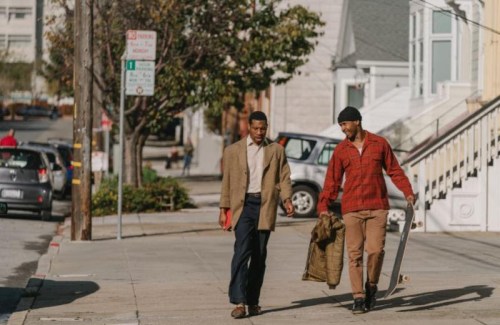
The Last Black Man in San Francisco has one of the most (if not THE MOST) valuable qualities in cinema, and art in general, insofar as it truly feels unlike anything else that has come before it. It’s about lifelong pals Jimmie (Jimmie Fails) and Montgomery (Jonathan Majors), who have a sort-of-magical journey living in the title city while squatting in the house that Jimmie claims his grandfather built years ago. The story is based on Fails’ own life, and I greatly appreciate the visionary perspective he provides along with director Joe Talbot.

This isn’t a movie I loved right away, but it’s one that I want to keep in mind to see how it sticks with me months, years, or even decades from now. It is one that I can imagine expanding in my mind as I digest more of its unique flavors. I saw it about a month ago, and I haven’t thought about it too much unprompted since then. For now, as I’m purposefully reflecting upon it, I must make sure to note my love of an early scene in which Jimmie and Montgomery skateboard through the city to the tune of a Philip Glass-esque composition, and I must also mention that former Dead Kennedys lead singer Jello Biafra plays a dorky tour guide. So that’s where we are in 2019.

The Last Black Man in San Francisco is Recommended If You Like: San Francisco Geography and Architecture, Discovering a New Voice, Sorry to Bother You, Blindspotting

Grade: 3.5 out of 5 Squatters

This Is a Movie Review: Barry Jenkins is as Sensitive and Empathetic as Ever with James Baldwin Adaptation ‘If Beale Street Could Talk’

Leave a comment

CREDIT: Tatum Mangus/Annapurna Pictures

This review was originally published on News Cult in December 2018.

Starring: KiKi Layne, Stephan James, Regina King, Teyonah Parris, Colman Domingo, Bryan Tyree Henry, Ed Skrein, Emily Rios, Finn Wittrock

Director: Barry Jenkins

Running Time: 117 Minutes

Rating: R for Longtime Friends Becoming Lovers and Their Families Yelling Awful Things at Each Other

Release Date: December 14, 2018 (Limited)

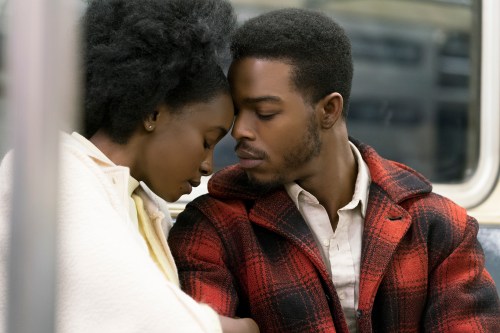
One of the strength of Barry Jenkins’ films is that they work much like how the human brain works. They process their stories from a clear beginning to end, but along the way they take detours, often expressionistic and dreamlike, because in their associative natures they have tendencies to temporarily disassociate. The narrative focus in If Beale Street Could Talk is on the effort to free Alonzo “Fonny” Hunt (Stephan James) from jail after he has been (obviously and egregiously) falsely been accused of rape. We stay close with his family and pregnant girlfriend Tish (KiKi Layne) as the weeks tick by and they do whatever they possibly can for a young black man in 1970s America. Interspersed with this steady passage of time are flashes of Fonny and KiKi’s memories, hopes, and nightmares. The images in these moments are often idyllic and tranquil, but there is an undercurrent of imprisonment demonstrating that the worst of reality cannot be fully escaped as it infects our psyches.

If On Beale Street Could Talk is based on James Baldwin’s novel of the same name, and Jenkins’ smooth hand ensures that Baldwin’s conception of Harlem is brought to tactile, contemporary life. Layne’s sweet, mischievous, and unapologetic narration; Nicholas Britell’s smooth score; and James Laxton’s crisp cinematography make for a sensuous feast that altogether works to achieve a remarkable feat of empathy generation. All films that are worth their weight put us in their characters’ headspaces and let us discover what they were all about, but Beale Street is a special case. Every moment is especially intimate and familial, and it is thus an honor to be invited in. Like most stories about false accusations and systemic discrimination, this one is frustrating to anyone who cares about justice, but amidst all that there is to be angry at, Jenkins somehow manages to achieve an odd sort of peace by the end. Everything is far from perfect, but the love between Tish and Fonny is real and worth celebrating.

If Beale Street Could Talk is Recommended If You Like: Moonlight, The Harlem Renaissance, Love & Basketball

Grade: 3.75 out of 5 People Who Love Each Other