‘Origin’ Brings Isabel Wilkerson’s ‘Caste’ to Vibrant Cinematic Life

1 Comment

CREDIT: NEON/Screenshot

Starring: Aunjanue Ellis-Taylor, Jon Bernthal, Niecy Nash-Betts, Emily Yancy, Vera Farmiga, Audra McDonald, Blair Underwood, Donna Mills, Leonardo Nam, Connie Nielsen, Finn Wittrock, Victoria Pedretti, Jasmine Cephas Jones, Mieke Schymura, Isha Blaaker, Myles Frost, Gaurav J. Pathania, Suraj Yengde, Nick Offerman

Director: Ava DuVernay

Running Time: 135 Minutes

Rating: PG-13 for Historical Discrimination

Release Date: December 8, 2023 (Awards-Qualifying Run)/January 19, 2024 (Theaters)

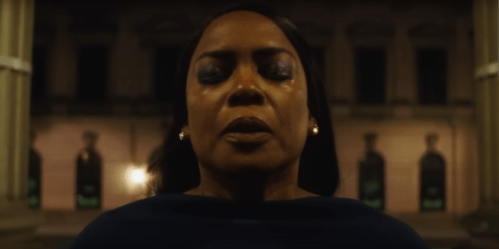
What’s It About?: Perhaps you read the 2020 nonfiction book Caste: The Origin of Our Discontents and found yourself wondering how the author, Isabel Wilkerson, went about crafting such a book. Well, it’s your lucky day, because in the grand tradition of Adaptation, Ava DuVernay has written and directed Origin, a big-screen version that reveals the story behind the story. Aunjanue Ellis-Taylor plays Isabel, whom we’re introduced to in the buildup to Caste‘s publication. We also get to know her ailing mother Ruby (Emily Yancy), her protective husband Brett (Jon Bernthal), and her cousin Marion (Niecy Nash-Betts). Interspersed within are some stories that demonstrate Isabel’s theory about how American racism is a classic example of social stratification seen throughout human history.

What Made an Impression?: Hung Up in Jargon: Since it is the story of a writer’s life, I was a little worried that Origin would be a little too talky for its own good. And for the first third or so, my fears were well-founded. As Isabel has polite debates with her editor and fellow cocktail party attendees, I realized why these conversations are not usually considered especially cinematic. These moments might be interesting to literature grad students, but for the rest of the population, they could come off a little dull and impenetrable.
Compelling Turning Point: Fortunately the rest of the movie does not maintain that overly literary veneer. And there’s one crucial scene that spells out a change in priorities. Isabel and Marion are hanging out together at a family cookout while Isabel explains the premise of her new book. Marion is initially bewildered by her rather abstract explanation, but then Isabel gets down to brass tacks with a more concrete example of what she’s getting at. Marion then assures her that this sort of storytelling ability is exactly how she should write her book, and the movie wisely follows that cue as well.
The Points Become Salient: Isabel’s journey of writing Caste takes her to the American Deep South, Nazi Germany, and India, with historical re-enactments illustrating how each of these societies have been shaped by strikingly similar caste systems. These segments are fairly straightforward, but what pushes them over the edge are Isabel’s reactions of inspiration. Ellis-Taylor is a subtle master at quiet euphoria. (That quality also serves as a counterpoint to the deep wells of sadness she must convey.) By the end of the movie, you’ll hopefully be able to feel as hopeful as Isabel appears to be. Not because these intractable problems will be solved anytime soon, but at the very least because someone is able to identify and explain them.

Origin is Recommended If You Like: Anti-racism, Listening to people who have liberal arts degrees

Grade: 3.5 out of 5 Castes

‘The Photograph’ Captures Generations of Love Blossoming and Spreading Free

1 Comment

CREDIT: Universal Pictures

Starring: Issa Rae, Lakeith Stanfield, Chanté Adams, Y’lan Noel, Rob Morgan, Lil Rel Howery, Teyonah Parris, Courtney B. Vance, Chelsea Peretti, Kelvin Harrison Jr., Jasmine Cephas Jones, Marsha Stephanie Blake

Director: Stella Meghie

Running Time: 106 Minutes

Rating: PG-13 for Some Sizzling Moments

Release Date: February 14, 2020

The ads for The Photograph have been giving off strong “Nicholas Sparks, but with black people” vibes. However, I had a hankering suspicion that it wouldn’t actually be as saccharine as that glossy presentation suggested. First and foremost, the two leads, Issa Rae and Lakeith Stanfield, are not exactly for taking on such gloopy material. Surely their presence would ensure that things would end up a little more left-field than this genre typically goes. Indeed that has turned out to be the case, but to be fair to the marketing team, this is not an easy movie to advertise. It has a slow-burn meditative spirit (driven along by Robert Glasper’s jazzy piano score) that does not immediately grab you in the way that trailers are meant to in a couple of minutes. But if you simmer in it for a couple hours, your heart might just grow a few sizes.

Michael (Stanfield) is a reporter working on a story that happens to involve recently deceased photographer Christina Eames (Chanté Adams). He then finds himself smitten by Christina’s daughter Mae (Rae), who is working her way through the truth bombs that her mom has left her in a pair of letters, one addressed to Mae and one to Mae’s father. Meanwhile, writer-director Stella Meghie frequently takes us back to Christina’s young adulthood in small-town Louisiana where she is unable to reconcile a possible future with the man that she loves (Y’lan Noel) and her dreams of making it big in New York City. She tends to always choose her professional goals over her loved ones, and in a case of family history rhyming, Mae and Michael find themselves worried that they are going to do the same. That struggle to find the nerve to say what you know is in your heart is deeply felt in The Photograph.

I have noticed a lot of excitement around this movie about the potential to see black love that is not also about trauma on the big screen. And if that is what you are looking for, I suspect that you will be satisfied. The blackness in The Photograph is not meant to represent all blackness, as Michael and Mae’s story is by no means a microcosm of all people of color. They are two people who happen to be black and happen to be falling in love. The details are their own, while also being part of a continuum of their lineage. It is an openhearted, generous story that I think a lot of people are going to be happy to witness.

The Photograph is Recommended If You Like: Beyond the Lights, Love & Basketball, A bottle of wine and a record player on a rainy night

Grade: 4 out of 5 Darkrooms

This Is a Movie Review: ‘Blindspotting’ is a Little Messy, But It Has Plenty to Say About Violence and Gentrification

1 Comment

CREDIT: Ariel Nava/Lionsgate

This review was originally published on News Cult in July 2018.

Starring: Daveed Diggs, Rafael Casal, Janina Gavankar, Jasmine Cephas Jones, Ethan Embry

Director: Carlos López Estrada

Running Time: 95 Minutes

Rating: R for Confrontational Profanity and Intense Physical Violence

Release Date: July 20, 2018 (Limited)

Are we defined by the most extreme moments in our lives? Please, somebody, tell Blindspotting, because it would like to know!

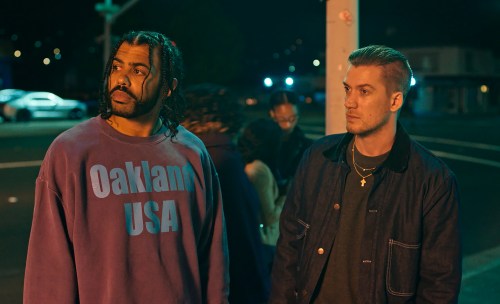
Longtime friends and Oakland, California natives Daveed Diggs and Rafael Casal star as longtime friends and Oakland, California natives Collin and Miles, respectively. They work together at a moving company, managed by Collin’s ex Val (Janina Gavankar). Collin is approaching the end of his probation, his jail stint the result of a violent incident that has forever seared itself on Val’s memory. A central question in Blindspotting is whether or not Val can ever look past Collin at his worst, and looming even wider is the question of whether or not Collin and Miles can look past the version of their hometown that they grew up in.

Gentrification has arrived for every urban area in this country with any hint of trendiness, and Miles could not be more opposed. Collin is more serene about the matter, perhaps because he has more intimate experience with the consequences of myopia. Development efforts may take away local color, but they also can make cities safer. Alas, they often just tuck the danger away into hidden corners, which Blindspotting does not turn its eyes away from. If only gentrification could clean up a population’s morality and make it more compassionate. It is a phenomenon that has its failings, but those failings do not call for as violent a reaction as Miles is predisposed towards. There is a lot of confrontation from all directions in this movie – the challenge is to cut through your blind spots and find the most useful message.

Blindspotting is Recommended If You Like: Daveed Diggs breaking big, Socially conscious sitcoms, Wayne Knight cameos

Grade: 3.5 out of 5 Kwik Ways