In ‘Landscape with Invisible Hand,’ the Alien and Human Cultures Clash and Collaborate

1 Comment

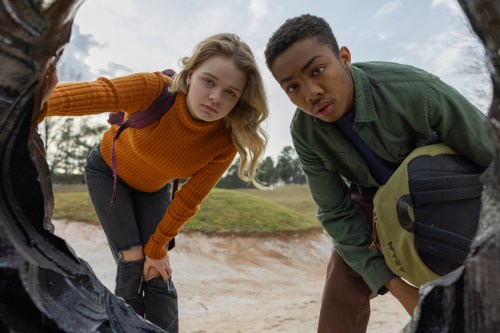
Which hand is invisible? (CREDIT: Lynsey Weatherspoon/ Metro-Goldwyn-Mayer Pictures)

Starring: Asante Blackk, Kylie Rogers, Tiffany Haddish, Josh Hamilton, Brooklyn MacKinzie, Michael Gandolfini, William Jackson Harper

Director: Cordy Finley

Running Time: 105 Minutes

Rating: R for Some Harsh Language Apparently (This Should Absolutely Be PG-13)

Release Date: August 18, 2023 (Theaters)

What’s It About?: The extraterrestrials have arrived! And they’ve completely transformed society. The aliens of Landscape with Invisible Hand are crustacean-esque creatures known as the Vuvv who like to claim that they’ve instituted a sort of utopia. But really, it’s just their own version of exploitative capitalism. A few humans make out like gangbusters by ingratiating themselves into Vuvv culture, while the majority of Earth’s population struggle to deal. both financially and ethically. Among the hustlers are teenage visual artist Adam Campbell (Asante Blackk), his mom Beth (Tiffany Haddish), and sister Natalie (Brooklyn MacKinzie). At least they still have a roof over their head, which is more than can be said for his classmate Chloe (Kylie Rogers). Sparks immediately fly between the two of them, and he fancies himself a Good Samaritan, so he invites her and her dad (Josh Hamilton) and brother (Michael Gandolfini) to stay at his house until they can find something steady. But this arrangement soon turns awkward, and it only gets weirder once the Vuvv become closely involved.

What Made an Impression?: Getting On to Get On: Landscape with Invisible Hand is a bit of a postmodern alien visitation flick, insofar as the Vuvv are students of Earth culture. They’re mostly fans of classic domestic sitcoms, since they reproduce asexually and concepts like romantic and familial love are generally foreign to them. But you also get the sense that they’re familiar with conquering cinematic ETs and that they’re making a concerted effort to present themselves as a benevolent alternative. But we’ve already heard this story before in Earth history: it’s called colonization.
Even if you recognize the holes in the Vuvv’s telling, this is the new status quo, and there’s only the merest hints of revolution. So in the meantime, pretty much everyone is forced to confront how much of their integrity they’re willing to compromise to get by. And so, we meet a neurosurgeon who gives up his practice for the much more menial and wholly unnecessary – but also much more lucrative – job of Vuvv driver. Plenty of others are forced to sell their own intimacy. Adam and Chloe hit upon a quick moneymaking scheme by broadcasting their budding relationship to the Vuvv, who are fascinated by the rituals of human courtship. And one Vuvv even “marries” Beth so that he can experience what it’s like to be a human father. If this sounds like modern social media and reality TV stardom, you’re not too far off.
You’ll Know ‘Em When You Hear ‘Em: LwIH harkens back to classic mid-century sci-fi with its theremin-heavy score from Michael Abels. It suggests a woozy promise of the future that rings profoundly false. Sure, there are spaceships hanging up in the sky, but most people are stuck on the ground eating faux-meat blocks. That care to the aural design extends to the idiosyncratic sound effects. The Vuvv’s language is communicated by rubbing their fin-like appendages to create an alphabet that resembles scratching sandpaper and scraping pencils. It presents a mundane, but also unforgettable, reshaping of how to perceive the universe.
The Colors Endure: And finally, I would be remiss not to mention the element that lends this movie its title, as we’re treated to a series of shots of Adam’s artwork over the years. He’s been painting and drawing ever since he was a toddler, resulting in a signature, often watercolor-based expressive style. Eventually, his most ambitious project to date captures the attention of a prominent Vuvv art critic, who offers Adam a lucrative position as a human artist-in-residence. There’s a lot thematically in play in Landscape with Invisible Hand, and it handles this conflict of creativity vs. commerce as deftly as everything else.

Landscape with Invisible Hand is Recommended If You Like: Classic sci-fi, Modern social media, YA novels

Grade: 4 out of 5 Vuvvs
Ant-Man and the Wasp: Review-a-mania

Leave a comment

Oh my God, Ant-Man admit it! (CREDIT: Marvel Entertainment/Screenshot)

Starring: Paul Rudd, Evangeline Lilly, Kathryn Newton, Jonathan Majors, Michael Douglas, Michelle Pfeiffer, David Dastmalchian, Katy O’Brian, William Jackson Harper, Bill Murray, Corey Stoll

Director: Peyton Reed

Running Time: 124 Minutes

Rating: PG-13

Release Date: February 17, 2023 (Theaters)

I liked the beginning of Ant-Man and the Wasp: Quantumania, because it was bright and sunny, both literally and metaphorically. I also liked the end, because it was once again bright and sunny. But I didn’t like the parts in the Quantum Realm as much, because they were quite dark. I saw it two days after my birthday, and it definitely wasn’t the best birthday movie, so it’s good that I didn’t see it on the exact anniversary of my expulsion from a uterus.

While the credits were unspooling, a youngster of about six told his dad, “I hate this movie,” as he walked past me. I try not to hate, but I kept holding my head at a weird angle while watching, and that wasn’t good for my neck. Both literally and metaphorically.

Grade: Infinity Plus 3 out of Infinity Times 2 Kangs

Mark Ruffalo Relentlessly Wades Through Some ‘Dark Waters’ to Expose the Soullessness of the Energy Industry

1 Comment

CREDIT: Mary Cybulski/Focus Features

Starring: Mark Ruffalo, Anne Hathaway, Tim Robbins, Bill Camp, Victor Garber, Mare Winningham, Bill Pullman, William Jackson Harper, Louis Krause

Director: Todd Haynes

Running Time: 126 Minutes

Rating: PG-13 for The Effects of Chemical Poisoning

Release Date: November 22, 2019 (Limited)

The “little man takes on a big bad corporation” biopic subgenre is a resilient go-to for anyone in the mood for making muckraking and/or inspirational cinema. It’s also in turn a ripe target for parody, which might make some potential viewers skeptical about the filmmaking merits of something like Dark Waters in 2019. But those concerns should not be the biggest deal in the world when this movie is sending us the message that a company has released poison that is probably present in every currently alive being on the planet. And we can trust that this message will be delivered with conviction and persistence, as the main character is played by Mark Ruffalo, who embodies that sort of relentless energy both in his personal life and onscreen (especially in 2015’s Spotlight). So while some of the speechifying may be a little overwrought, it’s nice to be reminded that we all ought to treat our fellow human beings with dignity instead of following the demands of the almighty dollar.

The crux of the story turns on just that sort of crisis of conscience. Rob Bilott (Ruffalo) is an attorney who has just made partner at a Cincinnati law firm that specializes in representing companies in the energy industry. One of their clients is DuPont, and as Rob’s story gets started, he thinks he’s just helping DuPont assuage the concerns of a West Virginia farmer (Bill Camp) whose livestock has been dying off en masse in nasty fashion and believes that the chemical company is to blame. Instead, Rob discovers a systematic cover-up that has been killing off not just animals but almost an entire segment of human society. It takes a couple of decades to set things aright, and as we see, that is a profound burden for any one person to take on.

Rob’s wife Sarah is played by Anne Hathaway, and accordingly, I found myself wondering if Dark Waters is one of those movies in which a thoroughly qualified actress is relegated to just “The Wife.” I do wish that she had more to do, but not in the same way that I’m bothered when a titan of industry or a lunar explorer neglects his family. Rather, I wish that Rob would unburden himself and let the people in his life help him out a bit (Sarah is also an attorney after all, though we meet her as a stay-at-home mom). This film’s most pertinent storytelling technique is how it portrays the stress of singularly fighting a mammoth opponent. Rob develops a hand tremor that looks like it might be a symptom of Parkinson’s disease. It isn’t quite that serious, but it does convey the alarming possibilities of not allowing yourself to be supported. Let’s look out for each other, so that the Rob Bilotts of the world don’t have to pick up all the slack and nearly kill themselves in the process.

Dark Waters is Recommended If You Like: Conviction (2010), Spotlight, Mr. Smith Goes to Washington

Grade: 3.5 out of 5 Fluorocarbons

Movie Review: Agony and Catharsis Fight for Prominence in the Emotional Turbulence of ‘Midsommar’: Which Makes It Out on Top?

2 Comments

CREDIT: A24

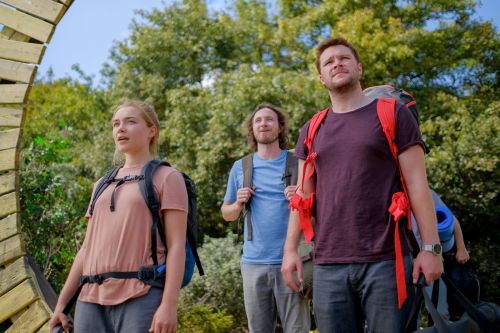
Starring: Florence Pugh, Jack Reynor, William Jackson Harper, Will Poulter, Vilhelm Blomgren

Director: Ari Aster

Running Time: 140 Minutes

Rating: R for Graphic Pagan Rituals

Release Date: July 3, 2019

Plenty of horror movies have served as metaphors for emotionally turbulent life events (Don’t Look Now, The Babadook, and director Ari Aster’s own Hereditary, to name a few), but never before have I been so relieved by that fact than in the case of Midsommar. Because if it weren’t a metaphor, its ending would be way too distressing to bear. The conclusion is about as terrifying as one could imagine given the premise, but it’s leavened with a sense of relief, as a breakup that really needed to happen has finally happened. If that sounds like a spoiler, rest assured that I’m just stating the inevitable.

Midsommar opens with Dani (rising supernova Florence Pugh) and Christian (Jack Reynor, aka Seth Rogen’s long-lost Irish cousin) looking like they are both about to realize their need to split up, but then Dani experiences a sudden family trauma, and dumping her is fully out of the question at this point as she really needs someone to lean on. If nothing else, Midsommar is about the importance of having a reliable network of emotional support, and the danger of how that need can be manipulated. That fact is unavoidable when Pelle (Vilhelm Blomgren) takes Dani and Christian and their other friends Josh (William Jackson Harper) and Mark (Will Poulter) to the Swedish commune he grew up in. It’s summer in Scandinavia, which means that the sun seemingly never sets, thus providing the perfect setting to confirm, or perhaps exceed, our worst suspicions of what a “commune” in a horror movie really means.

Ultimately, I am not quite sublimely thrilled by Midsommar; not quite underwhelmed, but perhaps just whelmed. It delivered what I expected, based on the trailer and Florence Pugh’s unrestrained agony on the poster. In that vein, it reminds me quite a bit of Get Out, which was similarly groundbreaking in its concept but rather straightforward in its accomplishment once I got onboard with its premise. But Get Out has proved ripe for revisiting and benefited accordingly, and I imagine that the same might be true in the long run for Midsommar once it is less weighed down by expectations. It certainly has the indelible imagery to make repeat visits worthwhile.

Midsommar is Recommended If You Like: The Wicker Man, Hereditary, Emotional Turmoil Raising the Stakes of Horror

Grade: 3.5 out of 5 Unexplained Bears

The Good Place Season 2 Review

Leave a comment

CREDIT: Colleen Hayes/NBC

This post was originally published on News Cult in February 2018.

Network: NBC

Showrunner: Mike Schur

Main Cast: Kristen Bell, Ted Danson, William Jackson Harper, Jameela Jamil, Manny Jacinto, D’Arcy Carden

Notable Guest Stars: Marc Evan Jackson, Tiya Sircar, Maribeth Monroe, Jason Mantzoukas, Dax Shepard, Maya Rudolph, Seth Morris, Angela Trimbur

Episode Running Time: 22 Minutes

It is difficult to talk about The Good Place in detail without spoiling anything, so SPOILER ALERT. But also go watch the entire series if you haven’t already. It’s really good.

Stylistically and tonally, The Good Place follows in the footsteps of the NBC Must See TV sitcoms that have preceded it, but since it is at its heart a mystery box puzzle show, its closest forerunner is Lost. Based on what I have gathered from interviews, creator Mike Schur conceptualized it as the NBC sitcom version of that stranded-on-a-desert-island juggernaut. Accordingly, it has been applying the lessons of what worked and what didn’t work on the island. So what we have in The Good Place Season 2 is a show that is constantly reinventing itself that amazingly is yet to show any wear and tear.

Lost dithered around occasionally in its first three seasons, but momentum locked into place for its final three years once an end date was set and the season episode orders were shortened. Thus, I have been heartened, and not worried at all, that NBC has given The Good Place 13-episode seasons right from the get-go instead of forcing it to stretch out to a more typical 20-plus run. It really feels like a series-long vision is in place. The first season finale, which revealed that Eleanor (Kristen Bell) and company were really in the Bad Place and were just being mentally tortured to think otherwise, seemed like a logical endpoint for the whole story, but in fact it has proven to be the perfect button on the first chapter that has been matched with just-as-satisfying shocks in Season 2.

After a two-part season opener in which our demon architect Michael (Ted Danson) tries and fails to reset everything with a bit of memory erasure, “Dance Dance Resolution” comes along to offer an entire series’ worth of plot twists in one episode. Not a season’s worth, a whole series’ worth. The Good Place has solved the problem that plagues shows that burns through plots too quickly by … burning through plots faster than anyone has ever seen. A glorious montage resets the status quo thousands of times. Subsequent episodes slow down that pace, but there is still about one reboot per half hour.

One of the reasons that The Good Place is one of the best shows currently airing is because it works for the smartest people in the room and the dumbest people in the room. If you want to figure out the twists ahead of time, the clues are there for you to puzzle them out, but if you prefer to be passive, the twists will eventually be explained, in a manner that avoids patronizing or reiterating the obvious. This is a show that rewards freeze-framing and re-watching (and there is still not enough room to contain all the flourishes from the writing staff). But it is also bright and boisterous enough for one helping to be filling. You don’t need to brush up on your Kant and Hume to understand the philosophical and ethical debates, but the supplementary reading is out there should you wish to seek it out.

While The Good Place has clearly done its homework regarding history’s most influential thinkers, I do wonder what the show’s own philosophy on existence and morality is. In aggregate, it is hard to pin down, which can be freeing, but also frustrating. Part of that is just the nature of fiction that tackles the afterlife. What happens after death is too ineffable to really be captured in any fully comprehensible fashion. The Good Place does not have to come up with some grand unified theory to be successful, but it is trying to say something weighty. Under close examination it can appear contradictory, though its message has thus far worked and can fairly be called “complicated.”

Should we really believe that a callous demon like Michael (the sublimely natural Ted Danson) can so quickly be humanized? Your mileage may vary on that conundrum, but Danson’s performance buys into the transformation, and perhaps these demons are fallen angels, or some similar beings that really do have capacity for goodness. It is easier to buy into the nature of A.I. program Janet (Arden), whose existence has been more or less created out of whole cloth. But the bugs she demonstrates suggest a haphazardness unexpected for infinity.

Along those same lines, the fate of our four principal lost souls can often seem petty, even without considering the self-improvement they began in Season 1 and have more or less been wholly committed to in Season 2. Sure, Eleanor is chronically thoughtless, Chidi (Harper) is dangerously indecisive, Tahana (Jamil) is profoundly self-absorbed, and Jason (Jacinto) is unselfconsciously vulgar. But they all have charms that elevate them beyond their worst selves. That is surely partly to due with the charming nature of each actor’s performance and how we as viewers tend to identify with lead characters, but at a certain part it feels like they are just being toyed with beyond what is fair or makes sense.

However, I suspect that that pettiness might be a feature of the show, and not a bug. The last couple episodes certainly seem to suggest that. The finale makes a case for making it up as you go along, with a gambit allowing the dead folks to (unwittingly) prove themselves in a simulation of how their lives could have played out if they were still alive. The haphazardness is unavoidable, but playing fast and loose with the rules (which might not be as intractable as we’ve been led to believe) could be the right thing to do if it makes the right connections. The parameters have been set up by a writers’ room, but they are justifying themselves thus far.

And finally, here’s to BORTLES! and accidental timeliness.

Best Episodes: “Dance Dance Resolution,” “The Trolley Problem,” “Rhonda, Diana, Jake, and Trent”

How Does It Compare to Season One? With its first and therefore biggest twist out of the way, The Good Place has necessarily become less surprising but the tradeoff is that it has become more daunting. It is a tricky high-wire act, but it has been sustained for at least one full season so far.

The Good Place Season 2 is Recommended If You Like: Lost, Pushing Daisies, Community

Where to Watch: Season 1 is available on Netflix, while Season 2 is currently available on NBC.com.

Grade: 4.5 out of 5 Shirt Balls