This Is a Movie Review: ‘Thoroughbreds’ is a Psychopathic Murder Scheme with Primary Color Flourishes

Leave a comment

CREDIT: Claire Folger/Focus Features

This review was originally posted on News Cult in March 2018.

Starring: Olivia Cooke, Anya Taylor-Joy, Anton Yelchin, Paul Sparks, Francie Swift

Director: Cory Finley

Running Time: 90 Minutes

Rating: R for a Psychopathic, Clinical Approach to Blood and a Little Bit of Language and Upper Middle Class Drug Use

Release Date: March 9, 2018 (Limited)

As as I became acquainted with the premise of Thoroughbreds – Lily (Anya Taylor-Joy) and Amanda (Olivia Cooke) team up to kill the former’s stepfather (Paul Sparks) – I of course had to ask: what is it that drives Lily all the way to murder? But alas, that is not really a question this film cares to answer. It is not exactly ignored, but you would expect a grave decision like this to be given more consideration than Lily gives it. If he were abusing her in some way, you could understand why she would go to such an extreme. But the conflict basically boils down to: he wants her to stop freeloading and she thinks he’s a jerk. It is totally understandable why they have such a chilly relationship, but it hardly justifies murder.

It should be noted, though, that that shallow decision-making and outsize retribution is kind of the point. This is a bloody satire in the vein of Heathers. But the whole affair is so underplayed that you never feel the over-the-top nature of the premise. There is a matter-of-fact presentation that makes it hard to peg what writer/director Cory Finley wants us to conclude about Lily and Amanda’s motives and machinations. Since one or both of them is in essentially every scene, we are immersed in their perspective to the point that what they are scheming seems like so much less of a big deal than it obviously is.

Thoroughbreds works best as a showcase for its two leads. Amanda is some sort of sociopathic or psychopathic, unable to intuit the meanings of facial expressions, but practiced at faking emotions. Cooke nails a combination of off-putting but somehow friendly. Lily is the apparently more “normal” of the two, but that description really only fits insofar as how she is more adept at displaying and interpreting typically genuine emotions. She is prone to moral slipperiness that reads as inherent to her nature. The title basically refers to how these two have been groomed by nature to be the perfect criminals. Anton Yelchin (in one of his last roles) shows up as a drug dealer to privileged kids who Lily and Amanda hire to help them carry out the deed. He puts his own spin on the “you’re all blind sheep” shtick, but mostly he just serves a plot convenience.

These off-kilter individuals get their very appropriate soundtrack in the form of Erik Friedlander’s weird percussive score. It is so lacking in melody or any aspect of musical structure that I wonder if what I’m recognizing is actually just part of the sound mixing. Either way, it is an appropriate fit. It is a cold and clinical soundscape that is fit for me to love, while that same approach with the narrative has more modest results.

Thoroughbreds is Recommended If You Like: Heathers, The Loved Ones, American Psycho, Avant-garde percussive scores

Grade: 3 out of 5 Practice Smiles

This Is a Movie Review: Eli Roth’s ‘Death Wish’ is Plenty Entertaining If You Don’t Want to Grapple Too Much with Vigilantism’s Complicated Morality

Leave a comment

CREDIT: Takashi Seida/Metro Goldwyn Mayer Pictures

This review was originally posted on News Cult in March 2018.

Starring: Bruce Willis, Vincent D’Onofrio, Dean Norris, Kimberly Elise, Beau Knapp, Elisabeth Shue, Camila Morrone, Mike Epps

Director: Eli Roth

Running Time: 107 Minutes

Rating: R for Brutal Gunfire and the Corresponding Bloody, Bone-Breaking Injuries

Release Date: March 2, 2018

By Eli Roth standards, Death Wish – a remake of the notorious 1974 Charles Bronson franchise-starter of the same name – is actually rather tame. The director of such modern-day exploitation as Cabin Fever, Hostel, and The Green Inferno has made a career out of pushing buttons, but the most objectionable elements of Death Wish are borrowed from the original. Based on the evidence on display here, I don’t know if Roth is an advocate for vigilantism, or if he even necessarily has any fully formed opinion. But no matter his own personal feelings, the film is plenty confrontational and liable to stir up heated feelings.

The setup is essentially the same as the original: Chicago-based surgeon Paul Kersey (Bruce Willis) turns to vigilantism after a robbery by professional burglars leaves his wife Lucy (Elisabeth Shue) dead and his daughter Jordan (Camila Morrone) in a coma. He is frustrated by the lack of leads in the case and the constant gang-related violence in his city, so he takes to heart those who bandy about the maxim that police only arrive after the crime has happened. So he procures a gun, dons his hoodie, and does what he can to clean up the streets, initially dispatching the likes of carjackers and soon working his way up to executing career criminals in broad daylight. He becomes a viral sensation, with some calling him the “Guardian Angel,” with others opting for “Grim Reaper.” There are some clear racial overtones, underlined by footage of real talk radio personalities discussing his activity, as Kersey is white and his targets tend to be people of color. But pointedly, he is also protecting many people of color. Admirably, Roth actually lets this issue remain as complicated as it deserves to be, but it could still have been addressed more head-on

When viewed straightforwardly as action movie fish fulfillment, Death Wish is well-crafted, crackerjack entertainment. I cannot deny that I was thrilled, nor can I dispute the comic relief that comes in the form of Vincent D’Onofrio as Paul’s schlubby but loyal younger brother, or Mike Epps as the resident horndog doctor, or just a well-timed gunshot. But naturally enough I find myself hesitant to cheer any movie in which a vigilante is the clear hero. That is somewhat mitigated by the fact that Paul is so clearly a decent person and that everyone he kills is clearly a bad guy. But then that clear demarcation between good and evil makes for its own problems. That stark opposition can work, with Lord of the Rings perhaps the best example.

So I would like to propose a theory of the Uncanny Valley of Realistic Violence, wherein a fantastical setting makes it easier to stomach an inherently good character killing an inherently evil character. But the closer the setting is to reality, the harder the killing is to accept, because the good/evil split is not so easy in real life. Roth flirts with examining that complication, but for the most part he is more interested in being a showman. Despite my problems with Death Wish’s ickiness, I do not feel too compelled to condemn it all that strongly on moral grounds. After all, it is clearly a fantasy, because where else but in the movies would the lead detective (Dean Norris) close the case with a delicious bite of pizza and an equally delicious one-liner?

Death Wish is Recommended If You Like: Eli Roth’s in-your-face style, Bruce Willis downplaying while remaining intense, Comic relief when it might not be appropriate

Grade: 2.5 out of 5 Head Shots

This Is a Movie Review: ‘Foxtrot’ Takes the Book of Job to Modern-Day Israel

Leave a comment

CREDIT: Sony Pictures Classics

This review was originally posted on News Cult in February 2018.

Starring: Lior Ashkenazi, Yonaton Shiray, Sarah Adler, Shira Haas

Director: Samuel Maoz

Running Time: 113 Minutes

Rating: R for Shocking, Sudden Violence and Exaggerated Comic Book Nudity

Release Date: March 2, 2018 (Limited)

All life is suffering, at least according to the Judeo-Christian view. There’s a particular strain on the Judeo side of things that goes at least as far back as the Old Testament, specifically the Book of Job, in which humans are pawns in a system of dramatic irony at the hands of a confounding god. The Coen brothers took a deep dive into this mythology with A Serious Man, and now Samuel Maoz’s Israeli film Foxtrot takes it to particularly tragic ends. The result is a striking look at the toll borne by individuals living constantly on the edge of conflict.

Foxtrot begins with Tel Aviv couple Michael (Lior Ashkenazi) and Dafna Feldmann (Sarah Adler) informed that their soldier son Jonathan (Yonaton Shiray) has fallen in the line of duty. At first it looks like the film’s focus will be an examination of the effects of shock. Dafna immediately faints and remains unconscious for the first thirty minutes or so. Michael is able to remain awake, but he must rely on an alarm clock to remind him to drink water at regular intervals so as to keep his anxiety in check. It is an awfully clinical approach to take towards any film, and in this case it would seem to be promising a profound slog. But Foxtrot goes more mammoth and less straightforward. It is an emotional rollercoaster, with a force from beyond controlling the dips and the turns. When the focus shifts to what Jonathan is up to, the truth is brought into fuller, clearer focus. The irony comes to the fore, serving up the twin lessons that tragedy is both not as bad as it originally appears and also that it is just as bad as it originally appears.

An affluent middle-class couple dealing with loss is an unfortunately too frequent story present throughout the world. Jonathan’s portion of the story, meanwhile, is particularly resonant in its Israeli setting, but its existential milieu is also a significant aspect of the general human experience. He is assigned to a crossing outpost, and his days are mostly filled with waiting. Occasionally he lifts a crossing gate to let a camel walk through. But that boring setup belies the constant potential for explosiveness.

Foxtrot makes itself felt by interspersing a mostly steady, even-keeled narrative with occasional bursts of tragedy and character revelation. The latter is felt most strongly in an animated section in the form of a comic book drawn by Jonathan that tells his father’s story. The Feldmanns are not a particularly voluble family, which is why this subtextual understanding between father and son (also demonstrated by their shared love of the titular dance) is so appreciated. For a Job-like existence to be bearable, there needs to be love.

Foxtrot is Recommended If You Like: The Book of Job, A Serious Man, Finding bits of humor in the most tragic situations

Grade: 3.5 out of 5 Camels

This Is a Movie Review: ‘Annihilation’ is a Beautiful Hybrid

3 Comments

CREDIT: Paramount Pictures/Skydance

This post was originally published on News Cult in February 2018.

Starring: Natalie Portman, Jennifer Jason Leigh, Gina Rodriguez, Tessa Thompson, Tuva Novotny, Oscar Isaac, Benedict Wong, David Gyasi

Director: Alex Garland

Running Time: 115 Minutes

Rating: R for Gator-Shark Attacks, Giant Bear Attacks, Swirling Intestines, and a Little Bit of Nookie

Release Date: February 23, 2018

Annihilation needs you to trust that sometimes disorientation can be good. Or at least, that it can be exciting. I will admit that disorientation does not necessarily work out so well for this film’s characters. The relative safety afforded the audience in vicariously experiencing this vexing and dangerous journey makes secondhand disorientation easier to defend. But still, I think the message here is the same for both participants and observers: venturing into the confusion is how to make the spectacle happen.

Biology professor Lena (Natalie Portman) has been mourning the disappearance of her husband Kane (Oscar Isaac) ever since he took off for a highly classified military expedition a year ago, when suddenly he just reappears in their house one day. But Kane has essentially no memory of what happened, and it is clear soon enough that there is so much of his mission left to complete. So Lena is recruited by Dr. Ventress (Jennifer Jason Leigh) to join her and her team of scientists (Gina Rodriguez, Tessa Thompson, Tuva Novotny) to trek into Area X, the coastal location that Kane and many others have gotten lost in, and figure out what the hell is going on there.

I do not recall Annihilation specifying the exact geographical location of Area X. It is possible it did and I just missed it, which can happen when a film mentions a significant detail only briefly. But in this case it is appropriate that I would miss such a detail, whether or not it was actually omitted. Area X is surrounded by a liquidy substance, or perhaps “presence” is a better word, referred to as “a shimmer,” which disorients anyone who approaches or moves through it. When Ventress and her crew first awake in the area, they seem to have immediately lost days, maybe even weeks. If we as an audience feel like we are missing just as many details as they are, then writer/director Alex Garland is probably pulling off what he set out to do. What awaits all of us is a world of wonders that can be explained by science, even though science says they should be impossible.

Flowers of clearly different species are growing on the same branches. The team is attacked by a gator with shark teeth. Plants in the shape of walking humans have sprung up. Eventually these ladies recognize their own blood and DNA swirling and transforming. These combinations are supposed to be fundamentally incompatible according to life as we know it. Lena’s on-the-fly theorizing of this continuous mutation works as a sort of explanation of how mythical hybrid creatures or the monstrosities from genre films could come to exist if they were to exist in reality.

The crew confronts Area X and its inhabitants with a mix of paranoia, wonder, fatalism, and determination. Considering the constant transformation inherent to this setting, it could be argued that all or none or some indefinable combination of these approaches is the right plan of action. Appropriately, it is all rendered by a design and effects team inspiring awe on a thoroughly devastating scale. The lush greenery is both beautiful and explosive. The music, courtesy of Ben Salisbury and Portishead’s Geoff Barrow, is unnerving and entrancing, including a set of reverberating notes that the trailer has already made famous. This intoxicating mix also offers up a series of killer set pieces, including a riff on The Thing’s notorious blood test scene, but featuring the main animal from a creature feature imbued with the Freddy Krueger-style power to maintain the dying cries of its victims.

Annihilation hits that sci-fi sweet spot of a confusing, complicated premise that ultimately explains itself, but not in a way that betrays its intricacies or ambitions, or makes matters particularly comforting. This is visionary cinema, flourishing and fully realizing itself from glorious setup to perfect ending.

Annihilation is Recommended If You Like: The Thing, 2001, Fringe, Cronenbergian body horror, The design elements of A Nightmare on Elm Street, Mulholland Drive

Grade: 5 out of 5 Shimmers

This Is a Movie Review: ‘The Young Karl Marx’ Gives Communism Its Very Own Cookie-Cutter Biopic

Leave a comment

CREDIT: The Orchard

This review was originally posted on News Cult in February 2018.

Starring: August Diehl, Stefan Konarske, Vicky Krieps, Olivier Gourmet, Hannah Steele

Director: Raoul Peck

Running Time: 118 Minutes

Rating: Unrated, But It Would Probably Be PG-13 for Philosophically Fueled Arguments

Release Date: February 23, 2018 (Limited Theatrically)/March 6, 2018 (Digital and On Demand)

Among history’s most influential philosophers, Karl Marx deserves a lot of credit for clearly keeping in mind that his ideas exist for people. It is not particularly useful to get bogged down in theory when you could actually improve the way people live. The human element is baked right into his writing, especially his most famous quote: “Workers of the world, unite!” That spirit is clearly present in The Young Karl Marx, which is less about how the socialist pioneer wrote The Communist Manifesto and changed the course of history and more about how he had a wife and kids and friends and acquaintances. This focus offers an appropriately fraternal approach, but it also makes for a rather run-of-the-mill biopic.

The Young Karl Marx has a notably multicultural background, as it features two German actors (August Diehl and Stefan Konarske, respectively) as Marx and Friedrich Engels, a Luxembourgian (Phantom Thread’s Vicky Krieps) as Marx’s wife Jenny, and a supporting cast of Belgians, French, and Brits. Plus, its director is the Haitian Raoul Peck (probably best known for the James Baldwin documentary I Am Not Your Negro), and its dialogue weaves seamlessly between German, French, and English. This diversity may have some thematic connection to worldwide proletariat unity, but in practice it feels haphazard. Besides, it is simply a fact that Marx and Engels were multilingual. The polyglot nature feels meaningful and important, but it never goes much beyond the surface.

And that total straightforwardness is really the trouble with The Young Karl Marx. This is a major case of “this happened, then this happened, then this happened, the end.” Marx and Engels meet uneasily at first, and then they become great friends. They have disagreements with other philosophers who are too theory-centric, but then they all more or less come to an understanding with each other. Workers are suspicious of Engels’ motives, as he comes from a more privileged background, but then he proves his bona fides. Marx and Jenny struggle to get by on his writing income, and then they continue their lives together. It is all more or less acted with spirit, vigor, and dignity, and then The Communist Manifesto goes on to be one of the most influential texts of all time. If you’ve ever been exposed to Marxim, The Young Karl Marx won’t tell you anything new. It’s only worth seeking out if you’re a completist when it comes to historical figures’ domesticity.

The Young Karl Marx is Recommended If You Like: The home lives of philosophers, Debates about materialism and Hegelianism

Grade: 2 out of 5 Bourgeois Notions

This Is a Movie Review: Jennifer Lawrence Goes Deep in the Graphic Spy Thriller ‘Red Sparrow’

Leave a comment

CREDIT: Murray Close/Twentieth Century Fox

This review was originally posted on News Cult in February 2018.

Starring: Jennifer Lawrence, Joel Edgerton, Matthias Schoenaerts, Charlotte Rampling, Jeremy Irons, Ciaran Hinds, Bill Camp, Joely Richardson, Sakina Jaffrey, Mary-Louise Parker

Director: Francis Lawrence

Running Time: 139 Minutes

Rating: R for Nudity as Power, Pleasure, and Disgrace; Spycraft Violence; and Slice-and-Dice, Pounding Torture

Release Date: March 2, 2018

Red Sparrow is the latest spy story that hinges on a final act revelation of a mole. the logic (or lack thereof) of such a twist is something I often can’t make heads or tails out of. The narrative-consuming part of my brain just is not that wired that way. But as far as I can tell, this particular mole’s exposure does pass the plausibility test, though it is not especially impactful. But Red Sparrow’s intrigue thankfully goes beyond any straightforward conception of traitors and double agents. In fact, it questions and pokes at (without quite fully deconstructing) the entire concept of double agency when it involves someone who seems to be an ideal fit for the job but does not want anything to do with professional deception.

Jennifer Lawrence stars as Dominika Egorova, a Bolshoi ballerina who suffers a career-ending injury and then faces the crisis of how she will be able to continue to take care of her widowed mother. So her uncle Ivan (Matthias Schoenaerts) recruits her to become a spy at the Red Sparrow School, which essentially requires its trainees to sacrifice their entire identities to the Russian government. Meanwhile, CIA agent Nathaniel Nash (Joel Edgerton) gets mixed up with Dominika as he hunts down high-level Russian spies. (He is temporarily suspended after making a huge mistake out in the field, but that does not affect matters as it much as it seems like it is supposed to.) Nash and Dominika’s motivations appear to match up, but of course there is that age-old question: can opposing sides truly trust each other when working together? In this case, the answer actually does appear to be yes, and a more pressing question is: is it possible for individuals to get what they want when insidious bureaucratic forces are pulling the strings everywhere?

Fundamentally driving Red Sparrow and several of its characters is the idea that the Cold War never really ended (it just broke into many pieces, as one of them puts it). That may sound a little over-the-top for a film aiming for some degree of verisimilitude, but then you see what former KGB agent Vladimir Putin is up to, and all the alleged Russian hacking in foreign elections, and on second thought, maybe this does not sound so farfetched at all. Even if it did, it would be perfectly legitimate to put something insanely conspiratorial on film. The problem is that we have seen this sort of cinematic Russian subterfuge plenty of times before.

That familiarity is overcome a decent amount by Charlotte Rampling, whose performance sets the tone for the state of modern Russian spycraft. She is the headmistress of the Sparrow School, and she insists that you call her “Matron.” We have seen this sort of officious, beat-you-down-and-re-mold-you character in plenty of other iterations, but Rampling brings a level of camp and matter-of-factness hitherto unseen. Not only, in her parlance, is every person “a puzzle of need,” but also so many people today are “drunk on shopping and social media,” which would normally sound irritatingly reductive but comes off as venomously delicious when she says it.

Red Sparrow’s most lasting impact is derived less from espionage and more from its examination of human behavior and interpersonal power dynamics. There are several scenes featuring graphic torture and nudity (including rape and attempted rape), and they do not come off as simply exploitative, because they are there to elucidate the effects they have on individuals. It is heavily implied that Sparrows are really groomed from birth to give themselves over entirely to the government. They are indoctrinated that their bodies are not their own, that they must give themselves up to give their marks exactly what they want in service of a greater power. Dominika, while in many ways an ideal recruit, never fully gives in. She decides that she is willing to make her body available, but she maintains a level of resistance. When naked, she asserts her power, which is resonant in the Me Too era (and eternally so) and metatextually, it works as a statement from Lawrence, herself a victim of a nude photo hack, that she will work this intimately only on her own terms. Thanks to her steely performance, Red Sparrow works as a defense of the dignity of every individual human being.

Red Sparrow is Recommended If You Like: The Americans, Tinker Tailor Soldier Spy, Oppressed women taking control, Oppressed citizens taking control, Frightening headmistresses, Torture scenes with a purpose

Grade: 3 out of 5 Floppy Disks

This Is a Movie Review: ‘Nostalgia’ Makes Some Obvious, Occasionally Affecting Points About Nostalgia

Leave a comment

CREDIT: Bleecker Street

This review was originally posted on News Cult in February 2018.

Starring: Jon Hamm, Catherine Keener, John Ortiz, Ellen Burstyn, Bruce Dern, James LeGros, Nick Offerman, Amber Tamblyn, Patton Oswalt, Annalise Basso, Mikey Madison

Director: Mark Pellington

Running Time: 114 Minutes

Rating: R for Language Apparently, But It Should Otherwise Be Rated PG

Release Date: February 16, 2018 (Limited)

Nostalgia, the 2018 film directed by Mark Pellington, would like you to know that nostalgia, the sentimality for the past, is a feeling that exists and that people experience. It does not treat this as some big revelation, as this is a common human emotion and the film does not pretend otherwise. But it is so simplistic and obvious, but also matter-of-factly profound, in its explication of the definition that there is this weird mix of pretension and lack of ambition. Mostly, Nostalgia glides along in a quiet, unfussy groove that is occasionally enlivened by tragedy and committed performances.

This is one of those anthology-style, “we’re all connected” movies with multiple discrete-but-actually-closely-connected(-at-least-thematically) storylines. Instead of cross-cutting between each vignette and having them dance around each other, they take their turns and then hand the ball (one time quite literally) off to the next one, with at least one shared character per section. At first it looks like Nostalgia will follow the travails of an insurance agent (John Ortiz) and the people he encounters. That’s a justifiable enough premise, but the execution is strikingly mundane.

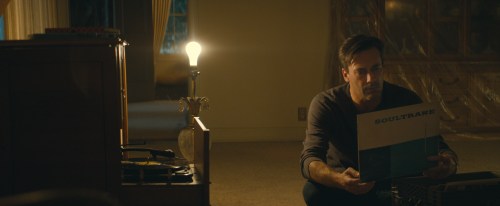
The film eventually shakes out instead to more broadly be a series of sketches of people dealing with loss and holding on to and/or letting go of sentimental objects, which is even more nondescript than the insurance agent setup, but there are some dynamic moments. In particular, there is the scene with Ellen Burstyn as a widow selling her late husband’s autographed baseball to a professional collector (Jon Hamm). His appraisal delivers exactly the sort of human touch you want when parting with an item with such high monetary and emotional value. Hamm’s entire section, in which he and his sister (Catherine Keener) are hit with a great loss in the midst of cleaning out their father’s old stuff, is filled with understated power. Its setup is just as lightweight as the other storylines, but it delivers enough poignancy to make Nostalgia just worthwhile enough.

Nostalgia is Recommended If You Like: Jon Hamm swooping in to save the day, Emotional gut punches

Grade: 2.5 out of 5 Verified Ted Williams Signatures

This Is a Movie Review: ‘Black Panther’ Absolutely Resides Within the Marvel Cinematic Universe, Just a Hitherto Barely Explored Corner

3 Comments

CREDIT: Disney/Marvel Studios

This post was originally published on News Cult in February 2018.

Starring: Chadwick Boseman, Michael B. Jordan, Lupita Nyong’o, Danai Gurira, Martin Freeman, Daniel Kaluuya, Letitia Wright, Winston Duke, Angela Bassett, Forest Whitaker, Andy Serkis, Sterling K. Brown

Director: Ryan Coogler

Running Time: 134 Minutes

Rating: PG-13 for Prolonged Fighting with a Variety of Weapons, Some of It Fairly Brutal and Bloody

Release Date: February 16, 2018

Black Panther culminates with the lesson, “The wise build bridges, while the foolish build barriers.” This appeal would seem to apply most directly to the United States at this particular cultural moment, but instead it is an exhortation to the fictional African nation of Wakanda now that its new king T’Challa (Chadwick Boseman) has ascended. Wakanda is filled with vast riches and incredibly advanced technology thanks to the stockpile of the alien metal vibranium long ago delivered by a meteorite crash. But it is also supposedly one of the poorest nations on the planet, likely due to a generations-long isolationist policy. Much of Black Panther feels like buildup to this point of opening up to the rest of the world, and in that way it is a prelude to the sequels that are sure to come. But what it reveals over the course of that prelude is thrilling.

Black Panther is not the first black superhero movie, but with a majority-black cast, black director, and African setting, it is unabashedly black in so many ways that are unprecedented for a blockbuster of this magnitude. It is unsurprising then that its initial villain is reminiscent of blaxploitation heroes fighting against The Man. Ulysses Klaue (an agreeably gonzo Andy Serkis) is a white South African arms dealer who is looking to get his hands on vibranium and make a pretty penny in the black market.  But after Klaue is dispatched, the conflict ultimately comes down to that between T’Challa and Eric “Killmonger” Stevens (Michael B. Jordan), who was born in America but has Wakandan roots and just as legitimate a claim to the throne as T’Challa. While Killmonger’s methods are overly destructive, his complaints, both personal and regarding how Wakanda does its public business, are legitimate. That Black Panther focuses on an intranational conflict should not be viewed as evidence of African and black cultures refusing to engage with the rest of the world, but rather an illustration that they already have plenty to keep themselves occupied.

While filled with several action set pieces and a fast-moving plot, Black Panther is most successful in its design and production elements. This is the sort of movie that brings a fully realized vision of a fictional world to life. The costumes are based on traditional African garb, but they are their own uniquely lavish style. Diverse tattoos and piercings add to the mix, including a few elements (such as one very stretched-out lower lip) that could be presented comically but are instead signs of dignity.

Culturally, this is a people that honors its elders, going so far as to have another dimension of sorts that exists at the nexus of technology and magic. Dubbed “the Ancestral Plane,” its purpose is for new kings to visit their deceased forebears for the sake of imparting necessary wisdom. Wakanda also treats its women in high regard, as they no big deal serve essential roles in government, science, and diplomacy. It may be true that the throne may not appear to be an option for woman (at least in this outing), but the monarchy is not as unilateral a position as it could possibly be. Considering all that progressiveness, it is disheartening that so much of Wakanda honor is bound up in a code of fighting and a culture of combat. That is not a complaint against the movie; in fact, what we have here is an appreciably complicated look at the difficulty to be a paragon of a nation.

The Black Panther is not just T’Challa, but rather a mantle that he holds currently. Accordingly, Black Panther the film is very much an ensemble piece, with attitude- and passion-driven performances from all the Wakandan tribes. The particular breakthrough is Letitia Wright (probably best known for the “Black Museum” episode of Black Mirror) as T’Challa’s spitfire younger sister Shuri, who manages to be both the comic relief and the Q to his James Bond.

Black Panther fits squarely within the overarching narrative of the Marvel Cinematic Universe, even though it can stand firmly on its own. Furthermore, it is nice to see it sidestep the easy template of the typical origin story that most solo superhero cinematic debuts tend towards. It has the standard two post-credits scenes, and weirdly enough they fit in the the MCU’s next chapter more squarely than other recent post-credits stingers. The last one is also more satisfying than those recent examples, perhaps because Black Panther takes care of its own, and we are ready when it stretches out.

Black Panther is Recommended If You Like: Shaft, Captain America: Civil War, Fruitvale Station

Grade: 3.75 out of 5 Headwraps

This Is a Movie Review: Russian Oscar Nominee ‘Loveless’ Manages to Engross by Being More Ominous Than Depressing

Leave a comment

CREDIT: Sony Pictures Classics

This review was originally posted on News Cult in February 2018.

Starring: Maryana Spivak, Aleksey Rozin, Marina Vasilyeva, Andris Keišs, Artyom Zhigulin, Sergey Dvoinikov, Matvey Novikov

Director: Andrey Zvyagintsev

Running Time: 128 Minutes

Rating: R for Tender and Vigorous Sex and a Glimpse at a Bloody Corpse

Release Date: February 16, 2018 (Limited)

If you think of Russia as a depressing wasteland of permanent winter, the premise – and title – of Loveless will not disabuse you of that notion. An Oscar nominee for Foreign Language Film, it tracks the saga of Moscow residents Zhenya (Maryana Spivak) and Boris (Aleksey Rozin), who are in the midst of a nasty divorce when their 12-year-old son Alexey (Matvey Novikov) runs away to escape the emotional turmoil. The rest of the film is focused on the search for Alexey, and there is little clue where he could have gone off to. He does not appear to be a target for kidnapping, he hardly has any friends to hide out with, and his grandmother would be a nightmare as a potential refuge. Zhenya and Boris seek comfort amidst their struggle with their new beaux (do note that there are multiple explicit sex scenes), but their lives remain cold and numb, and those relationships do not look like they would be all that fulfilling even if Alexey were still around.

The clues, or lack thereof, about Alexey’s whereabouts remain inscrutable and discouraging throughout. There is no omniscient viewpoint to even confirm the worst possibility. Despite that thorough lack of hope, Loveless is not as depressing as one might expect (or it least it wasn’t for me). It plays more like a mystery, and in that sense it is reminiscent of Prisoners, another recent ominous thriller about missing children. It is not quite as white knuckle as that nail-biter; it is more of a mood piece, weirdly akin to the snowbound wanderlust of the child-vampire film Let Me In (though not as much the more sunless Swedish original Let the Right One In).

There are a few inexplicable aspects to Loveless that suggest big implications but ultimately seem to serve no other purpose than setting the film in 2012. Whenever a TV or radio is playing, it is set to a news channel discussing either the American presidential election, the Mayan apocalypse, or both. Perhaps the politics angle means to say that the world is obsessed with America to the detriment of places like Russia. But I have no idea what that is doing in a film that is otherwise about domesticity. The possible apocalyptic symbolism is easier to parse, as the loss of a child can easily feel like the end of the world. But that obviousness seems out of place in a story that is mostly ambiguous. Overall, Loveless is an engaging portrait of emotionally deadness that leaves an impression, but seasoned with bits of absurdity that leave just as strong an impression.

Loveless is Recommended If You Like: Let Me In, Prisoners, This weird joke about a Volkswagen Passat and “Volkswagen Credit” (the humor might be lost in translation)

Grade: 3.5 out of 5 Screaming Matches

This Is A Movie Review: Aardman Kicks It Stone Age-Style with ‘Early Man’

Leave a comment

CREDIT: Lionsgate

This review was originally posted on News Cult in February 2018.

Starring: Eddie Redmayne, Tom Hiddleston, Maisie Williams, Timothy Spall, Richard Ayoade, Selina Griffiths, Johnny Vegas, Mark Williams, Gina Yashere, Simon Greenall, Rob Brydon, Kayvan Novak, Miriam Margoyles, Nick Park

Director: Nick Park

Running Time: 89 Minutes

Rating: PG for Stone/Rock/Boulder-Based Cartoon Physical Humor

Release Date: February 16, 2018

Early Man is the sort of film that delivers exactly what you expect and hope it would deliver. It is the latest stop-motion animated effort from Aardman, and it is just as understated, British, and charming as Wallace and Gromit, Chicken Run, and Shaun the Sheep. There might be a bit more physical humor this time around, though. It does take place in the Stone Age, after all, so it makes sense that it would feature a significant number of conks on the head.

This is one of those movies that presupposes that subsequent historical periods existed side by side against each other as opposing tribes. It may be true that the Bronze Age followed the Stone Age, but I’m pretty sure it didn’t go down with bronze-toting brutes declaring to a tribe of cavemen, “The Stone Age is SO OVER! Bronze is where it’s at now!” Of course, historical accuracy is not the point here, so these are not complaints, just descriptions of goofiness. It is worth noting, though, that ahistorical larks like Early Man like to pretend that they are historically accurate, thus why we get very precise setting-establishing subtitles like “neo-Pleistocene Age, near Manchester, around lunchtime.” It’s all in good fun!

Early Man is essentially an underdog sports movie, as the fight between the Stonies and the Bronzers comes down to a soccer match (or football, since we’re in England). After a Bronze Age army overruns the Stone Age village, caveman Dug (Eddie Redmayne) bumbles his way into the Bronze city and then brokers a deal with Lord Nooth (Tom Hiddleston) in which the two societies will face off on the pitch to determine who gets to retain residence of the village. As the caveman are totally unfamiliar with the sport, this leads to a predictably silly training montage. Also fitting in with the tropes of the genre is Goona (Maisie Williams), a Bronze Age vendor who defects to help the caveman, since she is not a fan of the big bad team winning all the time without emphasizing teamwork or allowing women into its ranks.

The character design would be grotesque if it were live action, but the Aardman style renders it cute, though still weird, but adorably so. The cavemen are all buck teeth and porcine snouts, while the Bronzers sport skinny heads and exaggerated midsections. The biggest fun comes from the puns based in hindsight and the retrofitted modern technology. Noting that their tribe are early risers, Dug reminds his chief (Timothy Spall) “we’re early men,” and for all you hooligans out there, there is indeed a team named “Early Man United.” But bringing me the most joy has got to be the “instant replay,” in which plays are reenacted with crude figures on a board along the sideline. Obviously this is not the actual origin of replay, but it is fun to spend an hour and a half within a world in which it is.

Early Man is Recommended If You Like: Wallace and Gromit, Chicken Run, Shaun the Sheep Movie

Grade: 3.5 out of 5 Buck Teeth

Older Entries Newer Entries