This Is a Movie Review: Affairs Are Revealed and Philosophical Rejoinders Are Dispatched at ‘The Party’

Leave a comment

CREDIT: Roadside Attractions

This review was originally posted on News Cult in February 2018.

Starring: Patricia Clarkson, Bruno Ganz, Cherry Jones, Emily Mortimer, Cillian Murphy, Timothy Spall, Kristin Scott Thomas

Director: Sally Potter

Running Time: 71 Minutes

Rating: R for Pretentious Strong Language and Furtive Cocaine Bumps

Release Date: February 16, 2018

If you want to make the case that The Party is a worthwhile viewing experience, you must remember that Patricia Clarkson is playing a cynical realist and that Bruno Ganz, as her estranged significant other, is playing a spiritualist. (There is another couple made up of an idealist and a materialist, but their philosophies don’t make as much of an impression.) Now you may be thinking, what is a fight between academic theories doing in a movie that is ostensibly about people? And initially, as I realized that wow, this is really going directly after that lecture hall crowd, I was just as disturbed as you may be. But it soon becomes clear enough that I do not especially care what is going on with these people and therefore pompous piffle like commenting about behaving in a “20th-century postmodern post-post-feminist sort of way” actually serves to lend this whole affair some personality.

The occasion for the titular get-together is Janet’s (Kristin Scott Thomas) appointment to shadow minister of health as a member of the British opposition party. As she is getting ready in the kitchen and chatting with April (Clarkson), her husband Bill (Timothy Spall) is in the living room, staring vacantly into the distance of the backyard, while Gottfried (Ganz) observes him with curiosity. Some more guests arrive: Martha (Cherry Jones) and Jinny (Emily Mortimer), who announce that their in vitro fertilization efforts have finally taken; and topping it all off is Tom (Cillian Murphy), with promises that arriving later for dessert will be his s.o. Marianne, who remains a topic of tension-spiked discussion throughout.

Then, as cinematic soirees tend to go, secrets are revealed and grievances are aired, much of it having to do with affairs. Ultimately, it appears that everyone has slept with the same person or slept with someone who has slept with that someone. Confined to the location of Janet and Bill’s home, The Party often feels like a play, and a one-act one at that, clocking in at just over 70 minutes. There are not many stylistic touches that require this drama to be on film instead of on a stage, save for the black-and-white photography (which does not serve much thematic purpose anyway). At least the short runtime is appreciated. The tone is too caustic for my tastes to be bearable for too long, and since there are no genuine characters, just a bunch of types, it helps that it makes its point quickly and then makes a hard exit.

The Party seems to be commenting on its own shallowness in the banter between April and Gottfried, as she constantly upbraids him for his frequent use of aphorisms, while she continues to make smug, pretentious remarks that are not helpful in any practical way. But Gottfried wins me over right away, because he is just happy-go-lucky while spouting clichés even as his partner constantly insults him. April, however, is too cold to embrace at first. But once it is clear that the film does not exactly agree with what she is saying, you can enjoy her for her ridiculousness and for the relish with which Clarkson spits such venom.

The Party is Recommended If You Like: Who’s Afraid of Virginia Woolf?, Attending university philosophy lectures

Grade: 2.5 out of 5 Burnt Pastries

This Is a Movie Review: ‘Fifty Shades Freed’ is Just as Boring as Its Predecessors, But More Histrionic and Pointless

Leave a comment

CREDIT: Universal Pictures

This review was originally posted on News Cult in February 2018.

Starring: Dakota Johnson, Jamie Dornan, Eric Johnson, Max Martini, Brant Daugherty, Arielle Kebbel, Fay Masterson, Luke Grimes, Eloise Mumford, Rita Ora, Marcia Gay Harden, Tyler Hoechlin, Hiro Kanagawa

Director: James Foley

Running Time: 105 Minutes

Rating: R for The Usual T&A, Sometimes Involving Ice Cream, Plus a Climactic Gunshot

Release Date: February 9, 2018

Fifty Shades Freed is just as boring as the rest of the Grey/Steele saga, and the whole S&M hook has ceased to be a big deal ever since the first entry was released. It’s not like it was ever that big a deal in the first place, though enough people were titillated by the promise of transgression to result in a phenomenon. But now that the aftershocks are nowhere near as explosive, what is the point? With Christian (Jamie Dornan) and Ana (Dakota Johnson) comfortably married, the whole frisson of inappropriateness is eliminated, and all Fifty Shades Freed has to fall back on is a fairly boilerplate tale of revenge and kidnapping.

The troubles that apparently drive the action involve Ana’s former boss Jack (Eric Johnson), who blames her for his firing, so he resorts to stalking to exact his revenge. There is never any tension that suggests that Jack will not be dispatched by the end or that it makes it thrilling at all in the moment. From a narrative standpoint, it exists, I guess, so that Christian can save Ana, thus solving any and all current and future marital troubles. Because the thing is, the struggles between the two of them have little to do with the parameters of their kinkiness and everything to do with emotional maturity or lack thereof. Christian is overly controlling and protective, and hilariously unprepared for the prospect of being a father. I worry about the long-term viability of this union, not because a possibility for abuse, but rather because any fundamental compatibility is just not there, and the shallow picture-perfect ending cannot convince me otherwise.

While the sex scenes are essentially window-dressing at this point, they are still the main attraction (along with the luxury travel porn). There is certainly some excitement to being in a crowded theater as the camera almost zooms in on a hardcore reveal. But if you are going to venture out to see this sort of action instead of pulling it up on your computer, there ought to be some romance leading up to it. But the two leads have just never managed to summon any significant chemistry.  Johnson is perpetually unsure what kind of movie she is in, alternating playing it straight with occasionally venturing a mildly subversive line reading that would fit a version of this movie that makes fun of itself. Dornan, meanwhile, sleepwalks through the whole thing. Arielle Kebbel, as an architect who gets a little too flirty with Christian, is the only one to zero in on a satisfyingly campy tone, but she is barely utilized. All this confusion is inherent to a traditional center attempting to be transgressive.

Fifty Shades Freed is Recommended If You Like: Porn Minus the Romance, Melodramatic Revenge Plots

Grade: 1.5 out of 5 Boobs in Boobland

This Is a Movie Review: ‘Peter Rabbit’ is Fun Enough for the Kiddos, But It’s Also Kind of Insane

Leave a comment

CREDIT: Sony Pictures

This review was originally posted on News Cult in February 2018.

Starring: James Corden, Domhnall Gleeson, Rose Byrne, Daisy Ridley, Margot Robbie, Elizabeth Debicki, Matt Lucas, Sia, Sam Neill

Director: Will Gluck

Running Time: 93 Minutes

Rating: PG for Cartoonish, But Quite Dangerous, Violence

Release Date: February 9, 2018

For the most part, Peter Rabbit is just another trifling kids movie with CG-animated animals. It is not the worst of the menagerie, though it is far from the best. But like many movies of this ilk, it also raises some weird metaphysical conundrums that I do not think it ever planned on grappling with but that it cannot avoid entirely. When you have anthropomorphic animals interacting with humans, especially when those humans are played by live-action actors, you have to decide how much the humans can recognize the critters’ extraordinary abilities. When the beasts talk to each other, does it just sound like animal noises to people? Or can they hear it perfectly, thus forcing the animals to be discreet? Or maybe there is only Dr. Dolittle-type, going mad over the loneliness of his interspecies communication powers.

In this case, Peter (James Corden), his triplet sisters Mopsy (Elizabeth Debicki), Flopsy (Margot Robbie), and Cottontail (Daisy Ridley), and their cousin Benjamin Bunny (Matt Lucas) are quite sneaky, and as their schemes become more and more elaborate, there is no reason to pretend that they are not fully intelligent creatures. The confirmation that they can in fact talk to humans is a rather sloppy reveal, as it begs the question: how have they hidden this secret for so long? Regardless of what mysterious machinations they have pulled off, the narrative requires that they spill the truth, considering that Peter is responsible for extensive property damage, and furthermore, he wants to apologize to Bea (Rose Byrne), the human that he loves, and make peace with Thomas McGregor (Domhnall Gleeson), the human that he has been torturing. This all makes for a resolution that is sweet but with disturbing subtext.

But beyond that, this is a fairly typical entry for this genre, as typified by its soundtrack of the pop hits of the past twenty years. Len’s “Steal My Sunshine,” Basement Jaxx’s “Do Your Thing,” and Portugal. The Man’s “Feel It Still” will keep the kids bouncing in their chairs without challenging their soundscapes. Lady Bird can take note that Peter’s use of Dave Matthews Band’s “Crash Into Me” is not similarly profound. Elsewhere, the film’s raison d’être is excessively painful physical gags, including a truly worrying number of electrocutions (this is nowhere near as gentle as Beatrix Potter’s source material). There is a rake gag that I must admit I chuckled at, though I am concerned that the target audience will not realize how heavily indebted it is to The Simpsons. And that is indicative of the whole: a satisfying diversion, but with some worrisome implications.

Peter Rabbit is Recommended If You Like: MouseHunt, Dr. Dolittle, the Pop Dance Hits of Today!

Grade: 3 out of 5 Winking Rabbits

This Is a Movie Review: ‘Winchester’ Fails to Explore Its Premise by Visiting Very Few Rooms in Its Vast Haunted Mansion

Leave a comment

CREDIT: Ben King/CBS Films

This review was originally posted on News Cult in February 2018.

Starring: Helen Mirren, Jason Clarke, Sarah Snook, Finn Scicluna O’Prey, Angus Sampson, Eamon Farren

Directors: Peter and Michael Spierig

Running Time: 99 Minutes

Rating: PG-13 for Gunfire, Creepy Contact Lenses, and a Very PG-13 Moment of Nighttime Companionship

Release Date: February 2, 2018

When a truly original idea arrives in horror, you’ve got to hold on to it tight. Winchester has quite a unique and intriguing premise, but you would not be able to tell from the execution. Inspired by true events, it is a haunted house tale that takes place in, as one character adroitly puts it, “a house under neverending construction built on the orders of a grieving widow.” But the film never takes full advantage of all that lurks within the title abode.

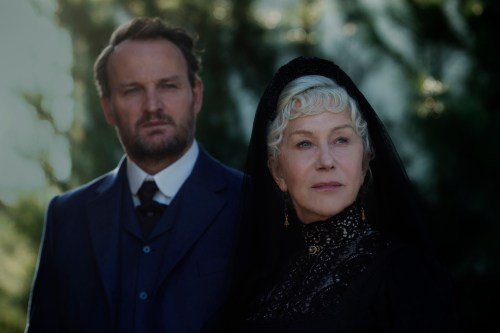
Sarah Winchester (Helen Mirren, fully embodying gothic haute couture) is the heiress to her late husband’s eponymous arms company, and Winchester’s plot is set in motion when Dr. Eric Price (Jason Clarke) is asked to evaluate her mental fitness and therefore capability to continue overseeing the company. Her fellow executives and shareholders have their doubts because of her obsession with endlessly adding more rooms to her mansion, which she is doing to contain the spirits of the many haunted souls who have been killed by Winchester firearms.

There is a perfect opportunity with this setup for a face-off between skepticism and belief in the supernatural. But instead, the existence of the ghosts is pretty much never in question, and no character expresses significant skepticism (nor indeed do they have any reason to). That is not necessarily a big loss, though, as the house itself allows plenty of opportunities no matter what the status of the ghosts. With construction having no master plan or endpoint, the mansion could be the most disorienting maze ever. But the film barely takes advantage of that spatial horror.

I do not mean to tell Winchester what sort of film it must be, but I do mean to express disappointment when what it chooses to be is so indistinct. Forgoing the more challenging haunts that it hints at, it instead is a run-of-the-mill possession and revenge story, with Sarah’s great nephew (Finn Scicluna O’Prey) doing his best creepy kid performance, rendering “Beautiful Dreamer” the stuff of nightmares. He is being influenced by the ghost of a Civil War veteran (Eamon Farren) who is predictably defeated in a final standoff, and then everyone moves on with their lives, the evil contained, for now at least.

Directors Michael and Peter Spierig (who previously worked with Winchester’s Sarah Snook on the twisty, heady Robert Heinlein adaptation Predestination) have a few tricks up their sleeve, holding on a shot just long enough for it to be unnerving when an arm suddenly bursts through a previously hidden opening. But overall they never develop a firm grasp on the jump scares or the slow burns, and they do not seem to be particularly committed to either. Plus, the underlying message of what constitutes terror in this story – something about fear being only in the mind – does not jibe with what is actually happening.

Winchester is Recommended If You Like: The Woman in Black, Helen Mirren in Period Clothing

Grade: 2 out of 5 Rifles

This Is a Movie Review: ‘A Fantastic Woman’ Finds a Trans Woman Making Her Defiant Case That She Deserves to Be Treated Like a Human Being

Leave a comment

CREDIT: Sony Pictures Classics

This review was originally posted on News Cult in January 2018.

Starring: Daniela Vega, Francisco Reyes, Luis Gnecco, Aline Küppenheim, Amparo Noguera, Nicolás Saavedra

Director: Sebastián Lelio

Running Time: 104 Minutes

Rating: R for Nudity Borne of Passion and Invasive Procedure, and Prejudicial Assault/Harassment

Release Date: February 2, 2018 (Limited)

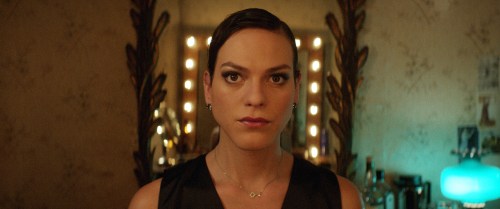
A lot of the discussion around films and TV shows about underrepresented communities focuses on the value of those people being given a voice. And while that discussion is important, I fear that it has given subpar storytelling a pass or promoted the merely decent to excellence. But A Fantastic Woman (an Oscar nominee for Foreign Language Film), about Marina (Daniela Vega), a trans Chilean woman, and the prejudice she faces in her daily life, is the rare example in which the act of giving the voiceless a voice is baked so seamlessly into the narrative. It is possible that it resonates so much with me because its experience is so far outside my purview (I do not have many close trans friends, I do not know Chile or its people very well) that it feels so revelatory where for others it might seem matter-of-fact. But regardless of familiarity or lack thereof, Fantastic Woman registers as successfully as it does because Marina’s story is so intrinsically about her fight to live and love as she pleases.

A Fantastic Woman begins as almost a fantasy of what life could be if trans people were fully accepted, and embraced, for whom they truly are. This is not it portrays anything physically impossible but rather it presents what is socially improbable. But it is possible, because even for those who are most oppressed, there are slivers of perfection, and this is indeed a sliver, but it is awash in sensuousness, romance, and tranquility. Orlando (Francisco Reyes) strolls into the club where Marina, his girlfriend, is singing, via an inviting tracking shot. It is her birthday, and they conclude the evening with a night of passion at their shared apartment. She may be trans, and he might be 30 years older than her, but this is the life they have carved out for each other, so none of that other stuff matters.

But alas, this is all a prelude to Orlando suddenly falling ill and dying at the hospital. Immediately, Marina is now alone, even before Orlando’s family arrives to shut her out. Her evasive reaction might be what makes her appear suspicious to the authorities, but the truth is that she was never going to have a fair chance to mourn Orlando. His son Bruno (Nicolás Saavedra) openly disdains her and is not against using abuse and harassment to show it. His ex-wife, Sonia (Aline Küppenheim) is more civil, though she makes it clear enough that she would like to erase Marina from existence. She has a bit of an ally in his brother Gabo (Luis Gnecco), but he is too ineffectual to make a difference. Then there is the female detective (Amparo Noguera) who has worked cases involving trans women before and tries to present herself as a friend, but in her assumptions of foul play, she proves to be among the most invasive.

As Marina walks around adrift in her distressing new normal, there are some flashes of actual fantasy. A visit to a nightclub results in a music video interlude that lifts her up in the style of Björk’s “It’s Oh So Quiet.” A moment of walking along the sideway turns into a fight against the elements as she stands diagonally, pushing against a sudden sustained gust of intransigent wind. This shot, encapsulating willpower vs. status quo, embodies the whole of A Fantastic Woman. Despite how much someone is constantly knocked back, no matter how systematically, there are still opportunities for transcendent, ineffable bursts of humanity.

A Fantastic Woman is Recommended If You Like: Brokeback Mountain, The Florida Project, Foreign Films Set in Countries You’ve Never Visited

Grade: 4 out of 5 Resilient Decisions

This Is a Movie Review: ‘Like Me’ Captures the Beautifully Disgusting Travails of an Underground Internet-Famous Renegade

Leave a comment

CREDIT: Kino Lorber

This review was originally posted on News Cult in January 2018.

Starring: Addison Timlin, Larry Fessenden, Ian Nelson, Jeremy Gardner

Director: Robert Mockler

Running Time: 80 Minutes

Rating: Not Rated, But It Could Be R for Its Disturbing Food-Based and Psychedelic Imagery

Release Date: January 26, 2018 (Limited Theatrically)/February 20, 2018 (On Demand)

Is social media breeding new forms of sociopathy, or is it the other way around insofar as those who are already sociopaths are naturally drawn to social media? Or maybe people just use whatever media they have available to them to deliver their messages, whether sociopathic, benign, or somewhere in between. Robert Mockler’s indie horror (or horror-adjacent, but horrific, nonetheless) Like Me does not provide any straightforward answers to any of these questions, but it is vividly drawn enough for viewers to draw their own conclusions.

A sort of 21st Century Taxi Driver with flashes of A Clockwork Orange, Like Me is primarily the portrait of a loner, burning for an outlet for her twisted proclivities. We never got much of a sense what Kiya’s (Addison Timlin) living or familial situation is, but we learn enough to know that she’s able to handle herself, despite her small, seemingly unimposing physicality. It is perhaps that unpredictability that allows her to pull off her … “schemes,” let’s call them. She harasses a convenience store employee into whimpering submission and then she lures a hotel worker with sexual promises into a force-feeding session that concludes with him vomiting milk (with the latter encounter leading into a bizarre buddy flick), broadcasting the most extreme moments for all her social followers to behold. Kiya definitely takes notice of the online reaction she engenders, but it appears to be the thrill of the moment itself that motivates her most.

If you’re like me, you’ll wonder why anyone could behave as Kiya does. Director Robert Mockler is not particularly interested in answering that conundrum, nor do I really want him to. Instead, he is more committed to crafting a sumptuous feast that overwhelms the senses. Kiya’s world is filled with dimly lit overwhelming colors. Gummy worms, a rotating camera, an ominous score heavily indebted to Goblin but with its own edge of urban dysfunction, and psychedelic light streams combine for a toxic blend of anti-satisfying sustenance. Several reaction videos to Kiya’s escapades are presented in Internet windows, captured in their full crappy webcam glory, clashing with the crisp digital photography of the main action. I can imagine this whole thing is a daydream that Mockler had one day, and it is probably healthy that he has now let it all out on the screen.

Like Me is Recommended If You Like: A Clockwork Orange, Taxi Driver, The Shining, Mixed Media Presentations

Grade: 3 out of 5 Forced Feedings

This Is a Movie Review: ‘Please Stand By’ as Dakota Fanning Tries on Autism and ‘Star Trek’ Fandom

1 Comment

CREDIT: Magnolia Pictures

This review was originally published on News Cult in January 2018.

Starring: Dakota Fanning, Toni Collette, Alice Eve, River Alexander, Jessica Rothe, Michael Stahl-David, Patton Oswalt

Director: Ben Lewin

Running Time: 93 Minutes

Rating: PG-13 for A Few Frank Mentions About Bodily Functions and an Emotional Breakdown or Two

Release Date: January 26, 2018 (Limited Theatrically and On Demand)

Early on in Please Stand By, Wendy’s (Dakota Fanning) Cinnabon co-worker Nemo (Tony Revolori) gifts her with a mix CD, which has me thinking, “Do people even make mix CD’s anymore?” As someone who believes in the virtue of simultaneously embracing both new and outdated forms of technology, I do not object to the presence of music on physical media (my own CD collection is still hefty and its recent slowdown in growth is due mostly to a dwindling in space and not a newfound preference for digital), but it does stick out as odd in a film that I am firmly certain is supposed to be taking place in the present day. In general, there are few, if any, clear markers indicating when Please Stand By is set. The best we have to go on is the fact that Wendy has an iPod, which tells us that the time must be no earlier than 2001.

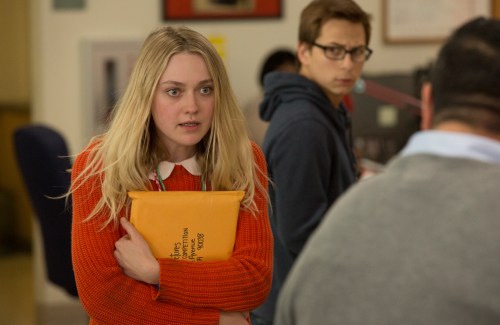
It is fitting that Wendy’s story has a somewhat out-of-time quality to it. She is autistic and accordingly sticks to a strict routine, one that she has probably spent years firmly establishing. (That still doesn’t explain why her friend from work is still into CD’s, but whatever.) I believe that autistic characters have been well-represented enough in film and television that any single character does not have to bear the burden of representing ALL autistic people. And that is helpful, because while Wendy’s autism does play a major part in her story, it is specific in ways that go beyond that.

Ultimately from a certain angle this is a pretty simple road trip movie starring a girl and her chihuahua. They are heading out to California so that Wendy can hand-deliver her 500-page Star Trek script to Paramount Studios for a fan contest. She missed the mailing deadline due to stress involving family, and now her sister (Alice Eve) and caretaker (Toni Collette) are tracking her down to make sure she’s okay, seeing as she’s never been on her own before. This is a story of fandom, focused around a fan with an unfathomably deep interior life.

There is not all that much unique about Please Stand By. There are plenty of stories about obsessive fans, as well as ones about autistic people who struggle to connect with those around them. And it is no surprise that when you combine those two elements, you get someone who identifies deeply with Mr. Spock, as we have seen that plenty of times already as well. My Star Trek knowledge is sporadic (I’ve only seen the reboot films and the first episode of Discovery), but I believe I know enough about the major themes to say that Please Stand By does right by its inspirations. This is the sort of film that gives what is mostly a cameo outsize billing, but it feels justified: Patton Oswalt plays a police officer who speaks Klingon and makes the sort of day-to-day connection that Wendy has always been looking for. It is not instantly transformative, but it is the crux that represents the film’s easily digestible, reaffirming, humanistic message.

Please Stand By is Recommended If You Like: Star Trek (especially if you identify with Spock), Little Miss Sunshine, Patton Oswalt Cameos

Grade: 3 out of 5 Mix CD’s

This Is a Movie Review: ‘The Death Cure’ Wraps Up the ‘Maze Runner’ Trilogy with High-Octane Action and Personal Battles of Class Warfare

Leave a comment

CREDIT: Joe Alblas/Twentieth Century Fox

This review was originally posted on News Cult in January 2018.

Starring: Dylan O’Brien, Kaya Scodelario, Thomas Brodie-Sangster, Dexter Darden, Rosa Salazar, Giancarlo Esposito, Aidan Gillen, Ki Hong Lee, Will Poulter, Patricia Clarkson, Walton Goggins, Barry Pepper

Director: Wes Ball

Running Time: 142 Minutes

Rating: PG-13 for Zombie Makeup, a Few Puncture Wounds, and Some Explosions

Release Date: January 26, 2018

Readers, I must be upfront with you: The Death Cure is the only Maze Runner movie I have seen. I was not yet on a regular reviewing beat when the first two came out, but as the trilogy comes to its conclusion, the assignment has fallen to me. Now, I suppose I could have made time to get caught up on the first two, but I often contend that viewers can watch multi-chapter entertainment properties in whatever order they feel like. The Maze Runner franchise is probably not the best choice for doing so, as it is the type of film series that doesn’t waste any time playing catch-up for newbies. But I decided to experiment a bit and see if any enjoyment could be had amidst the confusion.

The good news is that The Death Cure’s spectacle is exciting and well-crafted enough to be enjoyed devoid of context. The opening action chase sequence of vehicles barreling towards a cliff plays like a postapocalyptic cross between the opening of Fast Five and the tank chase from Indiana Jones and the Last Crusade. It is not as death-defying or as instantly iconic as its predecessors, but it sets itself apart enough to not be overly derivative. Director Wes Ball’s only three feature films thus far are the Maze Runner trilogy, but he has proven himself technically capable to fill in any openings that may exist in the action genre.

As for the story, I was generally able to fill in what must have happened in the first two enough to follow along, and it is not exactly what I was expecting. Thomas (Dylan O’Brien) and his crew are dealing with the aftereffects of a virus that has infected most of the world’s population, leaving many zombified while those who are well-off wall themselves in the Last City. Thomas is one of a few who are immune, and he could be instrumental in developing a cure, but he does not exactly agree with the methods of those dedicating themselves to finding one. There is plenty to be gleaned here about the struggle between the 99% and the 1%, and I appreciate that that point is not underlined too hard.

It is also welcome that this series (or the conclusion of it anyway) is not too beholden to the stereotypical “chosen one” YA narrative. Sure, Thomas holds the key to saving humanity, but that fact is accidental, and it does not really have anything to do with what makes him a good leader. As for a (good) quality of this genre that The Death Cure does play into, there is its surplus of quality adult actors (Giancarlo Esposito, Patricia Clarkson, Walton Goggins, Barry Pepper) popping up in supporting roles.

Ultimately, The Death Cure is a bit too long. There is no need to flirt with two and a half hours when much of the last act involves one group chasing after another, and then that second group chasing after the first, moving along in a constant struggle to get to the last stand. But while it is a bit thick with narrative, it never lags. This is not particularly groundbreaking cinema, but it is also no cheap knockoff. It is unique enough and content enough to explore its own little world to make it worth a visit.

Maze Runner: The Death Cure is Recommended If You Like: The Hunger Games, I Am Legend, The Action Sequences of the Indiana Jones and Fast and Furious series

Grade: 3 out of 5 Infection Checks

This Is a Movie Review: ‘Den of Thieves’ is a Warmed-Over, Mush-Mouthed Michael Mann Impersonation

1 Comment

CREDIT: STX

This review was originally published on News Cult in January 2018.

Starring: Gerard Butler, Pablo Schreiber, O’Shea Jackson Jr., Curtis “50 Cent” Jackson, Evan Jones, Cooper Andrews, Dawn Olivieri

Director: Christian Gudegast

Running Time: 140 Minutes

Rating: R for Cacophonous Continuous Gunfire, a Strip Club Detour, and Way Too Many F-Bombs

Release Date: January 19, 2018

According to the opening titles of Den of Thieves, Los Angeles is the “bank robbery capital of the world.” I do not know if that title is actually true, partly because this movie does not make me care enough to confirm or debunk the claim. Besides, it is essentially immaterial to the plot. This is not about an epidemic of robberies, but one specific crew, who could be pulling off their big heist anywhere so long as the cash is present and an escape route is available. As for Gerard Butler’s performance as the cop doggedly tracking them, it does not scream “L.A.” so much as “nutso actor sheds any semblance of sanity.”

Den of Thieves is the directorial debut of Christian Gudegast, who previously scripted the likes of London Has Fallen (which I have not seen, but I have heard it is just as dreadful as its predecessor Olympus Has Fallen). Michael Mann’s influence on him is obvious, but not fruitful. Gudegast clearly wants this to be a sprawling crime saga on the same level as Heat or Miami Vice, but that would require characters who deliver personality instead of an endless string of groan-inducing f-bombs.

As Merriman, the leader of the den, Pablo Schreiber mostly relies on bulging out his facial muscles. As his right-hand man, Curtis “50 Cent” Jackson basically stands off to the side and looks vaguely threatening. O’Shea Jackson Jr., as the team’s driver and newest recruit, is able to infuse the proceedings with a few amusing moments. (There is a running gag with a couple of randy female customers when he moonlights delivering Chinese food.) Meanwhile, the rest of the guys in the den are either too beefy or too masked to convey any tangible emotion.

But for better and for worse, this is the Gerard Butler show. His “Big Nick” is not so much corrupt or “flying off the handle” so much as he is filled with constant, fidgety, bizarre tics that do not resemble any sort of recognizable human behavior I am familiar with. I cannot say that any of his performance adds up to anything “good,” but I must admit that I could not look away.

Ultimately, the scheme wraps up with a series of twists that mostly serve to frustrate, not because they cheat with any internal logic, but because they require a great deal of patience to sit around before anything meaningful happens. At nearly two and a half hours, there is precious little to make that journey bearable. To be fair, the crowd I saw it was hooting and hollering throughout, so there clearly is an audience for this sort of muscled-up, unsubtle affair. But from my perspective, this is a dithering cacophony that drives me batty.

Den of Thieves is Recommended If You Like: Michael Mann’s crime sagas but without the visual and formal experimentalism, Training Day but with an unfathomable amount of scenery-chewing

Grade: 2 out of 5 Automatic Rounds


This Is a Movie Review: ‘Forever My Girl’ Could Be Charming If It Weren’t So Careless with Its Emotional Beats

Leave a comment

CREDIT: Jacob Yakob/Roadside Attractions/LD Entertainment

This post was originally published on News Cult in January 2018.

Starring: Alex Roe, Jessica Rothe, John Benjamin Hickey, Abby Ryder Fortson, Tyler Riggs, Peter Cambor, Gillian Vigman

Director: Bethany Ashton Wolf

Running Time: 104 Minutes

Rating: PG for Keeping Deep-Seated Anger and Frustration Mostly Polite

Release Date: January 19, 2018

In gooey romances like Forever My Girl, we always find our way back to the ones who we truly love and who truly love us. But I wonder how someone like country music superstar Liam Page (Alex Roe) ever could have lost himself in the first place. Because when the facts are laid out, he just does not seem like the type of guy who would ever want to leave his lovely fiancée Josie (Jessica Rothe) at the altar. And when I ponder what it means that he in fact does do that, the implications are quite troubling, and I wish writer/director Bethany Ashton Wolf (adapting the book of the same name by Heidi McLaughlin) had shown more care in reckoning with all that.

Eight years have passed since Liam has bailed on marriage, cutting off all contact with Josie, his dad (John Benjamin Hickey), his friends, and everyone else in his hometown of Saint Augustine, Louisiana (referred to as just “Saint” by the locals) in the process. Now he is selling out stadiums, thanks to the success of his banal party-bro country songs with lyrics like “don’t water down my whiskey.” But he has always held on to a sort of talisman from his past life: his old flip phone from high school, as a voicemail saved there contains his last communication from Josie, sent to him just a few days after he jilted her. When he hears that one of his friends has died in an accident, he abandons the last stop of his tour to return home, and I get the sense that he’s been wanting to escape the big time for a while (more on that later).

As these stories tend to go, it turns out that Josie has a 7-year-old daughter, Billy (a poised Abby Ryder Fortson), and of course Liam is the dad, but because of his town-wide ghosting, he never knew about her until now. It wouldn’t be the best idea for Liam to suddenly become a major part of Billy’s life, considering how disruptive that can be for a young child, not to mention Liam is a not-very-independent adult who can barely take care of himself. But of course, you can see where this is going: Liam learns how to be a good dad, he and Billy bond over music, and he and Josie fall back in love, because they never really fell out of love in the first place.

While none of this reinvents the wheel (in fact, it rolls right along with it), it is not necessarily a problem. What is a problem, though, is the mishap that threatens to upend this new stability for such a silly, unnecessary reason. And compounding that are all the emotional beats to get Liam and Josie to their final resolution. Alex Roe and Jessica Rothe are perfectly lovely and winning. We can be happy to see them end up together, but it’s hard not to feel cheated to see some crappy behavior go unrectified.

Ultimately I am left puzzling over why in the first place Liam left the things that seem to make him happiest. His inner conflict is never presented as a fight between the glories of fame versus the comfort and responsibility of family. Nor is it even a matter of professional ambition versus personal happiness. Just about everyone in his life is totally supportive of him. Even his publicity team and handlers are good friends for the most part, advising him to take all the time he needs to mourn, despite being on the hook for lost tour revenue. So why then does he struggle to commit to Josie when it is clear she makes him fulfilled? The best guess I can come up with is that he must be suffering from anxiety, or some pathological fear or distrust of happiness, or some other mental condition. If only the film had realized what a broken soul were at its center, then it could have been genuinely touching.

Forever My Girl is Recommended If You Like: The Nicholas Sparks Brand of Romance, Cloying country music

Grade: 1.5 out of 5 Hasty Reunions

Older Entries Newer Entries