McLuhan’s Commonsensical Maxim Applied to Nonsensical Media

Leave a comment

This essay was originally written as my final paper for my Media Theory class, taught by Barry Salmon, in Fall 2013 at The New School.
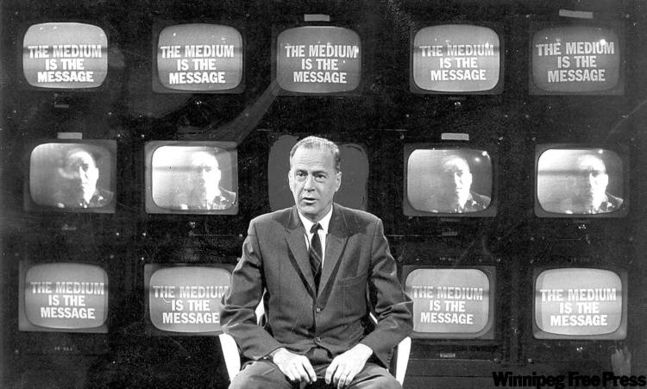
mcluhan

If the “medium is the message,” then what happens if the medium is the medium itself, or the anti-medium? The past few years have seen the rise of the “anti-talk show” in the alternative comedy scene, as typified by the podcast-turned-IFC series Comedy Bang! Bang!, local New York public-access cult sensation The Chris Gethard Show, the Funny or Die webseries Between Two Ferns, and Adult Swim’s The Eric André Show. These shows all consider the artifice and tropes of comedy talk shows and then ignore, analyze, trash, invert, and/or subvert them. Marshall McLuhan’s classic text is presented as a common sense formulation of how to consider any medium: “the personal and social consequences” are a result of the new “extension of ourselves” (129). So how then do we apply this commonsensical approach to a genre that is purposely nonsensical? McLuhan would surely be pleased by this trend of a genre that is strongly conscious of how the medium is the message, but an analysis of how these shows deconstruct their particular medium and genre is sure to melt your brain.

More

Remediating Remediation (A.K.A. Mediating Mediation)

Leave a comment

This essay was originally written as my final paper for my Sociology of Media class, taught by Paolo Carpignano, in Spring 2014 at The New School.

Jay David Bolter and Richard Grusin published Remediation: Understanding New Media in 2000. While their contention that all mediation is remediation was well-supported by the evidence available at the turn of the century, 14 years is a long time when it comes to the advancement of new media. One of their main examples of remediation is the CD-ROM (42-44), now an essentially obsolete medium. If Bolter and Grusin’s ideas are to hold up, then the forms of mediation that have taken the place of the CD-ROM must also be clear examples of remediation. Indeed, they anticipated that this would be the future, claiming that digital media would “function in a constant dialectic with earlier media, precisely as each earlier medium functioned when it was introduced” (50). They also postulated, “all mediation is remediation” (55). With this essay, I am picking up where they left off to show how developments since they published their take on the matter has proven them even more correct. Not only has media become even more remediated; it has made the world so hypermediated that it is clear that life itself is remediation.

More

Arrested Development Pilot Script Analysis

Leave a comment

This essay was originally written as my final paper for my Script Analysis and Audience Response class, taught by Helena Medina, in Spring 2014 at The New School.

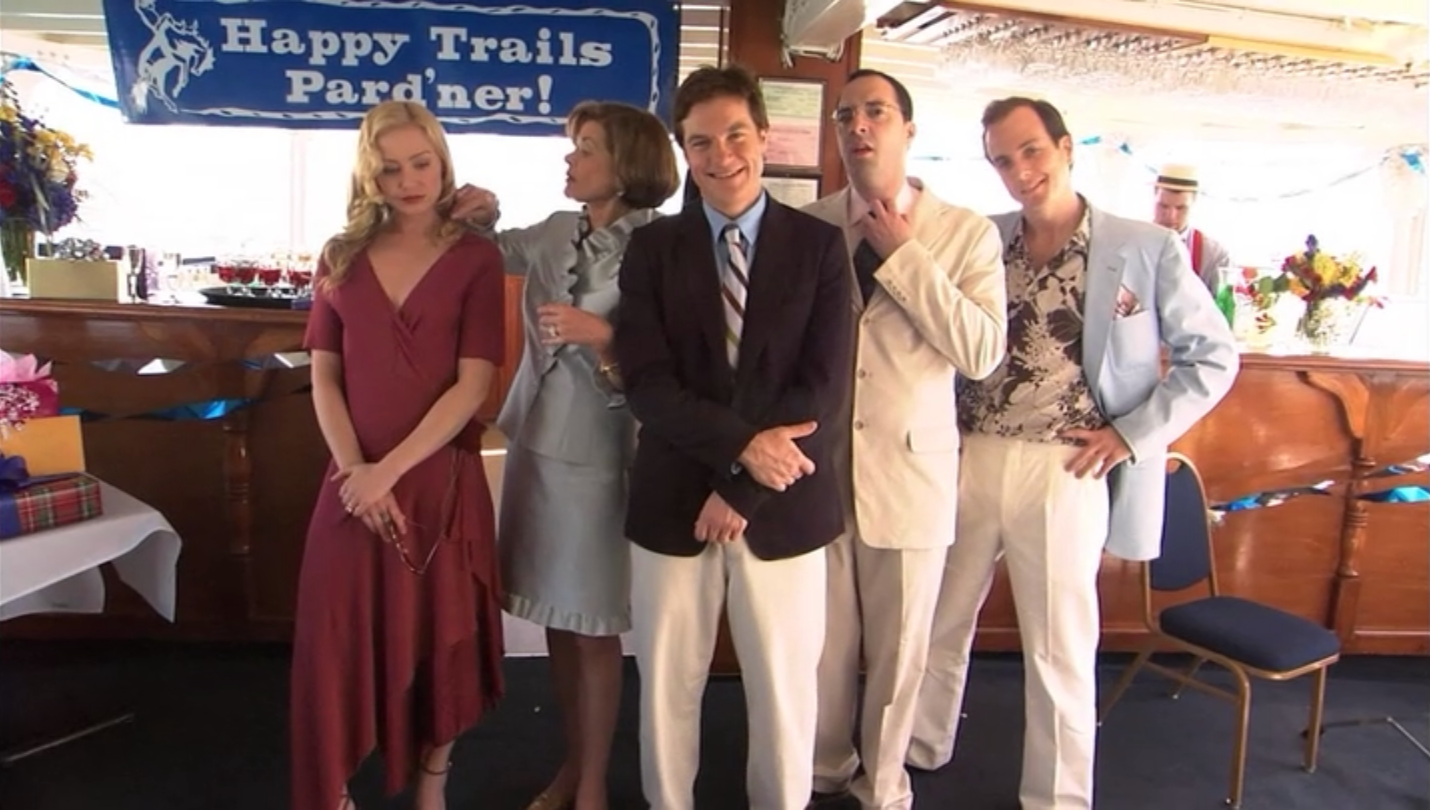
ADPilot_(10)

The patriarch of a dysfunctional family is arrested, and his only sane son is forced to save the family business.

The Bluth family consists of George, Sr. and his wife Lucille; their children George Oscar II, a.k.a. “Gob” (pronounced like the Biblical Job), twins Michael and Lindsay, and Byron “Buster”; Lindsay’s husband Tobias Fünke; Michael’s son George Michael, and Lindsay and Tobias’s daughter Mae, a.k.a. “Maeby”. George is the CEO of the family Bluth Company, located in Orange County, California. Michael, his second oldest son, has worked for the company for ten years and expects to be made partner on the occasion of his father’s retirement. But George appoints Lucille as the acting CEO, and it soon becomes clear why when he is arrested and the Securities and Exchange Commission freezes the company’s expense account, thus making it difficult for the Bluths to maintain their lavish lifestyles.

More

The Super-Female Postmodern Thing

2 Comments

This essay was originally written as my final paper for my Film Theory & Analysis class, taught by Royal Brown, in Spring 2014 at The New School.

“Trust’s a tough thing to come by these days.”
“Nobody trusts anybody now.”

the-thing

A common maxim of what makes the best horror movies effective is that they show relatively little, leaving the most terrifying parts to the imagination. What is unique about the John Carpenter-directed The Thing (1982) is how well it works despite, or because of (or despite AND because of) showing so much of its monster. A novice viewer would be forgiven for not realizing how much it actually does not show. Partly, the lack of showing is obvious: the famously ambiguous ending in which it is heavily implied that either Keith David’s Childs or Kurt Russell’s MacReady is now a Thing (or both are). But most of the rest of the film does not highlight how much is being hidden. It is, as Slavoj Žižek would put it, a product “with a distinctive mass appeal” (1). Its primary attractions are its tense action, creative makeup and special effects, and well-rounded performances. It is therefore qualified to be a postmodern work, and it fulfills that possibility with a premise and a villain that essentially guarantees open-endedness and speculative interpretation that goes beyond the narrative.

More

Über-Film Studies Case #1: Zardoz

2 Comments

This essay was originally written as my final paper for my Advanced Topics Media Theory class, taught by Eugene Thacker, in Spring 2015 at The New School.

The world now laughs, rent are the drapes of fright,
The wedding is at hand of dark and light—

-Friedrich Nietzsche, Beyond Good & Evil, “From High Mountains: Aftersong”

“We’ve all been used!” “And re-used!” “And abused!” “And amused!”
-Friend (John Alderton)/Arthur Frayn (Niall Buggy), Zardoz

zardoz

            If I discover an interpretation of a complicated work and then realize that this interpretation is a perfect explanation of this work, is this just a self-fulfilling prophecy? Perhaps the interpretation is well-founded, but my new reading will inevitably be colored by my knowledge of this theory. But maybe its rightness or wrongness is beside the point, at least in absolute terms. I do not have to agree exactly for my eyes to see anew. It could be the ramblings of a madman, but it may still be a message that is worthwhile. Discovering that Zardoz, a film I have cherished many years for its singular qualities, had been declared the epitome of a Nietzschean movie, I was irrevocably changed. “The Lord is risen!” “God is dead!” Zed is the Übermensch! So speak to me, Muse of Surprisingly Useful Amazon User Reviews, and keep me on a steady path in this endeavor.

~

            My first contact with Mr. Nietzsche was diffuse. He is one of those towering figures of philosophy that permeates academia and bleeds into the culture at large. He never came up in any comparative philosophy class I took, and without a philosophy background, any influence he had on me came secondhand. I was vaguely aware of his influence on any entertainment that established itself as nihilist, and the Übermensch concept was familiar enough to stand as a Big Idea of modern thought. From what I could gather, the Übermensch was some sort of German version of Superman. I sensed that this was not quite right, but I chalked whatever I was missing up to the nuances of translation and the subtlety of the actual literature.

More

Miley Cyrus: A Flashpoint of the Social Discourse

Leave a comment

This essay was originally written as my final paper for my Discourse Analysis class, taught by Theresa Cowan, in Fall 2014 at The New School.

Despite the dichotomy typical of the Western worldview, there is more than one stereotypical positive feminine role allowed within a patriarchal system. Alas, there is not necessarily a whole lot of variation among these roles. I have already discussed the Cool Girl and the constrictions enforced by that stereotype, and how damaging it can be even when those limitations are followed. Now I will be considering a relative of the Cool Girl – the Good Girl – and what tenor the discourse takes on when that role is transgressed. Specifically, I will consider this topic in light of pop star Miley Cyrus’ performance of “We Can’t Stop” and “Blurred Lines” at the 2013 MTV Video Music Awards.

More

What Won TV? – May 24-May 30, 2015

Leave a comment

In this feature, I look back at each day of the past week and determine what shows “won TV” for the night. That is, I consider every episode of television I watched that aired on a particular day and declare which was the best. This week, “What Won TV?” has been bought by Chinese billionaire Fung Wah.

FungWah

Sunday – Chinese Silicon Valley
Monday – American Fung!
Tuesday – iChineseZombie
Wednesday – Billionaire Jeopardy!
Thursday – The Chinese Gethard Show
Friday – Childrens Hospital, which takes place in China, which is where we are
Saturday – Billionaire Orphan Black

VH1’s The 20 – 5/30/15

Leave a comment

Each week, I check out VH1′s The 20 (formerly Top 20 countdown), and then I rearrange the songs based on my estimation of their quality.

Original Version
1. Wiz Khalifa ft. Charlie Puth – “See You Again”
2. Walk the Moon – “Shut Up and Dance”
3. Jason Derulo – “Want to Want Me”
4. Nick Jonas – “Chains”
5. Tove Lo – “Talking Body”
6. Fifth Harmony ft. Kid Ink – “Worth It”
7. Echosmith – “Bright”
8. Meghan Trainor – “Dear Future Husband”
9. Ellie Goulding – “Love Me Like You Do”
10. Andy Grammer – “Honey, I’m Good.”
11. George Ezra – “Budapest”
12. Sia – “Elastic Heart”
13. Maroon 5 – “Sugar”
14. Ryn Weaver – “Octahate”
15. Carly Rae Jepsen – “I Really Like You”
16. Zedd ft. Selena Gomez – “I Want You to Know”
17. Taylor Swift ft. Kendrick Lamar – “Bad Blood”
18. Adam Lambert – “Ghost Town”
19. Nate Ruess – “Nothing Without Love”
20. Britney Spears & Iggy Azalea – “Pretty Girls”

Jmunney’s Revision
1. Elastic Heart
2. I Really Like You
3. Talking Body
4. I Want You to Know
5. See You Again
6. Octahate
7. Bad Blood
8. Chains
9. Want to Want Me
10. Pretty Girls
11. Love Me Like You Do
12. Nothing Without Love
13. Shut Up and Dance
14. Budapest
15. Ghost Town
16. Sugar
17. Worth It
18. Dear Future Husband
19. Bright
20. Honey, I’m Good.

SNL Season 40 (2014-2015) Recap

Leave a comment

SNL_season_40_title_card

I will be posting a more in-depth analysis of the best of SNL Season 40 later in the summer, but for some now, here are some rankings.

Most Valuable Cast Members
1. Kate McKinnon
2. Cecily Strong

Best Sketches
1. Bad Boys
2. Graveyard Song
3. Anniversary Dinner
4. Grow-a-Guy
5. Woodbridge High School Theatre Showcase
6. Tad Rankin
7. Dinosaur Museum
8. Mr. Riot Films
9. Blazer
10. Bambi

Best Dress Cuts
1. Kyle 40
2. Inner White Girl
3. Bruce Chandling and Kevin Hart
4. Pentagon Presentation
5. 40 Greatest Guys

Best Hosts
1. Dwayne Johnson
2. Michael Keaton
3. Jim Carrey

Best Monologues
1. Reese Witherspoon
2. Louis C.K.
3. Chris Rock

Best Musical Guests
1. D’Angelo
2. Alabama Shakes
3. Florence + the Machine
4. Prince
5. Kendrick Lamar

Best Weekend Update Segments
1. Pete Davidson
2. Al Sharpton
3. Ruth Bader Ginsburg
4. One-Dimensional Female Character From a Male-Driven Comedy

Best Episodes
1. Dwayne Johnson/George Ezra
2. Reese Witherspoon/Florence + the Machine
3. Chris Pratt/Ariana Grande
4. Jim Carrey/Iggy Azalea
5. Michael Keaton/Carly Rae Jepsen

Best Lines
1. “Daddy needs his chocolate. He need it, need it, need it. Chocolate in the morning, chocolate in the evening, chocolate at suppertime, thank you.”
2. “Thank you, thank you, Colin Jost. Who tells the jokes? Excuse me. Colin Jost, who tells the jokes.”
3. “I called the park. They’ve been closed for two hours.”
4. “I float like a butterfly, I sting like a bee, I clean myself like a fly.”
5. “I haven’t crapped my pants all year!”
6. “If you don’t have a boner right now, you should just kill yourself.”
7. “If we want to treat women as equals, we shouldn’t put them on money. We should pay them an equal amount of money. And Michael Che shouldn’t be paid at all!”
8. “The fact that you would even ask me that makes you a spigot, and no, I’m not Jewish.”
9. “So next time you’re at Starbucks, why not order a double shot, of compassion?”
10. “Houston, we have a boner.”
11. “This is a fight.”
12. “The places in America with the worst bedbug problems are Chicago, Detroit, and yo’ mama.”
13. “If you C-section, say something.”

Community 6.12: “Wedding Videography”

Leave a comment

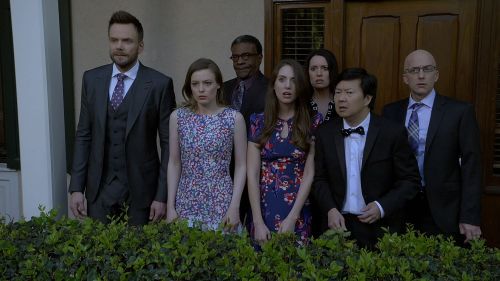
Community_Wedding-Videography

Community, “Wedding Videography” (CREDIT: Yahoo! Screen)

This review was originally posted on Starpulse in May 2015.

“Homer’s Enemy,” a classic episode of “The Simpsons” featured the story of Frank Grimes, a mild-mannered new hire at the Springfield Nuclear Power Plant, driven insane while forced to work alongside incompetent buffoon Homer. Since that episode aired, “Frank Grimes” has become shorthand in certain TV nerd circles for a one-off guest character who is a sort of audience surrogate who demonstrates just how maddening it would be to actually live alongside crazy TV people.

More

Older Entries Newer Entries