‘Poor Things’ Seeks to Break Free

4 Comments

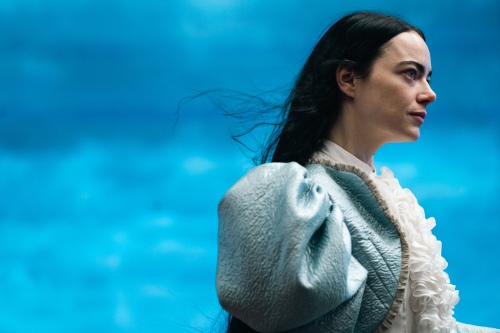
How POOR are they?! (CREDIT: Atsushi Nishijima/Searchlight Pictures)

Starring: Emma Stone, Mark Ruffalo, Willem Dafoe, Ramy Youssef, Christopher Abbott, Jerrod Carmichael, Margaret Qualley, Kathryn Hunter, Suzy Bemba, Hanna Schygulla

Director: Yorgos Lanthimos

Running Time: 141 Minutes

Rating: R for Weird Science and Lots and Lots of Sex

Release Date: December 8, 2023 (Theaters)

What’s It About?: The case of Bella Baxter (Emma Stone) is a strange one. Dr. Godwin Baxter (Willem Dafoe) discovers her body after she attempts suicide and proceeds to bring her back to life via reanimation and a brain transplant. But because the brain he uses is that of a baby, Bella reverts to a rather infant-like mental state upon her resurrection. Her development back to a fully conscious adult happens remarkably quickly, all things considered, perhaps because that brain recognizes that it’s been encased inside an adult body. Nevertheless, Bella also gets to have the profound experience of being able to rediscover all the sensory pleasures of life on Earth.

Dr. Baxter understandably tries to keep her locked away from the outside world, though he does invite into the fold medical student Max McCandles (Ramy Youssef), who soon finds himself proposing marriage to Bella. But before that wedding can happen, she’s decided to see the outside world alongside hedonistic lawyer Duncan Wedderburn (Mark Ruffalo). As in many a hero’s journey, she will eventually return back to her starting point, having changed. But unlike a lot of other hero’s journeys, Poor Things features an unbound number of ecstatic sex scenes.

What Made an Impression?: A Fresh Set of Eyes: If there’s one lesson to be learned from Bella Baxter above all others, it’s the power of childlike wonder. Most of us have been living within our systems and routines too long to ever be able to fully question if there’s a better way. But Bella is a blank slate blessed with a mature body that can take advantage of her pleasures as much as possible. It’s a big reason why she charms everyone she encounters so much, despite her profoundly off-kilter, often juvenile disposition. It’s also, of course, why she enjoys sex (which she dubs “furious jumping”) as much as she does. However, her lack of inhibitions sometimes lead her astray, such as when she threatens to punch a crying baby, or when she tries to upend the carefully tended business practices at a Parisian brothel. But as her mental capacities lock into focus, she eventually devises compromises that she is uniquely qualified to conceptualize.
A World of Experimental Wonders: Bella is not Dr. Baxter’s only test subject, as we also get to meet some hybrid animal creatures wandering around his property that have been formed by head and body swapping among a goose, pig, and bulldog. The obvious antecedent here is Victor Frankenstein, but I also detected some playfulness in Dafoe’s performance, a la Futurama‘s Professor Farnsworth. Dr. Baxter has plenty in common with his hubristic brethren, particularly his tendency to seem like a deity to his creations. (It’s not for nothing that his first name is abbreviated to “God.”) Despite his tendency to control, he’s not as much of a monster as you might suspect. Instead, he’s one of the titular poor things, considering his history of abuse and experimentation at the hands of his own father. His abode is terrifying, but comfortingly so.
Soaking It All Up: If you somehow can’t engage with any of the characters of Poor Things, you can hopefully at least appreciate all the pretty business that director Yorgos Lanthimos and his crew have assembled. He’s certainly developed a unique visual style over the course of his career, and a movie set in an alternate version of the late Victorian era has allowed him plenty of room to be indelible. Fisheye lenses, purple-pink skies, spiral staircases that hover in the sky, and plenty more design choices make an inimitable visual impression. It’s all lived-in, anachronistic, and surreal, which is to say, an ideal environment for the Bella Baxters of the world to thrive in.

Poor Things is Recommended If You Like: American Pie, Socialist feminism, Steampunk

Grade: 4 out of 5 Transplants

Jeff’s Wacky SNL Review: Jerrod Carmichael/Gunna

2 Comments

SNL: Gunna, Jerrod Carmichael, Heidi Gardner (CREDIT: NBC/Screenshot)

Why, hello there, readers of SNL reviews. You’re here just in time for my take on the Jerrod Carmichael/Gunna episode, which originally aired on April 2, 2022. (Although, since most of it happened after midnight on the East Coast, it really mostly aired on April 3, 2022. [H/t Scott Aukerman.])

Jerrod Carmichael is hosting, and he recently came out of the closet, so it’s the perfect time to get to know him. Meanwhile, Gunna is the musical guest, and I’m less familiar with him than I am with Jerrod, so hopefully we’ll get to know him a little bit better than before as well.

It’s been a few weeks since the last new episode aired, so in case you’ve forgotten, I’ve been doing something a little different with my reviews this season. Specifically, I’ve been listing the sketches in unique orders instead of simply opting for the order in which they aired. For this episode, I’ll be listing them in the order in which they appear on SNL‘s YouTube page. (Please note: there is currently one cut-for-time sketch up there, but I won’t be covering that in this review.)

Also, I must note that I wrote this review after running a four-mile race, and I tend to be in a good mood for most of the day afterwards following a morning cruise around the park.

More

This Is a Movie Review: Ferdinand is Not Your Typical Bull, But ‘Ferdinand’ is Your Typical CG-Animated Kids Movie

Leave a comment

CREDIT: Twentieth Century Fox

This review was originally posted on News Cult in December 2017.

Starring: John Cena, Kate McKinnon, David Tennant, Bobby Cannavale, Anthony Anderson, Peyton Manning, Jerrod Carmichael, Gina Rodriguez, Gabriel Iglesias, Miguel Ángel Silvestre, Flula Borg, Boris Kodjoe, Sally Phillips, Lily Day, Juanes, Jeremy Sisto

Director: Carlos Saldanha

Running Time: 107 Minutes

Rating: PG for Destruction Wrought by a Bull Who Refuses to Accept How Big He Is

Release Date: December 15, 2017

Based on Robert Lawson’s 1936 children’s book The Story of Ferdinand, the Blue Sky animated film Ferdinand is all about one of the most massive bulls in all of Spain. He is a beyond-perfect physical specimen for bullfighting, and in this country it goes without saying that calves spend their youths obsessing about the day they will get to face off against the matadors. But Ferdinand does not have the same pugnacious instinct as his peers. He would much rather spend his days on the farm, sniffing flowers, scarfing down carrots, and just hanging out with the preteen girl who dotes on him. But in a world that sees him as a beast, he must find a way to reconcile his hulking physicality with who he is on the inside.

Ferdinand the film, however, does not stick out from the pack as much as its titular character does. Its message of staying true to yourself is de rigueur in kids’ fare, and the CG animation, while certainly professional, does not pull off any truly lasting images. Thus, it lives and dies on the strength of its voice cast and the laugh-generating power of its gags. John Cena’s giant teddy bear persona is the correct vibe for Ferdinand, while Kate McKinnon is just right as the goat sidekick she’s versatile enough that she probably could have voiced any or all of the characters if the Ferdinand casting crew had been in the mood for that). While everyone else is at least adequate, the only significant standout is David Tennant as a heavily accented Scottish bull. Regarding the chuckles, there is some amusement to be had, as when Ferdinand sucks a caterpillar up his nose and sneezes it out as a butterfly or when the mostly blind owner of a china shop mistakes his tail for a feather duster.

Ferdinand also touches upon the fate of the bulls who are not deemed worthy of the bullfighting ring. I’m talking about the chop shop. This raises the question: are all films about talking animals secretly vegetarian propaganda? And if so, is that always, sometimes, or never intentional? A frequent, nigh-unavoidable trope of this genre is the slaughter that is just around the corner from failure or carelessness. When your lead character is an animal whose meat is favored by carnivores and omnivores, it is only natural to draw sympathy out of the threat of being eaten. Efforts to remain kid-friendly often result in daring escapes from pulverization as moments of triumph, and that is very much the case here. I do not mean to make a moral judgment one way or the other, but instead offer a philosophical pondering: are vegetarians drawn into working in the talking animal film business, or does the talking animal film business make its workers vegetarian?

Ferdinand is Recommended If You Like: Every Talking Animal Movie Ever

Grade: 2.5 out of 5 “Macarena”-Playing Flowerpots