
This Is a Movie Review: Nick Offerman and Kiersey Clemons Make Fine Father-Daughter Music in ‘Hearts Beat Loud’

Leave a comment

CREDIT: Gunpowder & Sky

This review was originally posted on News Cult in June 2018.

Starring: Nick Offerman, Kiersey Clemons, Toni Collette, Ted Danson, Sasha Lane, Blythe Danner

Director: Brett Haley

Running Time: 97 Minutes

Rating: PG-13 for A Little Drinking Here, a Little Smooching There, and a Few Outbursts

Release Date: June 8, 2018 (Limited)

There is a certain strain of indie film of the past decade that has turned to stars of recent NBC comedies for its talent pool. I’m talking about flicks like The To Do List with Aubrey Plaza, or Sleeping With Other People with Alison Brie and Jason Sudeikis, or The Skeleton Twins with Kristen Wiig and Bill Hader, or Friends With Kids with Kristen Wiig and Adam Scott, or Girl Most Likely with Kristen Wiig (a mini Kristen Wiig subgenre has kind of emerged, in case you hadn’t noticed). These tend to be more low-key than the zippy antics on the likes of Parks & Rec, Community, and SNL, but the stars are talented actors who definitely have it in themselves to stretch and show off. But there is still often a sitcom-y hangout vibe at play that makes these parts not that big of a departure. The latest example, Hearts Beat Loud, certainly has that low-key style as well, but it transcends it a bit by starring Nick Offerman, one of the more idiosyncratic of the NBC comedy vets.

Offerman plays Frank Fisher, a sometime musician and owner of the struggling Red Hook Records. The resolutely hirsute Offerman has established himself as the man’s man of comedy, both in his work and personal life. He is known for his woodworking, and his most famous character, Parks and Rec’s Ron Swanson, is a staunch libertarian who has codified his rules for proper living. But his gruffness is usually tempered by a mischievous silliness. In Hearts Beat Loud, that takes the form of Frank not being the most diligent with his responsibilities and holding onto a dream of being a rock star. He tries to convince his daughter Sam (Kiersey Clemons) to spend more time making music with him and less time obsessing over preparing for her pre-med college regimen, while she wants him to do a better job of keeping the family’s finances in order.

After a few blowouts, Frank and Sam eventually come to a compromise in which they are able to live and revel in the moment of what is a major transitional time for both of them. They get a little taste of success that might lead to something further, but there is also a sense of accepting and holding onto what is definitely real. The biggest charm of Hearts Beat Loud is perhaps its lived-in quality in Red Hook, an old shipping neighborhood in Brooklyn that is not so easily accessible available by public transport. As such, it has an out-in-the-boondocks feel even though it is not too far from away from more bustling areas. That there-but-not-there geographical situation is fitting for Frank and Sam’s life situation, and accordingly, Hearts Beat Loud, is a comfortingly empathetic viewing experience for anyone reckoning with major scholarly or professional transitions themselves.

Hearts Beat Loud is Recommended If You Like: Parks and Recreation, Record Stores

Grade: 3 out of 5 SoundClouds
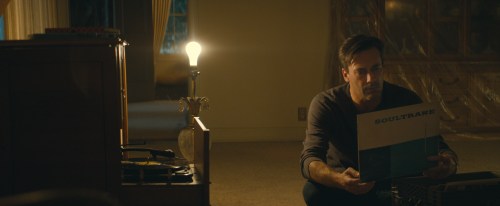
This Is a Movie Review: ‘Nostalgia’ Makes Some Obvious, Occasionally Affecting Points About Nostalgia

Leave a comment

CREDIT: Bleecker Street

This review was originally posted on News Cult in February 2018.

Starring: Jon Hamm, Catherine Keener, John Ortiz, Ellen Burstyn, Bruce Dern, James LeGros, Nick Offerman, Amber Tamblyn, Patton Oswalt, Annalise Basso, Mikey Madison

Director: Mark Pellington

Running Time: 114 Minutes

Rating: R for Language Apparently, But It Should Otherwise Be Rated PG

Release Date: February 16, 2018 (Limited)

Nostalgia, the 2018 film directed by Mark Pellington, would like you to know that nostalgia, the sentimality for the past, is a feeling that exists and that people experience. It does not treat this as some big revelation, as this is a common human emotion and the film does not pretend otherwise. But it is so simplistic and obvious, but also matter-of-factly profound, in its explication of the definition that there is this weird mix of pretension and lack of ambition. Mostly, Nostalgia glides along in a quiet, unfussy groove that is occasionally enlivened by tragedy and committed performances.

This is one of those anthology-style, “we’re all connected” movies with multiple discrete-but-actually-closely-connected(-at-least-thematically) storylines. Instead of cross-cutting between each vignette and having them dance around each other, they take their turns and then hand the ball (one time quite literally) off to the next one, with at least one shared character per section. At first it looks like Nostalgia will follow the travails of an insurance agent (John Ortiz) and the people he encounters. That’s a justifiable enough premise, but the execution is strikingly mundane.

The film eventually shakes out instead to more broadly be a series of sketches of people dealing with loss and holding on to and/or letting go of sentimental objects, which is even more nondescript than the insurance agent setup, but there are some dynamic moments. In particular, there is the scene with Ellen Burstyn as a widow selling her late husband’s autographed baseball to a professional collector (Jon Hamm). His appraisal delivers exactly the sort of human touch you want when parting with an item with such high monetary and emotional value. Hamm’s entire section, in which he and his sister (Catherine Keener) are hit with a great loss in the midst of cleaning out their father’s old stuff, is filled with understated power. Its setup is just as lightweight as the other storylines, but it delivers enough poignancy to make Nostalgia just worthwhile enough.

Nostalgia is Recommended If You Like: Jon Hamm swooping in to save the day, Emotional gut punches

Grade: 2.5 out of 5 Verified Ted Williams Signatures

This Is a Movie Review: The Naughty Nuns of ‘The Little Hours’ are Raunchy and Sweet

1 Comment

This review was originally posted on News Cult in June 2017.

Starring: Alison Brie, Dave Franco, Kate Micucci, Aubrey Plaza, John C. Reilly, Molly Shannon, Fred Armisen

Director: Jeff Baena

Running Time: 90 Minutes

Rating: R for Naked Witchcraft Acid Trips

Release Date: June 30, 2017 (Limited)

Fred Armisen shows up as a visiting bishop about halfway through The Little Hours. It is a hilarious scene, but it encapsulates the trepidation I had upon viewing this flick. In writer/director Jeff Baena’s riff on one of the tales from 14th-century story collection The Decameron, things are getting wild and crazy at a convent, with a trio of central nuns (Alison Brie, Aubrey Plaza, Kate Micucci) getting into sex, witchcraft, and other debauchery. While the premise alone is worth several chuckles, I had worried that it was better suited to a sketch rather than a full feature length, and Armisen’s routine demonstrates exactly what I was thinking of.

As Bishop Bartolomeo, Armisen takes stock of all the sinning that the residents have been getting up to, and it is a potent mix of petty, mundane, and outrageous. Running down kooky lists and taking a few breaks for exasperation is one of Armisen’s specialties. He revels in a litany that includes envy, “being a busy body,” “eating blood,” and “not being baptized.” This recaps everything important that has happened thus far and if this scene had been an SNL sketch (easily imaginable, considering the cast), our imaginations would just fill in the visuals for all that outrageousness. Instead, we get to see all the vulgarity play out, which could be a recipe for exhaustion after ninety minutes, but The Little Hours has some grounding elements to make the whole course palatable.

The focus is on three young brides of Christ – Alessandra (Brie), Fernanda (Plaza), and Genevra (Plaza) – who are either seeking to escape the convent or happy to stay there but not really interested in living the religious life properly. This would all be just a mélange of nuns behaving badly if not for the appearance of runaway servant Massetto (Dave Franco), who strikes up a romance with Alessandra and a deal with the head priest (John C. Reilly) to keep his true nature a secret. The love story is kinda sweet and Reilly is always so invested in the material no matter how ridiculous, elements that help offset all the debauchery, which is fitfully amusing but could have been exhausting if not for these counterpoints. Besides, this film cannot coast on shock value when its ladies do not bother one iota to resemble actual nuns.

The Little Hours is Recommended If You Like: History of the World: Part 1, The sexier scenes from Monty Python and the Holy Grail, The To Do List

Grade: 3.5 out of 5 Rolls in the Hay

This is a Movie Review: Of Course Sam Elliott is ‘The Hero’ We Need Now and Forever

Leave a comment

This review was originally posted on News Cult in June 2017.

Starring: Sam Elliott, Laura Prepon, Nick Offerman, Krysten Ritter, Katharine Ross

Director: Brett Haley

Running Time: 93 Minutes

Rating: R for Never Being Too Old for Drugs and Sex

Release Date: June 9, 2017 (Limited)

If you hear the logline “legendary cowboy actor who gets confused when an awards show clip featuring him goes viral” and do not immediately cast Sam Elliott, well then, I am glad you are not one of the people who made The Hero. The role of Western icon Lee Hayden is as tailor made for the famously drawling, silver-mustachioed Elliott as any role as ever been for anyone. He might not be as confused by modern media or as melancholy as his character is, but I do not know all the details of his personal life, and we all have our moments.

In the midst of Lee’s renewed burst of notoriety, he spends his days smoking weed with his buddy/dealer (Nick Offerman), attempting to reconnect with his estranged daughter (Krysten Ritter), and striking up some sort of an affair with a stand-up comedian a few decades younger than him (Laura Prepon). It is the latter relationship that gets the most narrative weight. May-December romances with big shot men can be a formula for a ton of tired creepiness, but Prepon holds her own in terms of self-assuredness and Elliott plays Lee as ambivalent as any viewer might be. What we see of Prepon’s stand-up is much more questionable.

All that this type of singularly focused character study requires to work are a compelling central performance and at least one resonant idea. We have already established that the former is met (it would be a shock if it weren’t). As for the latter, Lee utters the line, “Movies are other people’s dreams,” and this acts as the driving principle for much of the film. A series of dream sequences feature him at the edge of the ocean, waves lightly breaking in. Nothing much happens, but the mundanity is transcended by the beauty of simply living.

The Hero is Recommended If You Like: Being a Sam Elliott Fanboy

Grade: 3.5 out of 5 Weed Strains


This Is a Movie Review: Me and Earl and the Dying Girl

Leave a comment

me-earl-dying-girl-popsicle

Greg Gaines (the titular “me”) is reminiscent of Community‘s Jeff Winger. In the beginning of his story, he puts a great deal of effort into proving that he does not care, only for his ending to underscore the lengths to which he does care.

Greg defines himself by how detached he is from the high school clique system. He affects a dispassionate disposition, but he puts so much effort into being on amicable terms with every group. He goes so far as to devise a taxonomy that is thorough enough to include “Boring Jewish Senior Girls, Subgroup 2A.”

Every other major character is presented through Greg’s limited perspective, and accordingly they register as if they are all in their own distinct movies. Nick Offerman and Connie Britton play slightly against type/slightly extending from their types as Greg’s parents, making for a pretentious art flick and a slightly overbearing dramedy. Molly Shannon is right in her wheelhouse in the overbearing comedy portion as the mother of the girl with cancer. Jon Bernthal is Greg’s history teacher in the slightly dangerous bildungsroman. And Katherine C. Hughes, as Madison, the hot girl who means well but makes Greg feel terrible by virtue of being a hot girl, prompts the animated fantasy sequences.

Fuller portraits of Earl and Rachel (the titular girl) manage to shine through, thanks to their significant screen time. Greg refers to Earl, his filmmaking partner, as his “co-worker,” but Earl is quick to point out that they are in fact friends. There is a bit of a magical Negro vibe at play, which could have been unfortunate save for RJ Cyler making Earl so strong-willed and the narrative presenting plenty of personal background.

Rachel could have very well been the embodiment of cancer-related epiphanies or just one half of a typical teenage weepie romance. Indeed, Greg often suggests that the story seems to be going in that direction, only to immediately rebuke that idea. Instead, Olivia Cooke keeps Rachel appropriately grounded, as she comes across as just a person dealing with her illness on her own terms. As far as Greg and Rachel’s relationship goes, they develop a true friendship as a result of spending a lot of time with each other. Potential interpretations of the exact nature of their friendship are left wide open.

Madison represents an intriguingly unique story tack. She emerges as another love interest for Greg, which – for a character with only a handful of scenes in a movie with a more expected potential romance – is disconcerting, but also resonant. Greg assumes that Madison’s attention towards him is just pity, but there are enough subtle tells to suggest that her interest is genuine. What emerges is a film accomplished in its thorough commitment to taking on the subjective perspective of a protagonist so insecure that he cannot imagine that anyone would actually think highly of him. As Me and Earl and the Dying Girl is stuck in Greg’s head for so long, it is cathartic when he is finally able to get out of it.

A few words must also be devoted to Greg and Earl’s parody films (with dumbly brilliant pun titles like “Eyes Wide Butt,” “My Dinner with Andre the Giant,” and “Pittsburghasqatsi”). Because Greg is so unassuming regarding their quality, they come off as more charming than annoying. And based on what footage is actually shown, there appears to be decent composition and editing. It helps that Earl’s committed performances consistently shine through. Much of the story is leading up to the premiere of the film that the duo are making for Rachel, which could have ended up as so many clichés, but instead emerges as an idiosyncratic vision (regardless of quality level) and hardly what anyone could have possibly expected.

Newer Entries