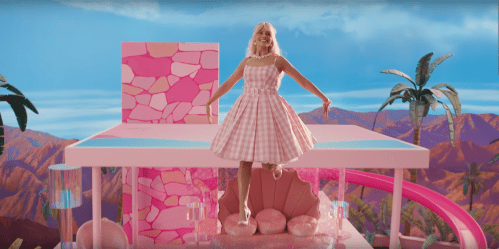
Hey, Barbie … wassup! (CREDIT: Warner Bros. Pictures/Screenshot)
Starring: Margot Robbie, Ryan Gosling, Helen Mirren, America Ferrera, Will Ferrell, Ariana Greenblatt, Kate McKinnon, Issa Rae, Hari Nef, Alexandra Shipp, Emma Mackey, Sharon Rooney, Ana Cruz Kayne, Dua Lipa, Nicola Coughlan, Ritu Arya, Marisa Abel, Michael Cera, Kingsley Ben-Adir, Simu Liu, Scott Evans, Ncuti Gatwa, Rob Brydon, John Cena, Rhea Perlman, Jamie Demetriou, Connor Swindells, Emerald Fennell, Ann Roth, Annie Mumolo, Lauren Holt
Director: Greta Gerwig
Running Time: 114 Minutes
Rating: PG-13 for Discussions About Doll Genitals, or Lack Thereof
Release Date: July 21, 2023 (Theaters)
What’s It About?: Barbie has had remarkable staying power. The eternally popular line of dolls represents a sort of perfect womanhood that’s impossible to achieve in real life. But in Barbieland, that perfection is a plain fact. Or so the opening of the 2023 film version of Barbie would have us believe. But that intro also quickly reveals some cracks in the glittery pink feminine utopia. The classic version of the title character, aka “Stereotypical Barbie” (Margot Robbie), is inexplicably starting to ponder her mortality. So she and one of the Kens (Ryan Gosling) head off to the real world to discover where this negative energy is coming from. They get a rude awakening with a very different status quo on Venice Beach, and then they head to Mattel headquarters to meet their makers. If it all works out, our relationship to Barbie and her relationship to us promise to never be the same.
What Made an Impression?: A Thin Line Between Fantasy and Reality: What’s especially striking about the mechanics of Barbie is just how easy it is to travel between Barbieland and the real world. While in the throes of her existential crisis, Stereotypical Barbie seeks counsel with the somewhat outcast Weird Barbie (Kate McKinnon). She’s basically this movie’s Morpheus, but instead of offering a blue or red pill, the choice is between high heels and Birkenstock sandals. Once Stereotypical Barbie opts for the hero’s journey, all she has to do is drive, and soon enough, she’s in sunny Southern California. That ease of transport cuts both ways, as the only requirement to travel into Barbieland appears to just be rollerblades. It’s a wonder there hasn’t been more interaction between worlds before this point! But maybe there actually has been. Indeed, the Mattel employees refer to some previous similar incidents, and while Barbie’s fish-out-of-water routine leads to some assumptions that she’s mentally unwell, the ultimate conclusion is that it’s perfectly reasonable that a flesh-and-bones version of this classic doll would appear eventually.
A Thorough Education: I’m not one to always advocate for the primacy of Showing over Telling, as there are times when exposition is perfectly satisfying. But Barbie does lean a little hard on the Telling side of the equation and ends up a bit in Didactic territory. Characters spell out simple emotions that they’re experiencing for the first time, with a bluntness that threatens to rip away all of the magic. There’s ultimately a similarly blunt conflict that I found surprising, though perhaps I should have seen it coming. When the main Ken encounters the patriarchal systems of the real world, he excitedly smuggles those ideas into Barbieland and transforms the dreamhouses into mancaves with no resistance from the suddenly hypnotized Barbies. Masculine insecurity becomes the enemy perhaps too simplistically, although I do appreciate the fact that Ken thought the patriarchy was actually about horses. That cluelessness is an ace in the hole, while the chauvinism is more run-of-the-mill.
That Mattel Magic: While the title and so much of the dialogue squeals “Barbie!,” the heart of the movie can actually be found in some of the more human characters. To wit: the Mattel office, which initially appears to be as stiflingly patriarchal as the Kens eventually become. And it certainly is in one respect, as all of the top executives are men in suits making decisions about what’s best for girls and women. But it’s a little more complicated than that. Led by Will Ferrell in his most eager-to-please form as the CEO, their core motivation is to genuinely provide the world with the best possible version of Barbie. They embrace the fun and frothiness and rollerblading of it all in a way that I can only hope is true of all toy executives.
But the crux of the narrative lies with America Ferrera as Gloria, the CEO’s assistant, as well as her tween daughter Sasha (Ariana Greenblatt). Whereas Sasha views Barbie as the source of all of the unrealistic expectations heaped on women, Gloria can’t help but hold on to a girly fantasy world. But if Barbie is to still mean anything to Gloria (and by extension everyone) else in 2023, then she needs to embrace the anxiety-inducing messiness of life. Barbie the Movie invites viewers to adapt Barbie the Concept into whatever version they need at whatever particular moment they’re going through. It may be a little frightening to have that lesson centered around a corporate product, but it’s what we’ve got in the culture.
Barbie is Recommended If You Like: The Lego Movie, Rollerblading, eBay-focused nostalgia
Grade: 3.5 out of 5 Dreamhouses

 Jmunney's Blog