This Is a Movie Review: Dick Cheney is Ten Chess Moves Ahead of Everyone in Adam McKay’s Typically Ambitious ‘Vice’

Leave a comment

CREDIT: Matt Kennedy/Annapurna Pictures

This review was originally published on News Cult in December 2018.

Starring: Christian Bale, Amy Adams, Steve Carell, Sam Rockwell, Jesse Plemons, Alison Pill, Lily Rabe, Justin Kirk, Tyler Perry, LisaGay Hamilton, Eddie Marsan

Director: Adam McKay

Running Time: 132 Minutes

Rating: R for Profanity in the Halls of Power and Images of War and Torture

Release Date: December 25, 2018

If I’m understanding Vice correctly, then Adam McKay believes that Dick Cheney (here embodied by Christian Bale) is directly or indirectly responsible for everything that is wrong with the current state of American politics. That actually is not as much of a stretch as it sounds. During his eight years as vice president, Cheney wielded a degree of influence that was profoundly unprecedented for the position. The conventional wisdom is that his views on executive power and surveillance now represent the status quo for whoever is occupying the White House. Thus, McKay is not so far off the reservation to imply all that he is implying. But he may have bitten off a little more than he can chew with the expansiveness of his argument. He was similarly ambitious with The Big Short, but that earlier effort is more durable to scrutiny because there he laid the responsibility on forces that were perpetrated both actively and passively by many people. It may very well turn out to be true that Cheney’s influence is as wide-ranging as McKay claims – it’s just tricky to say so about a person who is still living.

Interestingly enough, that tenuousness is baked right into the script. If not for a few key decisions, the life of Dick Cheney, and ergo America, could have played out very differently. Without the presence of his wife Lynne (Amy Adams conjuring Lady Macbeth), he could have ended up a drunk nobody. And if not for his propensity to see life like a chess match in which he is ten moves ahead of everyone else, there might be no Patriot Act, ISIS, or extreme income inequality.

The thesis of Vice is that it was all so close to going differently. Through fourth-wall breaking and formal experimentation (like playing the end credits halfway through), the message is that all that we have been living through was not foreordained. Some may find that frightening, as it indicates that we are always on the precipice of disaster. And McKay’s propensity to cut to random footage of pop culture ephemera may come off as a lamentation that we are too distracted to do anything about it. But I actually see encouragement. You don’t have to like Cheney for him to be an inspiration. If you have a problem with the way things are in the country right now, maybe you can see an opportunity where everyone else sees the masses placated by “Wassup!” commercials. I’m not sure how well Vice works as a movie, but I choose to see it as an exhortation to make things right.

Vice is Recommended If You Like: The Big Short, Oliver Stone’s political thrillers, The Daily Show, Fourth-wall breaking

Grade: 3.5 out of 5 Unitary Executive Theories

This Is a Movie Review: ‘Bumblebee’ is Retro Fun and Mercifully Economical

1 Comment

CREDIT: Paramount Pictures

This review was originally published on News Cult in December 2018.

Starring: Hailee Steinfeld, Jorge Lendeborg Jr., John Cena, Pamela Adlon, John Ortiz, Stephen Schneider, Jason Drucker, Dylan O’Brien, Angela Bassett, Justin Theroux, Peter Cullen

Director: Travis Knight

Running Time: 114 Minutes

Rating: PG-13 for Deadly Alien Technology That Vaporizes Blood and Guts

Release Date: December 21, 2018

The Transformers series is addicted to origin stories and secret histories. Bumblebee does not break that spell, but it does present it in a much more palatable package than usual. The 2007 franchise starter supposedly presented the first time that the Autobots and Decepticons made themselves known on Earth in a major way. But as the series has rattled on, it’s been revealed that the bots have actually been around on this planet in some capacity for thousands of years, which sounds exhausting to hear about, and is even more exhausting to watch. I checked out after 2011’s Dark of the Moon, but I’ve heard horror stories from folks who stuck around for 2014’s Age of Extinction and 2017’s The Last Knight.

The spinoff nature of Bumblebee offers the potential to go in a fresh direction, but its elevator pitch does not exactly inspire confidence. “What if a teenager finds a beat-up old car that turns out to be a Transformer?” is pretty much the exact same starting point as the first Transformers. But while the setup is familiar, the details are unique and mercifully leaner compared to what’s come before. Wisely, only four Transformers play significant roles. There’s the title little fellow, opting for a modest Volkswagen Beetle disguise instead of his typical Camaro look. On his tail are the Decepticons Shatter and Dropkick, voiced with nasty verve by Angela Bassett and Justin Theroux. And Optimus Prime shows up occasionally to keep Bumblebee’s spirits up, mostly in Princess Leia-to-Obi-Wan Kenobi-style pre-recorded message form. Metal clanking against metal is still no more aesthetically pleasing than it’s ever been, but there’s thankfully a lot less of it this time around.

As for the humans, Hailee Steinfeld is a natural in coming-of-age mode. She plays Charlie Watson, a teenager in 1987 San Francisco who would much rather spend her time fixing up cars (like she used to always do with her dad before he passed away) rather than hang out with her family or classmates. There are plenty of hallmarks of the genre: an awkward neighbor with a huge crush (Jorge Lendeborg, Jr.), an overbearing mom and stepdad (the delightful pair of Pamela Adlon and Stephen Schneider) who try and fail to get Charlie to smile more often, an annoying younger brother, and bitchy classmates. Bumblebee slots into her universe as a sort of wounded animal that she nurses back to health and also as the only one who really understands Charlie. Bumblebee hardly reinvents the wheel, but it’s a perfectly fun and satisfying addition to the girl-and-her-bot genre.

Bumblebee is Recommended If You Like: The first Transformers movie but not the Michael Bay excess, The Smiths, ’80s-set coming-of-age flicks

Grade: 3.5 out of 5 Volkswagen Bugs

This Is a Movie Review: ‘Mortal Engines’ is Full of Striking Visuals and Admirable Ambition But a Little Pedestrian in the Execution

Leave a comment

CREDIT: Mark Pokorny/Universal Pictures

This review was originally published on News Cult in December 2018.

Starring: Hera Hilmar, Robert Sheehan, Hugo Weaving, Jihae, Leila George, Ronan Raftery, Patrick Malahide, Stephen Lang

Director: Christian Rivers

Running Time: 128 Minutes

Rating: PG-13 for Guns, Knives, and Giant Metal Gears

Release Date: December 14, 2018

It’s not very often that you encounter a premise as fresh as that of Mortal Engines. In a dystopian future in which society has rebuilt itself following a planet-destroying war, cities are mobile, with the larger populations swallowing up smaller settlements as they chug along the land. Also, there’s a bizarre reference to the Minions of Despicable Me fame. The opening segment is invigorating, as the facially disfigured Hester Shaw (Hera Hilmar) gets consumed  into London and attempts to assassinate Thaddeus Valentine (Hugo Weaving), head of the Guild of Historians. The clanking machinery and whirring gears are stunningly realized, bizarre but never quite disorienting. With a script by the Lord of the Rings team and a steampunk aesthetic, the pedigree and look are familiar, but with a first-time director in Christian Rivers (the storyboard artist for most of Jackson’s films) and a cast mostly made up of little-knowns, the vibe at first glance is wholly fresh.

Alas, after that kickoff, Mortal Engines mostly relies on tired fantasy tropes. There are discoveries about the truth of one’s parentage, flashbacks to growing up with a makeshift guardian, a long and arduous journey for characters to complete a mission and learn more about themselves along the way, and a big climactic battle in which all the chickens come home to roost. That formula can still work in this day and age, but it is just not particularly compelling in this case. At least there are some unique visual flourishes here and there to tide us over.

There is also plenty of room to ponder the philosophical query of what geographically defines a city in its most fundamental terms. If cities are constantly moving around, then what are they traversing across? Immobile cities, or something that we don’t even have a conception of in 2018? Of course, the cities of today are also moving, insofar as Earth is always orbiting around the Sun. Rivers and his cast and crew may very well have benefited from really poring more deeply into the quandary of relativity of location.

Mortal Engines is Recommended If You Like: Steampunk, Ambition above all else

Grade: 2.5 out of 5 Traction Cities


This Is a Movie Review: In ‘The Mule,’ Clint Eastwood is an Unlikely Drug Trafficker Who Complains About the Internet

2 Comments

CREDIT: Warner Bros.

This review was originally published on News Cult in December 2018.

Starring: Clint Eastwood, Bradley Cooper, Laurence Fishburne, Michael Peña, Dianne Wiest, Andy García, Isabel Eastwood, Taissa Farmiga, Ignacio Serricchio, Eugene Cordero

Director: Clint Eastwood

Running Time: 116 Minutes

Rating: R for Casual Racist Slurs and Showing Someone a Good Time (*Wink Wink*) for the Night

Release Date: December 14, 2018

The Mule does not need to feature casual racism and crankiness about how young people are ruining everything with their newfangled technology, but it stars and is directed by Clint Eastwood, so what are you gonna do? At this point in time, he can at least be entertaining as a self-parody. This is, after all, a movie in which he literally says “if you can’t open a fruit box without calling the Internet” and “Damn Internet, it ruins everything.” Or maybe this ultimate cinematic tough guy is actually self-aware and toying around with his reputation. In one moment, when he calls a black family “Negroes” while helping them change a tire, he does get chided for his ignorance. But it isn’t like that scene even needs to exist. Nor does there need to be a scene when he makes a connection with lesbian motorcyclists who proudly call themselves “dykes on bikes.” If The Mule is woke, it is simplistically so, which is fairly amusing, but also a little concerning.

There is a level of professionalism but also a lack of consideration that makes The Mule entertaining and imbues it with a strong message but also renders it shallow. The script is based on a New York Times article about the real-life story of Leo Sharp, who in his 80s became a drug mule for the Sinaloa Cartel. Eastwood plays Earl Stone, a fictionalized version of Sharp. He has spent decades dedicating himself to his horticulture career at the expense of his family, and now that the bottom has dropped out on his business, he finds himself turning to a much more lucrative and much more illegal profession.

The story of a man who never made time for his wife and daughter because he was too focused on his flowers is certainly different, but everything else about The Mule is predictable, sometimes worryingly so. Most of the characters who are people of color are cartel members, while all of the white characters are either Earl and his friends and family or DEA agents. That in and of itself is not wrong as it may very well reflect reality, but in 2018 it feels tone deaf not to more carefully consider that racial divide. And that really is a shame in this case, because The Mule actually does appear interested in taking a more unique approach to the material. The plot hinges on Earl realizing that it is never too late to be a good spouse and parent, a lesson he attempts to impart to his cartel handlers and the DEA agent on his tail (Bradley Cooper). It is a fascinating story on its own that also comes across on screen as mostly fascinating, but it’s spiked with a few too many shots of Eastwood crankiness.

The Mule is Recommended If You Like: The Crankiness and Casual Racism of Late-Era Clint Eastwood

Grade: 3 out of 5 Dykes on Bikes for Entertainment Value/2 out of 5 Stereotypes for Social Value


This Is a Movie Review: Barry Jenkins is as Sensitive and Empathetic as Ever with James Baldwin Adaptation ‘If Beale Street Could Talk’

Leave a comment

CREDIT: Tatum Mangus/Annapurna Pictures

This review was originally published on News Cult in December 2018.

Starring: KiKi Layne, Stephan James, Regina King, Teyonah Parris, Colman Domingo, Bryan Tyree Henry, Ed Skrein, Emily Rios, Finn Wittrock

Director: Barry Jenkins

Running Time: 117 Minutes

Rating: R for Longtime Friends Becoming Lovers and Their Families Yelling Awful Things at Each Other

Release Date: December 14, 2018 (Limited)

One of the strength of Barry Jenkins’ films is that they work much like how the human brain works. They process their stories from a clear beginning to end, but along the way they take detours, often expressionistic and dreamlike, because in their associative natures they have tendencies to temporarily disassociate. The narrative focus in If Beale Street Could Talk is on the effort to free Alonzo “Fonny” Hunt (Stephan James) from jail after he has been (obviously and egregiously) falsely been accused of rape. We stay close with his family and pregnant girlfriend Tish (KiKi Layne) as the weeks tick by and they do whatever they possibly can for a young black man in 1970s America. Interspersed with this steady passage of time are flashes of Fonny and KiKi’s memories, hopes, and nightmares. The images in these moments are often idyllic and tranquil, but there is an undercurrent of imprisonment demonstrating that the worst of reality cannot be fully escaped as it infects our psyches.

If On Beale Street Could Talk is based on James Baldwin’s novel of the same name, and Jenkins’ smooth hand ensures that Baldwin’s conception of Harlem is brought to tactile, contemporary life. Layne’s sweet, mischievous, and unapologetic narration; Nicholas Britell’s smooth score; and James Laxton’s crisp cinematography make for a sensuous feast that altogether works to achieve a remarkable feat of empathy generation. All films that are worth their weight put us in their characters’ headspaces and let us discover what they were all about, but Beale Street is a special case. Every moment is especially intimate and familial, and it is thus an honor to be invited in. Like most stories about false accusations and systemic discrimination, this one is frustrating to anyone who cares about justice, but amidst all that there is to be angry at, Jenkins somehow manages to achieve an odd sort of peace by the end. Everything is far from perfect, but the love between Tish and Fonny is real and worth celebrating.

If Beale Street Could Talk is Recommended If You Like: Moonlight, The Harlem Renaissance, Love & Basketball

Grade: 3.75 out of 5 People Who Love Each Other

This Is a Movie Review: Free Solo

Leave a comment

CREDIT: Jimmy Chin/National Geographic

I saw Free Solo on a December night, yet the sight of Alex Honnold scaling thousands of feet of bare rock without any supports was enough for my palms to leave a big wet spot on my shirt. Of course, I was inside and simmering in room temperature as opposed to the seasonal cool, but even so, I don’t usually get sweat saturation while merely sitting down this time of year. Anyway, if you haven’t heard about Free Solo, it’s about this guy who climbs massive rock formations without any protective equipment or partners, which has, according to him, low risk but high consequences. That is to say, the risk is low because he’s among the best in the world, but the consequences are high because one mistake means almost certain violent death. Watching this documentary is sure to make many wonder about the ethics of simply bearing witness to a fundamentally dangerous endeavor. But if there weren’t a film being made about him, Honnold would surely be scaling the highest heights anyway. Might as well record it to capture the triumph or to help pick up the pieces if something goes wrong.

I give Free Solo 3000 Feet out of 4000 Climbing Notes.

This Is a Movie Review: ‘Mary Queen of Scots’ Ponders So Many Questions About Who Belongs on the Throne

Leave a comment

CREDIT: CREDIT: Liam Daniel/Focus Features

This review was originally published on News Cult in December 2018.

Starring: Saoirse Ronan, Margot Robbie, Jack Lowden, Joe Alwyn, David Tennant, Guy Pearce

Director: Josie Rourke

Running Time: 125 Minutes

Rating: R for A Surprisingly Horny Approach to the Material and the Violent Retribution That Results

Release Date: December 7, 2018 (Limited)

If you’re an anglophile who loves tracking all historical matters of royal succession, then you ought to add Mary Queen of Scots to your to-watch list. But if you’re more ambivalent on the subject, this film is likely to instead get you frustrated and shout at the 16th century to move ahead hundreds of years when questions of leadership have less to do with the intricacies of bloodlines. Of course, 21st century politics has its own problems, but Mary Queen of Scots feels obsessed with the minutiae of what was specific to a bygone era. There is some intriguing conflict to be had, as Mary (Saoirse Ronan) and her cousin Elizabeth (Margot Robbie) both apparently have legitimate claims to the English throne. The internal psychological drama and external tension of impatient courts and citizenry are present, but the same points keep getting pounded over and over.

Part of the problem is the film’s lopsided structure. It makes sense that the title is what it is and not “Mary & Elizabeth,” as this is at least two-thirds Mary’s story, if not more. Perhaps there is an element of correcting the historical record, or the cinematic historical world, as Elizabeth’s story has hitherto been told more often than Mary’s. But if that’s the case, then you might as well go whole hog into Mary’s realm and render Elizabeth more or less heard but not seen. As it stands, though, it makes me wonder, “Why can’t they both be queen?” Alas, for the sake of the narrative (and historical accuracy), that’s probably too pat and conflict-free. But it’s almost all worth it for the scene when Mary and Elizabeth finally meet in person. Ridiculous measures are taken to keep this meeting “secret,” thus fulfilling a promise to really examine the nonsense inherent to this state of affairs. It’s all silly, and should be treated as such, instead of resorting to beheadings.

Mary Queen of Scots is Recommended If You Like: Any and all royal British period piece

Grade: 3 out of 5 Heirs


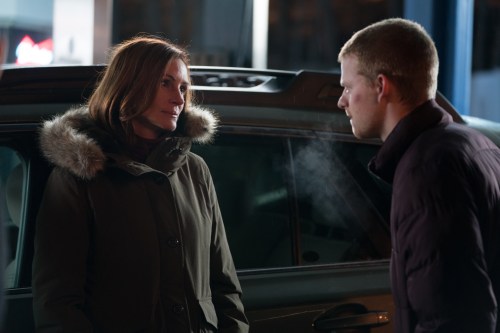
This Is a Movie Review: ‘Ben is Back’ Mixes Familial Addiction Crisis with Suburban Thriller

Leave a comment

CREDIT: Mark Schafer/LD Entertainment/Roadside Attractions

This review was originally posted on News Cult in December 2018.

Starring: Julia Roberts, Lucas Hedges, Courtney B. Vance, Kathryn Newton

Director: Peter Hedges

Running Time: 103 Minutes

Rating: R for The Profanity of Familial Frustration and Some Drug Use

Release Date: December 7, 2018 (Limited)

Ben is Back reminds me quite a bit of Good Time, despite the two being wildly different in tone and purpose. But their narrative structures and momentum match up strikingly. Both are about all-night attempts to retrieve a beloved family member, with secrets, subterfuge, and drug use along the way. It just goes to show you that when it gets right down to it, outer borough dwellers who resort to crime aren’t all that different from upstate suburban families.

Where Good Time was about Robert Pattinson springing his brother out of jail after a botched robbery, Ben is Back follows Holly Burns (Julia Roberts) and her son Ben (Lucas Hedges) as they track down the beloved family dog in the wake of Ben’s history of bad decisions catching up with him. Ben has just unexpectedly showed up at home from rehab on Christmas Eve, and he promises that he is making an honest effort to stay clean. But then someone comes to collect a debt by kidnapping the dog, and the temptations to relapse shoot up exponentially.

Movies with premises like Ben is Back‘s tend to make a double-edged promise to their audience: they feature tremendous, heartfelt acting and have thoughtful and open-minded things to say about the opioid crisis, but they are also stressful and depressing viewing experiences. Beautiful Boy is a prime recent example that was overwhelming in its anxiety. But Ben is Back bypasses that disquiet, or at least sets it aside for the moment, with the urgency of its plotting. It makes for a cinematic experience that is not exactly fun, but certainly thrilling. And it’s not like it avoids the hard questions. Indeed, the matters of whether or not Holly can ever trust Ben, and how much his brain is even in control of how much he can be trustworthy, are brought into sharp relief by the occasion of finding the dog. This is what the opioid crisis looks like during the holidays for one family – there might be enough hope for them to make it through.

Ben is Back is Recommended If You Like: Good Time but if it were about the opioid crisis

Grade: 3.5 out of 5 Relapses

This Is a Movie Review: ‘Vox Lux’ is a Traumatic and Entrancing Journey Through Pop Music Stardom

Leave a comment

CREDIT: NEON

This review was originally posted on News Cult in December 2018.

Starring: Natalie Portman, Raffey Cassidy, Jude Law, Stacy Martin, Jennifer Ehle, Willem Dafoe

Director: Brady Corbet

Running Time: 110 Minutes

Rating: R for School Shooting Violence, Drug Use, and Staten Island Accented-Profanity

Release Date: December 7, 2018 (Limited)

There is a scene about midway through Vox Lux in which pop star Celeste Montgomery (Natalie Portman) is at a diner with her daughter Albertine (Raffey Cassidy, who also plays the teenage Celeste), expounding about how the press is always hounding her, and it turns into this incomprehensible rant about the misbegotten state of the world. She sounds like someone who watched Fight Club too many times as a teenager, specifically the scene in which Tyler Durden espouses his whole philosophy. But the causes of Celeste’s unique psychology can actually be traced to much more intense external forces. The armchair nihilist philosophizing is just gravy.

The adult Celeste is the product of two adolescent experiences that no teenager is naturally wired to perfectly handle. Both of these types of experiences on their own can, and have, resulted in long-term negative effects for many people. But together they produce … well, they produce Vox Lux. Celeste’s journey begins by surviving a shooting at her middle school, which is obviously traumatic enough to produce scars that last a lifetime. During her recovery, she writes a song to create some love out of the violence, and it ends up becoming a huge hit and leads into a full-on pop music career. But teenage stardom is not ideal for most people, and Celeste does not buck that trend. Fast-forward to the present day, in which at 31 years old she is emotionally still a child.

The culmination of Celeste’s story is hardly surprising, but director Brady Corbet makes it entrancing even at its most disturbing. This is a truly singular whirlwind of a person, and even knowing how messed up her personal life is, we can see how she remains compelling through and through to the public at large. The final 15 minutes or so take place at her new tour’s kickoff performance at her hometown of Staten Island. Considering the series of crises on the way to getting her to the stage in one piece, I thought that this moment was going to end with her collapsing or otherwise failing to finish the show. But instead, she is a wonder to behold, as bedazzling as any modern pop star at the top of her game. This triumph is even more stunning considering the struggle leading up to it. Celeste becomes more admirable while simultaneously remaining as much of a cautionary tale as ever. She remains a symbol by holding up the weight of circumstances that are so much heavier than any one person could possibly bear.

Vox Lux is Recommended If You Like: The Spectacle of Pop Music, Black Swan, Staten Island accents, Actors playing the same characters 20 years apart

Grade: 4 out of 5 Losses of Innocence

This Is a Movie Review: The Front Runner

Leave a comment

CREDIT: Frank Masi/Sony Pictures

The Front Runner raises a lot of valid points about the propriety, or lack thereof, of prying into politicians’ personal lives, but it is liable to leave you more confused than ever, even if you have strong opinions about all the issues it raises. As the narrative goes, the coverage of Gary Hart’s supposed indiscretions during the 1988 Democratic primary completely derailed his campaign and led to the overall coarsening of the political media landscape that we have today. That may be an accurate narrative, but is it a bad thing that we know more about the personal lives of those who govern us? The fact that it all remained secret for so long is one reason why powerful people have gotten away with terrible behavior.

But as for how it affected Gary Hart specifically, did he deserve what happened to him? The way the movie presents it, it seems like he had been unfaithful in his marriage, but not necessarily in this case. And the Miami Herald, which originally reported on the story, did not appear to do their duest diligence to verify their implications. At least I can unequivocally say it is a good thing that Donna Rice, Hart’s alleged mistress, gets to have her side of the story presented. But otherwise, The Front Runner is a bit of a mess. Although, it could be a portrait of a mess.

I give The Front Runner 2.5 (Million) Accusations out of 5 (Possible) Indiscretions.

Older Entries Newer Entries