
CREDIT: Roadside Attractions
I give Beast 3.5 out of 5 Glass Shards: https://uinterview.com/reviews/movies/beast-movie-review-british-thriller-reveals-that-the-animal-lies-within-us-all/
Jeff "Jmunney" Malone's Self-Styled "Expert" Thoughts on Movies, TV, Music, and the Rest of Pop Culture
May 10, 2018
Cinema, Movie Reviews Beast, Geraldine James, Jessie Buckley, Johnny Flynn, Michael Pearce Leave a comment
CREDIT: Roadside Attractions
I give Beast 3.5 out of 5 Glass Shards: https://uinterview.com/reviews/movies/beast-movie-review-british-thriller-reveals-that-the-animal-lies-within-us-all/
May 4, 2018
Cinema, Movie Reviews Anna Faris, Eugenio Derbez, Eva Longoria, John Hannah, Mel Rodriguez, Overboard, Overboard 2018, Overboard remake, Rob Greenberg, Swoosie Kurtz Leave a comment

CREDIT: Metro Goldwyn Mayer Pictures/Pantelion Films
I give Overboard (2018) 3 out of 5 Baggy Seahawks Jerseys: http://uinterview.com/reviews/movies/overboard-movie-review-anna-faris-and-eugenio-derbez-are-a-sweet-enough-duo-to-overcome-this-remakes-fundamental-flaws/
May 2, 2018
Cinema, Movie Reviews Charlize Theron, Diablo Cody, Jason Reitman, Mackenzie Davis, Mark Duplass, Ron Livingston, Tully Leave a comment

CREDIT: Focus Features
This review was originally posted on News Cult in May 2018.
Starring: Charlize Theron, Mackenzie Davis, Ron Livingston, Mark Duplass
Director: Jason Reitman
Running Time: 96 Minutes
Rating: R for PG-13-level Profanity, a Wish-Fulfilling Sex Scene, and Some Nudity (Mostly Breastfeeding-Related)
Release Date: May 4, 2018
“How could anyone possibly want to be a mother?” I find myself thinking multiple times while watching Tully. Sure, kids can be bundle of joys for folks who are parentally inclined, but the purgatory of pregnancy and postpartum malaise that Charlize Theron steeps herself in conveys unequivocally the crushing sacrifices required to assemble a happy family. Now, not every mother or mother-to-be is as susceptible to depression as Theron’s Marlo is, but creating another life inside your body pretty much guarantees a transformation of your sense of personhood. So what a blessing it would be to have someone devoted to helping with that transition, and I think we can all agree that a smiling, eager Mackenzie Davis on our doorstep fits the requirements perfectly.
Davis’ titular nanny, hired to take care of Marlo’s new baby overnight so that Mom can get some much-needed sleep, shares a lot of DNA with Manic Pixie Dream Girls, that oft-bemoaned breed of rom-com stock character designed for the express purpose of making the lead character discover the joy of loving life. But the Manic Pixie Night Nanny, or at least this particular one, avoids being similarly frustrating, because taking care of all of Marlo’s needs is kind of in her job description. She comes across as a real, layered person because some people really are that expertly enthusiastic about childcare, and she is granted a life and concerns of her own outside her employment. But as Tully proves to be the most perfect nanny ever and starts to become a friend and confidante, the questions arise: just how is it possible that she is this perfect? How long can, and should, this arrangement last?
In her third collaboration with director Jason Reitman, screenwriter Diablo Cody takes plenty of piercing (but loving?) digs at the sort of suburban bougie lifestyle that accompanies the concept of a night nanny. According to Marlo’s brother Craig (Mark Duplass, so often playing the embodiment of bougie entitlement), this may be the sort of indulgence only rich assholes get to have, but at least these particular rich assholes are of the unwittingly hilarious kind. The New York crowd at my screening cracked up heartily at a dog named “Prosecco” and the reveal that an elementary school kid’s talent show talent is “Pilates.” (Distressingly, though, I was the only one laughing at a sneaky reference to a certain ’90s cartoon.)
I feel that I must now get into a spoiler alert, which I want to be careful about, because the fact that there is a spoiler alert is already a bit of a spoiler, as this is not the type of movie you would expect to have secrets that need protecting. But because of the nature of what is spoilable, it feels irresponsible not to mention that it could be traumatic to mothers who have experienced pregnancy-related mental health issues. Tully ultimately reveals itself to be a different movie than it initially appears to be – not worse, but a lot heavier. It is something I cannot get out of my head, and I think that is a good thing, as it offers an approach to certain facts of life that is well worth digesting.
Tully is Recommended If You Like: Bougie Suburban Satire (like that of Beatriz at Dinner), Young Adult, The Babadook
Grade: 4 out of 5 Milk Spills
May 1, 2018
Cinema, Movie Reviews Betsy West, Clara Spera, Gloria Steinem, Julie Cohen, Nina Totenberg, RBG, Ruth Bader Ginsburg, The Notorious RBG Leave a comment

CREDIT: Magnolia Pictures
This review was originally published on News Cult in May 2018.
Starring: Ruth Bader Ginsburg, Gloria Steinem, Nina Totenberg, Clara Spera
Directors: Betsy West and Julie Cohen
Running Time: 97 Minutes
Rating: PG for Eyeroll-Style Rebukes to Years of Discrimination
Release Date: May 4, 2018 (Limited)
RBG is not so much about lionizing Ruth Bader Ginsburg as much as it is about capturing the moment of Ruth Bader Ginsburg. It is compelling in that regard because the fact that a woman achieves her greatest fame in her eighties, for whatever reason, is notable in and of itself. Ginsburg’s singularity is understandable insofar as becoming a justice on the United States Supreme Court is typically the culmination of a decades-long career, but her uniqueness is nonetheless still remarkable. Directors Betsy West and Julie Cohen make the case that this moment is richly deserved, as Ginsburg has played critical roles in key moments in American legislative history. This is a documentary that makes the case for someone who has so assiduously made many cases for others.
As a progressive-minded individual, and a fan of Ginsburg’s already, I am pre-disposed to enjoy a doc that takes an admiring approach towards her. But as a critic, I am always inclined to wonder if I have fallen prey to a bit of hagiography. I imagine this film would not have gotten made if not for the existence of the “Notorious R.B.G.” tumblr, but this is not the “RBG memes” movie. It puts in the work to justify why this story is worth being told. In clear, efficient terms, it presents how Ginsburg was integral in multiple landmark decisions involving gender equity, as she rectified institutional discrimination that had been hurting both men and women. And as much as RBG reveals how Ginsburg deserves gratitude from certain constituencies, it does not turn a blind eye to her more questionable moments, as it examines the appropriateness, or lack thereof, of her critical comments about Donald Trump during the 2016 campaign.
Overall, RBG demonstrates admirable commitment to the concept of cura personalis, Latin for “care for the entire person” (an idea that graduates of Jesuit institutions will intimately recognize). This is surely not the first documentary focused around the totality of an individual, but this particular doc displays care for the entire person more than most, whether or not its makers are familiar with any particular term. It is hardly groundbreaking that a chronicle of Ginsburg’s career is accompanied with stories of her family life, or friendly interactions with her colleagues, or her reactions to Kate McKinnon’s SNL impression of her as a Def Jam-style comedian. (It is perhaps a little bit surprising, though, that we also get to see footage of her daily workout routine.) Ultimately the value of a film like this is fully in focus in the scenes with Ginsburg and her granddaughter, law student Clara Spera (who is equal parts admiring of the public figure and loving of the family member), and that value is that everyone should be treated with such thorough, compassionate care.
RBG is Recommended If You Like: Ruth Bader Ginsburg the Person, Ruth Bader Ginsburg the Justice, Ruth Bader Ginsburg the Meme, Kate McKinnon’s impression of Ruth Bader Ginsburg
Grade: 3.75 out of 5 Dissents
April 26, 2018
Cinema, Movie Reviews Alessandro Nivola, Disobedience, Rachel McAdams, Rachel Weisz, Sebastián Lelio Leave a comment

CREDIT: Bleecker Street
This review was originally posted on News Cult in April 2018.
Starring: Rachel Weisz, Rachel McAdams, Alessandro Nivola
Director: Sebastián Lelio
Running Time: 114 Minutes
Rating: R for Bodily Fluid Swapping
Release Date: April 27, 2018 (Limited)
It’s nice when a movie like Disobedience, which looks like it is on a one-way track to a depressing conclusion, actually manages to have a happy ending. Now, “happy ending” might be a bit of a stretch, as it does not wrap up with the most joyous of notes, but the main characters do have decent prospects for the future, thus managing a note of hope I was nowhere near expecting.
Ronit Krushka (Rachel Weisz) is a photographer living in New York who returns to the insular Orthodox Jewish community in London where she grew up to attend the funeral of her rabbi father, a pillar of the community. While there, sparks re-emerge between her and Esti Kuperman (Rachel McAdams), a childhood friend and clearly much more. Disobedience then is a close relative to Brokeback Mountain, as it is a gay love story negotiated within an oppressively culturally conservative community, but whereas Brokeback’s arc is tragic, Disobedience manages to be about resolution and compromise.
While the Orthodox Judaism of this film is hardly open-minded to the prospect of a lesbian couple, there are other traditional ideas that manage to be more insidiously oppressive. It feels like a bigger scandal that a woman would choose to be childless or abandon her home than for her to fall in love with another woman. Thus, Ronit bears the brunt of the ostracization, whereas Esti, who has married a man and made a steady living as a schoolteacher, maintains cordiality and respect despite her orientation being something close to an open secret. Esti’s husband Dovid (Alessandro Nivola) knows the truth about her, and he embodies the idea implied by the community that if you are a woman and you have an affair with another woman, it will be more or less ignored so long as you get married and have sex once a week and at least try to have a baby. Disobedience is smart about recognizing that while romance and its attendant passions are important, there are other fundamentals to life that are worth focusing on.
This is a drab film, with characters endlessly dressed in black or other dark tones. Surely that is partly to due with mourning the loss of a loved one, but you get the sense that this is how this community always dresses. Perhaps they are taking a cue from the perpetually rainy weather of their hometown. Even the brunette Esti wears a wig of a darker shade. While these outfits strike me as painfully passionless, much of the community wear them well. Esti can make them work to a certain extent, while Ronit is clearly uncomfortable throughout. This is a story about whether the two of them can meet in the middle, and being surprisingly okay with it when they cannot quite get there.
Disobedience is Recommended If You Like: Brokeback Mountain, Doomed (But Not That Doomed) Romances, Portrayals of Orthodox Life
Grade: 3.5 out of 5 Orthodoxies
April 22, 2018
Cinema, Movie Reviews A Wrinkle in Time, André Holland, Ava DuVernay, Bellamy Young, Chris Pine, David Oyelowo, Deric McCabe, Gugu Mbatha-Raw, Levi Miller, Michael Peña, Mindy Kaling, Oprah Winfrey, Reese Witherspoon, Rowan Blanchard, Storm Reid, Zach Galifianakis Leave a comment

CREDIT: Disney
I certainly enjoyed Ava DuVernay’s spin on A Wrinkle in Time, though I am a little disappointed it does not reach the level of blockbuster classic that I hoped it would. I think much of that has to do with its too-low-calorie mix of epic and low-key. Sure, Meg travels a great interdimensional distance to save her father from a dark entity threatening the entire universe, but she does so over just the course of an afternoon. That relative speed is part of the hook, sure, but it should not feel so speedy. It really would have been beneficial to more deeply explore the effects of tessering on Meg, Calvin, and Charles Wallace.
There are a lot of wonderful design elements and sufficiently creepy moments, but much of those do not feel terribly specific to what this particular film is trying to say. Perhaps the scariest sequence is the disturbingly harmonious cul-de-sac on Camazotz, but that is not really preying on any unique Murry family fears; the fight at hand is not really one against suburban conformity. As for the supposedly weightless bromides of inspiration and self-confidence, I do not find them terribly off-putting, but they certainly could have benefited from the offbeat verve that Zach Galifianakis naturally taps into as the Happy Medium.
I give A Wrinkle in Time 3 Happy’s out of 5 IT’s.
April 19, 2018
Cinema, Movie Reviews Abby Kohn, Adrian Martinez, Aidy Bryant, Amy Schumer, body image, Busy Philipps, Emily Ratajkowski, I Feel Pretty, Lauren Hutton, Marc Silverstein, Michelle Williams, Rory Scovel, Tom Hopper Leave a comment

CREDIT: Mark Schafer/STX Films
This review was originally posted on News Cult in April 2018.
Starring: Amy Schumer, Rory Scovel, Michelle Williams, Aidy Bryant, Busy Philipps, Lauren Hutton, Tom Hopper, Emily Ratajkowski, Adrian Martinez
Directors: Abby Kohn and Marc Silverstein
Running Time: 110 Minutes
Rating: PG-13 for Strategically Filmed Nudity
Release Date: April 20, 2018
A friend who accompanied me to the I Feel Pretty screening remarked afterwards that Amy Schumer was the wrong fit for the lead role and that an actual plus-size actress like Nicole Byer or Aidy Bryant (who plays one of Schumer’s close friends) would have made more sense. Her point is salient, for while Schumer does not have a supermodel’s stereotypical rail-thin body, she is hardly anywhere near obese. But this movie, in which a cosmetics company employee suddenly starts believing that she is transcendentally beautiful, is about perception more than reality. What it requires in the lead then is someone with a body that can both convincingly cause self-esteem issues and be stunningly attractive. That is to say, it could be anybody, and that is the underlying message. I Feel Pretty is not about a fat girl who starts to believe that she is skinny, but rather, it is about someone with low self-esteem who transforms into the most self-assured woman ever.
Writing/directing duo Abby Kohn and Marc Silverstein take their cues from the likes of Big (even featuring clips from that 1988 Tom Hanks classic to make the connection even more obvious), as Renee (Schumer) wishes at a fountain that she can be one of the beautiful people that commands the attention of any room she walks into. The next day at SoulCycle she gets knocked out after hitting her head, and when she comes to, she looks in the mirror, and voilà! Her wish has come true, and she proceeds to admire and shamelessly caress all her assets. But here’s the kicker: her appearance has not changed, and there is no indication that she is hallucinating an idealized version of herself. The audience sees the same body she has had the whole time, and presumably that is what Renee sees, too. It is only how she sees it that has changed.
I Feel Pretty walks an unceasing tightrope, as it is built on a foundation of cognitive dissonance. Schumer has to play a character who is insane enough that she has a sort of inverted body dysmorphia but not so insane that she cannot function in society. (Appropriately enough, one of the biggest laugh lines comes from her being assured that her company offers plenty of mental health services.) She gets away with it by maintaining a relaxed energy befitting the self-confidence she achieves. And besides, while constant confusion may not be the best formula for logic, it is a perfect formula for laughter, as the brain attempts to make sense of the nonsense of self-discovery.
Much of the humor derives from the reactions of those around Renee. Her best friends Vivian (Bryant) and Jane (Busy Philipps) humor her assurances of “It really is me” while subtly worrying that she has lost her mind. As for those who meet her after her “change,” Rory Scovel, as Renee’s love interest, and Michelle Williams and Lauren Hutton, as her co-workers, get a lot of comedic mileage out of just looking on in stunned amazement at this truly singular woman in their presence. What they are responding to has almost nothing to do with her body and everything to do with her self-assurance. (Williams, for her part, is unforgettable in her affectation of a breathy baby-doll voice that is supposedly her character’s natural way of speaking.)
The story falters a bit in the middle for the sake of fitting into the genre’s typical denouement. Renee initially remains as nice as she always been after her transformation, but after a taste of life on the other side, she starts displaying some casual cruelty that feels less like a natural regression and more a betrayal of character consistency. These conflicts lead to some sweet resolutions, but they are not quite satisfying enough to make the means of getting to that point easy to stomach.
I Feel Pretty’s message that self-confidence and self-acceptance are the keys to success and happiness is no great revelation, but that does not make it any less true or not worth repeating. But I am left wondering: would it have resonated more if the lead had a less normative body type? From a business standpoint, it would be positive if more starring roles went to those who are plus-size, queer, trans, and/or people of color. But the point is that self-confidence and self-doubt are both available to everyone, no matter how traditionally attractive they are or are not. So theoretically the lead of I Feel Pretty could have been anyone, but in practice it had to be one person. At least there is a genuine invocation of inclusivity with a conclusive speech. It is the sort of speech that has been co-opted to sell cosmetic products (both within and outside the film), but it is nonetheless worth holding onto its positivity and running with it.
I Feel Pretty is Recommended If You Like: Big, Laughing While Being Confused, Finding the Inspiration to Achieve Your Dreams
Grade: 4 out of 5 Diffusion Lines
April 13, 2018
Cinema, Movie Reviews Brad Peyton, Dwayne Johnson, Jake Lacy, Jeffrey Dean Morgan, Joe Manganiello, Malin Åkerman, Naomie Harris, Rampage Leave a comment

CREDIT: Warner Bros.
This review was originally posted on News Cult in April 2018.
Starring: Dwayne Johnson, Naomie Harris, Jeffrey Dean Morgan, Malin Åkerman, Jake Lacy, Joe Manganiello
Director: Brad Peyton
Running Time: 107 Minutes
Rating: PG-13 for Pummeling and Devouring by Mutated Animals, Frighteningly Evocative Urban Destruction, and Crude Gorilla Hand Gestures
Release Date: April 13, 2018
If you subscribe to the belief that bigger is better in cinema, then you ought to head straight to Rampage. Its entire premise is: what if three already fairly large animals became gigantic? The main focus is on our good buddy George, an albino silverback gorilla who knows sign language. He hooks up with a grey wolf that “weirdos on the Internet” have dubbed “Ralph,” as well as a crocodile who goes by Lizzie. The three of them have been mutated by a mysterious gas that fell from the sky. In addition to blowing them up, it has given them abilities typical of other species. It is a bit like the hybridization in Annihilation, but much less nightmarish and internally disruptive.
There is a lot of time devoted to explaining that the mutations are the result of developments in CRISPR genetic editing technology. Some cursory research on my part reveals that early research into CRISPR was happening in the mid-’80s, coincidentally around the same time that the first entry in the Rampage video game series (on which the film is based) was released. It can sometimes be helpful to ground a creature feature with real science, but in this case it is beside the point. We’re just here to see George, Ralph, and Lizzie let loose, and what is appreciated is that there are only three of them, because if the mutations had gotten even more out of hand, this could have all just been a cacophonous mess.
Tasked with wrangling these huge creatures are some actors both literally and metaphorically big. Who else could be the human star of Rampage besides Dwayne “The Rock” Johnson, who is reliably big when it comes to muscles, charisma, and box office results? Lending him a hand is a government agent played by Jeffrey Dean Morgan, who, though a tall man himself, is certainly not quite as large as Johnson. But as the “asshole looking out for other assholes,” he knows just how big and vibrant a supporting performance in this type of film needs to be. And rounding out the cast’s bigness are Malin Åkerman and Jake Lacy as a sniveling brother-sister villainous duo. Their experience in comedy has trained them well for just how to calibrate their broadness. Lacy especially, constantly with a sandwich or Pop-Tart in hand, is bound to get you chuckling with his pouty face.
The climax, in which the mutant trio tears apart Chicago, is filled with stunningly big and bold decisions. The onscreen deaths are somewhat alarmingly violent, though not unexpectedly so. But when we get to a skyscraper collapse that evokes the Twin Towers falling on 9/11, the film scrambles through about 100 different tones. These outsize decisions are consistent with Rampage’s entire approach, but they are liable to leave you unable to process quite what is happening. Bigger is not always better. Sometimes you need to take a step back and ask yourself if a certain choice is really a good decision, but Rampage never lets its foot off the gas.
Rampage is Recommended If You Like: Godzilla, King Kong, Godzilla vs. King Kong, Honey, I Blew Up the Kid
Grade: 2.5 out of 5 Gorilla Middle Fingers
April 11, 2018
Cinema, Movie Reviews Aurora Perrineau, Blumhouse, Blumhouse's Truth or Dare, Hayden Szeto, Jeff Wadlow, Landon Liboiron, Lucy Hale, Nolan Gerard Funk, Sam Lerner, Sophia Ali, Truth or Dare, Tyler Posey, Violett Beane Leave a comment
CREDIT: Peter Iovino/Universal Pictures
This review was originally posted on News Cult in April 2018.
Starring: Lucy Hale, Tyler Posey, Violett Beane, Hayden Szeto, Landon Liboiron, Nolan Gerard Funk, Sophia Ali, Sam Lerner, Aurora Perrineau
Director: Jeff Wadlow
Running Time: 100 Minutes
Rating: PG-13 for Douchey College Behavior, Serious Alcoholism, Disturbing Secrets, Freaky Images, Sudden Broken Bones and Gunfire, and One Quick Sex Scene
Release Date: April 13, 2018
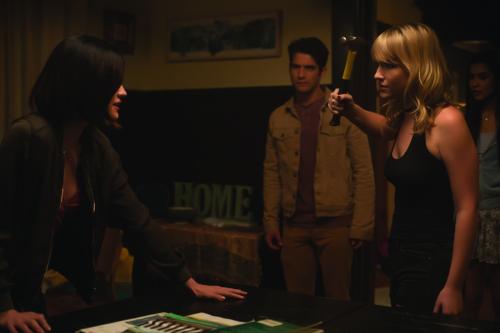
It takes a while for Blumhouse’s Truth or Dare to really get going. At first it’s just about a group of college friends hanging out in Mexico on spring break, which is fair enough because these movies are often about attractive young people whose lives get upended by some ancient curse. But you would think there would be a little more foreboding about the dangers to come. Instead, we get the most banal opening credits sequence in a good long while, which is effectively just a social media vacation slideshow that is livened up in no way at all with genre signifiers. At least the first third gives us Ronnie (The Goldbergs’ Sam Lerner), the ultimate parody of a fratty interloper, who delivers beautiful poetry like, “I can’t say no to shots. Everyone knows that.”
Thankfully director Jeff Wadlow and his fellow screenwriters figure out how to make their premise truly unsettling about halfway through. The stakes of the titular game, cursed by a demonic presence, are literally life-or-death: tell the truth, or you die; complete your dare, or you die. Trouble is, the challenges can be just as lethal as the consequences. When these kids are not told to literally kill someone, they are asked to reveal secrets that might drive their friends to kill themselves. There are Final Destination-style dynamics of victims being picked off one by one here, but the methods used to terrorize them are uniquely effective. This is the horror of confronting painful secrets that can lead to irreparable rifts between loved ones. On top of that, there is the creepy signature visual effect involving faces contorted into uncanny valley-style bulging eyes and unnaturally stretched-lips smiles.
While it is appreciably unsettling, Truth or Dare could have taken more care to grapple with its morality. It confronts the eternal dilemma of choosing between saving a small group of loved ones and a larger group of strangers, as well as the conflict between self-interest versus protecting others who may not be deserving of such care. Olivia (Lucy Hale) is both the narrative and moral center. She gives money to the homeless and professes that she would save the larger group, while dealing with her own feelings for the boyfriend of her best friend, who is constantly cheating on him. This all leads to an ending that is undeniably devastating that but might just betray the message that Olivia has attempted to demonstrate throughout. It is fine when a horror flick ends on a sour note, but it is not exactly playing fair when it is such a stark departure from what has come before.
Truth or Dare is Recommended If You Like: It Follows But Wish It Were More Like Traditional Friday Night Multiplex Horror (For Good and For Ill), The Ring, Final Destination
Grade: 3 out of 5 Creepy Smiles
April 11, 2018
Cinema, Movie Reviews Bjorn Borg, Borg vs McEnroe, Janus Metz Pederson, John McEnroe, Shia LaBeouf, Stella Skarsgård, Sverrir Gudnason, Tuva Novotny Leave a comment

CREDIT: Julie Vrabelova/Neon
This review was originally posted on News Cult in April 2018.
Starring: Sverrir Gudnason, Shia LaBeouf, Stella Skarsgård, Tuva Novotny
Director: Janus Metz Pederson
Running Time: 107 Minutes
Rating: R for the F-Bombs of Athletic Frustration and Incidental Nudity
Release Date: April 13, 2018
A study in contrasts often makes for both thrilling athletics and fascinating cinema. Thus it makes sense that we now have a film chronicling the 1980 Wimbledon men’s final between the Swedish Björn Borg and the American John McEnroe, considered by many to be one of the greatest, if not the greatest, tennis matches of all time. It is surprising, perhaps, that it has taken decades for Borg vs McEnroe to happen, though that is perhaps attributable to tennis not being as marquee as other sports. But it is also good that we have had to wait, as it has given us time to digest the moment. The end result is appropriately internationally flavored, with a Danish director, production support from multiple countries, and only about two cast members well-known in America.
As a major tennis fan, I can’t help but think about how dramatically different Borg vs McEnroe would have gone if today’s officiating technology were available. The Hawk-Eye system used at many tournaments is an exceptionally efficient method for confirming whether or not balls have landed in or out of bounds. Had it been around 40 years ago, it could have prevented McEnroe from developing his hothead reputation, much of which came from his disputes with the umpires about supposedly blown calls. He could have been vindicated, though perhaps he would have found something else to complain about. But because it all went down as it did, B v M sets up its titular rivalry in terms that could be an alternate title: “Ice-Borg vs. Superbrat.”
Instead of a traditional dramatization of a rivalry, Borg vs McEnore is really more a concurrent double biopic. The buildup over the course of the tournament to the championship match is interspersed with flashbacks that paint both competitors as outsiders fighting their way into a game that has historically been elitist and dismissive of outsiders. Borg (who displays a temper on par with McEnroe’s in his teenage years) is treated with insults by the sport’s upper crust; though he is embraced by fans after winning the four prior Wimbledons in a row, he still maintains a resolve of doing things his own way. McEnroe is the upstart attempting to break through, showing little concern for decorum at the tournament where it is valued more than anywhere else, and he is met with the boos to match his impishness. As Borg, Sverrir Gudnason is not asked to do much besides remain still and calm outside of the tennis scenes, but there is a world of action taking place within his eyes. Shia LaBeouf does not try to mimic McEnroe’s voice, but he does deploy his similar propensity for asshole outbursts.
B v M’s filmmaking techniques are unique among most sports biopics, and are practically avant-garde when compared to typical live televised athletics. Rarely does the camera focus merely on the ball landing on the court, one of the most essential aspects of the game, instead criss-crossing between the reactions of the two players as well as key figures in the stands. The editing is often frenetic, suggesting the whirlwind of emotions and pressure Borg and McEnroe are digesting throughout. The journey ends on a note of profound respect, their twinned stories appropriately subsumed within each other, leading into the expected epilogue that hits harder and deeper than most.
Borg vs McEnroe is Recommended If You Like: The filmmaking of Triumph of the Will, Rivalry Friendships
Grade: 3.5 out of 5 Epic Tiebreaks
 Jmunney's Blog