
CREDIT: A24
I give Never Goin’ Back 3 out of 5 Beer-Soaked Waitress Uniforms: https://uinterview.com/news/never-goin-back-movie-review-friendship-means-crude-shenanigans-in-the-hot-texas-summer/
Jeff "Jmunney" Malone's Self-Styled "Expert" Thoughts on Movies, TV, Music, and the Rest of Pop Culture
August 3, 2018
Cinema, Movie Reviews Augustine Frizzell, Camila Morrone, Joel Allen, Kendal Smith, Kyle Mooney, Maia Mitchell, Matthew Holcomb, Never Goin' Back Leave a comment
CREDIT: A24
I give Never Goin’ Back 3 out of 5 Beer-Soaked Waitress Uniforms: https://uinterview.com/news/never-goin-back-movie-review-friendship-means-crude-shenanigans-in-the-hot-texas-summer/
August 3, 2018
Cinema, Movie Reviews Brad Garrett, Bronte Carmichael, Christopher Robin, Ewan McGregor, Hayley Atwell, Jim Cummings, Marc Forster, Mark Gatiss, Nick Mohammed, Peter Capaldi, Pooh, Pooh Bear, Sara Sheen, Sophie Okonedo, Toby Jones, Winnie the Pooh Leave a comment

CREDIT: Laurie Sparham/Disney
This review was originally published on News Cult in August 2018.
Starring: Ewan McGregor, Hayley Atwell, Bronte Carmichael, Mark Gatiss, Jim Cummings, Brad Garrett, Nick Mohammed, Peter Capaldi, Sophie Okonedo, Sara Sheen, Toby Jones
Director: Marc Forster
Running Time: 104 Minutes
Rating: PG for Some Bumpy Rides on Trains and the Streets of London
Release Date: August 3, 2018
One reason the Winnie the Pooh stories have endured, particularly in cartoon form, is because of their commitment to the intense, occasionally overwhelming, wonders of the imagination. Ostensibly, the original fount of this imagination is Christopher Robin, whose stuffed animals have sprung to life in the Hundred Acre Wood. Christopher Robin the movie, starring Ewan McGregor as the grown-up title character, initially presents itself as being about the importance of retaining your inner child, as Pooh, Piglet, and the rest of the gang return unexpectedly after decades to visit their old friend. But along the way, Marc Forster’s film is powered along by the lessons of treating employees fairly so memorably espoused way back when (and year after year) in It’s a Wonderful Life. The businessmen of Christopher Robin are not quite as warped and frustrated as Mr. Potter, but they prevent people from properly enjoying their time with their spouses, children, and stuffies, and that cannot be abided.
The major conflict is that Christopher is unable to spend a weekend in the countryside with his wife Evelyn (Hayley Atwell) and daughter Madeline (Bronte Carmichael) because of work commitments. Far from a workaholic who has forgotten how to have fun, he is instead a businessman who is constantly stressed out by the demands of his bosses and his commitment to do what is asked of him. As the efficiency expert at Wilson Luggages, he is tasked with finding the most cost-effective way to lay off staff, and he must have his presentation ready by a Monday morning meeting. He gets to work fulfilling this heartbreaking task, resigned to being stuck in a rigged system. Then Pooh Bear shows up, and through a series of mishaps, Christopher is able to see this problem anew with fresh eyes and discover a way for decent, hardworking people to keep their jobs AND have paid vacation time while still retaining efficiency.
The presence of talking stuffed animals could be played to make Christopher Robin appear insane to the rest of the world, but the Hundred Acre Wood gang is too un-self-conscious to hide their true selves to anyone. Thus, Pooh’s presence is disarming to all his human friends, acquaintances, and audience. His propensity for simple wisdom in the vein of Zen aphorisms is on full display, as he remarks, “it’s usually today” when Christopher Robin screams out, “It’s tomorrow!” and later declares that today is in fact his favorite day. We all can benefit greatly from leaving room for Pooh in our hearts. When life feels like it is just making our floors sticky and breaking our glassware, we just need to take that as an opportunity to assess the situation differently and realize what is really important.
Christopher Robin is Recommended If You Like: It’s a Wonderful Life, Winnie the Pooh cartoons, Making time to vacation with your loved ones
Grade: 3.5 out of 5 Honeypots
August 3, 2018
Cinema, Movie Reviews Chloë Grace Moretz, Desiree Akhavan, Forrest Goodluck, Jennifer Ehle, John Gallagher Jr., Sasha Lane, The Miseducation of Cameron Post Leave a comment

CREDIT: Jeong Park/FilmRise
This review was originally posted on News Cult in August 2018.
Starring: Chloë Grace Moretz, John Gallagher Jr., Sasha Lane, Forrest Goodluck, Jennifer Ehle
Director: Desiree Akhavan
Running Time: 90 Minutes
Rating: Unrated, But It Would Probably Be R for Clear (Though Not-Entirely-Explicit) Sexuality
Release Date: August 3, 2018 (Limited)
There’s something fundamentally unsatisfying about the ending of The Miseducation of Cameron Post. But it would be unfair to be too angry at this lack of resolution, as it is justified both narratively and (I would imagine) by real-life verisimilitude. Chloë Grace Moretz plays the lesbian title character who gets sent by her aunt to God’s Promise, a camp that practices gay conversion therapy. Without spoiling too much, there is hope for her and a few other camp attendees by the conclusion, though there are also still plenty of reasons to be concerned about their future. That ambiguity is fine. But there is a larger impasse at play here that makes Cameron Post feel a little incomplete despite how astute and empathetic it is.
The issue is with the protagonist. To be entertaining, a movie does not require a dynamic, changing lead character, but it does require that if it wants to take us on a journey. Writer/director Desiree Akhavan does want to do that, but Cameron Post is rather static. Moretz does exactly what is asked of her. She is broken up over her family’s inability to embrace her true identity, but she will never believe any of the lies that God’s Promise feeds her. She recognizes emotional manipulation for what it is and is strong-willed enough to withstand it. She is like that when we meet her, and she remains so throughout. Her two closest friends (Sasha Lane, Forrest Goodluck) are similarly just as sure of themselves.
On the one hand, it would make more sense if Akhavan focused more on characters who are having a more difficult struggle. There would be no shortage of options, as multiple attendees attempt to buy into the camp’s teachings while ultimately unable to suppress their urges, some of them resorting to self-harm to deal with the conflict. But on the other hand, I appreciate that we get to spend more time with the kids who are defiantly certain about who they are. There is a low-key hangout vibe in what would otherwise be an emotional minefield. It’s a pleasant enough film, but it sometimes it takes unpleasant confrontation to make a difference.
The Miseducation of Cameron Post is Recommended If You Like: Saved!, Hangout Sitcoms with Dark Undertones
Grade: 3.5 out of 5 Icebergs
July 28, 2018
Cinema, Movie Reviews Aaron Horvath, Greg Cipes, Hynden Walch, Khary Payton, Kristen Bell, Peter Rida Michail, Scott Menville, Tara Strong, Teen Titans, Teen Titans Go! to the Movies, Will Arnett Leave a comment

CREDIT: Warner Bros. Animation
I give Teen Titans Go! To the Movies 4 out of 5 Doomsday Devices: https://uinterview.com/news/teen-titans-go-to-the-movies-movie-review-underdog-cartoon-heroes-show-the-rest-of-the-dc-universe-how-its-done/
July 21, 2018
Cinema, Movie Reviews Andrew Lees, Betty Gabriel, Colin Woodell, Connor Del Rio, Douglas Tait, Rebecca Rittenhouse, Savira Windyani, Screenlife, Stephanie Nogueras, Stephen Susco, Unfriended, Unfriended: Dark Web 1 Comment

CREDIT: BH Tilt
Unfriended: Dark Web repeats the same format and many of the same methods as the first Unfriended, but the feelings it inspires are of a different breed. The original was a dark morality tale about some truly awful teenagers experiencing karmic justice. But the twenty-somethings in Dark Web all appear to be decent human beings, yet the fates they experience are even worse. It is a thoroughly cruel movie, though I hesitate to call it mean-spirited, as the type of sadistic evil it presents does exist in the real world, and it can therefore work as a bleak warning.
Once again, the action unspools via Skype conversation and other laptop applications. Instead of a vengeful ghost, the big bad this time is a network of criminal hackers. Their technical prowess strains credulity, though it might be a case of sufficiently advanced (fictional) technology appearing like magic to us. (It might have been a good idea to explain it a tad.) Standout features include the difficulty of communicating via sign language over a computer and a particularly fraught case of the dilemma of being forced to choose which of two loved ones gets to survive. Telling the entire story on a laptop screen is once again initially disorienting but then disarmingly natural. Overall, my reaction to Dark Web is much like my reaction to Phantom Thread: I appreciate how well-made it is, but the experience of watching it is just so unpleasant.
I give Unfriended: Dark Web 3 Trephinations out of 5 Facebook Messages.
July 21, 2018
Cinema, Movie Reviews Blindspotting, Carlos López Estrada, Daveed Diggs, Ethan Embry, Janina Gavankar, Jasmine Cephas Jones, Oakland, Rafael Casal, Wayne Knight 1 Comment
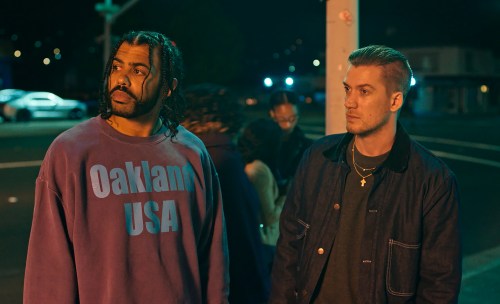
CREDIT: Ariel Nava/Lionsgate
This review was originally published on News Cult in July 2018.
Starring: Daveed Diggs, Rafael Casal, Janina Gavankar, Jasmine Cephas Jones, Ethan Embry
Director: Carlos López Estrada
Running Time: 95 Minutes
Rating: R for Confrontational Profanity and Intense Physical Violence
Release Date: July 20, 2018 (Limited)
Are we defined by the most extreme moments in our lives? Please, somebody, tell Blindspotting, because it would like to know!
Longtime friends and Oakland, California natives Daveed Diggs and Rafael Casal star as longtime friends and Oakland, California natives Collin and Miles, respectively. They work together at a moving company, managed by Collin’s ex Val (Janina Gavankar). Collin is approaching the end of his probation, his jail stint the result of a violent incident that has forever seared itself on Val’s memory. A central question in Blindspotting is whether or not Val can ever look past Collin at his worst, and looming even wider is the question of whether or not Collin and Miles can look past the version of their hometown that they grew up in.
Gentrification has arrived for every urban area in this country with any hint of trendiness, and Miles could not be more opposed. Collin is more serene about the matter, perhaps because he has more intimate experience with the consequences of myopia. Development efforts may take away local color, but they also can make cities safer. Alas, they often just tuck the danger away into hidden corners, which Blindspotting does not turn its eyes away from. If only gentrification could clean up a population’s morality and make it more compassionate. It is a phenomenon that has its failings, but those failings do not call for as violent a reaction as Miles is predisposed towards. There is a lot of confrontation from all directions in this movie – the challenge is to cut through your blind spots and find the most useful message.
Blindspotting is Recommended If You Like: Daveed Diggs breaking big, Socially conscious sitcoms, Wayne Knight cameos
Grade: 3.5 out of 5 Kwik Ways
July 21, 2018
Cinema, Movie Reviews ABBA, Alexa Davies, Amanda Seyfried, Andy García, Cher, Christine Baranski, Colin Firth, Dominic Cooper, Hugh Skinner, Jeremy Irvine, Jessica Keenan Wynn, Josh Dylan, Julie Walters, Lily James, Mamma Mia, Mamma Mia! Here We Go Again, Meryl Streep, Ol Parker, Pierce Brosnan, Stellan Skarsgård Leave a comment

CREDIT: Jonathan Prime/Universal Studios
This review was originally posted on News Cult in July 2018.
Starring: Lily James, Amanda Seyfried, Christine Baranski, Julie Walters, Pierce Brosnan, Colin Firth, Stellan Skarsgård, Jessica Keenan Wynn, Alexa Davies, Jeremy Irvine, Hugh Skinner, Josh Dylan, Dominic Cooper, Andy García, Cher, Meryl Streep
Director: Ol Parker
Running Time: 114 Minutes
Rating: PG-13 for Some Spicy Dialogue
Release Date: July 20, 2018
Mamma Mia! Here We Go Again wants us to care about how a young Donna Sheridan (Lily James) met the three possible fathers of her daughter Sophie (Amanda Seyfried). Or really, it just wants us to accept that as the framework around which some beautiful people frolic around a sunny Greek isle while singing the songs of ABBA … again! Audiences who already dig this sort of thing appear generally willing to accept whatever thin framework there is. (The setup in the present day, in which Sophie re-opening her late mom’s hotel is threatened by rain, is even thinner.) So it feels petty of me to call out Here We Go Again for its vaguely drawn backstories. But I wouldn’t call attention to them if the script didn’t also keep doing the same thing. Donna and her suitors keep on talking about the lives they are running away from, and if that motivation is so important, I just want to know the specifics. Or really, I think these characters want to tell us the specifics.
For certain audiences, those shortcomings won’t matter one lick, but for me, Here We Go Again never overcomes the inherent weirdness of a musical. But there is some fun to be had along the way that threatens to sweep up everyone in its path. Certainly, Christine Baranski’s tasty bons mot (“be still my beating vagina”) cannot be beat. Cinematographer Robert Yeoman really lets the colors pop, especially the oranges. And the final number, featuring the entire main cast, including Meryl Streep as a beyond-the-grave Donna and Cher as basically herself, really does manage to be irresistible. I don’t want to be a fuddy-duddy, so I will admit I enjoyed myself, but I must say it all feels rather fluffy and empty.
Mamma Mia! Here We Go Again is Recommended If You Like: Singing and Dancing Along Without Asking Any Questions
Grade: 2.5 out of 5 Waterloos
July 12, 2018
Cinema, Movie Reviews Beth Ditto, Carrie Brownstein, Don't Worry He Won't Get Far on Foot, Gus van Sant, Jack Black, Joaquin Phoenix, John Callahan, Jonah Hill, Kim Gordon, Mark Webber, Rooney Mara, Udo Kier Leave a comment

CREDIT: Scott Patrick Green, Courtesy of Amazon Studios
This review was originally posted on News Cult in July 2018.
Starring: Joaquin Phoenix, Jonah Hill, Rooney Mara, Jack Black, Mark Webber, Udo Kier, Kim Gordon, Beth Ditto, Carrie Brownstein
Director: Gus van Sant
Running Time: 113 Minutes
Rating: R for General Alcoholic Behavior, And Maintaining a Sexual Appetite Even When Your Body Can’t Move Freely
Release Date: July 13, 2018 (Limited)
Don’t Worry, He Won’t Get Far on Foot, based on John Callahan’s memoir of the same name, stars Joaquin Phoenix as Callahan, a recently paralyzed recovering alcoholic who discovers a passion for and makes a career out of wry, off-color cartoons. His moment of rock bottom could not be more dramatic, as an all-night session of non-stop partying ends in a terrible car crash that renders him a quadriplegic. There is plenty to Callahan’s story, but for my money, Don’t Worry is really about Jonah Hill’s weirdly transfixing performance as Donnie, John’s AA sponsor.
Hill was on hand for an interview after the screening I went to, where it was noted that Donnie’s homosexuality was probably the least interesting thing about him, and not even all that noticeable. While Donnie is certainly well-rounded enough to not be defined by his sexual orientation, that orientation is in fact clear eno9ugh. Although, the possibility that a straight man could be as fey and as much of an aesthete as Hill plays Donnie is plenty intriguing. He is an inspiration for everyone to be themselves. It is a lesson that John takes to heart. Extreme trauma is a roadblock that is always lurking; if you survive it, you shouldn’t let it stop you from discovering who you are.
Don’t Worry, He Won’t Get Far on Foot is Recommended If You Like: 50/50, ’70s Style and Interior Decorating
Grade: 3 out of 5 Motorized Wheelchairs
July 12, 2018
Cinema, Movie Reviews anxiety, Bo Burnham, Eighth Grade, Elsie Fisher, Josh Hamilton 1 Comment

CREDIT: A24
This review was originally posted on News Cult in July 2018.
Starring: Elsie Fisher, Josh Hamilton
Director: Bo Burnham
Running Time: 94 Minutes
Rating: R, Because The MPAA is Worried the Target Audience Can’t Handle a Frank Portrayal of Teen Sexuality
Release Date: July 13, 2018 (Limited)
I tend to be careful about recommending any movie that effectively showcases anxiety, because if it is well-made, it will all but guarantee an unpleasant experience for viewers who are prone to anxiety. In the case of Eighth Grade, which unflinchingly portrays the age that is for many the height of discomfort, it would seem to be the peak of a risky proposition. As 13-year-old Kayla, Elsie Fisher thoroughly embodies a state of constant uncertainty. If you have any empathy at all, it is a big ask on the part of the film to watch her story. But the end result is not a transfer of Kayla’s anxiety, but rather invigoration. It is quite the emotional wringer, but I am grateful for the experience, and I imagine you will be, too.
Writer/director Bo Burnham has talked about his own experiences with anxiety in his comedy performances, and he has found that teenage girls related to that side of himself more than any other group. Thus why he made a film about a middle school girl instead of what could have easily been something autobiographical. His understanding of permanent unease is clearly fundamental, which is abundantly clear in his sensory decisions. Kayla’s arrivals at various locations – school, the mall, a pool party – are accompanied by her own internal soundtrack. It tends to be exuberant party music, but overly busy with a staccato rhythm that gives it a jagged edge.
Kayla attempts to lift up herself (as well as anyone who might be out there listening) with YouTube videos offering advice about how to be more confident and adventurous in day-to-day life. Alas, we see her in a seemingly unending struggle to reap the benefits of following her own words. But by the end, she is genuinely excited for high school and in a much warmer place with her doting single father (Josh Hamilton). It seems like there really is a light at the end of the anxiety tunnel, and against all odds, Eighth Grade manages to leave me more hopeful than most movies. I hope that is not due to the randomness of my own shifting emotions, but rather genuine inspiration.
Eighth Grade is Recommended If You Like: Crazy Ex-Girlfriend, Inside Out, Emotional nakedness
Grade: 4.5 out of 5 Guccis
July 12, 2018
Cinema, Movie Reviews Byron Mann, Chin Han, Dwayne Johnson, Hannah Quinlivan, Matt O’Leary, McKenna Roberts, Neve Campbell, Noah Cottrell, Noah Taylor, Pablo Schreiber, Rawson Marshall Thurber, Richard Møller, Skyscraper Leave a comment

CREDIT: Kimberley French/Universal Studios
This review was originally posted on News Cult in July 2018.
Starring: Dwayne Johnson, Neve Campbell, Chin Han, Richard Møller, Pablo Schreiber, Noah Taylor, Hannah Quinlivan, Matt O’Leary, Byron Mann, McKenna Roberts, Noah Cottrell
Director: Rawson Marshall Thurber
Running Time: 102 Minutes
Rating: PG-13 for A Tall Building on Fire, But Mostly the Gunfire
Release Date: July 13, 2018
One of the many revolutionary joys of Die Hard was the motivation of the villains. They presented themselves as terrorists, but they were really just simple thieves. There are several reasons why Skyscraper, which is basically “Die Hard, but in the tallest building in the world,” is not as entertaining as John McClane’s original exploits. The premise is now far from unique, obviously. Plus, any character played by Dwayne Johnson, even an amputee in this case, is already too larger-than-life for any of his heroics to be surprising. But the most fundamental mistake is that the villains’ purpose is never clear. I’m pretty sure they’re not after money, but if they are terrorizing, it is never clear what point they are trying to make, if any. It is possible this was all explained at some point while I was momentarily distracted, but if it was that hard to miss, then that’s a problem.
Thus, then, just about the only reason to check out Skyscraper is to see Johnson pull off some gravity-defying stunts. If you suffer from acrophobia or vertigo, you will definitely want to stay away, whereas if your favorite action scene ever is Ethan Hunt on the Burj Khalifa, then you will find some thrills. Johnson does not quite reach Tom Cruise’s poetic heights, but he is not far off from them. It would just be nice if the whole affair were undergirded by more of a purpose.
But there is one piece of Skyscraper that I can endorse wholeheartedly, and that is its use of the old “turn it off and turn it back on again” trick. Seriously, that is the solution that solves the day, and it is actually quite satisfying. Bringing it back to Die Hard: brilliant in its simplicity.
Skyscraper is Recommended If You Like: Die Hard “on a whatever” (minus the memorable villains), Death-Defying Stunts
Grade: 2.5 out of 5 Prosthetic Legs

