This Is a Movie Review: Terminator Genisys

2 Comments

Arnie-Smile-Genisys

Terminator Genisys basically ignores the third and fourth movies in the series, but it should be noted that 3 and 4 do not really grapple with their predecessors, at least not very meaningfully. T3 backtracks on the message of T2, while Salvation merely fills in the blanks in a way that mostly stands on its own. Genisys, meanwhile, crisscrosses 1 and 2, while new machinations try to prevent or delay the victory or defeat of Skynet. It does not completely stand as its own thing, but there is so much thrown together (mostly gracefully), that it works as something. It manages to be fascinating, at least in an academic sense.

Sarah Connor and Kyle Reese’s interactions are colored by the knowledge of destiny, as they grapple with how to or how not to fulfill the roles that have already been set for them. It is a fairly effective treatise on the nature of stories in which the characters “know” what they are “supposed” to do. Emilia Clarke and Jai Courtney’s performances are not much more than serviceable, but maybe that is the point. Maybe in being locked into their roles, they cannot add too much extra color.

The most consistent draw of this series remains The Terminator himself. Arnold Schwarzenegger has been on a bit of a hot streak in finding relaxed, playful subtleties in his performances, and that continues here, as his awkward cyborg smiles are just exactly right. Also, J.K. Simmons shows up as a beat cop who gets caught up in everything, and he is completely superfluous but very much welcome.

This Is a (Quickie) Movie Review: Magic Mike XXL

1 Comment

MAGICMIKE-WANT-IT-THAT-WAY

If the Amber Heard subplot had been scuttled, Magic Mike XXL would have been all set to go. To be fair, though, her last scene, in which she is gyrated upon by Mike at the stripper convention, loosens up that stiffness.

The top highlights belong to Joe Manganiello. Of course, we have all already heard about his gas station convenience store performance to “I Want It That Way,” and it is worth the hype. But watch out for the transition from Bruno Mars’ “Marry You” to Nine Inch Nails’ “Closer” in the finale and the discussion about how every inch of BD Richie fit in Andie MacDowell’s “glass slipper.”

This Is a Movie Review: Me and Earl and the Dying Girl

Leave a comment

me-earl-dying-girl-popsicle

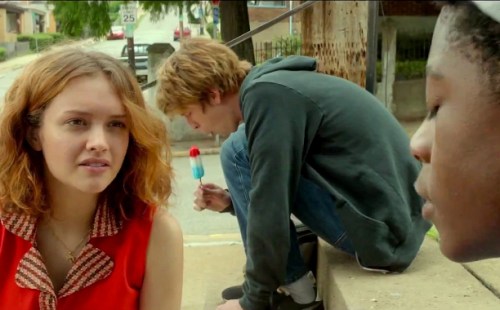
Greg Gaines (the titular “me”) is reminiscent of Community‘s Jeff Winger. In the beginning of his story, he puts a great deal of effort into proving that he does not care, only for his ending to underscore the lengths to which he does care.

Greg defines himself by how detached he is from the high school clique system. He affects a dispassionate disposition, but he puts so much effort into being on amicable terms with every group. He goes so far as to devise a taxonomy that is thorough enough to include “Boring Jewish Senior Girls, Subgroup 2A.”

Every other major character is presented through Greg’s limited perspective, and accordingly they register as if they are all in their own distinct movies. Nick Offerman and Connie Britton play slightly against type/slightly extending from their types as Greg’s parents, making for a pretentious art flick and a slightly overbearing dramedy. Molly Shannon is right in her wheelhouse in the overbearing comedy portion as the mother of the girl with cancer. Jon Bernthal is Greg’s history teacher in the slightly dangerous bildungsroman. And Katherine C. Hughes, as Madison, the hot girl who means well but makes Greg feel terrible by virtue of being a hot girl, prompts the animated fantasy sequences.

Fuller portraits of Earl and Rachel (the titular girl) manage to shine through, thanks to their significant screen time. Greg refers to Earl, his filmmaking partner, as his “co-worker,” but Earl is quick to point out that they are in fact friends. There is a bit of a magical Negro vibe at play, which could have been unfortunate save for RJ Cyler making Earl so strong-willed and the narrative presenting plenty of personal background.

Rachel could have very well been the embodiment of cancer-related epiphanies or just one half of a typical teenage weepie romance. Indeed, Greg often suggests that the story seems to be going in that direction, only to immediately rebuke that idea. Instead, Olivia Cooke keeps Rachel appropriately grounded, as she comes across as just a person dealing with her illness on her own terms. As far as Greg and Rachel’s relationship goes, they develop a true friendship as a result of spending a lot of time with each other. Potential interpretations of the exact nature of their friendship are left wide open.

Madison represents an intriguingly unique story tack. She emerges as another love interest for Greg, which – for a character with only a handful of scenes in a movie with a more expected potential romance – is disconcerting, but also resonant. Greg assumes that Madison’s attention towards him is just pity, but there are enough subtle tells to suggest that her interest is genuine. What emerges is a film accomplished in its thorough commitment to taking on the subjective perspective of a protagonist so insecure that he cannot imagine that anyone would actually think highly of him. As Me and Earl and the Dying Girl is stuck in Greg’s head for so long, it is cathartic when he is finally able to get out of it.

A few words must also be devoted to Greg and Earl’s parody films (with dumbly brilliant pun titles like “Eyes Wide Butt,” “My Dinner with Andre the Giant,” and “Pittsburghasqatsi”). Because Greg is so unassuming regarding their quality, they come off as more charming than annoying. And based on what footage is actually shown, there appears to be decent composition and editing. It helps that Earl’s committed performances consistently shine through. Much of the story is leading up to the premiere of the film that the duo are making for Rachel, which could have ended up as so many clichés, but instead emerges as an idiosyncratic vision (regardless of quality level) and hardly what anyone could have possibly expected.

This Is a (Quickie) Movie Review: Spy

1 Comment

Spy Movie
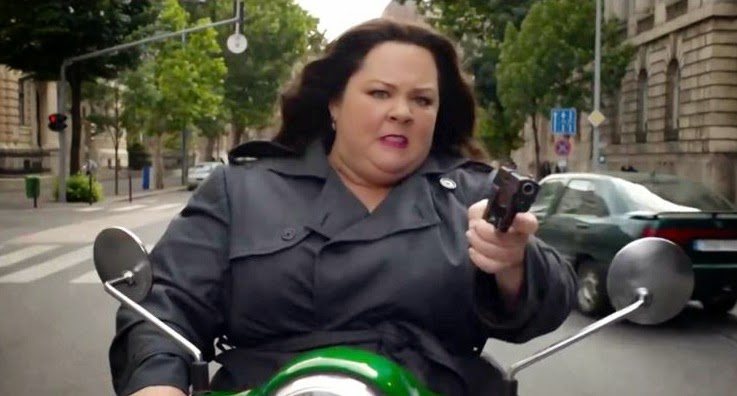
In the beginning of Spy, it makes sense that everyone underestimates Susan Cooper. She’s never been out in the field, and she does not look like the typical secret agent. But at a certain point, when her quick thinking and physical training gets her out of trouble for the umpteenth time, it is a little hard to believe that everyone has not noticed. But it also seems like everyone has noticed, whether or not they’ve said so. After all every major male character seems to have fallen in love with her by the end.

Since the message of Spy is so tangled, its success rests on the strength of its comedy. That aspect is rather mean-spirited, but understandably so, because the insults tend to come from some clearly terrible people. It would have added welcome depth if Rose Byrne’s Rayna Boyanov were more than cartoonishly evil, but she did relish yelling that she was surrounded by idiots.

The Super-Female Postmodern Thing

2 Comments

This essay was originally written as my final paper for my Film Theory & Analysis class, taught by Royal Brown, in Spring 2014 at The New School.

“Trust’s a tough thing to come by these days.”
“Nobody trusts anybody now.”

the-thing

A common maxim of what makes the best horror movies effective is that they show relatively little, leaving the most terrifying parts to the imagination. What is unique about the John Carpenter-directed The Thing (1982) is how well it works despite, or because of (or despite AND because of) showing so much of its monster. A novice viewer would be forgiven for not realizing how much it actually does not show. Partly, the lack of showing is obvious: the famously ambiguous ending in which it is heavily implied that either Keith David’s Childs or Kurt Russell’s MacReady is now a Thing (or both are). But most of the rest of the film does not highlight how much is being hidden. It is, as Slavoj Žižek would put it, a product “with a distinctive mass appeal” (1). Its primary attractions are its tense action, creative makeup and special effects, and well-rounded performances. It is therefore qualified to be a postmodern work, and it fulfills that possibility with a premise and a villain that essentially guarantees open-endedness and speculative interpretation that goes beyond the narrative.

More

Über-Film Studies Case #1: Zardoz

2 Comments

This essay was originally written as my final paper for my Advanced Topics Media Theory class, taught by Eugene Thacker, in Spring 2015 at The New School.

“The world now laughs, rent are the drapes of fright,
The wedding is at hand of dark and light—
”
-Friedrich Nietzsche, Beyond Good & Evil, “From High Mountains: Aftersong”

“We’ve all been used!” “And re-used!” “And abused!” “And amused!”
-Friend (John Alderton)/Arthur Frayn (Niall Buggy), Zardoz

zardoz

            If I discover an interpretation of a complicated work and then realize that this interpretation is a perfect explanation of this work, is this just a self-fulfilling prophecy? Perhaps the interpretation is well-founded, but my new reading will inevitably be colored by my knowledge of this theory. But maybe its rightness or wrongness is beside the point, at least in absolute terms. I do not have to agree exactly for my eyes to see anew. It could be the ramblings of a madman, but it may still be a message that is worthwhile. Discovering that Zardoz, a film I have cherished many years for its singular qualities, had been declared the epitome of a Nietzschean movie, I was irrevocably changed. “The Lord is risen!” “God is dead!” Zed is the Übermensch! So speak to me, Muse of Surprisingly Useful Amazon User Reviews, and keep me on a steady path in this endeavor.

~

            My first contact with Mr. Nietzsche was diffuse. He is one of those towering figures of philosophy that permeates academia and bleeds into the culture at large. He never came up in any comparative philosophy class I took, and without a philosophy background, any influence he had on me came secondhand. I was vaguely aware of his influence on any entertainment that established itself as nihilist, and the Übermensch concept was familiar enough to stand as a Big Idea of modern thought. From what I could gather, the Übermensch was some sort of German version of Superman. I sensed that this was not quite right, but I chalked whatever I was missing up to the nuances of translation and the subtlety of the actual literature.

More

This Is a (Quickie) Movie Review: Ex Machina

Leave a comment

EX-MACHINA

Ex Machina posits that A.I. is most convincing when you can see that it is a machine and yet it still registers as human consciousness. This is also the formula of a certain strain of great magic: the magician explains the trick to the audience, but the illusion still stands. Accordingly, Ex Machina is interested in magic, what with the main characters thoroughly expositing their ruses. But who will prove to be the master of misdirection: A.I. impresario Nathan, his employee/mark Caleb, or shiny new robot Ava? The twists are predictable, but the exploration upon getting to them is deeply fascinating.

Oscar Isaac has given the best performance of the year so far, and not just because of this:

This Is a (Quickie) Movie Review: Unfriended

3 Comments

unfriended-horror-movie

Unfriended, at heart, is a typical one-by-one mystery killer story. Ergo, it is not particularly scary. So when a horror movie is not very scary, it needs to be interesting. And boy, is it interesting. Essentially the entire running time takes place on an Apple laptop. With all the Chrome tabs, Skype windows, Spotify’s, Messenger’s, Recycle Bins, and desktop icons, I at first thought it was going to be exhausting, but then I soon remembered that I am used to all that.

It succeeds at relentlessly exploiting its killer premise and withholding information until the most effective moments. While I very much enjoyed it, it is not something I would jump at watching again, as all the characters are just terrible friends to each other. The best word to describe this movie is “nasty.” It’s a cautionary tale, a nasty movie for nasty people.

Film Editing Appreciation/Analysis: The Room’s Surprise Birthday Party

Leave a comment

The Movie: The Room
The Scene: Birthday Party
The Editor: Eric Chase

This essay was originally written as by final paper for my Aesthetics of Editing class, taught by Rafael Parra, in Fall 2014 at The New School.

The Room is a masterwork of surrealism in film. This may not have been intentional; director Tommy Wiseau, is known for his inscrutability and has given confounding explanations for what he was trying to accomplish with this movie. But the purest form of surrealism is accidental, which is why it works as well as it does in this case. The Room’s strange editing strategies underscore this sense. In this vein, the birthday party scene features a particularly fascinating mix of continuity and discontinuity elements. The film is made competently, both narratively and technically, but there are certain odd aspects that call attention to themselves and create a surreal ethos.

More

The 2014 Jeff Malone Academy Awards

Leave a comment

If I were in charge of unilaterally selecting the Oscars, here is who would be recognized.  Winners are at the top, and nominees are listed most deserving first.

Best Picture
1. Whiplash
2. The Lego Movie
3. Gone Girl
4. Nightcrawler
5. Snowpiercer

Lead Actress
1. Rosamund Pike, Gone Girl
2. Scarlett Johansson, Under the Skin
3. Felicity Jones, The Theory of Everything
4. Jennifer Lawrence, The Hunger Games: Mockingjay, Part 1
5. Emily Blunt, Into the Woods

Lead Actor
1. Jake Gyllenhaal, Nightcrawler
2. Michael Keaton, Birdman
3. Ralph Fiennes, The Grand Budapest Hotel
4. David Oyelowo, Selma
5. Andy Serkis, Dawn of the Planet of the Apes

More

Older Entries Newer Entries