‘Origin’ Brings Isabel Wilkerson’s ‘Caste’ to Vibrant Cinematic Life

1 Comment

CREDIT: NEON/Screenshot

Starring: Aunjanue Ellis-Taylor, Jon Bernthal, Niecy Nash-Betts, Emily Yancy, Vera Farmiga, Audra McDonald, Blair Underwood, Donna Mills, Leonardo Nam, Connie Nielsen, Finn Wittrock, Victoria Pedretti, Jasmine Cephas Jones, Mieke Schymura, Isha Blaaker, Myles Frost, Gaurav J. Pathania, Suraj Yengde, Nick Offerman

Director: Ava DuVernay

Running Time: 135 Minutes

Rating: PG-13 for Historical Discrimination

Release Date: December 8, 2023 (Awards-Qualifying Run)/January 19, 2024 (Theaters)

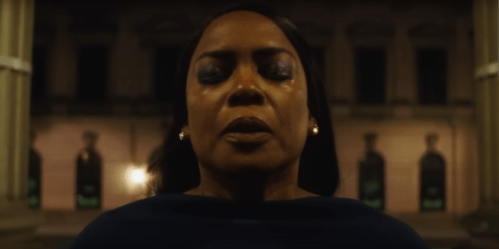
What’s It About?: Perhaps you read the 2020 nonfiction book Caste: The Origin of Our Discontents and found yourself wondering how the author, Isabel Wilkerson, went about crafting such a book. Well, it’s your lucky day, because in the grand tradition of Adaptation, Ava DuVernay has written and directed Origin, a big-screen version that reveals the story behind the story. Aunjanue Ellis-Taylor plays Isabel, whom we’re introduced to in the buildup to Caste‘s publication. We also get to know her ailing mother Ruby (Emily Yancy), her protective husband Brett (Jon Bernthal), and her cousin Marion (Niecy Nash-Betts). Interspersed within are some stories that demonstrate Isabel’s theory about how American racism is a classic example of social stratification seen throughout human history.

What Made an Impression?: Hung Up in Jargon: Since it is the story of a writer’s life, I was a little worried that Origin would be a little too talky for its own good. And for the first third or so, my fears were well-founded. As Isabel has polite debates with her editor and fellow cocktail party attendees, I realized why these conversations are not usually considered especially cinematic. These moments might be interesting to literature grad students, but for the rest of the population, they could come off a little dull and impenetrable.
Compelling Turning Point: Fortunately the rest of the movie does not maintain that overly literary veneer. And there’s one crucial scene that spells out a change in priorities. Isabel and Marion are hanging out together at a family cookout while Isabel explains the premise of her new book. Marion is initially bewildered by her rather abstract explanation, but then Isabel gets down to brass tacks with a more concrete example of what she’s getting at. Marion then assures her that this sort of storytelling ability is exactly how she should write her book, and the movie wisely follows that cue as well.
The Points Become Salient: Isabel’s journey of writing Caste takes her to the American Deep South, Nazi Germany, and India, with historical re-enactments illustrating how each of these societies have been shaped by strikingly similar caste systems. These segments are fairly straightforward, but what pushes them over the edge are Isabel’s reactions of inspiration. Ellis-Taylor is a subtle master at quiet euphoria. (That quality also serves as a counterpoint to the deep wells of sadness she must convey.) By the end of the movie, you’ll hopefully be able to feel as hopeful as Isabel appears to be. Not because these intractable problems will be solved anytime soon, but at the very least because someone is able to identify and explain them.

Origin is Recommended If You Like: Anti-racism, Listening to people who have liberal arts degrees

Grade: 3.5 out of 5 Castes

Best Film Directors of the 2010s

1 Comment

CREDIT: YouTube Screenshots

I’ve got another extra-innings Best of the 2010s for ya. This time, the focus is on Film Directors, those folks who hang out behind the camera and let everyone know how they would like the movie to go.

Based on the eligibility rules of the poll that I submitted my list to, each director had to have at least two films come out between 2010 and 2019 to be considered. I made my selections based on a combination of how much I enjoyed their output and how much they influenced the medium and the culture at large.

My choices, along with their 2010s filmography, are listed below.

More

Original Streaming Movie Catch-Up: ’13th’ Quickie Review

1 Comment

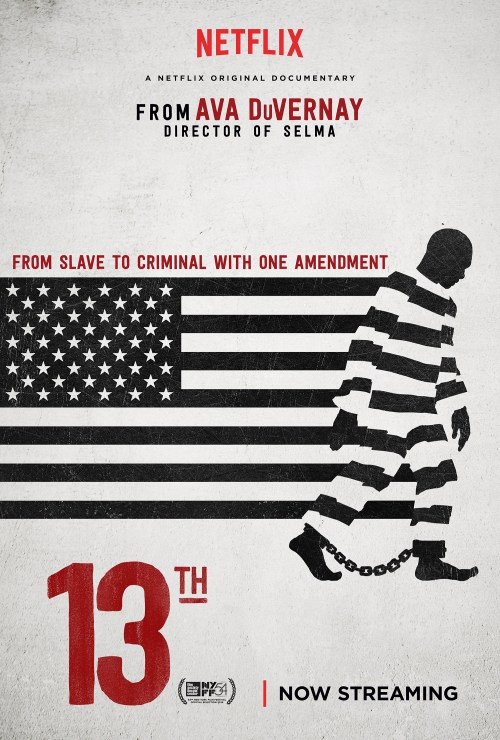
Every good civil rights movement needs its cool cucumbers that get you jazzed up and grinning from ear to ear. So when I finally sat down to watch 13th, I was on the lookout for folks delivering total zingers while refusing to let The Man get them down. That prayer is answered about a half hour in when Van Jones responds to an asinine comment from Grover Norquist about the infamous 1988 Willie Horton attack ad with a terse “Thanks, Grover.” Going forward, I would recommend that as a meme-ish stock response to anyone who refuses to acknowledge the part that race plays in the institutional failings of American criminal justice.

As galvanizing as that moment is, it is not where Ava DuVernay ultimately leads us with her documentary survey of the Thirteenth Amendment to the U.S. Constitution, which abolished slavery only to create a new form of slavery. It is a thorough diagnosis of the problem of how American prisons have perpetuated a de facto form of subjugation for people of color. Knowledge is the first step towards fixing a problem, but 13th ends on a bleak note that suggests that this particular social ill might just be too intractable to ever fully remove. Simply put, it’s in the most profitable interests of certain powers to permanently designate as criminal a significant segment of the population. But maybe there is room for some small hope that there could be a chance for a sliver of change. I watched 13th in 2020, amidst the rage of the most intense civil unrest of my lifetime, and it actually seems like some people in power are now actually considering taking revolutionary measures to address the problem. That undoubtedly has to happen if this country wants to work its way out of all the devil’s bargains it’s made.

This Is a Movie Review: A Wrinkle in Time

Leave a comment

CREDIT: Disney

I certainly enjoyed Ava DuVernay’s spin on A Wrinkle in Time, though I am a little disappointed it does not reach the level of blockbuster classic that I hoped it would. I think much of that has to do with its too-low-calorie mix of epic and low-key. Sure, Meg travels a great interdimensional distance to save her father from a dark entity threatening the entire universe, but she does so over just the course of an afternoon. That relative speed is part of the hook, sure, but it should not feel so speedy. It really would have been beneficial to more deeply explore the effects of tessering on Meg, Calvin, and Charles Wallace.

There are a lot of wonderful design elements and sufficiently creepy moments, but much of those do not feel terribly specific to what this particular film is trying to say. Perhaps the scariest sequence is the disturbingly harmonious cul-de-sac on Camazotz, but that is not really preying on any unique Murry family fears; the fight at hand is not really one against suburban conformity. As for the supposedly weightless bromides of inspiration and self-confidence, I do not find them terribly off-putting, but they certainly could have benefited from the offbeat verve that Zach Galifianakis naturally taps into as the Happy Medium.

I give A Wrinkle in Time 3 Happy’s out of 5 IT’s.