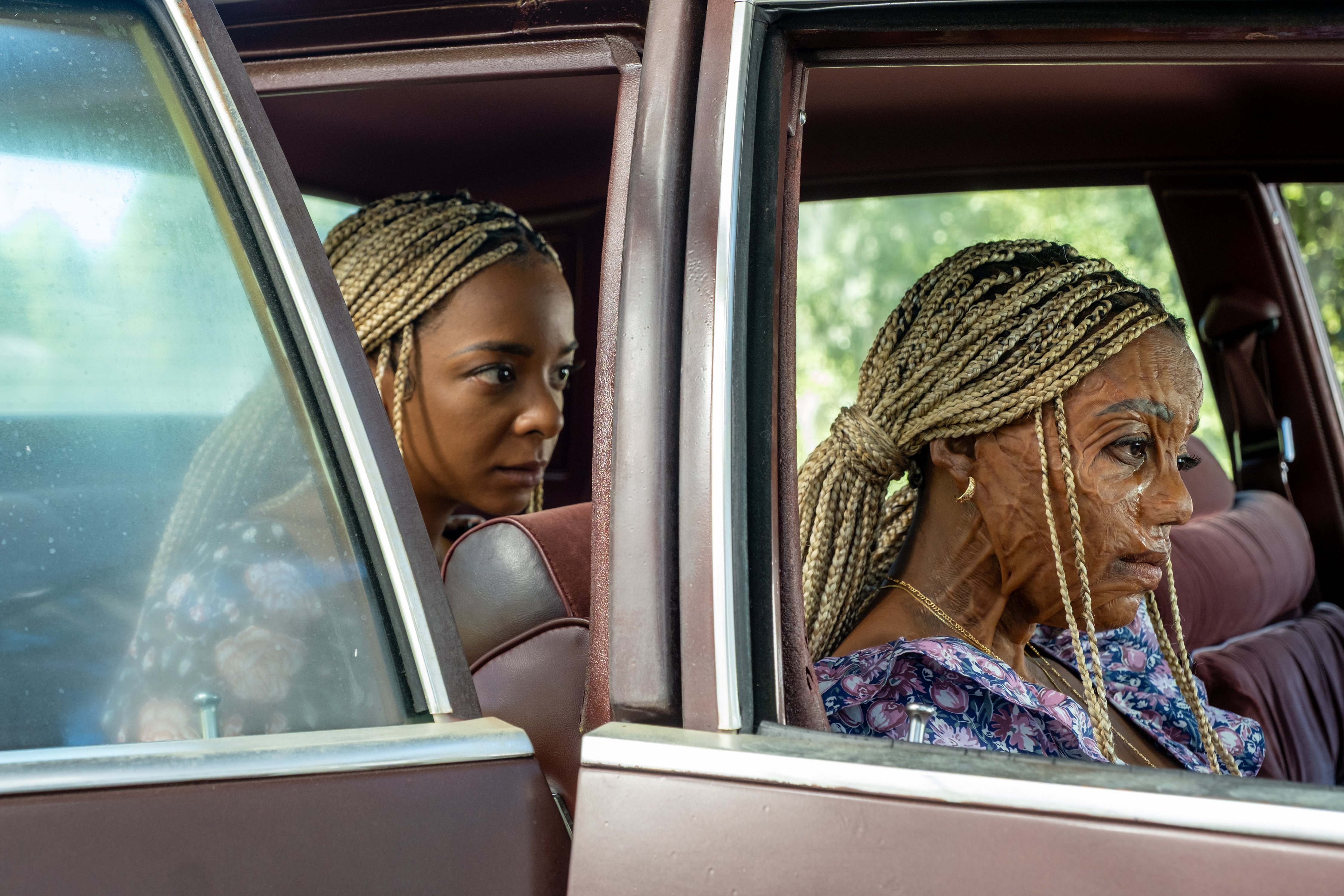
Well… IS God is? (PHOTO CREDIT: Patti Perret
© 2026 Amazon Content Services LLC. All Rights Reserved.)
Starring: Kara Young, Mallori Johnson, Sterling K. Brown, Vivica A. Fox, Janelle Monáe, Erika Alexander, Mykelti Williamson, Josiah Cross
Director: Aleshea Harris
Running Time: 100 Minutes
Rating: R for Extreme Violence and Unfettered Language
Release Date: May 15, 2026 (Theaters)
What’s It About?: Twins Racine (Kara Young) and Anaia (Mallori Johnson) have only had themselves to rely on ever since their dad (Sterling K. Brown) set their mom Ruby (Vivica A. Fox) on fire in a bathtub when they were little girls. The attack left burn marks up and down Rachine’s arm and all over Anaia’s face, leading the rest of the world to look down upon them as ugly outcasts. It also left their mom dead… or so they thought until one day when Ruby summons them and gives them a mission: kill their daddy. So they head out on their odyssey of revenge, encountering a colorfully alarming cast of new wives (Erika Alexander, Janelle Monáe) and half-siblings along the way. They’re frequently warned that their vengeance is just not worth it, but the pull to finally eliminate this monster is hard to resist.
What Made an Impression?: How Did It Get This Evil?: I thought Is God Is was going to be more stylized. The trailer certainly made it seem that way, and it’s a common tactic for making a premise like this more palatable. But instead, it’s a much, much more difficult watch. I wouldn’t exactly call it as realistic as possible, but it does force you to confront an environment where domestic violence is inescapable.
What’s the Takeaway?: With its unflinching approach to the subject matter, one would hope (or at least I would hope) that there could be an effort towards profundity. So what is the overarching message of Is God Is? Is it that vengeance destroys everyone caught in its trail? Is it that it’s better to escape the cycle of violence when you have the chance? Or is it that sometimes you inexplicably can’t escape even if you want to? There are elements of all of that here, but I’d be hard-pressed to tell you exactly what writer/director Aleshea Harris (adapting her play of the same name) wants to send us off with. Perhaps that confusion is the point. If so, it might be more frightening than she reckoned for.
Like They’re Going to Explode: So when I bemoaned this movie’s lack of stylization, I kind of lied. Or rather, I omitted just how over-the-top some of the performances are. Although maybe that’s not stylization, but instead just how some people would really behave in this scenario. Either way, watching the likes of Vivica A. Fox, Mykelti Williamson, and Janelle Monáe chew up the set like we know they can is easily the most enjoyable element of this movie. As the leads, Young and Johnson are required to be a little subdued, though they do have fun with their telepathic twin communication. Sterling K. Brown has quite a time biting into a rare opportunity to play the villain, but it’s Erika Alexander as a God-fearing jilted wife who leaves the biggest impression of “What the heck is going on here?” It’s what I’ll choose to remember more than the utter despair.
Is God Is is Recommended If You Like: Lifetime movies and ’70s revenge flicks
Grade: 2.5 out of 5 Burn Scars


