This Is a Movie Review: ‘Midnight Sun’ is a Mostly Bearable Slice of Teen Weepie Emotional Porn

1 Comment

CREDIT: Global Road Entertainment

This review was originally published on News Cult in March 2018.

Starring: Bella Thorne, Patrick Schwarzenegger, Rob Riggle, Quinn Shephard

Director: Scott Speer

Running Time: 91 Minutes

Rating: PG-13, Because Even Tame Teen Movies Are Rated PG-13

Release Date: March 23, 2018

It’s time for me to just come right out and admit: I have a soft spot for high school movies. How else could I explain my generally positive feelings toward the relatively unheralded Midnight Sun? The dialogue is hokey, and every little decision about what to do is super dramatic. This is all typical of the genre, and it is especially pronounced in this case. But in general, we like to give these excesses a pass, because adolescence is the height of hormonal awkwardness. And in the specific case of Midnight Sun, it is no big deal, charming even, because the vibes are good and everyone is looking out for each other.

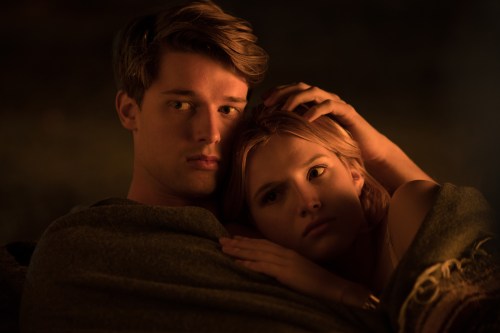
Katie Price (Bella Thorne) is a 17-year-old with xeroderma pigmentosum, a potentially deadly sensitivity to sunlight. So she spends her days inside with her loving, protective, widowed father Jack (Rob Riggle). Besides Dad and her team of doctors, the only in-person interaction of note she has had over the years is with her best friend Morgan (Quinn Shephard), who made her way into Katie’s life by sheer force of personality. Since Katie can never venture outside during the day, it makes practical sense that she has never interacted with the boy she is pining after, much more so than is typical for the genre. When that fella, Charlie (Patrick Schwarzenegger), chances to bump into her one night, they are pretty much a perfect item immediately. Since they act like actual teenagers, that initial super-spark does not track as totally unbelievable perfection.

Midnight Sun lays the emotional porn on thick, but it’s not like it is trying to hide its intentions. This is the type of film designed to get the waterworks going, and building the story around a chronic life-threatening disease is a quick, easy way to pull that off. But it is all justified by the fact that the emotions are so grounded. This is a movie in which everyone wants what is best for Katie and she wants what is best for them. They ask her to be honest, and the only times she ever fails to do so are when she does not want someone new to have to bear the burden of her disease. All of the relationships – familial, friendly, romantic – are healthy and admirable, and it is just satisfying to behold that.

It must also be said that Rob Riggle is a bit of a revelation here. From what I know of his career, he has never really stepped out beyond comedy, where he has settled into a niche of partly intimidating, but mostly charming bonhomie. He still more or less fills that role in Midnight Sun, but he recalibrates just enough to be the super-masculine dad who is really a big softie. And the movie needs him to pull that off, because someone has to deliver with conviction lines like “We’re in luck, ’cause she’s one in a million” (in response to being told that the chances of an obscure study leading to a viable treatment option are one in a million). That moment is the height of Midnight Sun’s dorkiness, and thanks to Riggle, I cannot help but love it.

Midnight Sun is Recommended If You Like: The Fault in Our Stars, Everything, Everything, A Walk to Remember

Grade: 3 out of 5 Acoustic Guitars

This Is a Movie Review: ‘Pacific Rim: Uprising’ Has a Few Interesting Moments Buried Within an Indifferently Presented Spectacle

Leave a comment

CREDIT: Legendary Pictures/Universal Pictures

This review was originally posted on News Cult in March 2018.

Starring: John Boyega, Scott Eastwood, Cailee Spaeny, Charlie Day, Rinko Kikuchi, Burn Gorman, Jing Tian

Director: Steven S. DeKnight

Running Time: 111 Minutes

Rating: PG-13 for Kaiju Guts, Tech Sparks, and Human Cuts and Bruises

Release Date: March 23, 2018

Pacific Rim: Uprising does not offer much in the way of a new paradigm in the annals of giant mecha or giant monsters. Honestly, the first Pacific Rim did not really offer that either. To be fair, this series’ purpose in terms of concept and design has never really been about establishing something groundbreaking (to my eyes, anyway). It has been more about the distillation of the gigantic tech and creature genres into something approaching an ideal form. That approach is all well and good as an academic exercise, but it does not have enough inherent oomph to ensure a fully entertaining feature-length film.

It is ten years since humans won the war against the interdimensional beings known as the Kaiju. There has been no hint of another breach by these creatures into Earth, but the training programs designed to fight against them are still operating. There is a weird mix between a sense of security that the threat has been permanently neutralized and an ever-present emphasis on defense. This seeming paradox is never commented upon, which gives the sense that this film has an ill-defined understanding of its own world. But it doesn’t really matter, because sure enough the Kaiju do return, and it is a good thing that the Jaeger program never folded.

The Jaegers were the one great concept of the first Pacific Rim, but in Uprising, their usage is rather perfunctory. As the mental stress is so great, these metallic war machines must be simultaneously operated by two pilots. They are neurally connected to each other, creating a partnership so intimate that they share not just responsibilities but memories and physiology as well, for a connection that lies somewhere between artificial and chemical. The main partnership this time is that between Jake Pentecost (John Boyega), the son of a hero from the first film who gets his personality across mostly through his ice cream eating habits, and Amara (Cailee Spaeny), who gets cool points for building her own Jaeger but mostly comes across as the thinnest of archetypes. These two have only one notable memory-sharing moment, and it registers as little more than just hitting a necessary story beat.

The PR:U trailers position Boyega as the star, and while he does lead the way in screen time, the only notable degree of star power among the cast comes from Charlie Day, returning as the eccentric Dr. Newt Geiszler. He is emblematic of how this film has no idea what to do with its best assets. Newt has been in a bit of a mind-meld relationship with a Kaiju specimen, which might just have something to do with why they have returned. So to a certain extent, he is the main villain this time around. But inexplicably, he spends the entire climax just overlooking the action and not participating in it at all. This is a film that has its toys lined up but little in the way of a plan (or an interesting plan, that is) for how to deploy them.

Pacific Rim: Uprising is Recommended If You Like: Kaiju Fever, John Boyega Making Himself a Sundae, Charlie Day Given Plenty of Space (But Not Enough) to Go Crazy

Grade: 2 out of 5 Kaiju Wives

This Is a Movie Review: ‘Final Portrait’ is a Frustrating Presentation of a Frustrated Artist

Leave a comment

CREDIT: Sony Pictures Classics

This review was originally posted on News Cult in March 2018.

Starring: Armie Hammer, Geoffrey Rush, Tony Shalhoub, Clémence Poésy, Sylvie Testud

Director: Stanley Tucci

Running Time: 90 Minutes

Rating: R for Artistic Frustration F-Bombs and a Few Slips of Nudity

Release Date: March 23, 2018 (Limited)

Can we please, as a society, be done with the idea that artists are just slaves to inspiration that comes and goes as it pleases and is totally beyond their control? Sure, there is something ineffable about sparks of creativity, but the actual act of creation requires discipline and firm decision-making, i.e., things that are within our control. Now, films that portray artists who insist on being totally subject to the whims of the universe are not necessarily in agreement with this philosophy. In the case of Final Portrait, writer-director Stanley Tucci is more interested in the friendship between Swiss painter Alberto Giacometti (Geoffrey Rush) and American writer James Lord (Armie Hammer) than in making any judgment on Giacometti’s chaos. But when such excess is presented matter-of-factly, it tends to be incredibly frustrating.

While visiting Paris in 1964, Lord agrees to be painted for a portrait by Giacometti, who assures him that the sitting will last “an afternoon at the most.” But that afternoon lasts into one more day, and soon enough that extra day has ballooned into a fortnight. Sometimes, Giacometti’s pauses are legitimate, as when he is running a fever or has business to attend to. Other times he just wants to eat, or he doesn’t even bother coming up with an excuse. It is essentially stated at one point that this state of incompletion is where he feels most comfortable. Rush’s wild mane is perfect for Giacometti’s untamed nature, and Hammer is the ideal fit for Lord’s constant bemusement. But overall, we and James are stuck in a dour loop that has us thinking, “Shouldn’t this be over already?” And it certainly does not help that this is taking place during what is apparently the cloudiest two-week stretch in Parisian history.

Elsewhere, there is some business involving Giacometti’s prostitute companion/frequent model Caroline (Clémence Poésy) and his frustrated wife Annette (Sylvie Testud), but hardly anything of note happens in those plot threads. That portion of the film is unceremoniously wrapped up by Giacometti paying off a couple of pimps with huge wads of cash.

There are a few moments that break up the excruciation, like a driving montage set to breezy ’60s French pop music. Giacometti and Lord’s occasional walks are welcome, as it is pleasant to just be outside. Plus, those strolls provide loopy non sequiturs, like Giacometti’s query of “Have you ever wanted to be a tree?” As a portrait of a friendship, Final Portrait has its moments, but as a portrait of a portrait, it never focuses enough on the tension of when James Lord will finally break free.

Final Portrait is Recommended If You Like: Geoffrey Rush Squinting, Armie Hammer’s Face Acting, Watching Someone Quickly Gulp Down Wine and Coffee

Grade: 2.5 out of 5 Sitdowns

This Is a Movie Review: ‘Isle of Dogs’ is an Adorable Allegorical Adventure About the Dangers of Fascism

Leave a comment

CREDIT: Fox Searchlight Pictures

This review was originally published on News Cult in March 2018.

Starring: Bryan Cranston, Koyu Rankin, Edward Norton, Bill Murray, Bob Balaban, Jeff Goldblum, Kunichi Nomura, Akira Takayama, Greta Gerwig, Frances McDormand, Akira Ito, Scarlett Johansson, Harvey Keitel, F. Murray Abraham, Yoko Ono, Tilda Swinton, Ken Watanabe, Mari Natsuki, Fisher Stevens, Nijiro Murakami, Liev Schreiber, Courtney B. Vance

Director: Wes Anderson

Running Time: 101 Minutes

Rating: PG-13 for Dog-on-Dog Violence and Dictatorial Tendencies

Release Date: March 23, 2018 (Limited)

“Whatever happened to man’s best friend?” Nothing, right? We human beings still love dogs, and that cannot possibly ever change! But what if something so terrible happened that it could make us turn on them? One of the functions of fiction is training ourselves to handle horrible hypotheticals. Thus, with the stop-motion animated Isle of Dogs, Wes Anderson has delivered an invaluable how-to guide for if the world should ever turn so severely on our furry companions.

Twenty years in the future, Japan has banished its entire canine population to the bluntly literally named Trash Island, due to a widespread outbreak of snout fever and dog flu. The two conditions appear to be connected as how HIV can lead to AIDS. In this dystopia, the fear from those in charge that the disease could spread to humans is enough to override any bounty of puppy love, despite promising progress for a cure. So intrepid folks must step up on their own to save the dogs, like the young boy Atari (Koyu Rankin), an orphaned ward of the state adopted by his distant uncle, Mayor Kobayashi (Kunichi Nomura). Atari ventures to Trash Island to save his canine protector Spots (Liev Schreiber), who also happens to be the outbreak’s Dog Zero. Joining up with him in his quest are a group of other cast-off dogs with variations on the same sort of name – Rex (Edward Norton), King (Bob Balaban), Boss (Bill Murray), and Duke (Jeff Goldblum) – as well as Chief (Bryan Cranston), the fiercely independent stray who has always lived on his own.

An island entirely populated by dogs might sound like the pinnacle of Wes Anderson giving into his most indulgent instincts, but the darkness of the premise is enough to assuage any of those concerns. Plus, the animation does not hold back from the more aesthetically displeasing elements. These pups are mangy, with fur falling off and distorted pupils. They are also fairly irritable; one early standoff results in an ear getting bit off. Isle of Dogs works as an adventure film as well as it does because it does not back away from the danger, while still bringing plenty of fun to that peril. Fight scenes are portrayed in cartoon chaos clouds, while an accidental trip through a trash incinerator is met with droll acceptance. The set pieces are whimsical, but the stakes are life-or-death.

Isle of Dogs could easily be appreciated just for its surface level sensations, but like so many talking animal flicks, there is an allegory lurking not too far below. And considering current worldwide political trends, Wes Anderson’s anti-fascist storytelling is profoundly welcome. Quarantining a contagious population is an understandable disease control tactic, but what happens to these dogs is more banishment than quarantine. And when a solution appears to be possible, Mayor Kobayashi hides that development for the sake of retaining power, trotting out clearly fraudulent election results in the process. BoJack Horseman-style anthropomorphic dogspeak (“my brother from another litter”) helps it go down easy, but these are heavy ideas that deserve and are granted careful consideration.

A few more items worth noting: even though the setting is Japan, the dogs just about exclusively speak English, even when communicating with humans speaking Japanese. In fact, there is a good deal of American and Japanese cultural mixing. All the political machinations are translated by an interpreter (Frances McDormand), apparently for American and other English-speaking audiences, and an American exchange student (Greta Gerwig) leads a revolt against Kobayashi. The bilingual setup feels woven together mostly seamlessly, though I do wonder if Asian audiences might have a different take on the matter than I do. And I would be terribly remiss if I did not mention Alexandre Desplat’s excellent score, pounded along by unrelenting taiko drums, keeping the tension both constantly uneasy and delicious.

Isle of Dogs is Recommended If You Like: Wes Anderson Symmetry, Fantastic Mr. Fox, Animal Farm, Zootopia, The Goonies, BoJack Horseman

Grade: 4.5 out of 5 Puppy Snaps


This Is a Movie Review: Steven Soderbergh Captures Claire Foy Possibly Losing Her Mind in His Latest ‘Unsane’ Experiment

1 Comment

CREDIT: Fingerprint Releasing/Bleecker Street

This review was originally published on News Cult in March 2018.

Starring: Claire Foy, Jay Pharoah, Joshua Leonard, Aimee Mullins, Amy Irving, Juno Temple, Polly McKie

Director: Steven Soderbergh

Running Time: 98 Minutes

Rating: R for Pill-Induced Distortion, Unsanitary Use of a Tampon, and a Violent Spree

Release Date: March 23, 2018

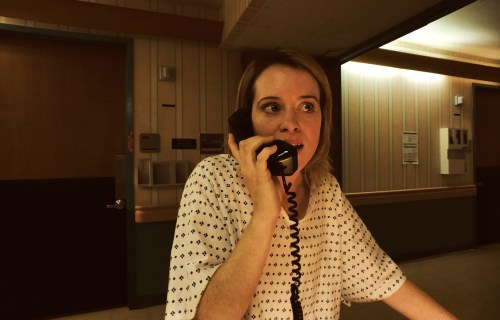
Steven Soderbergh has made a career out of messing around with the standard bounds of cinema, often in ways that could come off as a gimmick in the hands of a less assured director. His latest, Unsane, sets itself apart with its iPhone 7 Plus 4K cinematography (credited to Soderbergh himself). Smartphone photography is certainly advanced enough to make a feature film look as professional as it ought to, so for those who are capable, the smartphone option simply deserves to be added to the docket of available cameras. Thematically, an iPhone fits Unsane’s story of a woman committed to a mental institution against her will, as it compresses the depth of field and lends a dull sheen that lingers in the uncanny valley between intimate and detached.

Sawyer Valentini (Claire Foy) is a businesswoman rising up the corporate ladder, but she is haunted by a troubled past and feelings of loneliness in a new city. The nature of her job is never fully specified (kind of hilariously), but it appears to have something to do with customer service, and she also appears to have power to hire and fire. She has been dealing with occasionally crippling anxiety caused by a stalker . After one particularly bad episode, she drops by for a therapy session, which leads to her signing some forms, which somehow results in her being committed to a mental facility and unable to leave, as she has been declared a danger to herself and to others.

Sawyer’s circumstances quickly become too sinister for this to be a simple mistake or an innocent misdiagnosis, suggesting that a conspiracy is afoot. A staff member (Joshua Leonard) appears to be her stalker in disguise – has he orchestrated the whole thing? Or is the truth to be found from the most well-adjusted resident (Jay Pharoah), who divulges to Sawyer that she is the victim of an insurance scam in which the institution forces people to be committed for as long as their coverage will pay for it? Or is it some combination of forces, working together, or simultaneously coincidentally all ganging up on Sawyer? Of course, there is also the possibility that this could all be in her head, as everything unspools from her point of view the whole time.

This could be a formula for devastatingly unsettling ambiguity, but Soderbergh is not especially concerned about questioning the nature of reality. This is more just a setup for him to explore his particular tastes in psychological and claustrophobic thrills. In many respects, Unsane is satisfying simply on a lurid and pulpy level. Soderbergh does definitely dig deeper than that, presenting in stark terms how both institutional and corporate life can be dehumanizing, their loss of morals too easily justified with a sweep under the rug. Those moments of carelessness and lack of empathy do not usually result in ordeals as dangerous as Sawyer’s, but the opportunities for abuse are there for those who want to take advantage of them.

Unsane is Recommended If You Like: Side Effects, Shutter Island, One Flew Over the Cuckoo’s Nest, Gone Girl

Grade: 4 out of 5 Medical Forms

This Is a Movie Review: The New ‘Tomb Raider’ is the Old Everything Else

Leave a comment

CREDIT: Ilzek Kitshoff/Warner Bros.

This review was originally posted on News Cult in March 2018.

Starring: Alicia Vikander, Dominic West, Walton Goggins, Daniel Wu, Kristin Scott Thomas

Director: Roar Uthaug

Running Time: 118 Minutes

Rating: PG-13 for Bloody Violence in Which the Camera Cuts Away Before You See the Worst of It, and Indiana Jones-Style Skin Decomposition

Release Date: March 16, 2018

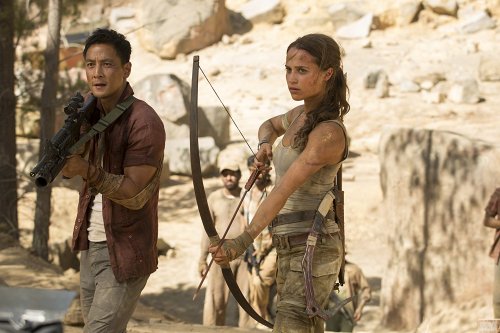
The latest big screen version of Tomb Raider supposedly justifies its existence by positioning itself as Lara Croft’s origin story, but it could hardly be considered untold, as it is fundamentally derivative of every other entry in the globetrotting action-adventure genre. Even if you have not seen the Angelina Jolie TR films or never played any of the video games (like myself), chances are you will still feel like you have already seen this “new” one. This is basically a video game transferred to a different medium, but without actually adapting it into cinematic form. To wit, Alicia Vikander’s Lara spends most of her time solving puzzles (like arranging rocks to open a cave door) or jumping across platforms (like bouncing around all the boats in a crowded dock to escape some baddies). Again, the conclusion to be drawn is: you’ve seen this all before, better and elsewhere.

The mythology that kicks Tomb Raider’s plot into motion is fairly fascinating: Himiko, Queen of Yamatai, is said to have had power over life and death, with the ability to kill people just by touching them. Lara’s father Richard (Dominic West) has spent much of his life tracking her down. After disappearing for years during his search, he is presumed dead, and an absentee dad is only the first classic genre trope TR makes sure to give us. We also get the timeless purity-vs-profitability conflict, as naturally enough the villain is Richard’s rival archaeologist Mathias Vogel (Walton Goggins), who only cares about getting rich off Himiko’s remains. Furthermore, the climax is essentially Indiana Jones-lite, with giant rolling rocks and unwise choices resulting in consequences akin to drinking from the wrong grail.

But despite all these shortcomings, I must accept that a fundamental aspect of my criticism (and all good criticism, I would argue) is identifying whether or not a film is exciting or boring. And on that score, Tomb Raider kept me engaged enough to feel like it was not a complete waste of time. Plus, it has a decently satisfying feminist bent, as any skin displayed by Lara primarily emphasizes Vikander’s athleticism, and at the moment when she thinks her father is being his most patronizing, he instead compliments her bravery. These are welcome elements, but they are mostly surface level. That shallowness prevents true terribleness, but it also leaves some uncomfortable implications less-than-fully addressed. Like, what is Mathias’ deal with wrangling up slave labor? There could have been an opportunity here for indelible villainy, but instead Tomb Raider plays it thoroughly safe.

Tomb Raider is Recommended If You Like: Every Indiana Jones knockoff, Watching someone else play a platform-jumping video game

Grade: 2.25 out of 5 Tank Tops

This Is a Movie Review: Zoey Deutch Shines in the Sweet and Sour ‘Flower’

Leave a comment

CREDIT: The Orchard

This review was originally posted on News Cult in March 2018.

Starring: Zoey Deutch, Adam Scott, Joey Morgan, Kathryn Hahn, Tim Heidecker, Dylan Gelula, Maya Eshet, Eric Edelstein

Director: Max Winkler

Running Time: 93 Minutes

Rating: R for Matter-of-Fact Crude Teen Dialogue, Implications and Discussions of Statutory Relationships, and an Artistically Impressive Penis Drawing

Release Date: March 16, 2018 (Limited)

When Tim Heidecker is playing the relatively normal person, you know that everyone else is stepping a bit outside their comfort zones and/or we have now realized that everybody is at least a little bit crazy. Along with his frequent partner Eric Wareheim, Heidecker has set the demented tone for much of 21st century comedy. But when he acts for other writers and directors, he works effectively as the most grounded presence. In the case of Flower, in which teenagers attempt to expose pedophiles through unsavory means, he comes across as the voice of reason, or at least the one most conscientiously attempting to do the right thing. Meanwhile, folks like Zoey Deutch and Adam Scott, who normally play sweet and wholesome, are afforded plenty of opportunities to tap into their darker impulses.

Heidecker plays Bob, the stepfather-to-be of Deutch’s Erica, who runs a small-time extortion scam with her friends Kala (Unbreakable Kimmy Schmidt’s Dylan Gelula) and Claudine (Maya Eshet), in which they lure adults into sex acts and then demand money once they reveal that they are underage. They sniff out a major opportunity when her future stepbrother Luke (Joey Morgan), stricken by panic attacks and suicidal tendencies, reveals that he was molested by Will (Scott), a former teacher of his who Erica recognizes as the hot older dude from the local bowling alley. She pronounces that shaking down a child molester is their “moral obligation,” but their sense of right and wrong is not exactly ideal, as they partly justify their actions by noting that they don’t want anyone to get fat after suffering abuse. Erica does seem to be motivated more by justice than cash, but her morals are too distorted to stop her from making things spiral out of control.

Flower is far from a Time’s Up rallying cry against abusers. It is much too complicated to be that. There are holes in Luke’s story, and Will seems too decent to be guilty of what he’s been accused of (and not in the way that abusers are often manipulatively charming), though it is certainly concerning that he allows the teenage Erica to insinuate herself into his life. And Erica and her friends are hardly appropriate symbols for victims reclaiming their dignity, as they are too quick to justify their own criminality as a means to the right end. Director/co-writer Max Winkler does not shy away from this messiness, getting a brazen but enticing performance out of Deutch in the process. But the ending ties everything up a little too neatly, opting for a romantic outlaw angle that ignores much of the film’s moral debris. The whole affair is a tonal ping-pong, for better and worse.

Flower is Recommended If You Like: The Edge of Seventeen, Donnie Darko, The Crush

Grade: 3 out of 5 Shakedowns

This Is a Movie Review: ‘7 Days in Entebbe’ Takes the Tension Out of Hijacking, But It Has Really Great Dance Scenes

Leave a comment

CREDIT: Liam Daniel/Focus Features

This review was originally published on News Cult in March 2018.

Starring: Daniel Brühl, Rosamund Pike, Lior Ashkenazi, Eddie Marsan, Mark Ivanir, Denis Ménochet

Director: José Padilha

Running Time: 106 Minutes

Rating: PG-13 for Threats of Violence Moreso Than Actual Violence and Outbursts Under Pressure

Release Date: March 16, 2018 (Moderate)

What does it mean when the best parts of a docudrama about a hijacking and a hostage rescue are its dance scenes? I don’t think this happens often enough to make any generalized conclusion, but in the case of 7 Days in Entebbe, it means that the dance parts are enthralling, while the actual meat of the story is not particularly attention-grabbing. And that is a problem, because while the dancing does take up a relatively significant portion of the running time, it still only amounts to about 10%. If Entebbe had suddenly turned into a full-fledged presentation of hoofing it up, it would certainly be strange and it would go against the promise its premise makes, but it would be a whole hell of a lot more interesting than what we have.

The nominal focus of the film is the 1976 hijacking of a plane en route from Tel Aviv to Paris by a group of two Germans and two Palestinians. They take the passengers hostage, rerouting them to Uganda, where they stow them away with the unlikely help of Ugandan president Idi Amin. They demand a ransom and the release of Palestinian and pro-Palestinian militants, making some provocative statements along the way, such as a claim that Israel is “the heir of Nazism.” The hostage operation offers little in the way of knuckle-biting thrills, and the film’s political bent is too ill-defined to say anything much beyond, “Israel and Palestine are stuck in an eternal impasse.”

But back to the dancing, because that’s the only aspect of this film that I really want to talk about. Choreographed by Ohad Naharin and performed by the Batsheva Dance Company, the dance scenes are justified by a subplot in which one of the dancers is the girlfriend of an Israeli commando. That justification is remarkably thin, but not unwelcome, considering the electric charge of the performances. About a dozen dancers are arranged sitting in chairs in a semicircle, popping up in stiff poses when the music hits an explosive note. The commando’s girlfriend has been struggling, and she keeps falling when everyone else stands up. But this routine is so powerful that that mistake could legitimately be part of the routine, and it would make perfect sense. Bottom line: if you’re an action aficionado, Entebbe will be sorely disappointing, but if you’re an appreciator of dance, summon the patience to deal with some boring action for the opportunity to witness some brilliant movement.

7 Days in Entebbe is Recommended If You Like: The existential prison of the Israel-Palestine conflict, Pina

Grade: 2 out of 5 Humanitarian Hijackers

This Is a Movie Review: ‘Gringo’ Finds Humor and Redemption in a World Gone Mad

Leave a comment

CREDIT: Amazon Studios

This review was originally posted on News Cult in March 2018.

Starring: David Oyelowo, Charlize Theron, Joel Edgerton, Amanda Seyfried, Thandie Newton, Sharlto Copley, Yul Vazquez, Harry Treadaway, Alan Ruck

Director: Nash Edgerton

Running Time: 110 Minutes

Rating: R for Corporate Profanity, Office Sex and Euphemistic Propositioning, and a Few Gunshots and Amputations

Release Date: March 9, 2018

Gringo exists mainly to stoke the ire of anyone who believes that the insurance industry is the greatest scam in the history of humanity. I am sure that there are some agents putting in decent work, and there certainly have been times when a smart policy have bailed folks out of emergencies. But why do have to put money aside (or pay folks off, in cynical parlance) to ensure all that? Why can’t we as a species just agree to have each other’s backs as part of the human contract? I suppose that the insurance industry is meant to be that agreement, but as Gringo proves, there are plenty of opportunities for abuse in its current form.

A less humanistic film than Gringo would have Harold Soyinka (David Oyelowo) seeking his revenge on the world for being constantly taken advantage of or falling into a pit of despair over how nice guys finish last. But instead, it is about how he realizes how he is rich in what truly counts in life through a chaotically dangerous, screwball journey. He is a mid-level businessman at the drug company Cannabix who is just a little too trusting of everyone around him. He catches wind that a lot of jobs are going to get cut very soon in unscrupulous fashion, and he is shocked that his boss Richard (Joel Edgerton) would ever do such a thing. But that bit of news should not be surprising to anyone who has spent more than a few minutes with this most weaselly of alpha males. Furthermore, Harold and his wife Bonnie (Thandie Newton) are tens of thousands of dollars in debt, mostly due to her highly irresponsible financial habits. Plus, she’s cheating on him (take a wild guess with who), and she’s kind of taking pity on how much he’s been letting this all happen right under his nose.

As Harold begins to learn the truth, Richard and his other boss, the more openly terrible Elaine (the scary when she’s funny Charlize Theron), bring him down to Mexico for a little business trip, making it the perfect time for Harold to win back a little of his dignity. So he fakes his own kidnapping in a scheme to make off with a ransom of $5 million. Such a kidnapping is believable, as the company has recently developed a very valuable product (medical marijuana in pill form), and they do business with a cartel. At first Richard and Elaine are willing to play ball (sort of) to get Harold home safe. But when it turns out that Cannabix’s insurance policies make it more valuable when an employee dies, things really go topsy-turvy.

Not that they ever weren’t pear-shaped in the first place. Harold may be faking his kidnapping, but he actually has been targeted for capture by the cartel, who mistake him for the boss. Adding to the fun are his run-ins with Sunny (Amanda Seyfried), a sweet and naive guitar shop employee who does not realize the extent of her boyfriend’s (Harry Treadaway) drug dealings, as well as Richard’s brother Mitch (Sharlto Copley), a sort of private special ops extractor who weirdly but effectively has some of the most integrity of any of the characters.

There is a lot of explosive coincidence in Gringo, but it is justified in that it is what ensures the hilarity. The humor is morally satisfying, as the worst actors are forced to reckon with what they deserve, while the lessons imparted are not overly didactic. Kindness is rewarded, as epiphanies emerge to show that life’s cruelty can be laughed upon. This is quite the loony bin of a cast, but ultimately this is The Manic High-Wire David Oyelowo Show, and he sells it with a supremely cool final shot.

Gringo is Recommended If You Like: Coen Brothers Crime Comedies, The Kind of Movie Wherein Gunfire Leads to Hilarious Screaming, Satisfying Morality

Grade: 3 out of 5 Gorilla

This Is a Movie Review: Tamara’s Still Not Home, and ‘The Strangers: Prey at Night’ is Frustratingly Minimalist Horror

Leave a comment

CREDIT: Brian Douglas/Aviron Pictures

This review was originally posted on News Cult in March 2018.

Starring: Christina Hendricks, Martin Henderson, Bailee Madison, Lewis Pullman

Director: Johannes Roberts

Running Time: 87 Minutes

Rating: R for Knives, Blood, Axes – The Usual

Release Date: March 9, 2018

A lot of franchises straddle the line between sequel and reboot with their follow-up entries. In the case of The Strangers: Prey at Night, that confusion is baked right into the very premise. The first Strangers featured a group of masked, essentially motiveless killers terrorizing a couple. Prey at Night features a group of masked, essentially motiveless killers terrorizing a family. Are these the same killers? The masks are the same, as are the methods, and therefore any continuity or lack thereof is beside the point. So let’s ignore what Prey at Night does or does not mean as a sequel and just deal with it as its own thing.

The victims this time around are a family of four taking a weekend trip at a trailer park owned by some relatives. I’ll mention the actors because they deserve credit. I was going to skip mentioning the character names because they hardly register as fully fleshed-out human beings, but then I decided I might as well name them for the sake of making it more convenient to explain what happens. So there’s mom Cindy (Christina Hendricks), dad Mike (Martin Henderson), and their teenage kids Kinsey (Bailee Madison) and Luke (Lewis Pullman). The whole family is on edge, mostly due to Kinsey’s recent behavior, which is never specified. She is wearing a Ramones T-shirt and a plaid jacket tied around her waist, which I guess is supposed to symbolize rebelliousness? Or it could mean nothing at all. Either way, it’s not worth getting hung up on.

But the thing is, we spend so much time with these people that I cannot help but get hung up on something about them. This film asks its audience to consider, “What if you were relentlessly attacked by a group of killers just because they had nothing better to do?” Thus it is understandable why the main characters lack any discernible identity. These people are just supposed to be Any American Family. In theory, that is an intriguing approach, but in practice it is frustrating to spend so much time with these people and know essentially nothing about them.

Before the screening, there was an intro video from director Johannes Roberts (47 Meters Down) who explained that he meant for Prey at Night to be his own spin on John Carpenter. Specifically, he’s referring to the small town portion of Carpenter’s oeuvre, particularly The Fog and of course Halloween. But that influence feels misplaced in a film marked heavily by its gory extremity. There are some striking, Carpenter-esque shots (like a mailbox surrounded by fog), but they do not really feel incorporated into the killers’ reign of terror. Elsewhere, there are some vicarious thrills when the family fights back. But overall, this is a situation that would be plenty scary if it actually happened to you but on screen in this case it doesn’t offer the catharsis necessary for a successful horror film.

The Strangers: Prey at Night is Recommended If You Like: Horror Movies with Characters Devoid of Any Personality

Grade: 2 out of 5 Cracked Cell Phones

Older Entries Newer Entries