This Is a Movie Review: IT (2017)

3 Comments

CREDIT: Warner Bros.

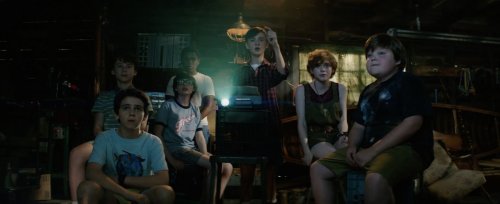
I am surprised that I haven’t come across more (or any) takes of IT that talk about how big a deal abuse is. Because as far as I can tell, that is what the whole thing is all about. Like, I’m pretty sure Pennywise is a metaphor for an entire town poisoned by a legacy of abuse. And that is what makes this movie scary. Every member of the Losers Club has a home life that ranges from sad to actively dangerous, and then when they go out into town, they are beset by shockingly violent bullies, who themselves are the victims of brutish parenting. It makes sense that Bill steps up as the leader, as the worst his dad does is refuse to confront his family’s loss head-on. The relative stability in that unit is allowed to be rocked by the death of younger brother Georgie because abuse has a long tail.

IT often presents its abuses and the responses to it with some combination of baroque and grotesque. Bev’s sexual advances from her father are met with their bathroom being filled with buckets of blood. Eddie’s mother, who fuels his hypochondria, is not just obese, she is so abnormally shaped that it looks like she has a bunch of balloons under her dress. The evil in IT is both morally and aesthetically ugly. In the town of Derry, it only makes sense that a force of pure evil would take the form of a smiling, dancing clown.

I give IT (2017) 400 Floats of 500 Too’s.

This Is a Movie Review: ‘Call Me by Your Name’ is a Quietly Desperate Plea to Place No Limits on Love

1 Comment

CREDIT: Sony Pictures Classics

This review was originally posted on News Cult in November 2017.

Starring: Timothée Chalamet, Armie Hammer, Michael Stuhlbarg, Amira Casar, Esther Garrel

Director: Luca Guadagnino

Running Time: 132 Minutes

Rating: R for Sticky Solo Sessions and Unbridled Pairings

Release Date: November 24, 2017 (Limited)

At the end of Call Me by Your Name, Oliver (Armie Hammer) checks in with Elio (Timothée Chalamet) over the phone. Elio’s parents join in on the call for a bit. After they hang up, Oliver notes how they talk to him like he is a member of the family. This accomplishment might seem small, but this sort of comfortable intimacy is a profound state that should not be discounted. Plenty of people in human history have achieved it, but many others have not. For Elio and Oliver, this is a postscript, but what they have shared is lovely enough to cherish forever.

Call Me by Your Name’s message is clear enough without having to be directly stated, but I appreciate that it is gently stated in the way that it is, thanks to Michael Stuhlbarg’s tender delivery. As Elio’s dad, archaeology professor Mr. Perlman, Stuhlbarg conveys an unforgettable treatise on why life is worth living. Simply by the power of observation, he knows what has been going on. It is the summer of 1983 in the northern Italian countryside, where Elio is living with his parents, and Oliver, an American student, is the latest houseguest they have invited to stay with them. Elio and Oliver spend several passionate nights and days together. Maybe they have fallen in love, maybe it is too soon to say so. Either way, their relationship is not fated to last beyond the summer. And in this situation, what Elio and the audience could use more than anything is assurance from his father that all is right. So many people make choices that leave them “bankrupt by the time [they’re] 30,” he tells us, but Elio has chosen love, and there is no reason to regret that.

There are few people who have loved anything as much as Mr. Perlman loves discovering and examining new artifacts. But loving another human being is a little harder, what with the back-and-forth, and the confusion, and the hormones, and the jealousy flare-ups. Love is not always easily strictly defined, either. Elio and Oliver may or may not both be bisexual. They certainly appreciate the female beauty around them; Elio even has a pretty intense fling with a girl close to his age (Esther Garrel). But they both gravitate most heavily to the most intense attractions, and that means plenty of fun but also plenty of sticky situations (and commensurate teasing), as we are all slaves to our bodily fluids. The whole of Call Me by Your Name, in fact, is a mix of pretty and sticky, a tapestry we ought to embrace if it is ever available to us.

Call Me by Your Name is Recommended If You Like: Moonlight, Any great romance with lovely cinematography

Grade: 3.5 out of 5 Nosebleeds

This Is a Movie Review: Gary Oldman Disappears Into Winston Churchill’s ‘Darkest Hour,’ and the Result is Fascinating But a Little Too Stiff

Leave a comment

CREDIT: Jack English/Focus Features

This review was originally posted on News Cult in November 2017.

Starring: Gary Oldman, Lily James, Kristin Scott Thomas, Ben Mendelsohn, Ronald Pickup, Stephen Dillane

Director: Joe Wright

Running Time: 125 Minutes

Rating: PG-13 for War Talk and a Dash of Naughty British Humor

Release Date: November 22, 2017 (Limited)

How do you solve a problem like a mumbling lead character? You could make him not mumble, but of course that’s not really an option when he is a real person whose mushmouth is historically accepted fact. So then you could make the difficulty to understand him part of the point, but could that really work when he is known for inspiring his country to plow ahead in a time of crisis? Darkest Hour certainly does not take it easy on Winston Churchill (an exceptionally unrecognizable Gary Oldman). Nobody in Parliament thinks he is up to the task, but somehow he manages to fire up the British citizenry for the war effort without having to tamp down his prodigious appetites. Maybe the men and women on the street appreciate all the bluster thickly surrounding all of his words.

Darkest Hour is the third in 2017’s (accidental) trilogy about Britain’s early days in World War II. First came Their Finest, depicting the production of a propaganda film about the evacuation of Dunkirk. Then of course there was Dunkirk, about the evacuation itself. And now Darkest Hour presents the political maneuverings surrounding these same events.

With Germany holding the upper hand in 1940, the crux of Darkest Hour’s conflict is Churchill wrestling with the decision of whether to negotiate with Hitler or to rally the nation to keep fighting. This is a more complicated narrative than the simplistic version many of us have been told, in which the concessionist Neville Chamberlain (Ronald Pickup) gave way to the bulldog Churchill. In fact, Chamberlain’s decision to step down may have had more to deep with his creeping cancer. And I am no expert on British government, but Darkest Hour makes it clear that the executive forces on Chamberlain’s side were very much still present when Churchill ascended.

As a character study, this film is best regarded as a portrait of Churchill awkwardly slipping into the suit of the prime ministership. With his bulbous shape, and that physicality serving as a shield over his lack of self-confidence, so much of Churchill’s life is ill-fitting. Darkest Hour is similarly aesthetically unpleasant, in ways that I imagine were both intentional and unintentional. It cannot be helped that England is often a dreary country, and it is fair that that should be emphasized. Also reasonable but frustrating is the decision is to set many of the scenes in the deepest and most cramped bureaucratic interiors.

So it is quite a relief when Churchill and Darkest Hour trek out into the world, turning to the opinions of everyday Londoners riding the tube. The message here, at least as far I take it, is not so much that the commoners won the war, as much as it is that breaking out of your constrictions is always a good idea, whether you are a prime minister, an Oscar-angling motion picture, or anyone or anything else. So there is plenty of inspiration to draw from this film, though its shape may feel a little stitched-together.

Darkest Hour is Recommended If You Like: Winston Churchill mania (it’s hot right now), The King’s Speech, Chugging a Scotch and Puffing on a Cigar While You Watch Movies

Grade: 2.75 out 5 Litanies of Catastrophe

This Is a Movie Review: ‘The Man Who Invented Christmas’ Fails Utterly at Its Supposed Purpose, But is Somewhat Entertaining in Other Ways

Leave a comment

CREDIT: Kerry Brown/Bleecker Street

This review was originally posted on News Cult in November 2017.

Starring: Dan Stevens, Christopher Plummer, Jonathan Pryce, Simon Callow, Morfydd Clark, Anna Murphy

Director: Bharat Nalluri

Running Time: 104 Minutes

Rating: PG for Intense Childhood Poverty Memories

Release Date: November 22, 2017 (Limited)

Did you know that Charles Dickens is the man to thank for Christmas in its current form? I am sure that many of you are aware how his novel A Christmas Carol has had an outsize impact on yuletide-celebrating cultures, but apparently his influence goes so much further. It turns out that his tale of Ebenezer Scrooge singlehandedly changed December 25 from a recognized, but inconsequential blip on the calendar into the biggest day of the year. Or so The Man Who Invented Christmas would have us believe…

Here’s the thing, though: beside its title and epilogue, The Man Who Invented Christmas does essentially nothing to support its supposed thesis. When reviewing cinema, I ask, “What is this movie trying to be, and is it successful?” This is a distinct question from “What is the director (or any of the other filmmakers) trying to do?” because sometimes a great film can be made accidentally. (Cult favorite The Room is the perfect such example.) But when a movie states its purpose so directly and then completely fails to even attempt to live up to that purpose, it is hard not to get frustrated.

All that being said, it is not as if The Man Who Invented Christmas is an hour and a half of nothing happening. In fact, much of it is actually a fairly fascinating examination of the creative process. Dickens (a fleet-witted, buzzy Dan Stevens) promises his publishers that he can complete his new Christmas-themed book in a grueling six weeks in time for a holiday release. As he writes, he is visited by what appear to be actual physical manifestations of the characters he is currently conjuring up: the Cratchits, Jacob Marley, and of course, Ebenezer Scrooge (Christopher Plummer, quite naturally slotting into all that humbug).

The parts of this film that are essentially a two-hander between Stevens and Plummer (with a few supporting Carol-ers) work quite well, and I think I would have really liked it if that had been the whole movie. But there’s also a fair amount of business to do with Dickens’ tumultuous personal life, much of it regarding his destitute father John (Jonathan Pryce), whom Charles alternately regards as a leech and a kindly old man. There is enough complicated psychology here to render a more straightforward biopic that could be a tough but rewarding watch. But as these moments are mostly there just to provide context, they do not go much deeper than surface level.

The Man Who Invented Christmas is Recommended If You Like: A Christmas Carol completism, Anything with Dan Stevens and/or Christopher Plummer

Grade: 2.5 out of 5 Deadlines

This Is a Movie Review: ‘Justice League’ is Okay, I Guess

Leave a comment

CREDIT: Warner Bros.

This review was originally posted on News Cult in November 2017.

Starring: Ben Affleck, Gal Gadot, Henry Cavill, Amy Adams, Ezra Miller, Jason Momoa, Ray Fisher, Ciarán Hinds, Jeremy Irons, Diane Lane, J.K. Simmons, Connie Nielsen

Director: Zack Snyder

Running Time: 120 Minutes

Rating: PG-13 for Localized Explosions, Heat Vision Mishaps, and Grotesque Insectoids

Release Date: November 17, 2017

Would you rather have a true auteurist vision that is decidedly ugly and off-putting, or a plainly adequate film with little distinct personality? If you want something to endlessly discuss and theorize about, go with the former. But if you want something to actually watch, go with the latter.

Justice League is perhaps the least Zack Snyder-y film of Zack Snyder’s career. Absent completely is the washed-out color palette. Fabian Wagner’s cinematography is mostly workmanlike, but he does what he can in a limited sandbox, and the result is actually pleasant to look at. Colors are not only present, they’re vibrant! There is an early scene of Bruce Wayne and Diana Prince walking along some lush greenery, and it makes me wish the whole film had just been Justice League Hanging Out in the Park. The action might still fit within Snyder’s kinetic pinball wheelhouse, but it is not as garishly stylized as usual. And because this is a post-Wonder Woman world, the hard-to-be-a-god, brooding cynicism has given way to genuine hopefulness. Really, the only Snyder signature that unequivocally remains is the best one, i.e., the rediscovered rock song scoring the opening credits (this time, it’s Norwegian singer Sigrid’s take on Leonard Cohen’s “Everybody Knows”).

The main duty of Justice League is finding a way forward after the colossal slog that was Batman v. Superman: Dawn of Justice by way assembling its titular superteam and resurrecting its most iconic member. The returning headliners, namely Affleck’s Batman and Gadot’s Wonder Woman, unquestionably know how to handle this heft. Ezra Miller’s Flash and Jason Momoa’s Aquaman convey their characters economically enough. Ray Fisher could use some more prime time as Cyborg, but it’s an okay start. Overall, it’s refreshing that everyone is eager to team up because they simply recognize how much the entire world is at stake. Isn’t that how superheroes were always meant to be?

As for Superman’s rise from the grave, it isn’t surprising, nor is it meant to be. The (theoretical) fun of it is seeing how it plays out. And on that point, it is fairly entertaining. When Supes comes to, his mind is a bit scrambled, causing him to indiscriminately attack whomever is in the path of his heat vision. Henry Cavill plays it like his body vomiting up the last remnants of Snyder’s inexplicably distasteful take on the Man of Steel. This concession to a lighter version is in fact indicative of the whole Justice League ethos. Finally, the DC Extended Universe is allowed to crack jokes! And I’m not talking glib, Marvel-style one-liners, but actual character moments, like malapropisms and other exposures of vulnerability. Ma Kent (Diane Lane), for one, informs Lois Lane (Amy Adams) that Clark said Lois was “the thirstiest young woman he ever met” (she means hungriest). It’s okay to laugh!

As for the actual story engine, the DCEU is still testing our patience. If this were a pilot episode of a Justice League TV show, it would be fine enough. A little long, but a decent setup. And if you’re in the business of silver linings, that is the best takeaway to come away with here. Future sequels are inevitable, and I can see a roadmap where they might actually be good. The best villains are being saved for later, but this time around the big bad is incredibly perfunctory. Steppenwolf (Ciarán Hinds under a lot of CG) is some sort of gargoyle whose motivation does not go anywhere beyond “try to take over the world.” His army of insect-men is just a nuisance in every capacity. It’s fair to save the best for later, but it helps to actually get to the best at some point.

Justice League is Recommended If You Like: Incremental Improvement

Grade: 2.5 out of 5 Doomsday Clocks
This Is a Movie Review: ‘Wonder’s’ Lessons in Kindness Are Obvious, But Timelessly Valuable

1 Comment

CREDIT: Lionsgate Entertainment

This review was originally published on News Cult in November 2017.

Starring: Jacob Tremblay, Julia Roberts, Owen Wilson, Izabela Vidovic, Mandy Patinkin, Daveed Diggs, Noah Jupe, Ali Liebert, Danielle Rose Russell, Bryce Gheisar, Millie Davis, Elle McKinnon

Director: Stephen Chbosky

Running Time: 113 Minutes

Rating: PG for Middle School Bullying

Release Date: November 17, 2017

If you plan on seeing Wonder, please do yourself a favor and bring tissues. That is not a mark of quality in either direction, just a fair warning of what you’re in for. Of course, if you know the premise of the film, chances are you could have guessed as much. The story of Auggie Pullman (Jacob Tremblay), a boy with a congenital facial deformity struggling to fit in at middle school, could not be anything but emotional. But the explanation for Wonder’s knack for keeping the waterworks running for two hours straight goes beyond the obvious. This is the type of movie in which rhetorically gifted actors make grand pronouncements about the importance of kindness and loyalty. Their insights are far from groundbreaking, sure, but their eloquence is a gift and the realization that people have had the courage to live up to these ideals is profoundly affecting.

Director Stephen Chbosky already demonstrated his emotional bona fides with the adaptation of his novel The Perks of Being a Wallflower, and with Wonder he has now confirmed himself as one of the best in the business for prompting a good cathartic cry. He pulls it off this time by taking full advantage of the academic setting. School is not just a place for learning how the world works, but also how to be a good person. It helps in that regard when you have dedicated educators, and Auggie has a couple of excellent teachers played by Daveed Diggs and Ali Liebert, and a fantastic principal played by Mandy Patinkin. They are not defined by their quirks but by their love of teaching. Diggs’ Mr. Browne is the type to write inspirational sayings like “our deeds are our monuments” on his chalkboard. It helps to be in an environment that reminds you of such simple, but necessary truths. Patinkin’s bow tie-sporting Mr. Tushman (yes, he’s fine with you laughing at his name) fulfills the bulk of the speechifying. With his words, he is marvelously generous, maintaining and spreading a positive attitude.

Wonder begins with Auggie’s perspective and narration, naturally enough. But it extends that generosity to multiple characters, making this less a story about overcoming physical defects and more one about how there are so many ways we can be cruel to anybody, but it is so much better if we instead reach out with kind gestures. The gift of subjectivity and their own narrated segments is granted to Auggie’s teenage sister Via (Izabela Vidovic), Auggie’s best friend Jack (Noah Jupe), and Via’s best friend Miranda (Danielle Rose Russell). The lesson here is clear and effective: you never know someone else’s full story if you haven’t lived through it, so it is always wise to allow them to share it with you.

Chbosky can be a little haphazard with this subjectivity. It is no big loss that Auggie’s parents (Julia Roberts and Owen Wilson) are not afforded their own segments, as we still get satisfying peeks into their interiority. But it would have been nice, for example, if we had gotten a closer look at Julian (Bryce Gheisar), Auggie’s most frequent bully. We do meet his very unreasonable parents, but for a movie that is so kind in all capacities, it stings a little that he does not have more of a chance for redemption.

When you get right down to it, Wonder is simply a force for good in this world, demonstrating as it does that kindness, courage, second chances, and cameos from Chewbacca never go out of style.

Wonder is Recommended If You Like: The Perks of Being a Wallflower, Dead Poets Society, Room

Grade: 3.5 out of 5 Astronaut Helmets

This Is a Movie Review: ‘Daddy’s Home 2’ is Amiably, Almost Transcendently Sweet, Except When Its Nasty Side Mucks Things Up

Leave a comment

CREDIT: Paramount Pictures

This review was originally posted on News Cult in November 2017.

Starring: Will Ferrell, Mark Wahlberg, John Lithgow, Mel Gibson, Linda Cardellini, Alessandra Ambrosio, John Cena

Director: Sean Anders

Running Time: 100 Minutes

Rating: PG-13 for Alarmingly Near-Lethal Accidents and the Budding Birds and Bees

Release Date: November 10, 2017

There is a principle in improv comedy that stresses avoiding introducing conflict too quickly, as arguments can be anathema to the performative harmony required by yes-and’ing. That same advice is not as often applied to a scripted narrative, as conflict is frequently the engine that drives the plot. But for a family-centric hangout comedy like Daddy’s Home 2, which derives its most humorous moments out of character-based foibles, it might actually be best to keep conflict to a minimum. For its first 30 minutes or so, this sequel easily bests its original by allowing its blended families to be mostly harmonious. But it cannot quite quit its nasty, mean-spirited streak. Still, there are enough moments that genuinely convey the magic of the holidays and the power of choosing love over frustration for this to mostly be a success.

When we first check back in on Brad (Will Ferrell) and Dusty (Mark Wahlberg), they’re the perfect picture of co-dadding. Whenever they are told that theirs is a strange arrangement between father and stepfather, they do not care, because they genuinely get along with each other now, despite their significant differences. But all is not 100% well, as the kids are not fans of swinging back and forth between two houses, especially on Christmas. The solution: one big holiday getaway with all the kids and all the parents, with Brad’s dad Don (John Lithgow) and Dusty’s dad Kurt (Mel Gibson) joining to add a few new wrinkles.

The juxtaposition between these two patriarchs is where DH2 derives most of its laughs. Don and Brad are unabashedly close, always greeting each other with a kiss on the lips. Dusty, meanwhile, resents Kurt for rarely showing up to be an adequate father and grandfather. These stark differences could lead to a bunch of cheap gags, but instead the interplay between this quartet remains mostly palatable, thanks to the sweet treatment of Don and Brad’s closeness, Kurt not being as much of a Neanderthal as the previews implied, and the film clearly presenting his absenteeism and macho bullshit as bad things. Plus, Brad and especially Don avoid being bullied by remaining confident in their identities and playfully acknowledging Dusty and Kurt’s different personal styles.

Thus why it is too bad that DH2 cannot trust itself to maintain this bonhomie. Every little disagreement and accident gets blown way out of proportion. Sure, even people who get along get on each other’s nerves every once in a while, but generally they do not turn into completely unrecognizable assholes, as they do in this film. There are plenty of funny moments of folks just goofing off, so there is no comedic need for all the shouting and chaos.

This over-the-top-tendency does not even touch on the moments of (unintentional?) pure horror, when mishaps with heavy machinery and weaponry result in main characters just a few inches away from death. A snow blower gets stuck in Christmas lights and flies around the house! An errant chainsaw nearly impales Brad! Don gets lost and is almost left facedown in the snow overnight! A shotgun accidentally fires, and the bullet grazes Kurt’s arm! Somehow all this madness leads to a genuinely heartwarming conclusion that almost makes all these extremes almost forgivable.

One particularly insightful scene represents what Daddy’s Home 2 is at its best and for a few minutes, places it among the upper tier of 2017’s cinematic offerings. It is telling that this film understands certain improv principles, as an outing at an improv show demonstrates the danger and revelations that can happen at a live comedy performance. Don has been taking improv classes, so Brad has volunteered him as an audience participant. A prompt for the scene hits a little close to home, exposing the secrets cracking away at his endlessly chipper façade. The wrenching agony on Lithgow’s face presents an actor at the top of his game, always giving his all no matter how silly or sentimental the material.

Daddy’s Home 2 is Recommended If You Like: National Lampoon’s Christmas Vacation, The Other Guys, Anything with John Lithgow

Grade: 3 out of 5 Loaded Guns (Literal and Metaphorical)

This Is a Movie Review: Thelma

1 Comment

CREDIT: The Orchard

After catching the whoosh of horror newness that is Joachim Trier’s Thelma, I find myself wondering how this flick might be franchise-able. After all, that’s the way it goes with horror. The sequels come and the formula gets repeated, twisted, maybe even subverted – a whole stew of mythology enhancement. Thelma at first glance might seem too icy, and you know, too Scandinavian, for follow-ups. But maybe Norwegians are also into the sequels. I’d love to see how a foreign sensibility matches up (or doesn’t) with a business-driven trend that often enough accidentally produces some creative results. But for now, we’ve got one lean, mean psychosexual machine.

I give Thelma 3 Disappearances out of 4 Personal Lightning Bolts.

This Is a Movie Review: Seeking Justice for a Cold Rape/Murder Case, ‘Three Billboards Outside Ebbing, Missouri’ is the Timeliest Dark Comedy of 2017

Leave a comment

CREDIT: Merrick Morton/Twentieth Century Fox

This review was originally posted on News Cult in November 2017.

Starring: Frances McDormand, Woody Harrelson, Sam Rockwell, Lucas Hedges, John Hawkes, Caleb Landry Jones, Peter Dinklage, Abbie Cornish, Željko Ivanek, Kathryn Newton

Director: Martin McDonagh

Running Time: 115 Minutes

Rating: R for Constant Cussing, Police Abuse, and Arson

Release Date: November 10, 2017 (Limited)

The release of Three Billboards Outside Ebbing, Missouri could not be any more timely. We are currently living in a moment unprecedented in terms of the rate at which prominent sexual harassers and abusers are being exposed. By putting up the titular billboard triptych calling out local law enforcement for its inability to solve the case of her daughter’s rape and murder, Mildred Hayes (Frances McDormand) is instantly a symbol of this age. Unsurprisingly, she butts up against a fair deal of racism within the Ebbing police department. But that discrimination isn’t coming from Sheriff Bill Willoughby (Woody Harrelson), who, though he may be a bit hard-edged, is absolutely well-meaning; he so wishes he had physical evidence in the Hayes case. And the racist officer in question might actually have some good detective in him and maybe even some decent humanity.

Based on his track record, writer/director Martin McDonagh is not an obvious choice to stick the sensitive landing that Three Billboards pulls off. With In Bruges and Seven Psychopaths, he demonstrated his knack for understanding the foibles of humanity, especially when it comes to souls existentially cast adrift by the whims of fate. Such an approach would not be impossible for a film about an unsolved rape case, but it would be depressing. While McDonagh can be cutting, he is so for the laughs. It is not his bag to make his audience endlessly despair. Thus, while Three Billboards does feature plenty of his signature jabs, he ultimately re-calibrates his typical tone enough to make this effort truly uplifting.

The most astute trick that McDonagh pulls off involves the constant acknowledgement that individuals contain multitudes and are not easy to pin down, even in a story driven by something so obviously wrong as rape. Mildred’s crusade is righteous, but plenty of townspeople wish she would just go away. While much of that has to do with a tendency to defend the status quo, it is also due to her own prickly personality. But to be fair to her (and the movie certainly is), not many people have figured out how to insist upon justice while remaining kind. Willoughby receives the brunt of Mildred’s ire, and while he can be too heated for his own good, he knows what’s right. And because this movie is so generous to its characters, he has his own terminal cancer-fueled narrative. Also coming in hot is Mildred’s relationship with her ex-husband (John Hawkes), which turns especially nasty when it comes to his new much younger girlfriend (Samara Weaving). But it turns out that he is with her less because she is a pretty young thing and more because she has instilled in him a Zen calm, noting that anger only begets more anger.
The evolution of Officer Jason Dixon illustrates that proposition best of all. On the page, his transformation might read as too transformational to be believed, even with a writer as skilled as McDonagh. But thanks to the chops of Sam Rockwell, his redemptive arc reads as perfectly natural. When we meet him, Dixon is frequently drunk, openly racist, and constantly abusing his power. But when relieved of his badge, he finds room to make amends, ultimately teaming up with Mildred to fulfill his duty as a decent person. In a world where evil acts continue to be perpetrated, it is nice to know that humanity can persist.

Three Billboards Outside Ebbing, Missouri is Recommended If You Like: Fargo, M*A*S*H, Groundhog Day

Grade: 4.5 out of 5 Fat Dentists

This Is a Movie Review: Kenneth Branagh’s Take on ‘Murder on the Orient Express’ Has a Killer Instinct But Not a Killer Execution

Leave a comment

CREDIT: Nicola Dove/Twentieth Century Fox

This review was originally posted on News Cult in November 2017.

Starring: Kenneth Branagh, Penélope Cruz, Willem Dafoe, Judi Dench, Johnny Depp, Josh Gad, Derek Jacobi, Leslie Odom Jr., Michelle Pfeiffer, Daisy Ridley, Marwan Kenzari, Olivia Colman, Lucy Boynton, Manuel Garcia-Rulfo

Director: Kenneth Branagh

Running Time: 114 Minutes

Rating: PG-13 for Stab Wounds and Attempted Gun Wounds

Release Date: November 10, 2017

Kenneth Branagh’s take on Hercule Poirot, one of the most famous and prolifically portrayed detectives in English literary history, is the sort of man who cannot enjoy his breakfast unless his two eggs are perfectly symmetrically arranged. As he puts, “I can only see the world as it should be.” His skill at identifying culprits so precisely derives from his distaste for his surroundings being askew in any capacity. And when a crime has been committed, things are certainly askew. For a Poirot newbie like myself, this thesis statement is clear and compelling enough. It points to a tradition that has led to a recently predominant style in which brilliant detectives do not fit on a normative intellectual scale.

As for how this version of this most classic of Poirot cases plays out, Branagh is eager to put his many new spins on locked room mystery tropes. But first, certain typical patterns are unavoidable. Each passenger must be introduced with just enough color to make everyone a legitimate suspect, and the camerawork must be painstakingly particular to note every cabin, door, and hidden compartment. But once the setup is through, there is fun to be had (or at least attempted) in mixing up expectations. Oftentimes, characters in these stories try to get away with little lies or hide pieces of their identities that ultimately prove to be quite telling. In this case, the experiment – and alas, mistake – is that everyone gives themselves away with such dishonesty.

A good mystery should be a few steps ahead of most of its viewers. Branagh does indeed pull that off, but he is also a few steps ahead of his own movie, which is not similarly advisable. The result is an end product in which the love for the genre is clear, but the volume at which it is being poked and prodded is too much weight to bear. Most of the performances are overly stiff, stuck in roles within roles in which the unnatural seams start to show. Only Michelle Pfeiffer manages to truly cut loose. Branagh’s formal openness is a good start, but ultimately a star-studded affair like this one requires much more lasting personalities to really hit.

Murder on the Orient Express is Recommended If You Like: Agatha Christie completism, Marvelous mustaches, the Michelle Pfeiffer Renaissance

Grade: 2.75 out of 5 Symmetrical Arrangements

Older Entries Newer Entries